
Another way to say “go above and beyond” is “exceed expectations,” “go the extra mile,” “give it your all,” or “do more than expected.” These alternatives describe someone who puts in extra effort, delivers exceptional results, or does more than their role requires.
The phrase “go above and beyond” is commonly used to describe someone who makes an extra effort or does more than what is required. While it is a useful expression, repeating it too often can make your writing sound predictable.
Fortunately, there are many natural alternatives. The best choice depends on whether you are writing a professional email, praising an employee, thanking a friend, or describing exceptional effort.
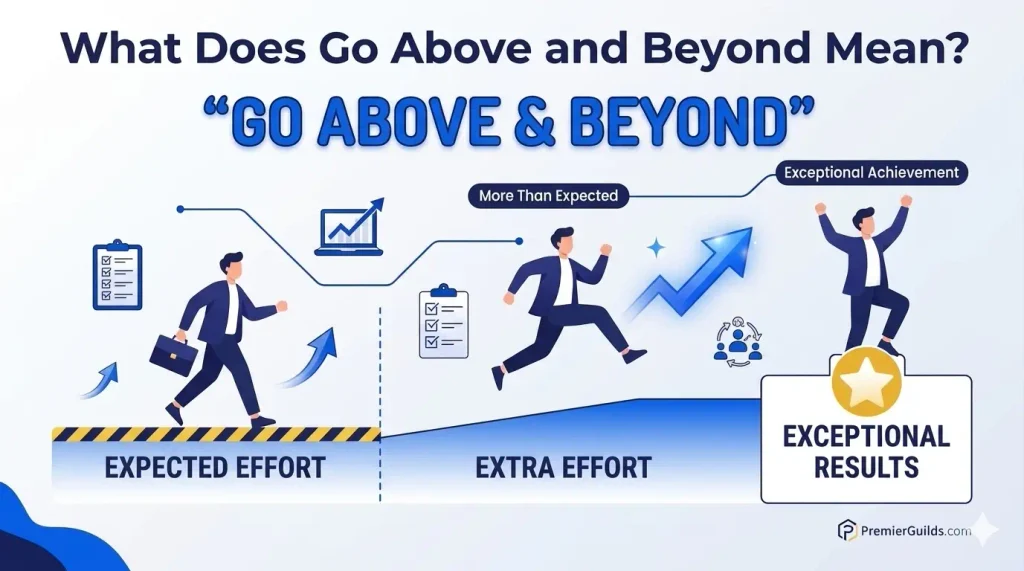
To go above and beyond means to do more than what is expected or required. It often describes someone who puts in extra time, effort, care, or attention to achieve an excellent result.
People commonly use this phrase in workplaces, customer service, schools, and personal conversations. For example, you might say an employee went above and beyond to help a client or a friend went above and beyond to support you during a difficult time.
The phrase is popular because it clearly communicates appreciation for exceptional effort.
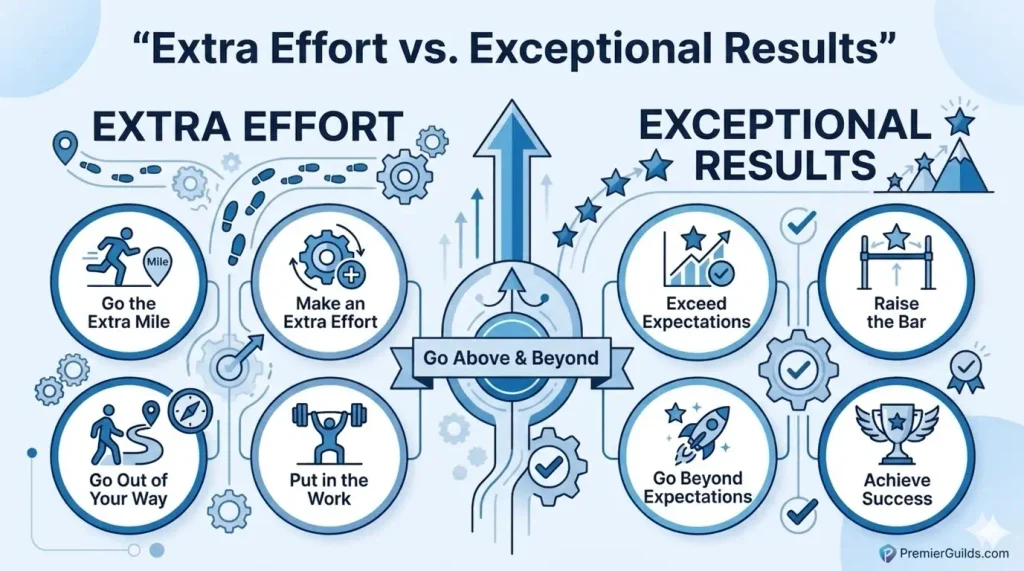
Using different expressions can make your communication sound more natural and specific. Some alternatives also better match the tone of your situation.
Other benefits include:
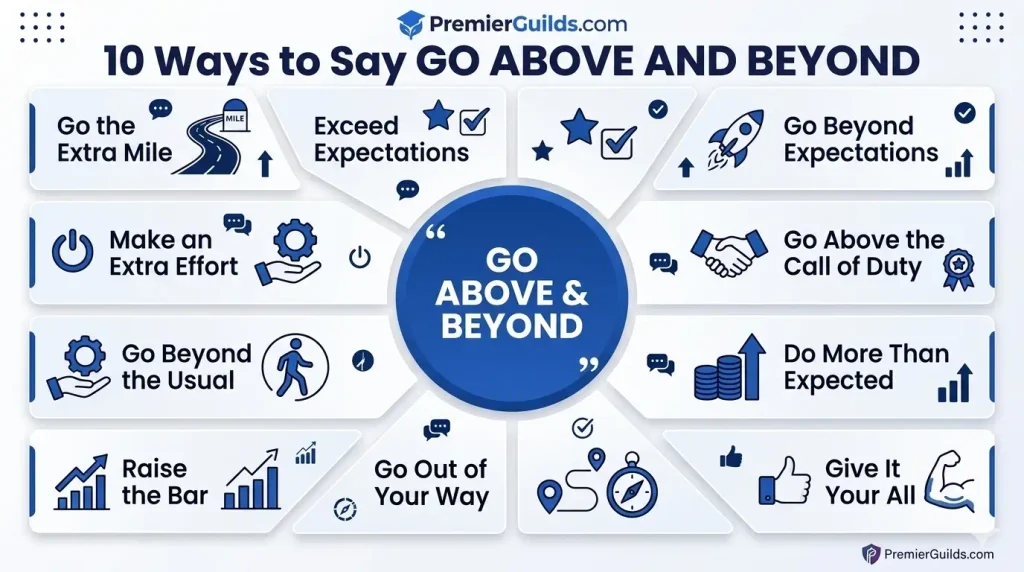
“Go the extra mile” means to make an additional effort beyond what is normally expected. It is one of the closest and most natural alternatives to “go above and beyond.”
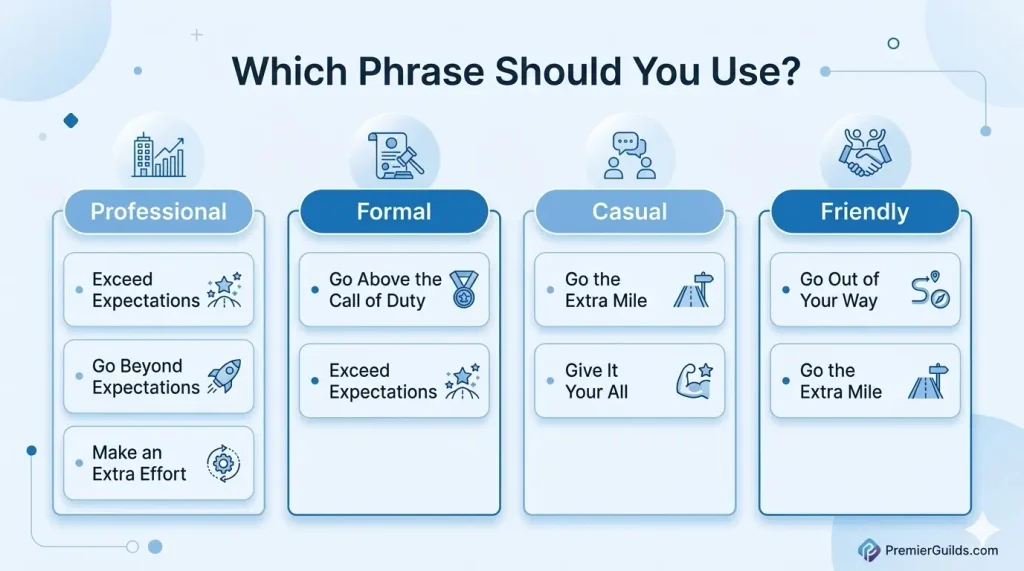
Professional, Casual, Friendly
Our customer support team always goes the extra mile to solve problems quickly.
She went the extra mile to make sure every guest felt welcome.
Use this phrase when emphasizing extra effort without sounding overly formal.
“Exceed expectations” means to perform better than people anticipated. It focuses on the quality of the final result rather than only the effort involved.
Professional, Formal
Your work on this project exceeded everyone’s expectations.
The new employee continues to exceed expectations in her role.
This is an excellent choice for performance reviews, business emails, and professional praise.
“Go beyond expectations” means to deliver more than people reasonably expected. It closely reflects the meaning of “go above and beyond” while sounding slightly more direct.
Professional, Formal
The team went beyond expectations to complete the project before the deadline.
His attention to detail went beyond what the client expected.
Use this phrase when you want to highlight exceptional performance in a polished way.
“To go above the call of duty” means to do more than your responsibilities normally require. It often suggests dedication, commitment, or personal sacrifice.
Formal, Professional
The nurse went above the call of duty to comfort the patient’s family.
Several volunteers went above the call of duty during the community event.
Use this expression when someone has clearly done more than their normal responsibilities.
“Do more than expected” is a simple and direct way to describe extra effort. It works especially well when you want clear language that anyone can understand.
Professional, Casual, Friendly
He consistently does more than expected without being asked.
Our contractor did more than expected and finished the repairs ahead of schedule.
Choose this option when clarity matters more than sounding creative or formal.
“Give it your all” means to put maximum effort and energy into something. Unlike some alternatives, it focuses more on dedication and effort than on exceeding a specific expectation.
Casual, Friendly, Warm
You could tell she gave it her all during the championship game.
Even when the project became difficult, Marcus gave it his all.
Use this phrase when praising someone’s determination and commitment.
“Go out of your way” means to make a special effort to help someone or accomplish something. It often suggests that the person did something inconvenient or unnecessary simply because they wanted to help.
Friendly, Warm, Polite
Thank you for going out of your way to help me with the move.
She went out of her way to introduce me to everyone on the team.
This phrase works especially well when expressing gratitude for a personal favor.
“Raise the bar” means to set a higher standard through excellent performance. It suggests that someone’s work has improved expectations for everyone else.
Professional, Casual
Your presentation really raised the bar for the rest of the department.
The company’s new service standards have raised the bar for customer care.
Use this phrase when exceptional work creates a new or higher standard.
“Go beyond the usual” means to do more than what is normally done in a similar situation. It sounds flexible and can describe service, effort, creativity, or personal care.
Professional, Friendly
Their staff goes beyond the usual to make every customer feel valued.
She went beyond the usual when planning the retirement celebration.
Use this phrase when comparing someone’s effort with what normally happens.
“Make an extra effort” means to intentionally put more time, energy, or attention into something. It is straightforward, natural, and appropriate in almost any conversation.
Professional, Casual, Polite
Please make an extra effort to review the details before sending the proposal.
He made an extra effort to learn each client’s individual needs.
Use this phrase when you want to emphasize additional effort without sounding overly dramatic.
| Alternative | Best Used In | Tone |
| Go the extra mile | Work, customer service, everyday conversations | Professional, friendly |
| Exceed expectations | Performance reviews, business communication | Professional, formal |
| Go beyond expectations | Projects, achievements, professional praise | Professional, formal |
| Go above the call of duty | Exceptional service or dedication | Formal, respectful |
| Do more than expected | General praise and clear communication | Neutral, natural |
| Give it your all | Sports, personal encouragement, motivation | Warm, casual |
| Go out of your way | Thank-you messages and personal favors | Friendly, appreciative |
| Raise the bar | High-quality performance and leadership | Professional, confident |
| Go beyond the usual | Service, events, and thoughtful actions | Professional, friendly |
| Make an extra effort | Work instructions and general praise | Neutral, polite |
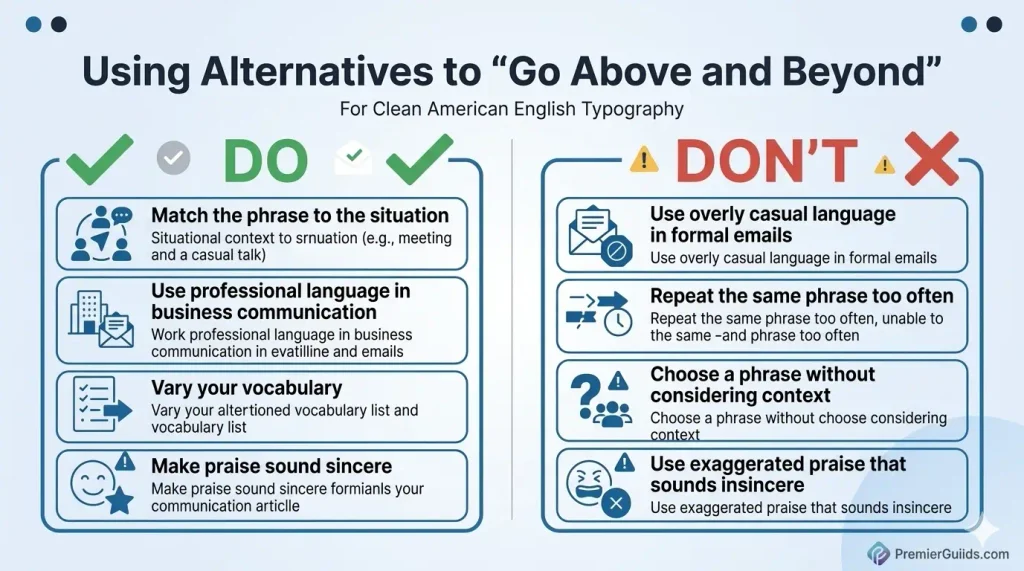
Expressions such as “give it your all” may sound too informal in a performance review or formal business document. Choose “exceed expectations” when you need a more professional tone.
“Go above the call of duty” can sound overly serious in a casual thank-you message. Match your wording to the relationship and situation.
Using “go above and beyond” several times in one article, email, or conversation can sound repetitive. Switching between natural alternatives keeps your writing engaging.
Not every alternative means exactly the same thing. “Raise the bar,” for example, focuses on setting a higher standard, while “go out of your way” focuses on making a special effort.
Overly dramatic praise can feel forced if it does not match the situation. Choose language that accurately reflects what the person actually did.
“Exceed expectations” is one of the best professional alternatives. It sounds polished and works well in performance reviews, recommendation letters, workplace emails, and business presentations. “Go beyond expectations” is another strong choice when you want to emphasize exceptional results.
You can say “go the extra mile,” “make an extra effort,” or “exceed expectations,” depending on the tone of your email. For formal workplace communication, “exceed expectations” is usually the safest option. For a warmer message, “go the extra mile” sounds natural and appreciative.
You could say, “Thank you for going the extra mile,” or “I appreciate the extra effort you put into this.” Another warm option is, “Thank you for doing more than expected.” These alternatives can sound more personal and specific.
The two phrases have very similar meanings. Both describe making more effort than required. However, “go the extra mile” often emphasizes the additional effort itself, while “go above and beyond” can also highlight exceptional results, service, or commitment.
“Exceed expectations” means to perform better than someone anticipated. It is commonly used in professional settings to describe outstanding work, strong results, or exceptional service. The phrase focuses on surpassing a standard or expectation.
You can describe that person as dedicated, hardworking, dependable, committed, or exceptionally helpful. You might also say they consistently exceed expectations or always go the extra mile. The best description depends on whether you want to emphasize effort, results, or character.
It is understandable, but it can sound vague on a resume. Instead, show how you exceeded expectations with measurable results. For example, describe how you improved a process, increased sales, reduced costs, or completed a project ahead of schedule.
“Exceed expectations” and “demonstrate exceptional commitment” are strong formal choices. “Perform beyond the requirements of the role” can also work in professional evaluations when you want to clearly describe effort that exceeded normal responsibilities.
Finding another way to say “go above and beyond” can help your writing sound more natural, specific, and appropriate for the situation. For professional communication, “exceed expectations” and “go beyond expectations” are strong choices. In everyday conversations, “go the extra mile” and “make an extra effort” sound natural and easy to understand.
If you are thanking someone personally, “go out of your way” can add warmth and sincerity. When praising determination, “give it your all” may be the better choice.
The key is to focus on what you want to emphasize. Are you praising extra effort, outstanding results, personal sacrifice, or exceptional dedication? Choose the phrase that best matches that meaning, and your message will sound clearer and more genuine. You can also understand the meaning of “go the extra mile” to see why this popular expression is such a natural alternative for describing extra effort.

Senior English Editor & Stylistics Director
Michael Bennett is a veteran editor, lexicographer, and publishing consultant with more than two decades of experience in academic and educational publishing. Formerly a senior editorial director at major university presses, he specializes in structural editing, register refinement, and vocabulary development. Michael oversees tone, precision, and stylistic consistency across all publication channels, ensuring content meets rigorous editorial and pedagogical standards.