
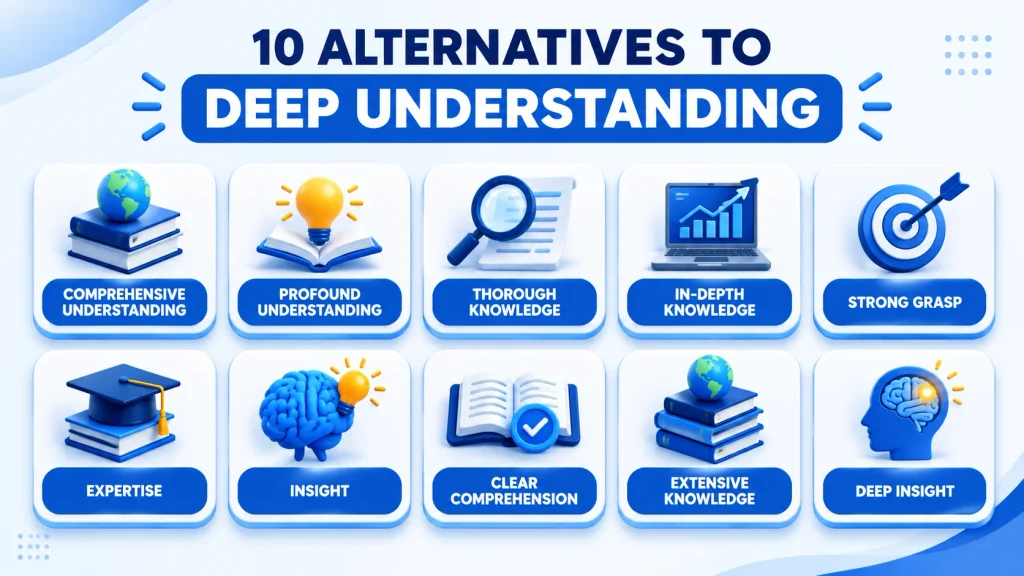
Another way to say deep understanding includes thorough knowledge, profound understanding, comprehensive understanding, strong grasp, in-depth knowledge, expertise, insight, and clear comprehension. The best alternative depends on the context. For academic writing, “comprehensive understanding” works well, while “expertise” is often better for professional contexts.
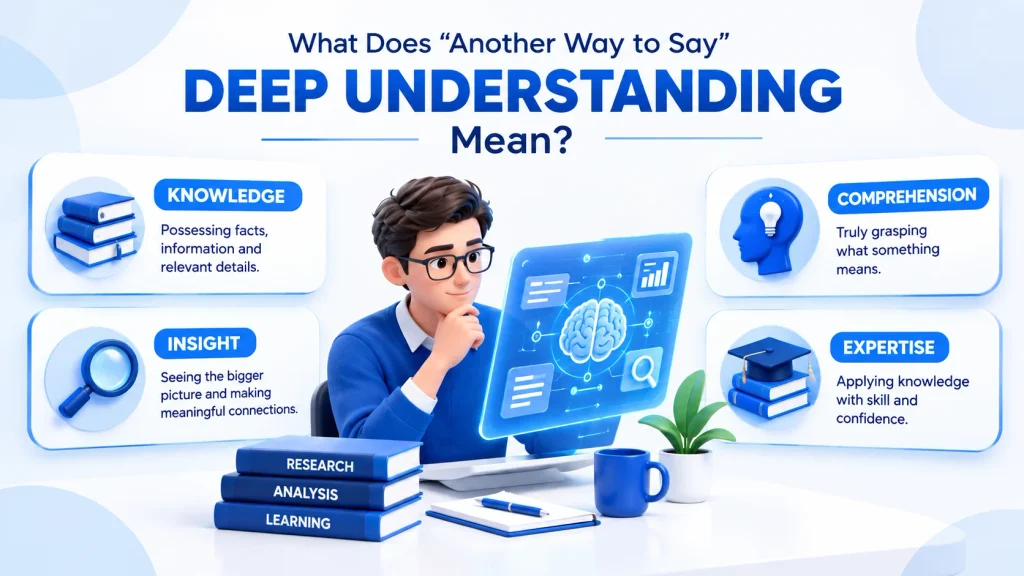
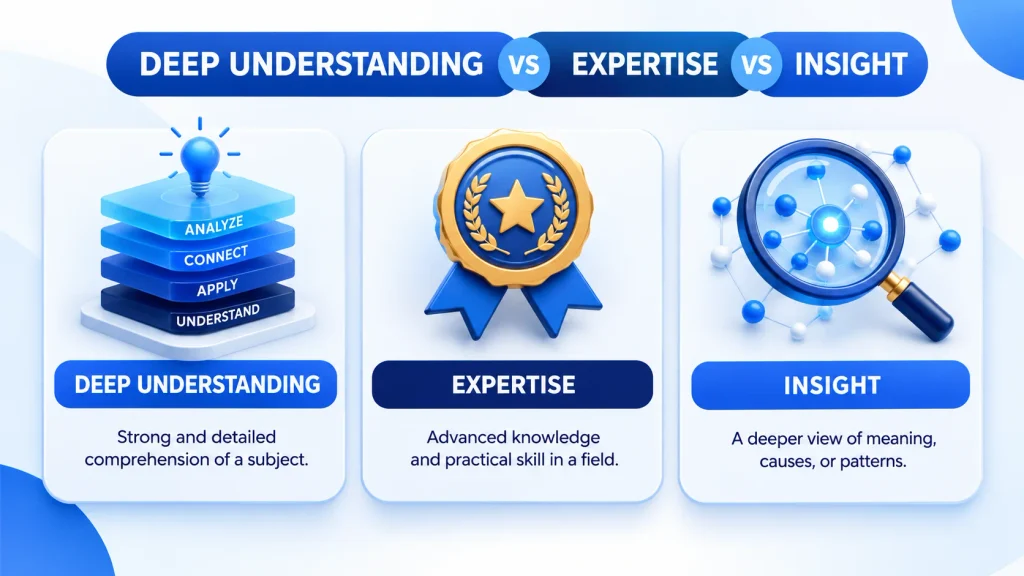
The phrase “deep understanding” describes a strong and detailed grasp of a subject, idea, process, person, or situation. It suggests more than basic knowledge because it often includes the ability to understand relationships, causes, details, and underlying meaning.
People use this phrase in academic writing, workplace communication, research, education, business, and everyday conversations. For example, someone may have a deep understanding of customer behavior, a complex theory, or a difficult problem.
The best alternative depends on what you want to emphasize. Expertise highlights advanced knowledge and skill, while insight focuses on seeing the deeper meaning behind something.
Using alternatives can make your writing more precise and prevent the phrase from becoming repetitive. It can also help you match the level of formality to your audience.
Consider alternatives when you want to:
For example, “a comprehensive understanding of the research” emphasizes breadth, while “expertise in the field” emphasizes advanced knowledge and ability.
“Comprehensive understanding” suggests knowledge that covers the important parts of a subject or issue. It emphasizes breadth, completeness, and a strong grasp of the details.
“The research team developed a comprehensive understanding of the factors affecting customer retention.”
“Students need a comprehensive understanding of the material before taking the final exam.”
Use this when you want to emphasize that someone understands many or all important aspects of a topic.
“Profound understanding” describes an unusually deep or meaningful level of comprehension. It often sounds more formal and emphasizes depth rather than simply having a lot of information.
“Her research demonstrates a profound understanding of modern environmental challenges.”
“The professor has a profound understanding of how historical events shaped the region.”
Use “profound” when the understanding is especially deep, meaningful, or intellectually significant.
“Thorough knowledge” means having detailed and well-developed knowledge of a subject. It suggests that the person has examined the topic carefully rather than knowing only the basics.
“The position requires thorough knowledge of federal reporting requirements.”
“Her thorough knowledge of the software helped the team solve the issue quickly.”
Choose this phrase when you want to emphasize detailed knowledge rather than emotional or intuitive insight.
“In-depth knowledge” refers to extensive knowledge that goes beyond surface-level information. It is common in professional, academic, technical, and educational contexts.
“The consultant brings in-depth knowledge of the healthcare industry.”
“An in-depth knowledge of grammar can improve the quality of academic writing.”
This is one of the most natural direct replacements for “deep understanding” when discussing a subject or field.
“A strong grasp” means having a clear and confident understanding of a topic. It sounds natural and is often less formal than “profound understanding.”
“Maria has a strong grasp of financial concepts and explains them clearly.”
“The training gave new employees a strong grasp of the company’s procedures.”
Use “strong grasp” when you want your writing to sound clear and natural without becoming overly formal.
“Expertise” refers to advanced knowledge and skill in a particular subject or field. Unlike “understanding,” it usually suggests that someone can apply what they know effectively.
“His expertise in cybersecurity made him a valuable member of the project.”
“The company hired her for her expertise in digital marketing.”
Use “expertise” when describing a person’s advanced knowledge and practical ability, not simply their comprehension of an idea.
“Insight” refers to a clear and often deeper understanding of a person, problem, situation, or idea. It can suggest the ability to recognize something that is not immediately obvious.
“The survey provided valuable insight into why customers changed their buying habits.”
“Her experience gave her useful insight into the challenges faced by new employees.”
Use “insight” when the focus is on underlying meaning, causes, or perspectives rather than simply having information.
“Clear comprehension” emphasizes the ability to understand something accurately and without confusion. It works particularly well when discussing learning or explaining complex material.
“The lesson helped students develop clear comprehension of the scientific process.”
“Clear comprehension of the instructions is essential before beginning the experiment.”
This phrase is useful when accuracy and understanding are more important than the amount of knowledge someone possesses.
“Extensive knowledge” means having a large amount of information or experience in a particular area. It emphasizes breadth and range more than the emotional or intellectual depth suggested by “profound.”
“The engineer has extensive knowledge of renewable energy systems.”
“Her extensive knowledge of the industry helped the company identify new opportunities.”
Use this when you want to emphasize how much someone knows, rather than how deeply they understand one particular issue.
“Deep insight” highlights a meaningful understanding of the underlying nature of a person, situation, or problem. It is especially useful when discussing analysis, research, behavior, or complex issues.
“The report offers deep insight into the causes of employee turnover.”
“His interviews provided deep insight into how customers make purchasing decisions.”
Choose “deep insight” when your focus is on discovering something beneath the surface.
| Alternative | Best Used In | Tone |
| Comprehensive Understanding | Academic writing, reports | Formal, precise |
| Profound Understanding | Research, academic writing | Formal, intellectual |
| Thorough Knowledge | Work, technical writing | Professional, precise |
| In-Depth Knowledge | Work, education, research | Professional, formal |
| Strong Grasp | Education, workplace | Natural, confident |
| Expertise | Careers, business, professional writing | Professional, authoritative |
| Insight | Research, analysis, business | Analytical, professional |
| Clear Comprehension | Education, instructions | Formal, clear |
| Extensive Knowledge | Professional and academic contexts | Formal, knowledgeable |
| Deep Insight | Research, analysis, reports | Analytical, sophisticated |
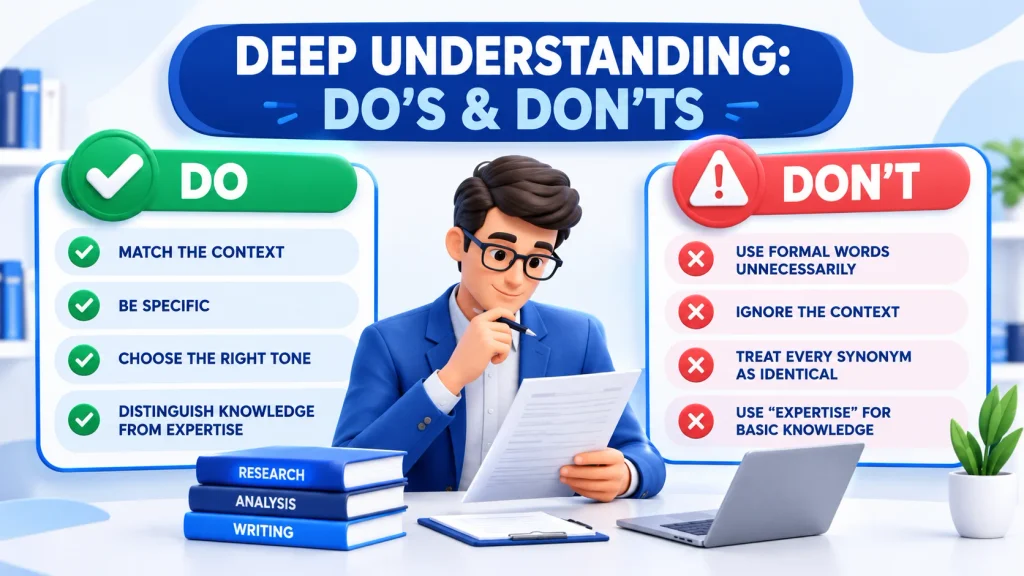
These phrases overlap, but they are not interchangeable in every sentence. “Expertise” describes advanced knowledge and ability, while “insight” focuses more on deeper understanding or perspective.
“Profound understanding” sounds formal and intellectually strong. Using it for ordinary topics can make simple writing sound unnecessarily serious.
“Extensive knowledge” tells readers that someone knows a lot, while “expertise” can also suggest the ability to apply that knowledge professionally.
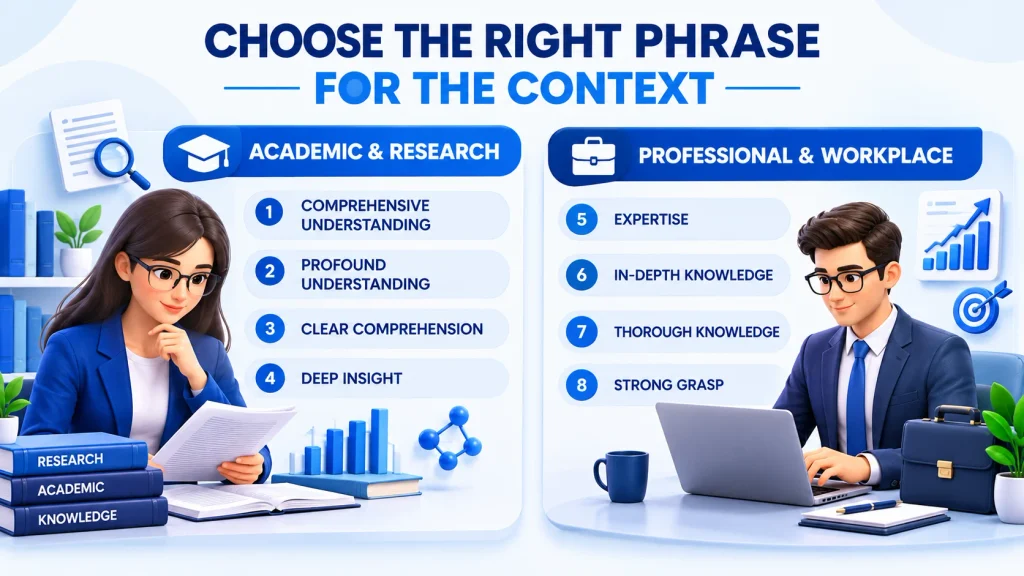
An academic paper may benefit from “comprehensive understanding,” while a resume may sound more natural with “expertise” or “in-depth knowledge.”
A sophisticated word is not automatically better. Choose the phrase that preserves the exact meaning you want to communicate.
Common alternatives include comprehensive understanding, profound understanding, thorough knowledge, in-depth knowledge, strong grasp, expertise, insight, clear comprehension, extensive knowledge, and deep insight. The best choice depends on whether you want to emphasize depth, breadth, skill, clarity, or the ability to recognize underlying ideas.
For professional writing, you can use in-depth knowledge, extensive knowledge, expertise, comprehensive understanding, or strong grasp. “Expertise” is especially useful when describing a person’s advanced knowledge and ability in a particular field, while “in-depth knowledge” works well for resumes, reports, and business communication.
Useful alternatives include expertise, in-depth knowledge, extensive knowledge, thorough knowledge, mastery, and profound understanding. “Expertise” is particularly appropriate when the knowledge is specialized and connected to professional ability. The right word depends on whether you want to emphasize the amount of knowledge, its depth, or the ability to apply it.
Not exactly. “Expertise” usually means advanced knowledge and skill in a specific area, while “deep understanding” focuses on the depth of comprehension. Someone can have a deep understanding of a subject without being considered an expert, especially if they have not developed extensive practical experience.
Academic alternatives include comprehensive understanding, profound understanding, in-depth knowledge, thorough knowledge, and clear comprehension. “Comprehensive understanding” is useful when discussing broad coverage of a subject, while “profound understanding” emphasizes intellectual depth. Academic writing should favor the phrase that most accurately describes the specific type of understanding.
On a resume, consider using expertise, in-depth knowledge, strong grasp, extensive knowledge, or proficiency, depending on the skill. For example, instead of “deep understanding of data analysis,” you could write “in-depth knowledge of data analysis” or “expertise in data analysis.” This makes the statement more specific and professional.
When referring to a person, useful alternatives include insight, empathy, strong understanding, emotional awareness, and clear perception. The best option depends on what you mean. “Insight” suggests recognizing underlying thoughts or motivations, while “empathy” focuses more specifically on understanding another person’s feelings and perspective.
“Deep understanding” emphasizes comprehension, including how and why something works. “In-depth knowledge” emphasizes detailed information and familiarity with a subject. They often overlap, but the first focuses more on understanding, while the second can focus more on the amount and detail of knowledge someone possesses.
There are many effective alternatives to “deep understanding,” but the best choice depends on the exact meaning you want to convey. For broad knowledge, comprehensive understanding is a strong option. For detailed subject knowledge, choose thorough knowledge or in-depth knowledge. When describing advanced professional ability, expertise is often more precise.
If you want to emphasize deeper meaning or a fresh perspective, insight or deep insight may work better. For straightforward communication, strong grasp keeps the language natural and easy to understand.
The most important rule is to choose a synonym based on context rather than formality alone. A precise, natural phrase will usually make your writing clearer and more effective than a complicated word.

English Language & Communication Specialist
Dr. Emily Carter is an English language and communication specialist focused on vocabulary, word choice, professional writing, and practical English usage. She helps readers understand the differences between similar words and choose expressions that sound natural, clear, and appropriate for different contexts.