
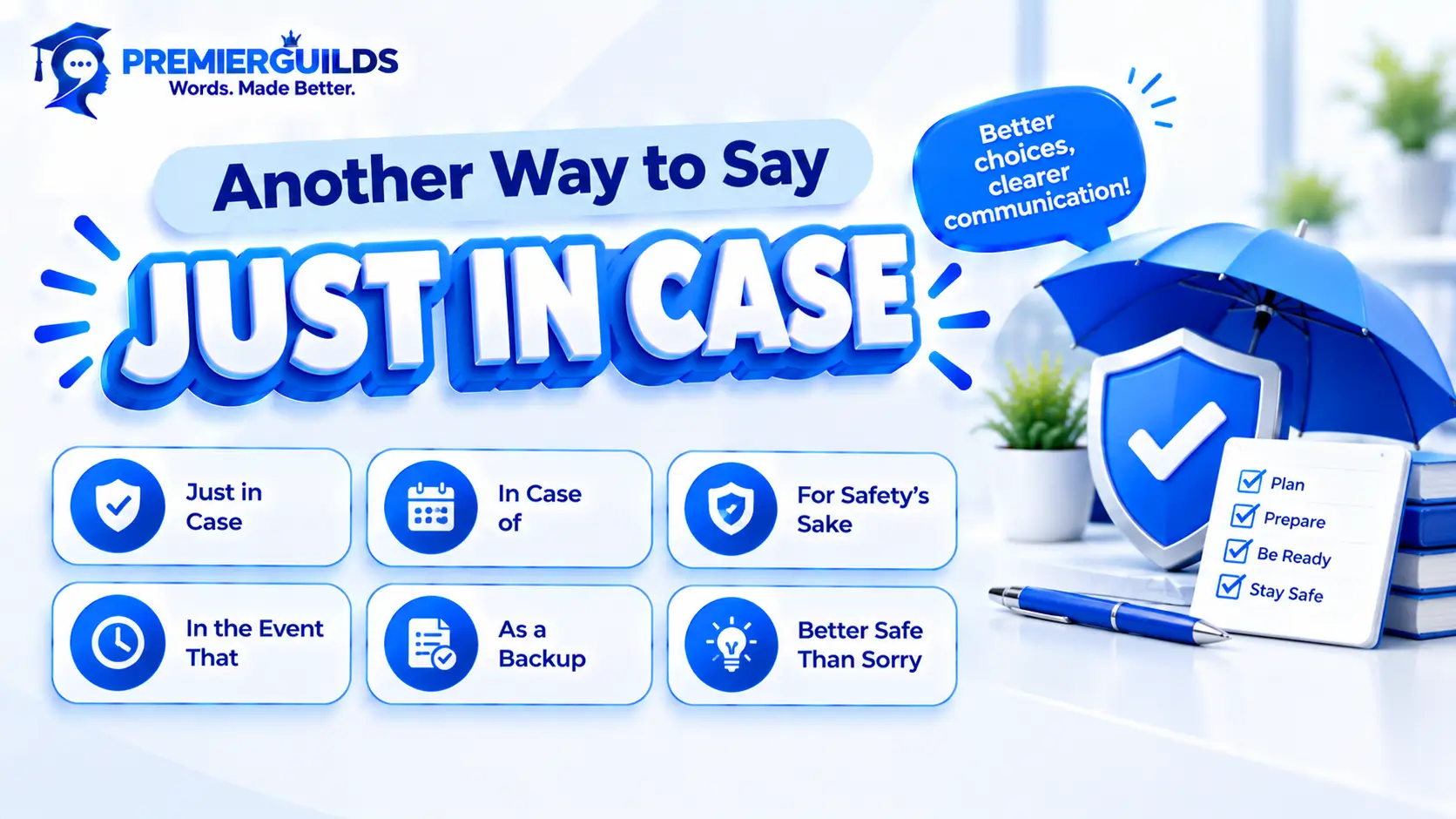
Another way to say just in case is “as a precaution,” “to be safe,” “if needed,” or “in the event that.” For professional writing, “as a safeguard” and “as a precautionary measure” are useful choices. The best alternative depends on whether you’re preparing for a possible problem, making backup plans, or explaining a condition.
“Just in case” is a common expression in American English. People use it when preparing for unexpected events or possible problems.
For example, you might say, “Take an umbrella just in case it rains.”
The phrase is simple and useful. However, different situations may call for more specific wording.
In a business email, you may prefer “as a precaution.” In casual conversations, “to be safe” often sounds more natural.
Learning these alternatives can help you explain precautions, backup plans, and possible situations more clearly.
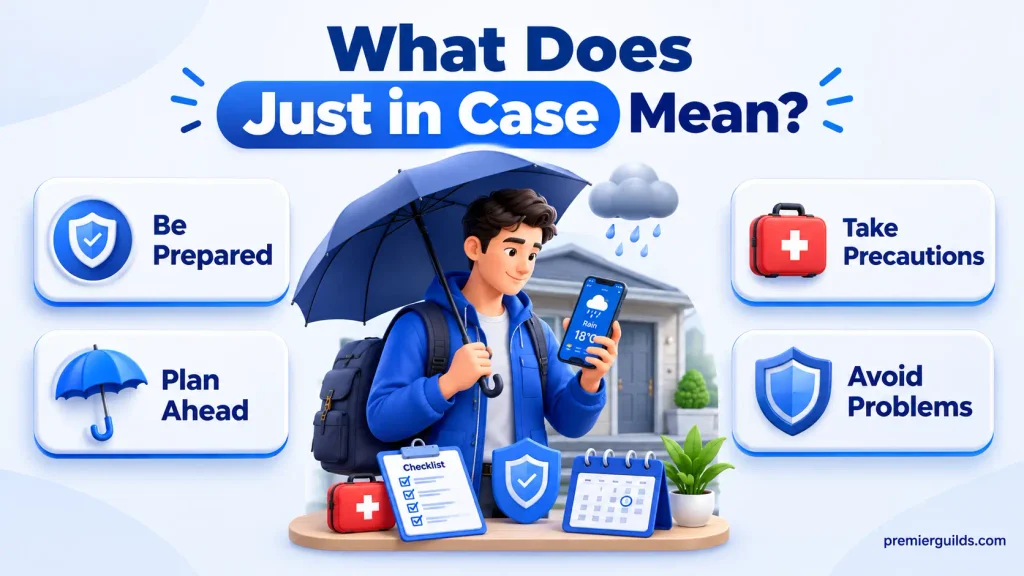
“Just in case” means taking action because something might happen, even when you’re not certain it will.
It often expresses caution, preparation, or a desire to avoid problems.
For example, “Save a copy just in case” means keeping an extra copy in case you need it later.
People use this expression in daily conversations, travel plans, workplace instructions, and emergency preparation.
It can introduce a possible event or appear at the end of a sentence when the risk is already understood.
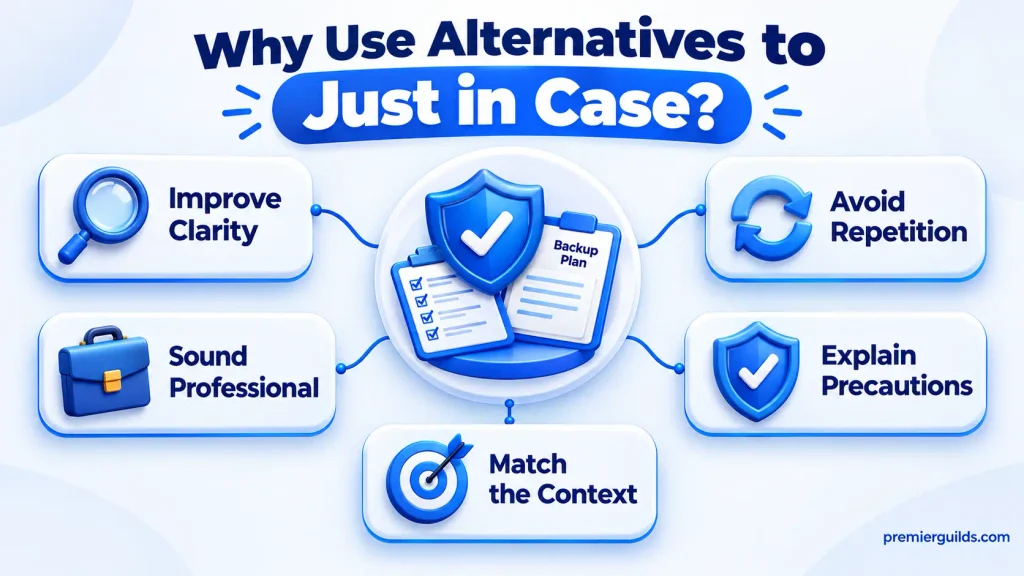
Different alternatives help you describe precautions and possible situations more precisely.
Some expressions emphasize safety, while others focus on conditions or backup plans.
Here are five reasons to use alternatives:
For example, “as a precaution” explains why you take an action, while “if needed” describes when an action may become necessary.
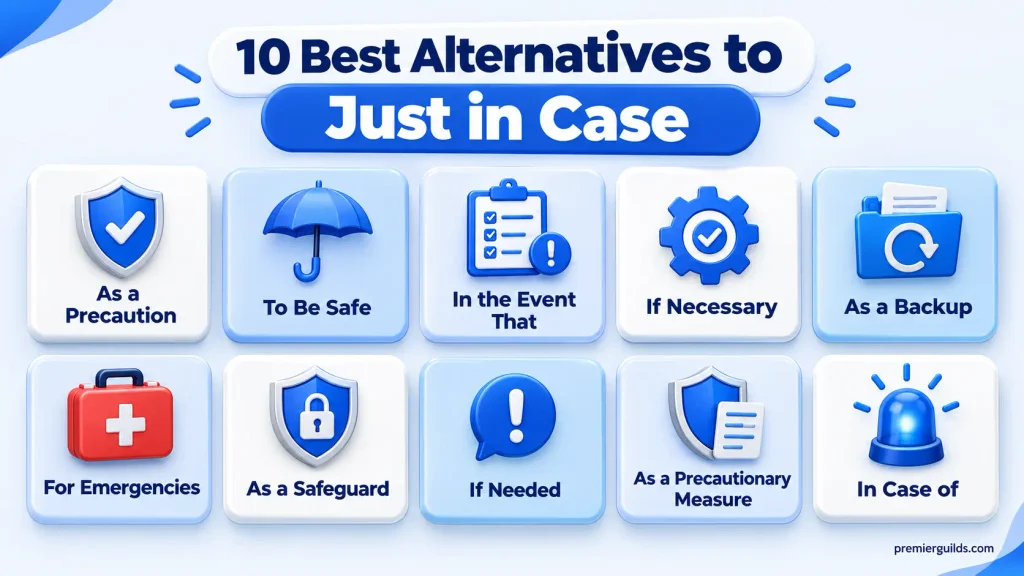
These ten alternatives cover everyday precautions, formal conditions, and backup planning. They are not always interchangeable, so pay attention to the examples.
Meaning
“As a precaution” means taking an action to prevent a possible problem. It emphasizes careful preparation before something goes wrong.
Best For: Professional, Formal, Polite
Example 1: As a precaution, we saved another copy of the customer records.
Example 2: The school canceled outdoor activities as a precaution during the storm warning.
Quick Tip: Use this phrase when explaining a preventive action.
Meaning
“To be safe” means doing something extra to reduce risk. It sounds natural and friendly in everyday conversations.
Best For: Casual, Friendly, Polite
Example 1: Bring a light jacket to be safe because the weather might change.
Example 2: I’ll charge my phone before leaving, just to be safe.
Quick Tip: Choose this expression for simple, practical precautions.
Meaning
“In the event that” introduces a possible situation and explains what should happen if it occurs. It is more formal than “just in case.”
Best For: Formal, Professional
Example 1: In the event that the meeting is canceled, all participants will receive an email.
Example 2: Please contact the front desk in the event that your room key stops working.
Quick Tip: Use this phrase in formal instructions, policies, and procedures.
Meaning
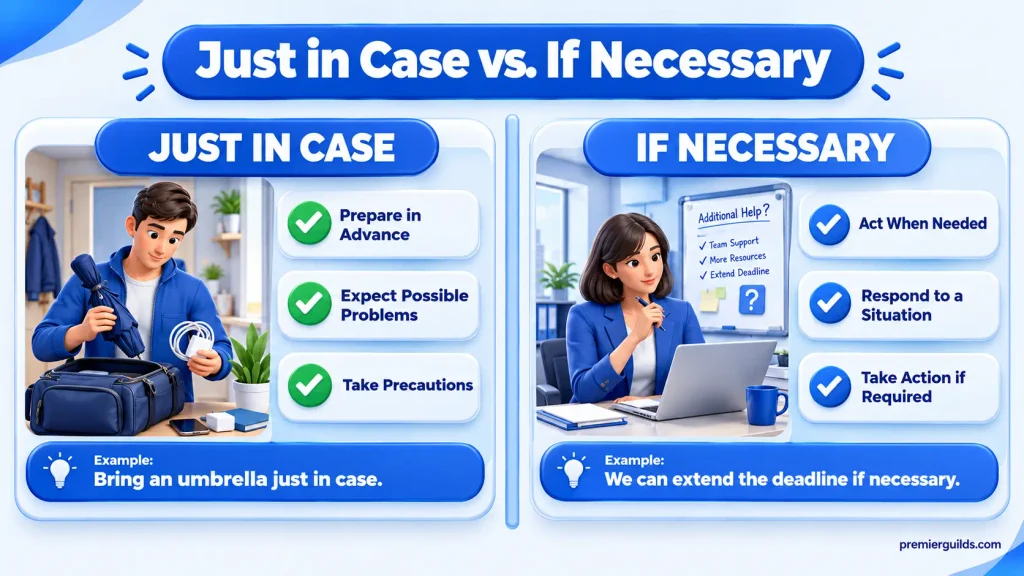
“If necessary” means an action should happen only when it becomes required. It focuses on need rather than general caution.
Best For: Professional, Formal, Polite
Example 1: We can extend the deadline if necessary.
Example 2: The technician will replace the damaged part if necessary.
Quick Tip: Use this phrase when describing an optional action based on a need.
Meaning
“As a backup” describes an extra option prepared in case the main choice fails. It often refers to plans, supplies, or resources.
Best For: Professional, Casual, Friendly
Example 1: We reserved a second conference room as a backup.
Example 2: I packed an extra charger as a backup for the road trip.
Quick Tip: Use this expression when you have an alternative ready.
Meaning
“For emergencies” means keeping something available for urgent or unexpected situations. It usually refers to serious needs rather than minor problems.
Best For: Professional, Casual, Polite
Example 1: Keep a flashlight in your car for emergencies.
Example 2: The office maintains extra medical supplies for emergencies.
Quick Tip: Use this phrase only when an urgent situation is possible.
Meaning
“As a safeguard” describes a measure that protects people, information, or property. It often appears in business and safety discussions.
Best For: Professional, Formal
Example 1: The company requires two-step verification as a safeguard against unauthorized access.
Example 2: We added a second review process as a safeguard against billing errors.
Quick Tip: Choose this phrase when emphasizing protection or risk reduction.
Meaning
“If needed” means an action or resource is available when required. It is shorter and more conversational than “if necessary.”
Best For: Professional, Casual, Friendly
Example 1: You can borrow my laptop if needed.
Example 2: Our support team can provide additional training if needed.
Quick Tip: Use this phrase when offering help or an optional resource.
Meaning
“As a precautionary measure” describes a specific step taken to reduce a possible risk. It sounds formal and emphasizes deliberate prevention.
Best For: Professional, Formal
Example 1: As a precautionary measure, the building staff inspected every emergency exit.
Example 2: The hospital increased cleaning procedures as a precautionary measure.
Quick Tip: Use this expression in official notices and safety reports.
Meaning
“In case of” introduces an event or situation that may require action. It is commonly followed by a noun or noun phrase.
Best For: Professional, Formal, Polite
Example 1: In case of a fire, use the stairs instead of the elevator.
Example 2: Keep your receipt in case of a return.
Quick Tip: Use “in case of” before a noun, such as “an emergency,” rather than a complete sentence.
| Alternative | Best Used In | Tone |
|---|---|---|
| As a Precaution | Preventive actions | Professional |
| To Be Safe | Everyday preparation | Casual |
| In the Event That | Policies and instructions | Formal |
| If Necessary | Conditional actions | Professional |
| As a Backup | Alternative plans | Neutral |
| For Emergencies | Urgent situations | Practical |
| As a Safeguard | Security and protection | Formal |
| If Needed | Offers and support | Friendly |
| As a Precautionary Measure | Official safety notices | Formal |
| In Case of | Emergency instructions | Professional |
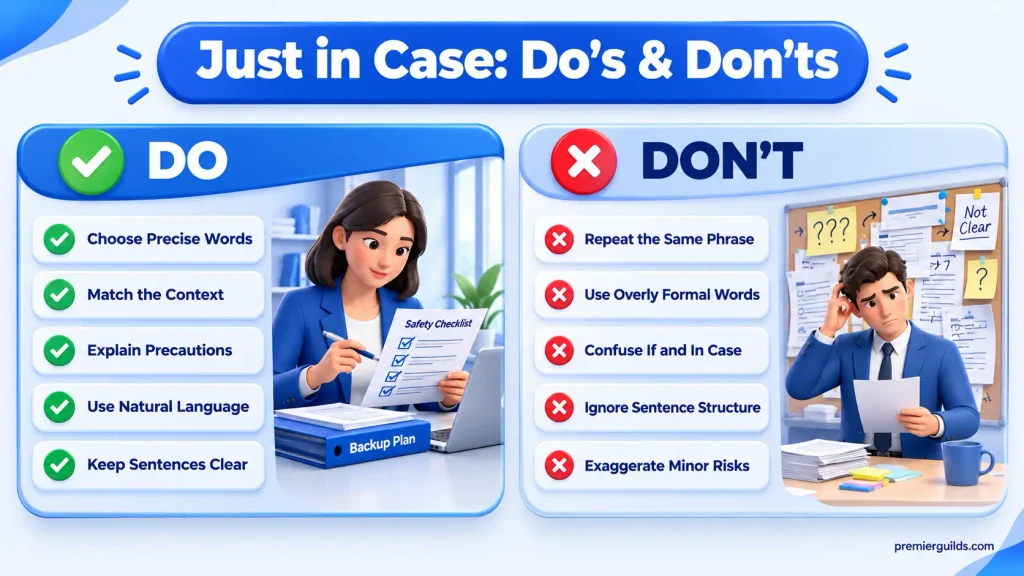
“In case” often explains preparation before something happens. “If” introduces a condition.
For example, “Take water in case you get thirsty” describes preparation.
“In the event that” may sound unnatural in a casual text. Use “if” or “to be safe” when simpler language works.
This expression suggests an urgent situation. Avoid using it for ordinary inconveniences.
Use “in case of” before a noun, such as “in case of rain.” Use “in case” before a clause, such as “in case it rains.”
Using “just in case” several times can make writing repetitive. Choose precise alternatives without changing the meaning.
You can say “as a precaution,” “to be safe,” or “as a backup.” These expressions work when describing preparation. For conditional situations, “in the event that” or “if needed” may be better. The correct choice depends on what you want to communicate.
“As a precaution” is a clear professional alternative. You can also use “as a safeguard” when discussing protection or risk management. In formal instructions, “in the event that” works well. Choose the expression that accurately explains the reason for your action.
“Just in case” is generally conversational, but it is acceptable in many workplace situations. Formal documents may benefit from more specific wording. For example, “as a precaution” sounds polished in a business report, while “in the event that” suits formal procedures.
It means preparing for something that might happen. For example, “Bring your ID just in case they ask for it” means taking your identification because someone may request it. The phrase often shows caution rather than certainty about a future event.
Sometimes, but the meaning can change. “Take an umbrella in case it rains” means preparing before rain starts. “Take an umbrella if it rains” makes taking the umbrella depend on the rain occurring. Choose the structure that matches your intended timing.
You might write, “I’ve attached an extra copy as a precaution” or “The document is available if needed.” Both sound professional and clear. If you’re describing a backup arrangement, “as a backup” may fit better. Avoid using a formal phrase when a simple one communicates your message.
“Just in case” often describes preparation before a possible event. “If necessary” means taking action only when a need arises. For example, saving a backup file is preparation, while restoring that file if necessary is a response to a problem.
The expressions are related but have different sentence structures. “In case of” is followed by a noun phrase, such as “in case of an emergency.” “Just in case” can stand alone or introduce a clause. Both can describe possible situations, but they are not always interchangeable.
Finding another way to say just in case helps you describe preparation, safety, and possible situations more clearly.
For everyday conversations, “to be safe” is a simple and natural choice. It works well when discussing small precautions.
In professional writing, “as a precaution” and “as a safeguard” can explain steps taken to reduce risk.
For formal instructions, “in the event that” and “in case of” help describe possible situations. However, they require different sentence structures.
When discussing backup plans, “as a backup” is often the most accurate expression.
Remember that not every alternative has the same meaning. Some describe preparation, while others explain conditions or actions that may become necessary.
The best choice is the expression that matches your situation, preserves your intended meaning, and keeps your message easy to understand.

Our editorial team brings together decades of expertise in applied linguistics, lexicography, and educational publishing. Dedicated to clarity, precision, and tone, our experts ensure that every resource meets the highest standards of professional and academic excellence.