

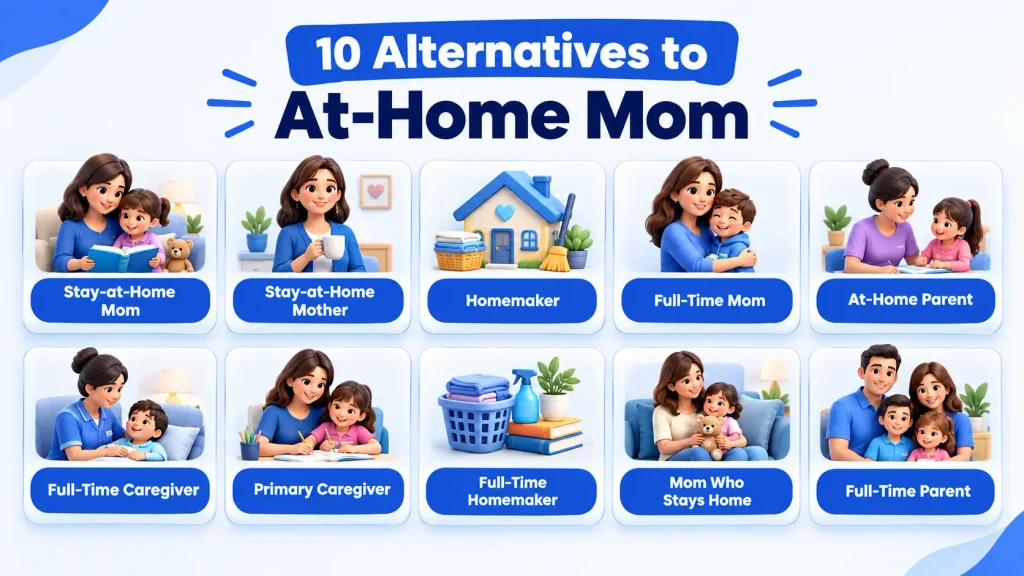
Another way to say at-home mom is stay-at-home mom, stay-at-home mother, homemaker, full-time mom, or at-home parent. The best choice depends on the context. “Stay-at-home mom” is the most common everyday phrase, while “homemaker” highlights managing a household and “primary caregiver” emphasizes responsibility for a child’s care.
Finding another way to say at home mom can help you describe parenting responsibilities more clearly. You might need a phrase for a conversation, a social media bio, a personal introduction, or a piece of writing.
The right expression depends on what you want to emphasize. Some phrases focus on caring for children, while others highlight household management or a parent’s daily role. Below are 10 natural alternatives, along with examples and tips for choosing the best one.
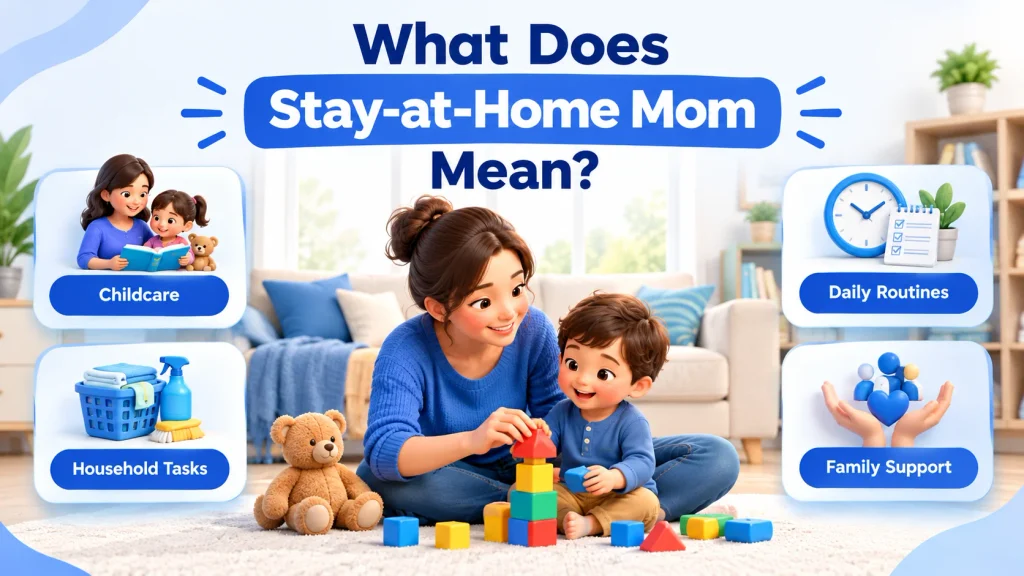
An at-home mom is a mother who primarily stays home to care for her children and manage family responsibilities rather than working in a job outside the home. The more common American English expression is “stay-at-home mom.”
People use this phrase in everyday conversations, parenting discussions, online profiles, and family introductions. However, staying at home does not mean a mother is not working. Childcare, meal planning, household tasks, and supporting children’s development can require substantial time and effort.
The term also does not necessarily mean a mother never works for pay. Some stay-at-home moms work remotely, run businesses from home, or take on freelance projects.
Different expressions can help you communicate more naturally and describe a parent’s role with greater accuracy.
Here are some reasons to choose an alternative:
Meaning: “Stay-at-home mom” is the most common and natural alternative in American English. It describes a mother whose primary role involves caring for her children and managing responsibilities at home.
Best For: Casual, Friendly, Warm, Polite
Example 1: My sister is a stay-at-home mom who spends her mornings helping her children learn to read.
Example 2: As a stay-at-home mom, Jessica plans family activities around her children’s school and appointments.
Quick Tip: Use this phrase in everyday conversations, parenting articles, and social media profiles. Hyphenate “stay-at-home” when it appears before a noun.
Meaning: “Stay-at-home mother” communicates the same basic idea as “stay-at-home mom,” but it sounds slightly more formal. It works well when writing for a broad audience or discussing parenting in a more serious context.
Best For: Formal, Professional, Polite
Example 1: The article explores the challenges and rewards experienced by stay-at-home mothers.
Example 2: A local support group offers resources for stay-at-home mothers adjusting to life with a newborn.
Quick Tip: Choose “mother” instead of “mom” when the surrounding writing has a formal or informational tone.
Meaning: A homemaker manages household responsibilities, which may include preparing meals, organizing schedules, shopping, and maintaining the home. The term does not automatically mean the person has children, so use it when household management is the main point.
Best For: Formal, Polite, Professional
Example 1: After their second child was born, Maria decided to focus on being a homemaker for a few years.
Example 2: He described his mother as a homemaker who kept the household running smoothly.
Quick Tip: Use “homemaker” when you want to emphasize managing a household rather than focusing only on childcare.
Meaning: “Full-time mom” emphasizes the time and commitment a mother gives to raising her children. It sounds conversational and highlights parenting as a major daily responsibility.
Best For: Casual, Friendly, Warm
Example 1: After leaving her office job, Erin became a full-time mom to her two young children.
Example 2: Being a full-time mom keeps Danielle busy with school activities, meals, and family routines.
Quick Tip: This phrase is useful in personal conversations, but it is less precise than “stay-at-home mom” because it does not always explain whether the mother works outside the home.
Meaning: “At-home parent” is a gender-neutral expression for a parent who primarily cares for children at home. It is especially useful when discussing families without assuming that caregiving is always a mother’s responsibility.
Best For: Professional, Formal, Polite
Example 1: The school invited at-home parents to attend its daytime reading program.
Example 2: As an at-home parent, Chris organizes his schedule around the children’s needs.
Quick Tip: Choose this term for parenting resources, family policies, or articles intended for all parents alike.
Meaning: A full-time caregiver provides regular, ongoing care for someone who depends on them. In a parenting context, this phrase emphasizes the responsibility of looking after children, although it can also describe people who care for older adults or individuals with support needs.
Best For: Professional, Formal, Polite
Example 1: She became a full-time caregiver for her toddler while her partner returned to work.
Example 2: The family relies on a full-time caregiver to maintain a consistent routine for their young children.
Quick Tip: Use this phrase when caregiving responsibilities are the focus. Make the relationship clear if readers might not know whom the person cares for.
Meaning: A primary caregiver is the person who takes the leading role in someone’s daily care. A mother can be the primary caregiver while staying home, working remotely, or holding a job outside the home.
Best For: Professional, Formal
Example 1: Although both parents share responsibilities, Nina is the primary caregiver during the school week.
Example 2: The pediatrician asked the child’s primary caregiver about sleep habits and daily routines.
Quick Tip: This term describes responsibility rather than employment status, so it is useful when the mother’s exact work situation is not relevant.
Meaning: A full-time homemaker spends much of their time managing household duties and family needs. The expression places more emphasis on running the home than on parenting alone.
Best For: Formal, Polite, Friendly
Example 1: After moving to a new city, Lauren worked as a full-time homemaker while her children settled into school.
Example 2: He admired his grandmother, a full-time homemaker who carefully managed the family budget.
Quick Tip: Use this expression when household management is a central part of the role you want to describe.
Meaning: “Mom who stays home” is a straightforward, conversational way to describe a mother who primarily cares for her family at home. It sounds less like a label and more like a description of someone’s current routine.
Best For: Casual, Friendly, Warm
Example 1: She is a mom who stays home with her preschooler until kindergarten begins.
Example 2: My neighbor is a mom who stays home and volunteers at the community library.
Quick Tip: This wording works well in informal conversations. For concise writing, “stay-at-home mom” is usually smoother.
Meaning: “Full-time parent” describes someone whose main daily responsibility is raising and caring for their children. It can apply to mothers or fathers and does not necessarily specify whether the person also earns money from home.
Best For: Professional, Casual, Polite
Example 1: Mark became a full-time parent after his family welcomed twins.
Example 2: She introduced herself as a full-time parent who also enjoys volunteering in her community.
Quick Tip: Use this phrase when you want inclusive wording or when the person’s parenting role matters more than their gender.
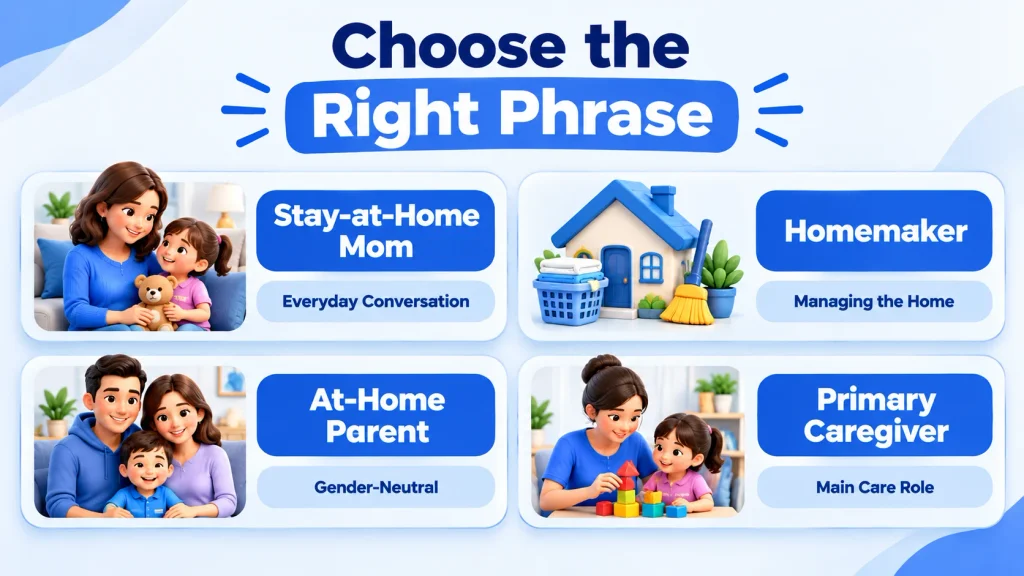
| Alternative | Best Used In | Tone |
|---|---|---|
| Stay-at-Home Mom | Everyday conversation and parenting content | Natural, friendly |
| Stay-at-Home Mother | Articles and formal writing | Formal, neutral |
| Homemaker | Household responsibilities | Respectful, descriptive |
| Full-Time Mom | Personal conversations and bios | Warm, conversational |
| At-Home Parent | Inclusive family content | Neutral, professional |
| Full-Time Caregiver | Caregiving discussions | Professional, practical |
| Primary Caregiver | Parenting and care-related contexts | Formal, precise |
| Full-Time Homemaker | Household management discussions | Formal, descriptive |
| Mom Who Stays Home | Casual conversation | Relaxed, personal |
| Full-Time Parent | General parenting discussions | Inclusive, neutral |
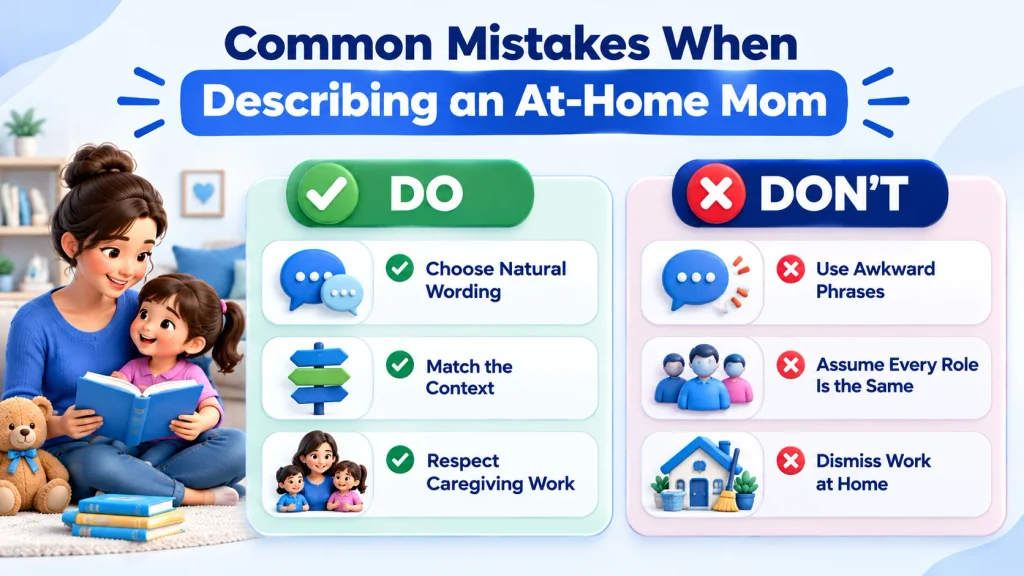
“At home mom” is understandable, but “stay-at-home mom” is the standard expression in American English. Use the more familiar version when writing articles, introductions, or social media descriptions.
Some mothers focus mainly on childcare, while others also manage a household, work remotely, or operate a business. Choose a phrase that accurately reflects the role being discussed.
A homemaker focuses on managing the home, while a primary caregiver takes the leading role in someone’s care. One person may do both, but the terms emphasize different responsibilities.
Expressions such as “primary caregiver” may sound unnecessarily formal when talking with friends. In everyday conversation, “stay-at-home mom” or “full-time mom” usually feels more natural.
Caring for children and managing a household require time, planning, and effort. Avoid language that dismisses these responsibilities or assumes a parent does nothing productive because they do not work outside the home.
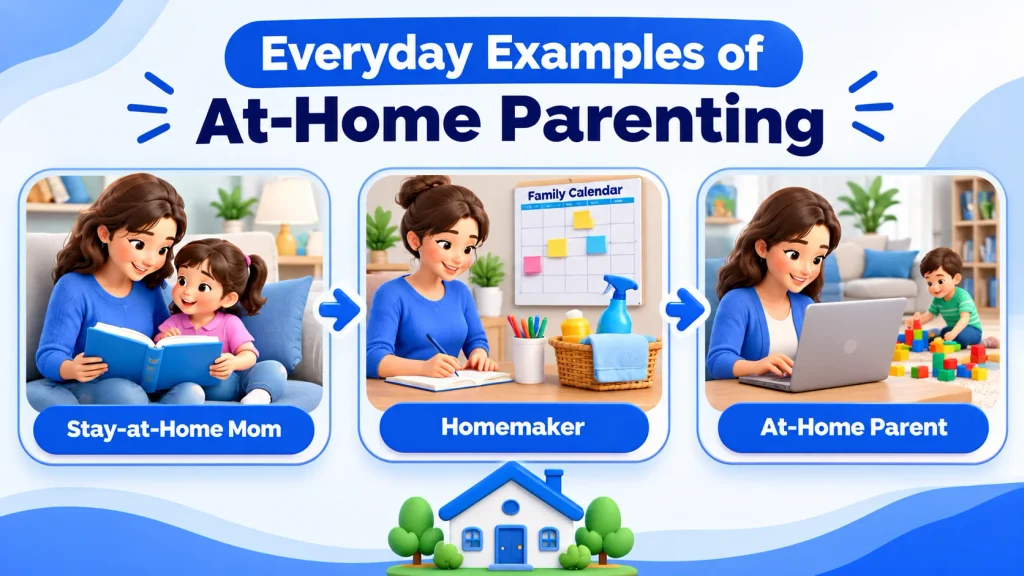
“Homemaker,” “full-time mom,” and “stay-at-home mother” are common alternatives. “At-home parent” is another option if you prefer gender-neutral wording. The best choice depends on whether you want to emphasize childcare, household management, or a parent’s broader role in the family.
“Stay-at-home mom” is the most common everyday expression in American English. People use it in conversations, parenting articles, and family introductions. “Stay-at-home mother” is a slightly more formal version that works well in informational or professional writing.
Not exactly. A homemaker manages household responsibilities, but the term does not necessarily mean the person has children. A stay-at-home mom specifically describes a mother who primarily cares for her children at home. One person may fit both descriptions.
“At-home parent” is a neutral option, while “primary caregiver” works when the person’s main responsibility is caring for a child. “Homemaker” is suitable when household management is the focus. Choose the term that accurately describes the person’s role instead of using a more formal label just to sound professional.
“At-home parent” and “full-time parent” are useful gender-neutral alternatives. Both describe a parenting role without specifying whether the person is a mother or father. These phrases are particularly helpful in parenting resources, school communications, and writing intended for different family structures.
Yes. “Full-time mom” is natural in casual conversations and emphasizes the time spent raising children. However, it does not always clearly indicate whether someone stays home. If you need to communicate that detail directly, “stay-at-home mom” is more precise.
Focus on relevant skills and experience rather than relying only on a label. Depending on your actual responsibilities, you might highlight scheduling, budgeting, organization, project coordination, or caregiving. Do not claim professional qualifications or job experience you do not have, and tailor each description to the role you’re applying for.
Yes. “Stay-at-home mom” is a widely understood and generally respectful expression. Still, individual preferences vary, so use the term someone chooses for herself when possible. “Homemaker,” “at-home parent,” or “full-time parent” may be better alternatives in certain contexts.
Choosing another way to say at home mom helps you communicate clearly and naturally. “Stay-at-home mom” is the best everyday choice because it is familiar and easy to understand. If you want to emphasize household responsibilities, consider “homemaker” or “full-time homemaker.” For a more inclusive expression, “at-home parent” and “full-time parent” work well. Meanwhile, “primary caregiver” is useful when the main focus is responsibility for a child’s daily care.
Always consider your audience and the point you want to make. A casual conversation may call for simple wording, while an article or professional document may benefit from a more precise description. Most importantly, choose language that accurately reflects the person’s role without making assumptions about their work, family, or daily routine.
Helpful takeaway: When in doubt, use “stay-at-home mom” for everyday American English and choose a more specific alternative when the context calls for it.

Senior English Editor & Stylistics Director
Michael Bennett is a veteran editor, lexicographer, and publishing consultant with more than two decades of experience in academic and educational publishing. Formerly a senior editorial director at major university presses, he specializes in structural editing, register refinement, and vocabulary development. Michael oversees tone, precision, and stylistic consistency across all publication channels, ensuring content meets rigorous editorial and pedagogical standards.












