

Looking for another way to say hurry up? Depending on the situation, you can say “please be quick,” “let’s get moving,” “we need to move quickly,” “pick up the pace,” or “please hurry.” The best choice depends on whether you want to sound casual, friendly, polite, or professional.
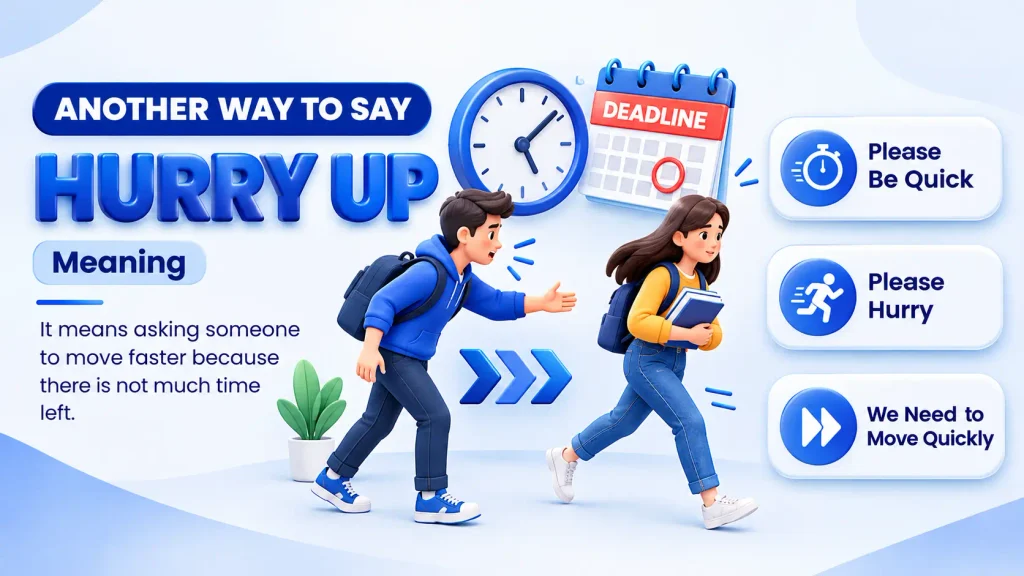
“Hurry up” means asking someone to do something faster or move more quickly because there is limited time. People commonly use it when they are waiting for someone, running late, preparing to leave, or trying to meet a deadline.
For example, a parent might tell a child to hurry up before school, while a friend might say it when they are waiting to leave. Although the phrase is natural and widely understood, it can sound impatient depending on your tone.
In professional settings, a softer alternative is often better. Phrases such as “please be quick,” “let’s move forward,” or “we need to move quickly” can communicate urgency without sounding unnecessarily harsh.
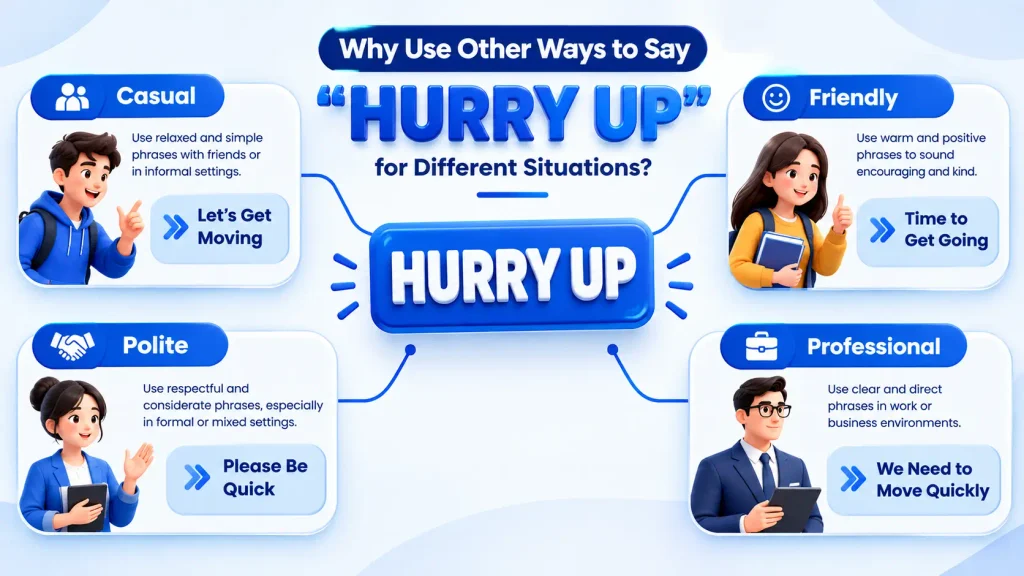
Using different expressions can help you communicate urgency while matching the situation and your relationship with the other person.
Other alternatives can help you:
The right phrase can make a significant difference. A friendly request works well with friends, while a professional expression is usually better for coworkers, customers, or business communication.
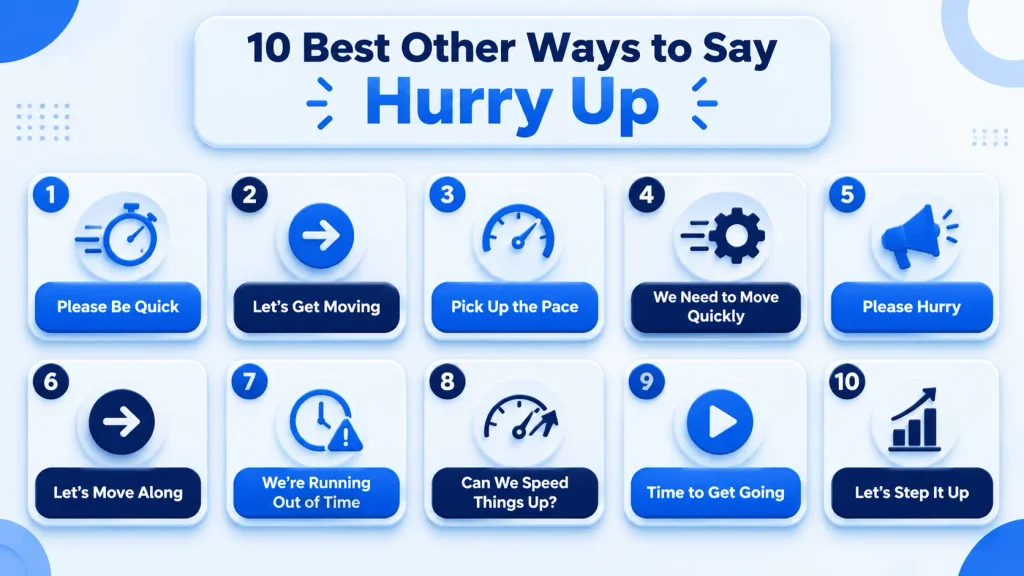
“Please be quick” asks someone to do something soon without directly telling them to “hurry up.” Adding “please” makes the request softer and more polite.
Polite, Formal, Professional
Please be quick because the meeting is about to begin.
Could you please be quick with the final review? We need to submit the document shortly.
Use this phrase when you need speed but still want to sound respectful.
“Let’s get moving” encourages people to start moving or taking action. Because it uses “let’s,” it sounds less demanding than directly telling someone to hurry.
Casual, Friendly, Warm
Let’s get moving if we want to catch the early train.
Everyone is ready, so let’s get moving.
This is an excellent choice when you want to encourage a group without sounding bossy.
“Pick up the pace” means to increase speed or work faster. It can describe physical movement as well as progress on a task.
Professional, Casual
We need to pick up the pace if we want to finish the project today.
The team picked up the pace during the final stage of the race.
Use this expression when someone is already doing something but needs to do it faster.
“We need to move quickly” communicates urgency without directly blaming or criticizing another person. It focuses on the situation rather than someone’s behavior.
Professional, Formal
We need to move quickly if we want to meet the client’s deadline.
The weather is changing, so we need to move quickly.
This is one of the safest alternatives for workplace conversations because it sounds direct but professional.
“Please hurry” is a polite version of “hurry up.” It clearly tells someone that you need them to move faster while maintaining a respectful tone.
Polite, Casual, Friendly
Please hurry because our reservation starts in ten minutes.
Please hurry and grab your coat before we leave.
Use “please” when speaking to someone you do not want to sound impatient with.
“Let’s move along” encourages someone or a group to continue rather than stay in the same place or spend too much time on one task.
Casual, Friendly, Professional
We have covered this topic, so let’s move along to the next question.
The kids are ready, so let’s move along before it gets too late.
This phrase is especially useful when you want people to continue with the next step.
“We’re running out of time” explains why action needs to happen quickly. Instead of commanding someone to hurry, you give them the reason for the urgency.
Professional, Polite, Formal
We’re running out of time, so let’s finalize the presentation.
We’re running out of time before the store closes.
This is a good choice when you want to communicate urgency without directly ordering someone to move faster.
“Can we speed things up?” politely asks whether a person or group can work faster. It is more collaborative than simply saying “hurry up.”
Professional, Polite, Casual
Can we speed things up so we can send the proposal before lunch?
Can we speed things up a little? I have another appointment shortly.
Use this phrase when you want to encourage faster progress without sounding aggressive.
“Time to get going” means that it is time to leave or begin an activity. It can create a sense of urgency while still sounding friendly.
Casual, Friendly, Warm
It’s time to get going if we want to arrive before noon.
Time to get going—the movie starts in twenty minutes.
This works especially well when you are encouraging friends, family, or a group to leave.
“Let’s step it up” means to increase effort, speed, or performance. It is commonly used when a person or team needs to make faster progress.
Casual, Friendly, Professional
Let’s step it up so we can finish the presentation before the meeting.
We need to step it up during the final quarter of the project.
Use this expression when you want to motivate people rather than simply tell them to hurry.
| Alternative | Best Used In | Tone |
| Please Be Quick | Requests, workplace situations | Polite |
| Let’s Get Moving | Friends, groups, travel | Friendly |
| Pick Up the Pace | Work, sports, tasks | Direct |
| We Need to Move Quickly | Business, deadlines | Professional |
| Please Hurry | Everyday requests | Polite |
| Let’s Move Along | Conversations, activities | Casual |
| We’re Running Out of Time | Deadlines, urgent situations | Professional |
| Can We Speed Things Up? | Work, projects, requests | Polite |
| Time to Get Going | Leaving, starting activities | Friendly |
| Let’s Step It Up | Work, teams, motivation | Energetic |
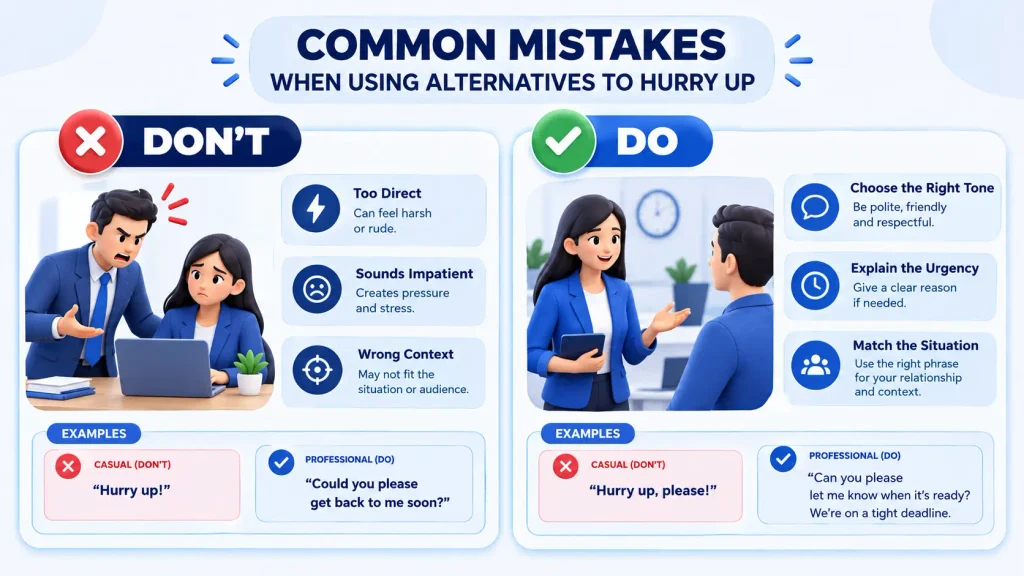
“Hurry up” is natural, but repeating it can make your communication sound impatient. Choose a softer alternative when the situation requires more tact.
Telling a coworker or customer to “hurry up” can sound demanding. Instead, explain the urgency with phrases such as “we need to move quickly” or “we’re running out of time.”
Sometimes people respond better when they understand why something needs to happen quickly. Saying “we’re running out of time” gives useful context instead of only giving an instruction.
A phrase like “we need to move quickly” may sound unnecessarily serious when talking to close friends. “Let’s get moving” or “time to get going” may feel more natural.
Words such as “speed up” or “pick up the pace” can sound forceful if used with the wrong tone. When speaking to someone who needs encouragement rather than pressure, use a collaborative phrase such as “can we speed things up?”

A polite way to say “hurry up” is “please be quick” or “please hurry.” Both communicate urgency while softening the request. In professional situations, “we need to move quickly” can be even better because it focuses on the situation rather than directly telling another person what to do.
A professional alternative is “we need to move quickly.” It communicates urgency without sounding rude or impatient. You can also say “can we speed things up?” when asking a coworker or team to make faster progress while maintaining a collaborative tone.
Friendly alternatives include “let’s get moving,” “time to get going,” and “let’s step it up.” These expressions encourage people to move faster without sounding as commanding as “hurry up.” They work especially well when talking with friends, family members, classmates, or teammates.
Explain the reason for the urgency or use a collaborative expression. For example, “we’re running out of time” explains why you need faster action, while “can we speed things up?” turns the request into a question instead of a command.
“Pick up the pace” is not automatically rude, but it can sound direct depending on your tone and relationship with the listener. It works well when discussing work, sports, or a task that needs to move faster. In sensitive situations, “can we speed things up?” may sound softer.
At work, try “we need to move quickly,” “can we speed things up?” or “we’re running out of time.” These alternatives communicate urgency while sounding more professional. They are particularly useful when discussing deadlines, meetings, projects, reports, or customer requests.
Casual alternatives include “let’s get moving,” “time to get going,” and “let’s move along.” These phrases sound natural in everyday conversations. The best choice depends on the situation. For example, “time to get going” is useful when leaving, while “let’s get moving” can encourage a group to start an activity.
You can use “hurry up” in an email, but it may sound too blunt, especially in professional communication. A better option is often “could you please prioritize this?” or “we need to move quickly.” These expressions communicate urgency while keeping the message respectful and professional.
There are many effective ways to say “hurry up” without sounding impatient or demanding. The best alternative depends on the situation, your relationship with the listener, and how urgent the request is. For casual conversations, “let’s get moving” and “time to get going” sound natural and friendly. For professional communication, “we need to move quickly” and “can we speed things up?” are more appropriate.
If you need to motivate someone, “let’s step it up” or “pick up the pace” can add energy to your message. When politeness matters, “please be quick” or “please hurry” works well. The key is to communicate urgency while choosing a tone that fits the person and situation.

English Language & Communication Specialist
Dr. Emily Carter is an English language and communication specialist focused on vocabulary, word choice, professional writing, and practical English usage. She helps readers understand the differences between similar words and choose expressions that sound natural, clear, and appropriate for different contexts.












