

Another way to say “in order” depends on the meaning you want to express. Use “so that” or “to” to explain a purpose, “sequentially” or “step by step” to describe a process, and “properly” or “correctly” to describe how something is done. Choose the phrase that best fits your sentence.
Looking for another way to say in order? The best alternative depends on what you mean. You might want to explain a purpose, describe the steps in a process, or say that something is organized and working correctly.
Although “in order” is a common English expression, repeating it can make your writing sound less natural. Learning a few alternatives can help you write clearer emails, stronger essays, and more effective instructions.
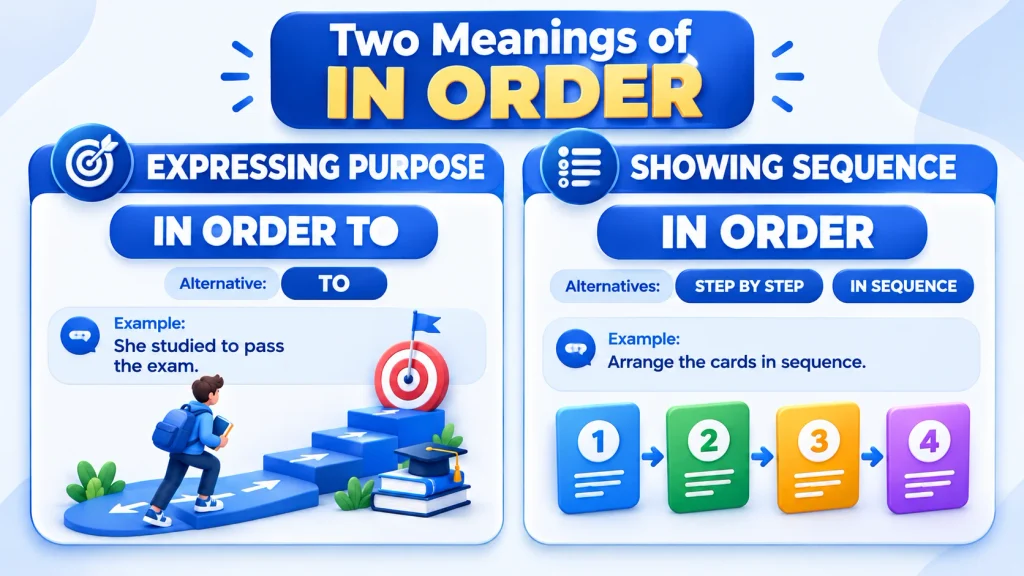
The phrase “in order” has several meanings in American English. Its meaning usually depends on the words around it.
First, “in order to” explains the purpose of an action. For example, “She studied every evening in order to pass the exam” means she studied because she wanted to pass.
Second, “in order” can describe a sequence or arrangement. For example, “Please list the names in order” means the names should follow a particular sequence.
Finally, “in order” can mean that something is correct, organized, or working as expected. For example, “All the documents are in order” means the documents are complete and properly arranged.
Understanding these meanings helps you select a suitable replacement without changing your sentence’s meaning.
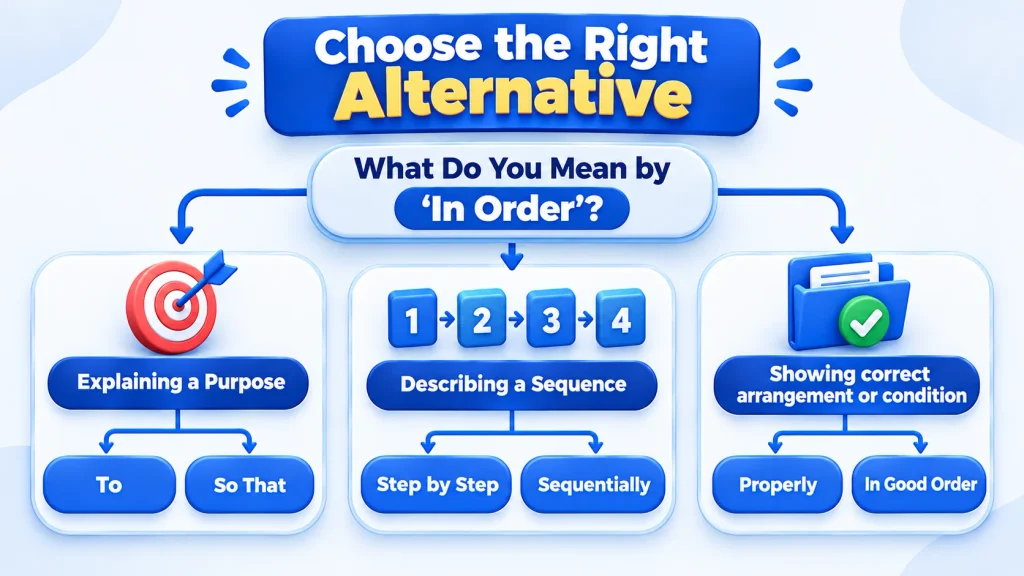
Using different expressions can make your writing clearer and easier to understand. The right phrase also helps you match your tone to the situation.
Consider these benefits:
The goal is not to replace every instance of “in order.” Instead, choose an alternative when it communicates your meaning more clearly.
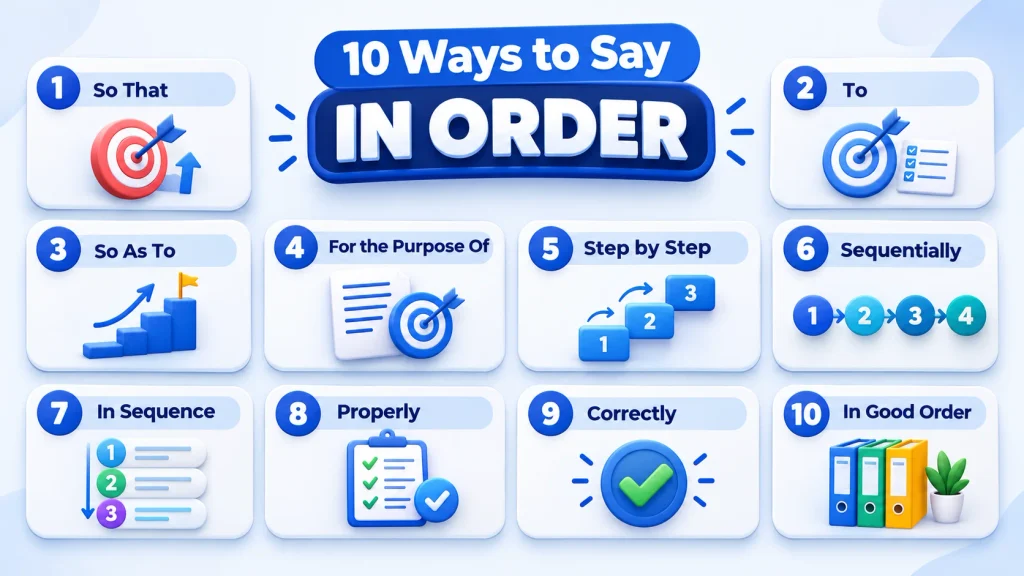
Meaning: “So that” explains the purpose of an action. It often introduces the result someone wants to achieve.
Best For: Professional, Academic, Polite
Example 1: Please send the report today so that the team can review it before Friday.
Example 2: Maya wrote down the address so that she would not forget it.
Quick Tip: Use “so that” when you want to explain why someone does something. It often sounds more conversational than “in order to.”
Meaning: “To” is a short, natural way to express the purpose of an action. In many sentences, it can replace “in order to” without changing the meaning.
Best For: Professional, Casual, Academic
Example 1: I called the office to confirm my appointment.
Example 2: Daniel saved money to buy a new laptop.
Quick Tip: Prefer “to” when the meaning is clear. “In order to” is sometimes useful for emphasis, but it is often longer than necessary.
Meaning: “So as to” expresses the purpose of an action. It is generally more formal than “to” and can be useful in carefully written instructions or professional documents.
Best For: Formal, Professional, Academic
Example 1: The manager revised the schedule so as to reduce delays.
Example 2: Please keep your explanation brief so as to leave enough time for questions.
Quick Tip: Use this expression sparingly. In everyday writing, “to” or “so that” usually sounds more natural.
Meaning: “For the purpose of” clearly identifies the aim or reason behind an activity. It often appears in formal documents, policies, and official explanations.
Best For: Formal, Professional
Example 1: The survey was created for the purpose of gathering customer feedback.
Example 2: Employees must complete the form for the purpose of updating their contact information.
Quick Tip: This phrase can sound wordy in casual writing. Use it when you need to state a purpose explicitly or maintain a formal tone.
Meaning: “Step by step” describes completing an activity through a series of clear stages. It is especially useful when explaining instructions or teaching a skill.
Best For: Professional, Friendly, Casual
Example 1: The instructor showed us how to install the software step by step.
Example 2: Follow the recipe step by step to prepare the dish correctly.
Quick Tip: Use this phrase when the focus is on completing a process in manageable stages rather than explaining the purpose of an action.
Meaning: “Sequentially” means following a specific order, with one item or action coming after another. It is common in technical, academic, and process-related writing.
Best For: Formal, Professional, Academic
Example 1: The system processes incoming requests sequentially.
Example 2: Arrange the chapters sequentially before submitting the final manuscript.
Quick Tip: This word is precise but slightly technical. In instructions for general readers, “one after another” may be easier to understand.
Meaning: “In sequence” means arranged or completed according to a particular order. It is useful when the order of items or actions matters.
Best For: Professional, Formal, Academic
Example 1: Enter the verification codes in sequence to complete the setup.
Example 2: The researcher reviewed the events in sequence to understand what happened.
Quick Tip: Use “in sequence” when you want to emphasize the correct arrangement of items or events, rather than the purpose of an action.
Meaning: “Properly” means in the correct or suitable way. It can replace “in order” when the original phrase refers to something being arranged, prepared, or handled correctly.
Best For: Professional, Polite, Casual
Example 1: Please make sure the equipment is properly stored after use.
Example 2: The assistant checked that every application was properly completed.
Quick Tip: “Properly” does not usually replace “in order to.” Use it when you mean that something is done correctly, not when you are explaining a purpose.
Meaning: “Correctly” means accurately or according to the relevant rules or instructions. It works well when you want to emphasize accuracy rather than arrangement.
Best For: Professional, Academic, Polite
Example 1: Check each answer to make sure the calculations are completed correctly.
Example 2: The technician connected the cables correctly before starting the machine.
Quick Tip: Choose “correctly” when accuracy matters. If you mean that something is organized or ready, “properly arranged” or “in good order” may be more suitable.
Meaning: “In good order” means organized, properly arranged, or in an acceptable condition. It is especially useful when describing records, documents, equipment, or arrangements.
Best For: Formal, Professional
Example 1: The auditor confirmed that the financial records were in good order.
Example 2: Before the guests arrived, the staff made sure the conference room was in good order.
Quick Tip: Use this expression when talking about organization or condition. It is not a direct replacement for “in order to” when describing a purpose.
| Alternative | Best Used In | Tone |
|---|---|---|
| So that | Explaining a purpose or intended result | Natural, clear |
| To | Everyday sentences and concise writing | Simple, direct |
| So as to | Formal explanations and instructions | Formal |
| For the purpose of | Policies and official documents | Highly formal |
| Step by step | Tutorials and instructions | Friendly, practical |
| Sequentially | Technical processes and academic writing | Technical, precise |
| In sequence | Ordered lists and procedures | Neutral, professional |
| Properly | Correct handling or preparation | Practical, professional |
| Correctly | Accuracy and following rules | Direct, precise |
| In good order | Documents, records, and organization | Formal, professional |
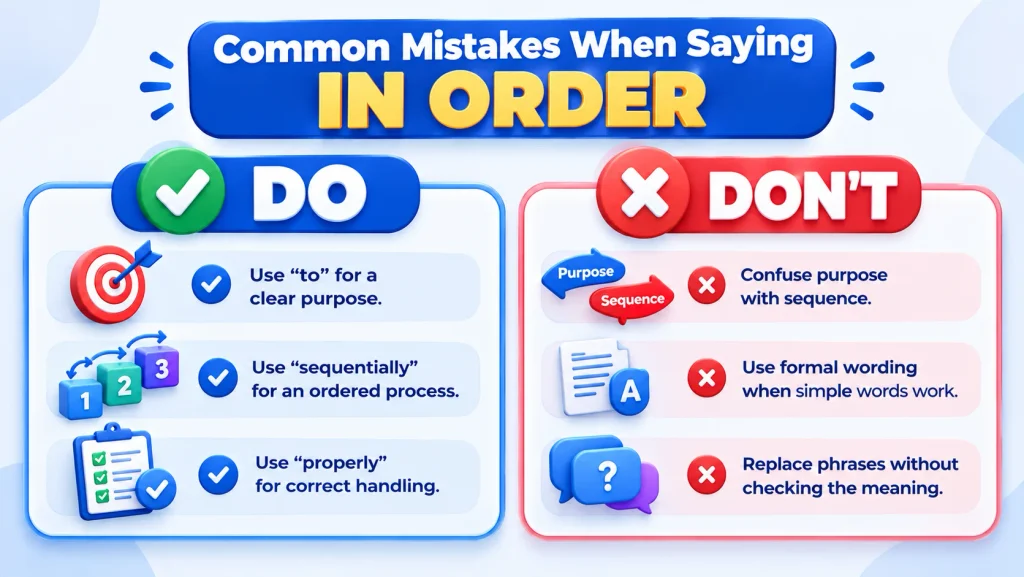
Not every alternative has the same meaning. “So that” explains a purpose, while “sequentially” describes the order of actions.
Better approach: Identify what “in order” means in your sentence before choosing a replacement.
Phrases such as “for the purpose of” can sound unnecessarily complicated in everyday speech.
Better approach: Use simple expressions such as “to” or “so that” when speaking with friends or writing informal messages.
“In order to finish the project” explains a goal. “Put the files in order” describes an arrangement.
Better approach: Use purpose expressions for goals and sequence expressions for steps or lists.
These phrases are not interchangeable in every sentence. “Properly” describes how something is done, while “in order to” introduces a purpose.
Better approach: Check whether your sentence answers “How?” or “Why?” before selecting a phrase.
Adding several formal words does not automatically improve your writing. For example, “in order to complete the task” can usually become “to complete the task.”
Better approach: Choose the shortest phrase that expresses your meaning clearly.
Common alternatives include “so that,” “to,” “sequentially,” “step by step,” “properly,” and “in good order.” The best choice depends on your sentence. Use “to” when explaining a purpose, “sequentially” when describing an ordered process, and “properly” when referring to correct handling or preparation.
Professional alternatives include “to,” “so that,” “in sequence,” “sequentially,” and “for the purpose of.” For example, you could write, “Please submit the form to complete your registration.” Choose the phrase based on the meaning you want to express and keep business communication clear rather than unnecessarily formal.
In most sentences, you can use “to” instead of “in order to.” For example, “She attended the meeting in order to discuss the budget” can become “She attended the meeting to discuss the budget.” You can also use “so that” when introducing a clause with its own subject and verb.
For academic writing, consider “to,” “so that,” “sequentially,” “in sequence,” or “for the purpose of.” The right expression depends on your point. Use “so that” to explain an intended result and “in sequence” to describe the order of events. Clear wording is usually better than overly complicated vocabulary.
They can express a similar purpose, but their sentence structures differ. “In order to” is generally followed by a base verb, as in “She practiced in order to improve.” “So that” is followed by a clause, as in “She practiced so that she could improve.” Choose the structure that fits your sentence.
You can say “organize things,” “arrange items,” “sort things out,” or “put everything in its proper place.” For example, “I need to organize my files before the meeting” sounds natural and clear. “Sort things out” is more informal and may refer to resolving a problem rather than arranging physical items.
“To” is usually the simplest alternative when “in order to” expresses a purpose. For example, “He left early to catch the train” is shorter and more natural than “He left early in order to catch the train.” When discussing arrangement, “properly” or “in sequence” may be more appropriate.
Yes. “In order” is acceptable in formal writing, especially when it clearly describes a sequence or condition. However, “in order to” may be shortened to “to” when the purpose is obvious. Avoid changing a phrase just to sound formal; accuracy, clarity, and natural sentence structure matter more.

Choosing another way to say “in order” can make your writing clearer, more natural, and more precise. The best alternative depends on what you want to communicate. Use “to” or “so that” to explain a purpose, “step by step” or “sequentially” to describe a process, and “properly” or “correctly” to show that something meets the right standard.
For academic writing, “in sequence” and “for the purpose of” may fit certain formal contexts. In everyday English, shorter expressions often work better. Remember that these phrases are not interchangeable in every sentence, so always consider the surrounding words and intended meaning.
The key takeaway: Choose the phrase that communicates your meaning most clearly. Good writing does not require the longest or most formal expression; it requires the right words for the situation.

English Language & Communication Specialist
Dr. Emily Carter is an English language and communication specialist focused on vocabulary, word choice, professional writing, and practical English usage. She helps readers understand the differences between similar words and choose expressions that sound natural, clear, and appropriate for different contexts.












