
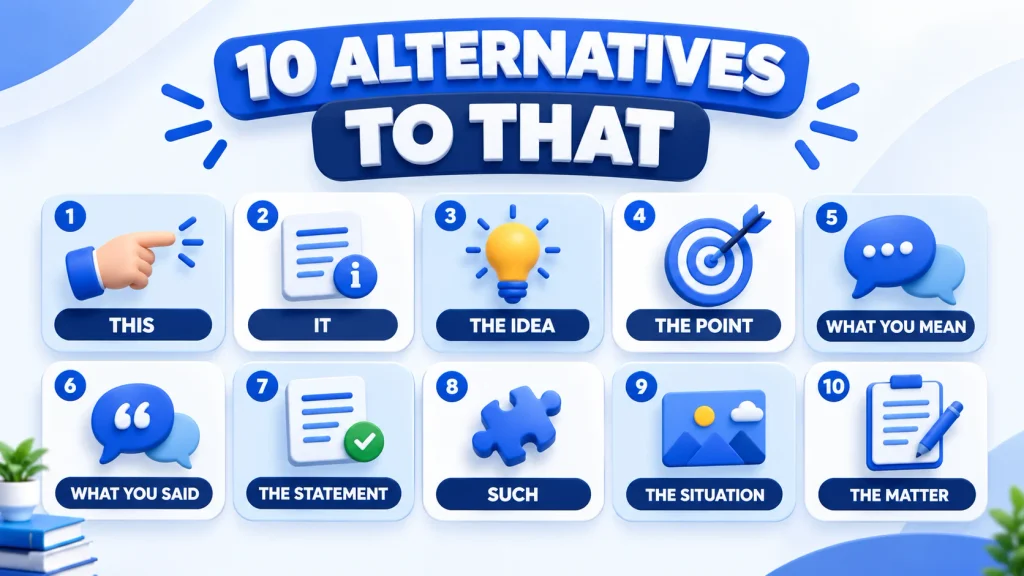
Looking for another way to say that? Depending on the context, you can use phrases such as this, it, the idea, the point, what you mean, what you said, that idea, such, or the statement. The best choice depends on whether you are referring to an object, idea, statement, or previously mentioned information.
The word “that” is one of the most common words in English, but repeating it too often can make your writing feel vague or repetitive. Fortunately, there are several natural alternatives you can use when you want to make your meaning clearer.
The right replacement depends on what “that” refers to. You may be pointing to an idea, referring to something already mentioned, describing a statement, or talking about what another person meant.
In other words, there is no single replacement that works in every sentence. The best option depends on the purpose of the sentence and the tone you want to create.
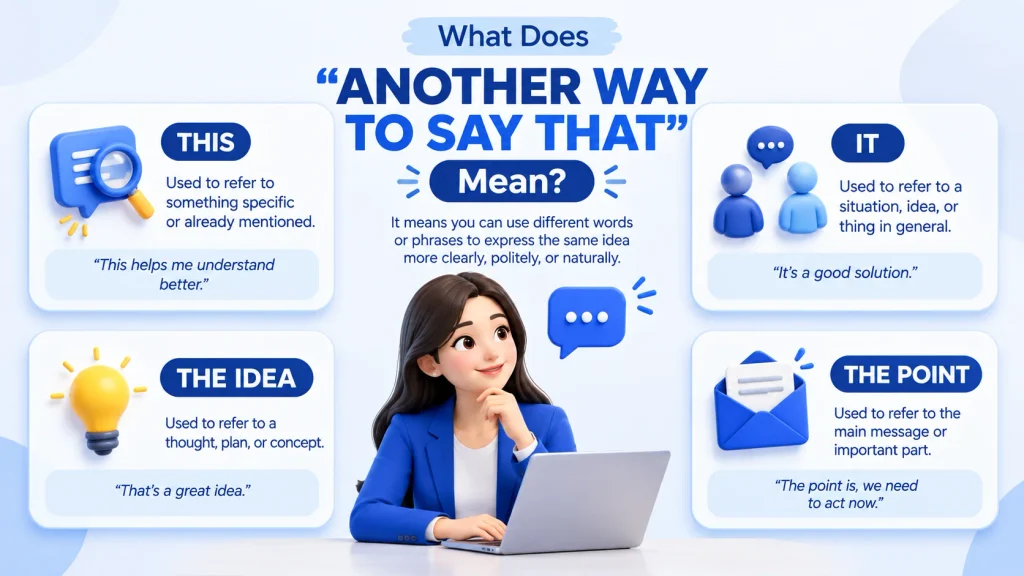
The phrase “another way to say that” means you want to express the same idea using different words. People use it when they want to rephrase something, make an explanation clearer, avoid repetition, or find a more natural expression.
For example:
“That was a difficult decision.”
You might rephrase it as:
“It was a difficult decision.”
In another context, “that” could refer to an idea:
“That is a good point.”
You could say:
“The idea you mentioned is a good point.”
The phrase is common in everyday conversations, texting, emails, and general writing. Similar searches often focus on alternatives that help speakers restate or clarify an idea without repeating the same wording.
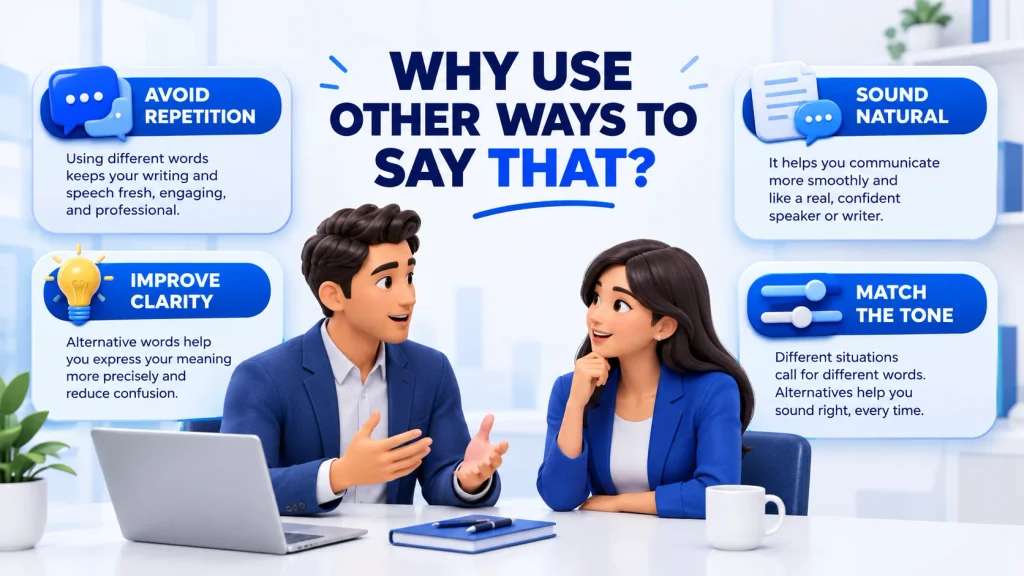
Replacing “that” can make your communication more specific and natural. It can also help readers understand exactly what you mean.
Here are some common reasons to use alternatives:
For example, “That was interesting” is perfectly natural, but “The presentation was interesting” gives the reader more information.
“This” can replace “that” when you want to refer to something that feels closer to the speaker, the current situation, or the idea being discussed. The choice between “this” and “that” often depends on perspective and context.
This is exactly what I was talking about earlier.
I think this is the best solution for our team.
Use “this” when you want to bring an idea closer to the current discussion or emphasize something that is happening now.
“It” is often a natural replacement when “that” refers to a previously mentioned thing, situation, or idea. It can make a sentence shorter and smoother.
The meeting was longer than expected, but it was productive.
You mentioned the new schedule, and it sounds reasonable to me.
Use “it” when the thing you are referring to is already clear from the previous sentence.
“The idea” is useful when “that” refers to a thought, suggestion, belief, or concept. It gives the reader a clearer description instead of relying on a vague pronoun.
The idea could help us reduce unnecessary costs.
I understand the idea, but I think we need more information first.
Choose “the idea” when “that” refers specifically to someone’s suggestion, thought, or concept.
“The point” works when “that” refers to the main message, argument, or important part of what someone has said. It is especially useful when discussing opinions or explanations.
I understand the point you are trying to make.
The point is that we need to finish the project before Friday.
Use “the point” when you are talking about the central message rather than a physical object or specific thing.
“What you mean” is useful when “that” refers to someone’s intended meaning. It sounds natural when asking for clarification or showing that you understand another person’s message.
I understand what you mean, but I see the situation differently.
Now I see what you mean about the deadline.
Use this phrase when the focus is on someone’s intended meaning rather than the exact words they used.
“What you said” directly refers to another person’s previous statement. It can be clearer than “that” when the listener may not immediately know which part of the conversation you mean.
What you said during the meeting gave me a new perspective.
I agree with what you said about improving customer service.
Use “what you said” when you are specifically referring to a person’s earlier words.
“The statement” is a more formal alternative when “that” refers to something someone has stated or written. It provides a specific noun and can make formal writing sound more precise.
The statement in the report needs additional clarification.
We reviewed the statement before sending the final response.
Use this option for reports, formal discussions, official documents, or situations where precision matters.
“Such” can replace a repeated noun or idea when the meaning is already clear. It is especially useful in formal or professional writing, although it should not be forced into casual sentences.
The company introduced a new policy, and such a change may affect several departments.
The team faced an unexpected challenge and responded well to such circumstances.
Use “such” carefully because it can sound more formal than everyday alternatives such as “this” or “it.”
“The situation” is helpful when “that” refers to a circumstance, event, or problem rather than a specific object. It makes the reference more descriptive.
The situation became easier to manage after we created a clear plan.
I understand the situation, and we will work on a solution.
Choose “the situation” when you are discussing circumstances or events rather than a single idea or object.
“The matter” refers to an issue, subject, or situation being discussed. It has a somewhat formal tone and works particularly well in professional or official communication.
We need to discuss the matter before making a final decision.
The manager asked the team to review the matter carefully.
Use “the matter” for serious or formal discussions. For casual conversation, “the issue” or “the situation” may sound more natural.
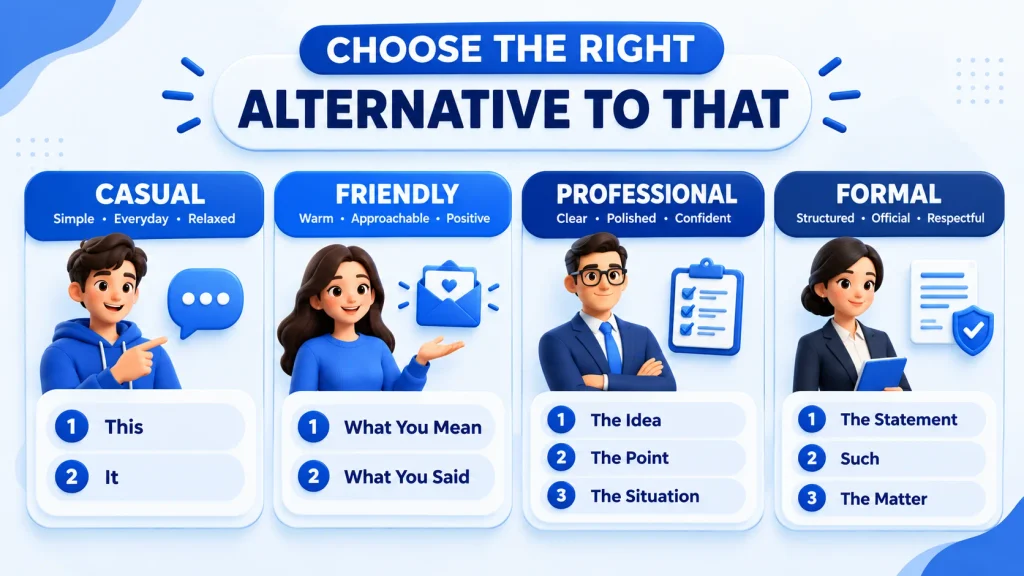
| Alternative | Best Used In | Tone |
| This | Everyday conversation, current ideas | Natural |
| It | Previously mentioned things or situations | Neutral |
| The Idea | Suggestions and concepts | Clear |
| The Point | Arguments and main messages | Direct |
| What You Mean | Clarifying someone’s meaning | Friendly |
| What You Said | Referring to previous words | Natural |
| The Statement | Reports and formal communication | Formal |
| Such | Formal writing and repeated concepts | Formal |
| The Situation | Circumstances and events | Neutral |
| The Matter | Official or serious issues | Formal |
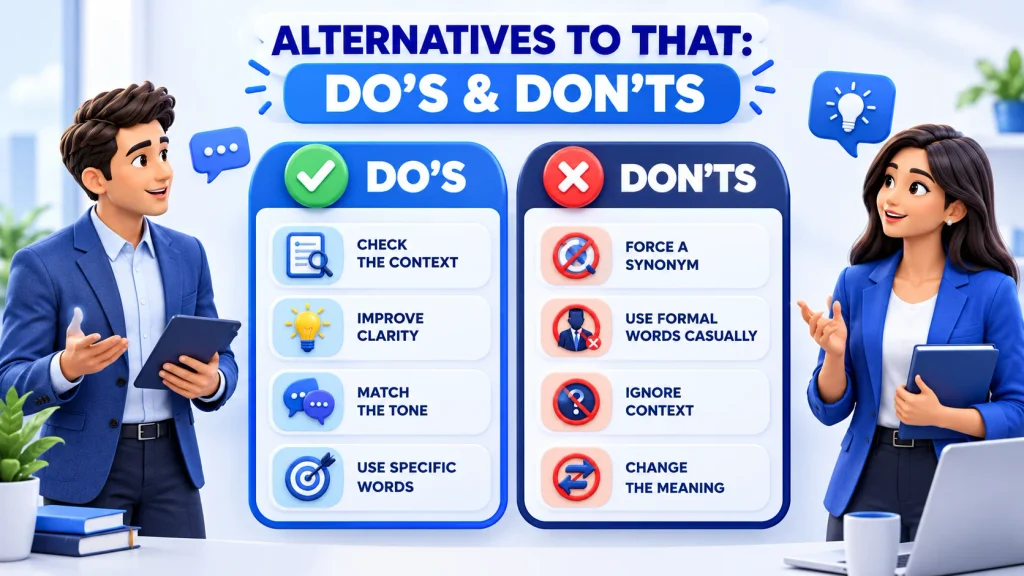
Not every use of “that” can be replaced with the same word. First identify whether it refers to an object, idea, statement, situation, or someone’s meaning.
Words such as “the matter” or “such” can sound stiff in everyday speech. In casual situations, “this,” “it,” or “what you mean” may sound more natural.
Replacing “that” with another vague word does not always improve a sentence. If clarity matters, use a specific noun such as “the proposal,” “the report,” or “the situation.”
Pronouns such as “it” and “this” depend heavily on context. Make sure readers can easily identify what the word refers to.
A synonym should preserve the original meaning. Before replacing “that,” check whether the new phrase still communicates exactly what you intended.
Depending on the sentence, alternatives include this, it, the idea, the point, what you mean, what you said, the statement, such, the situation, and the matter. The correct choice depends on what “that” refers to and whether you are writing casually, professionally, or formally.
In casual conversation, “this” and “it” are often natural choices. You can also use phrases such as “what you mean” or “what you said” when referring to another person’s words or meaning. The best option depends on the specific sentence and context.
Professional alternatives depend on the meaning. “The statement,” “the idea,” “the situation,” and “the matter” can work well in workplace communication when they accurately describe the reference. In many professional sentences, however, simply using “it” or “this” may sound more natural.
Yes, in many sentences, but the meaning can change slightly. “This” often points to something closer to the current speaker, discussion, or situation, while “that” can point to something previously mentioned or more distant. Always check the surrounding context before switching them.
In writing, you can replace “that” with a specific noun or phrase when greater clarity is needed. Options include “the idea,” “the statement,” “the situation,” “the point,” or “the matter.” A specific noun is often better than simply replacing one vague word with another.
Instead of repeatedly using “that,” identify exactly what the word represents. You might use a noun such as “the argument,” “the result,” or “the finding.” You can also restructure the sentence when appropriate. This makes academic writing more precise without forcing unnecessary synonyms.
Not always. “It” and “that” can both refer to something previously mentioned, but they do not perform the same grammatical role in every sentence. “That” can also function as a determiner, pronoun, conjunction, or relative marker. Therefore, replacing it mechanically can create an incorrect sentence.
There is no single best alternative for every sentence. “This” works well for many current or emphasized ideas, while “it” works naturally for previously mentioned things. If clarity is the goal, replacing “that” with a specific noun such as “the idea” or “the situation” can be more effective.
Finding another way to say “that” is less about memorizing synonyms and more about understanding what the word refers to. In casual conversation, “this” and “it” are often simple and natural choices. When you are referring to someone’s meaning or words, “what you mean” and “what you said” can make your sentence clearer.
For professional or formal writing, options such as “the idea,” “the statement,” “the situation,” and “the matter” can add precision. However, do not replace “that” simply to avoid repetition. Choose a phrase that keeps the original meaning and makes the sentence easier to understand. The best alternative is always the one that fits your context, audience, and intended meaning.

Senior English Editor & Stylistics Director
Michael Bennett is a veteran editor, lexicographer, and publishing consultant with more than two decades of experience in academic and educational publishing. Formerly a senior editorial director at major university presses, he specializes in structural editing, register refinement, and vocabulary development. Michael oversees tone, precision, and stylistic consistency across all publication channels, ensuring content meets rigorous editorial and pedagogical standards.