

If you’re looking for another way to say leading to, useful alternatives include resulting in, causing, contributing to, bringing about, giving rise to, resulting from, producing, creating, triggering, and culminating in. The best choice depends on whether you are writing academically, professionally, or conversationally and how directly you want to express cause and effect.

The phrase “another way to say leading to” refers to alternative expressions that describe one action, event, condition, or situation producing or contributing to a particular result.
Leading to is commonly used to explain cause-and-effect relationships. For example, you might write, “Poor communication is leading to delays,” or “The research findings are leading to new questions.”
Because leading to can sometimes feel repetitive, writers may want alternatives that are more precise or appropriate for a particular context. The best replacement depends on whether you mean directly causing an outcome, contributing to it, producing it, or eventually ending in it.
Although leading to is natural and widely understood, using different expressions can make your writing more precise and engaging.
Alternative phrases can help you:
For example, causing suggests a more direct relationship, while contributing to suggests that several factors may be involved. Similarly, culminating in emphasizes the final result of a longer process.

Resulting in is one of the closest alternatives to leading to. It describes an action, event, or condition that produces a particular outcome.
The heavy rainfall resulted in widespread flooding.
Poor planning resulted in unnecessary delays.
Use resulting in when you want to clearly connect a cause with its outcome in formal writing.
Causing directly states that one thing produces a particular effect. It is straightforward and usually stronger than contributing to.
The software error is causing problems with the system.
Excessive noise can cause difficulty concentrating.
Choose causing when you want to show a direct cause-and-effect relationship.
Contributing to means helping to produce a result without necessarily being the only or primary cause. It is useful when several factors influence an outcome.
Rising costs are contributing to higher product prices.
Lack of sleep may be contributing to reduced productivity.
Use this phrase when you want to avoid suggesting that one factor is solely responsible for the outcome.
Giving rise to means causing something to happen or creating a particular situation. It has a formal tone and is common in academic and professional writing.
The new policy gave rise to several important questions.
Rapid technological changes are giving rise to new business opportunities.
This phrase works especially well when the result is an idea, issue, opportunity, or situation.
Bringing about means causing a change or result to happen. It often emphasizes deliberate action or a significant transformation.
The new strategy brought about significant improvements in efficiency.
Community cooperation can bring about positive change.
Use bringing about when you want to emphasize that an action or decision produced a noticeable change.
Producing means creating or generating a particular result or effect. It is concise and works well when discussing measurable outcomes.
The treatment produced positive results for many participants.
The updated process is producing better outcomes.
Use producing when the result is something concrete, measurable, or clearly generated.
Triggering means causing something to begin or happen, often suddenly. It can describe events, reactions, changes, or responses.
The announcement triggered a strong reaction from investors.
The system failure triggered a series of technical problems.
Choose triggering when the cause initiates a reaction or event, especially when the response happens quickly.
Creating can replace leading to when an action or situation produces a new condition, opportunity, problem, or effect.
The merger is creating new opportunities for employees.
Limited resources are creating challenges for the organization.
Use creating when the result can be described as a new situation, opportunity, challenge, or condition.
Culminating in describes a process or series of events that eventually reaches a final result. It emphasizes the end point rather than a simple immediate cause.
Months of negotiations culminated in a new agreement.
Years of research culminated in the development of a new treatment.
Use culminating in when several events or steps eventually lead to an important final outcome.
Resulting from is useful when you want to describe the source or cause of something rather than the outcome that follows it. It reverses the direction of the relationship.
The delays resulted from unexpected technical issues.
The improvements resulted from several changes to the process.
Be careful with sentence structure: resulting in introduces an outcome, while resulting from introduces a cause.
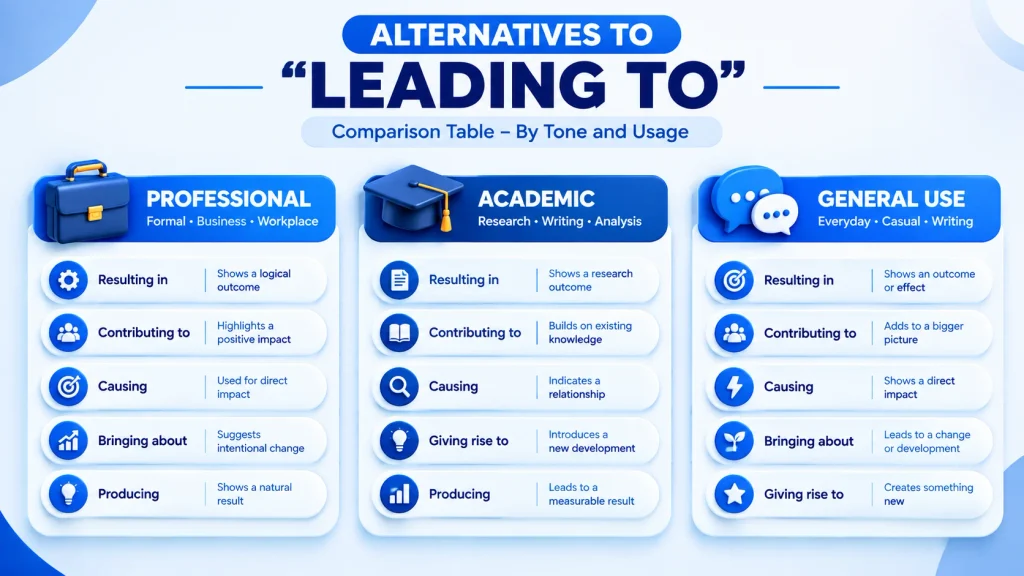
| Alternative | Best Used In | Tone |
| Resulting in | Academic writing, reports | Formal, Neutral |
| Causing | Direct cause-and-effect statements | Direct, Neutral |
| Contributing to | Research, analysis, reports | Formal, Careful |
| Giving rise to | Academic and professional writing | Formal |
| Bringing about | Change and transformation | Formal, Positive |
| Producing | Measurable results and outcomes | Professional, Neutral |
| Triggering | Reactions and sudden events | Direct, Neutral |
| Creating | Opportunities, problems, conditions | Neutral, Professional |
| Culminating in | Final outcomes after a process | Formal |
| Resulting from | Explaining the source of an outcome | Formal, Neutral |
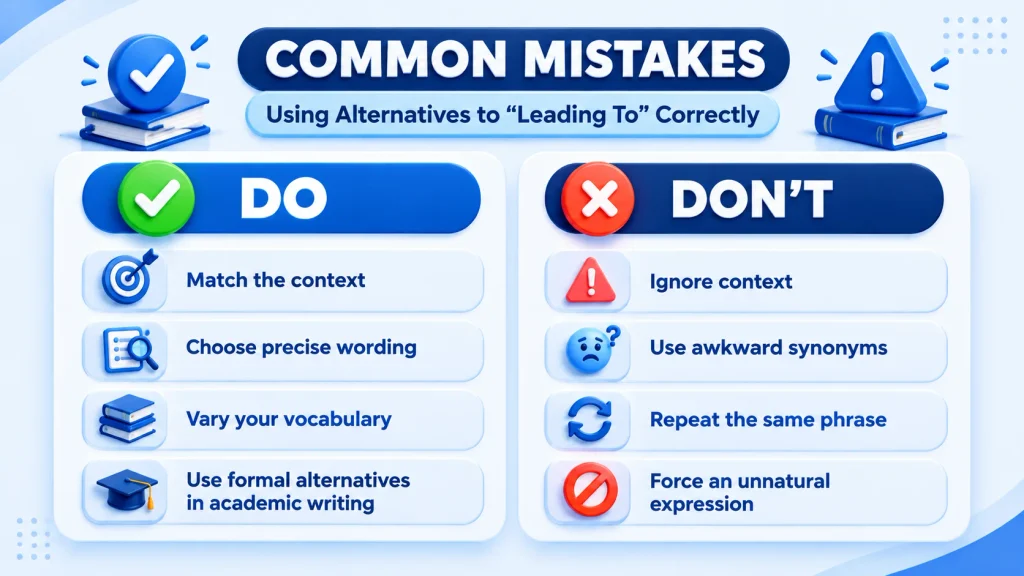
Not every phrase has exactly the same meaning. Causing can suggest a direct relationship, while contributing to indicates that something is only one factor.
These phrases work in opposite directions. Resulting in introduces the outcome, while resulting from identifies the cause.
Poor planning resulted in delays.
The delays resulted from poor planning.
Culminating in usually suggests a longer process that eventually reaches a final outcome. It may sound unnatural when describing a simple, immediate cause.
Phrases such as giving rise to and culminating in can sound formal. In everyday writing, causing, creating, or resulting in may sound more natural.
If several factors contribute to an outcome, contributing to may be more accurate than causing. Choosing the wrong expression can make your statement sound stronger than the evidence supports.

Common alternatives include resulting in, causing, contributing to, giving rise to, bringing about, producing, triggering, creating, and culminating in. The best option depends on the relationship you want to describe. For formal writing, resulting in is often a natural replacement, while contributing to works well when multiple factors are involved.
Professional alternatives include resulting in, contributing to, bringing about, producing, and giving rise to. For example, instead of writing “The changes are leading to improved efficiency,” you could write, “The changes are resulting in improved efficiency.” The appropriate choice depends on whether the relationship is direct or indirect.
Formal alternatives include resulting in, giving rise to, bringing about, and culminating in. Resulting in is especially useful in reports and academic writing because it clearly connects an action or condition with its outcome without sounding overly complicated.
Resulting in and leading to are often interchangeable when describing a cause-and-effect relationship. However, resulting in can sound slightly more direct and formal. For example, “The decision led to delays” and “The decision resulted in delays” communicate essentially the same relationship.
For an essay, useful alternatives include resulting in, contributing to, giving rise to, causing, and bringing about. If you are discussing multiple factors, contributing to can be more precise. If one factor directly produces an outcome, causing or resulting in may work better.
In a research paper, you can use resulting in, contributing to, causing, associated with, giving rise to, or producing, depending on the evidence. Avoid choosing a stronger causal expression such as causing when your research only demonstrates an association or contribution.
Yes, but only when the context supports a direct causal relationship. Causing is stronger because it explicitly identifies something as producing an outcome. If the factor is only partly responsible, contributing to may be more accurate.
Leading to can describe a general connection between an action and an outcome. Culminating in emphasizes a final result after a series of events or stages. For example, “Several meetings led to an agreement” is general, while “Months of negotiations culminated in an agreement” emphasizes the process and final outcome.
There are many useful alternatives to “leading to,” but the best choice depends on the exact cause-and-effect relationship you want to communicate. Resulting in is a versatile option for academic and professional writing, while causing clearly expresses a direct relationship.
When several factors play a role, contributing to may be more precise. Giving rise to and bringing about offer formal alternatives, while triggering works well for reactions or events that begin quickly. For a process that eventually reaches a final outcome, culminating in can be a better fit.
The key is to choose the phrase that accurately reflects the relationship between the cause and the result. A precise alternative can make your writing clearer, more natural, and more professional.

English Language & Communication Specialist
Dr. Emily Carter is an English language and communication specialist focused on vocabulary, word choice, professional writing, and practical English usage. She helps readers understand the differences between similar words and choose expressions that sound natural, clear, and appropriate for different contexts.