
If you need another way to say “look forward to,” useful alternatives include anticipate, await, be eager to, be excited to, hope to, and be pleased to. The best choice depends on your meaning and tone. Professional emails often call for polished expressions such as “anticipate,” while friendly conversations may sound more natural with “be excited to.”
Finding another way to say “look forward to” can make your writing more natural and precise. Although the phrase is common in professional emails, conversations, applications, and messages, repeating it too often can make your communication feel predictable.
The good news is that you have several alternatives. Some emphasize professional expectation, while others express enthusiasm, hope, politeness, or willingness.
“Look forward to” means to feel positive or excited about something that you expect to happen in the future. It can refer to an event, conversation, meeting, opportunity, experience, or action.
For example, you might write, “I look forward to meeting you” after a job interview or say, “I look forward to seeing you this weekend” when making plans with a friend.
The phrase is especially common in professional communication because it sounds polite and positive. It can appear at the end of emails, in business letters, during workplace conversations, and when discussing future plans.
One important grammar point is that “look forward to” is followed by a noun, pronoun, or gerund (-ing form).
Because “to” functions as a preposition in this expression, the verb that follows it takes the -ing form.
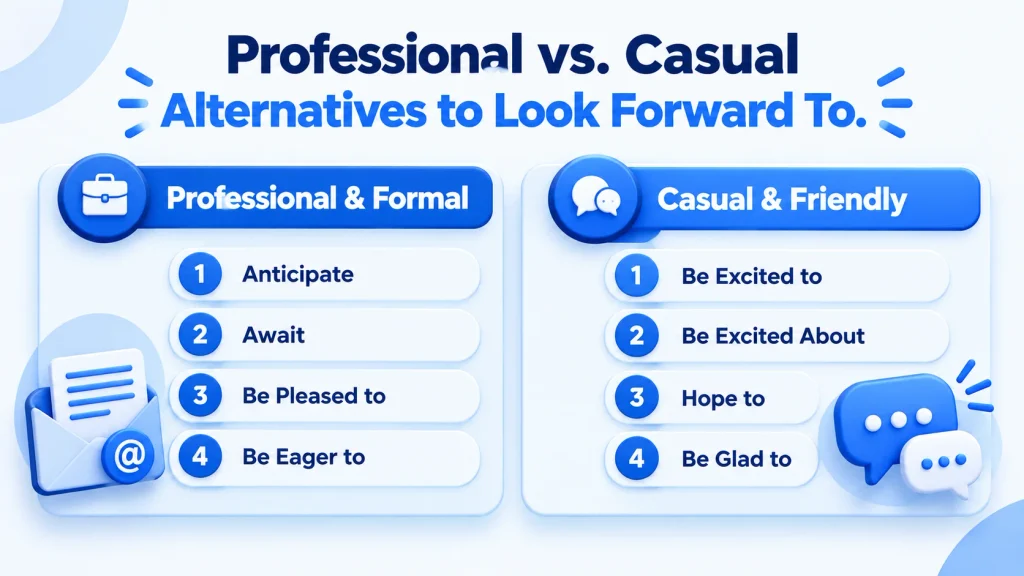
Using alternatives can help you communicate your exact meaning instead of relying on the same expression in every situation.
Different phrases can also change the tone of your message. For example, “I anticipate” sounds more formal, while “I’m excited to” sounds warmer and more conversational.
Using different expressions can help you:
The key is not to replace “look forward to” automatically. Instead, choose an alternative that preserves the meaning you want to communicate.
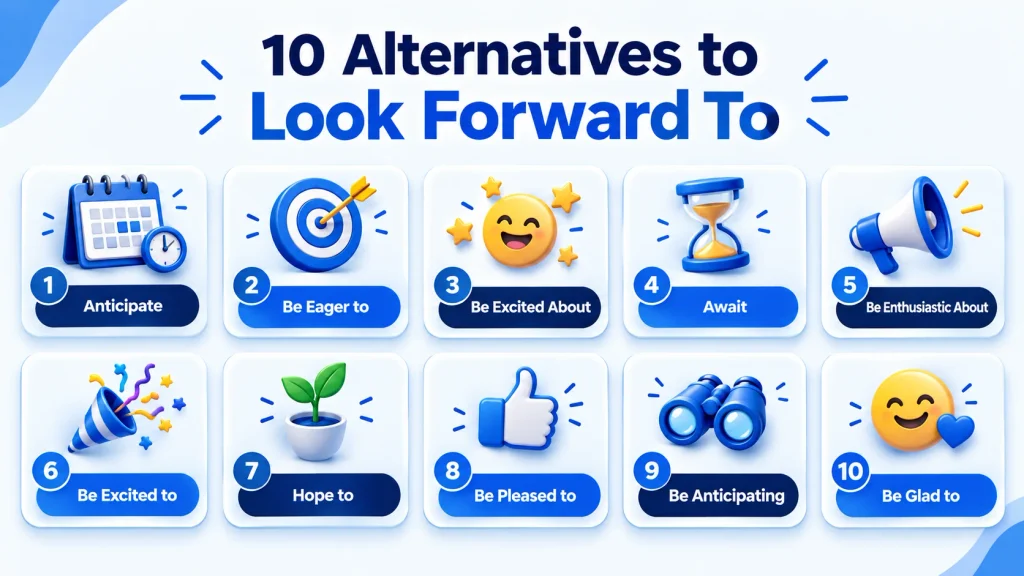
Here are 10 useful alternatives, ranging from formal business expressions to warm and conversational choices.
“Anticipate” means to expect something to happen or to think about a future event before it occurs. It is a strong choice when you want to communicate professional expectation without sounding overly emotional.
In business writing, “anticipate” can sound polished and direct. However, it does not always carry the same warm feeling as “look forward to.”
We anticipate a productive discussion during tomorrow’s meeting.
I anticipate hearing from you once the review is complete.
Use “anticipate” when your main idea is expectation, rather than excitement.
“Be eager to” means to be very interested in doing something or to strongly want an opportunity to happen. It communicates more enthusiasm than a neutral expression such as “expect to.”
This phrase works particularly well when you want to show motivation in a professional setting.
I’m eager to discuss the new project with your team.
She is eager to begin working with her new colleagues.
Choose “be eager to” when you want the reader to notice your enthusiasm and interest.
“Be excited about” expresses genuine enthusiasm for a future event, experience, opportunity, or idea. It is more emotional and conversational than “anticipate.”
It can work in workplace communication when the environment is friendly, but it is also very common in everyday conversations.
I’m excited about joining the team next month.
We’re excited about seeing everyone at the conference.
Use this phrase when you want to emphasize positive emotion, not simply future expectation.
“Await” means to wait for something that is expected to happen. It has a formal tone and is often used in business correspondence, official writing, reports, and professional messages.
Unlike “look forward to,” it focuses more strongly on waiting for something than on expressing excitement about it.
We await your response regarding the proposed changes.
The committee awaits further information before making a decision.
“Await” is normally followed directly by a noun or noun phrase, such as “your response” or “the results.”
“Be enthusiastic about” communicates strong positive feelings toward an upcoming activity, opportunity, project, or idea. It clearly shows that someone has a positive attitude toward what is coming.
The phrase can be useful in professional writing when genuine enthusiasm is important.
Our team is enthusiastic about the opportunity to work with your company.
He is enthusiastic about taking on the new leadership role.
Use this expression when enthusiasm itself is an important part of your message.
“Be excited to” is a natural way to express enthusiasm about a future action. It is common in everyday speech, workplace messages, announcements, social posts, and friendly emails.
It is usually followed by a base verb, such as “meet,” “start,” “share,” or “work.”
I’m excited to meet the rest of the team next week.
We’re excited to share the final results with you.
Use “be excited to” when the emphasis is on enthusiasm about doing something.
“Hope to” expresses a positive desire or expectation about something that may happen in the future. It is softer and less definite than “anticipate.”
This makes it useful when an outcome depends on circumstances or when you want to avoid sounding too certain.
I hope to speak with you again soon.
We hope to welcome you to our office next month.
Use “hope to” when the future event is possible but not guaranteed.
“Be pleased to” communicates positive feelings about an action, opportunity, or future interaction. It has a courteous and professional tone and can work well in formal business communication.
It is especially useful when you want to express positivity without sounding overly enthusiastic.
We are pleased to discuss the next stage of the partnership.
I’m pleased to have the opportunity to work with your organization.
Use this phrase when you want to sound positive, respectful, and professional.
“Be anticipating” can describe expecting something to happen in the future. However, it is less natural in many situations than the simpler verb “anticipate.”
It may appear in formal or business contexts when describing an expected development, response, change, or result.
We are anticipating a strong response to the new program.
The department is anticipating several important changes this quarter.
In most professional emails, “anticipate” is more concise and natural than “be anticipating.”
“Be glad to” communicates that you are happy or willing to do something. It does not always have exactly the same meaning as “look forward to,” but it can work naturally when the focus is on welcoming a future action.
It is particularly useful when you want to sound approachable and helpful.
I’ll be glad to discuss the details with you next week.
We’ll be glad to answer any questions during the meeting.
Use “be glad to” when you want to emphasize willingness or readiness, rather than anticipation alone.
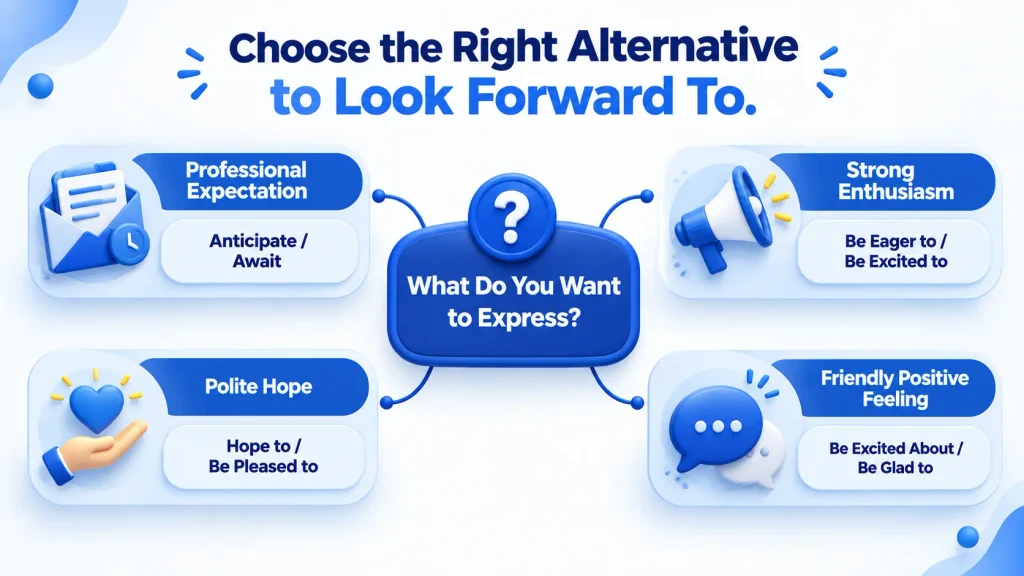
| Alternative | Best Used In | Tone |
| Anticipate | Business emails, formal writing | Professional |
| Be Eager to | Workplace communication, opportunities | Enthusiastic |
| Be Excited About | Conversations, friendly messages | Warm |
| Await | Formal correspondence | Formal |
| Be Enthusiastic About | Work, projects, opportunities | Positive |
| Be Excited to | Everyday and workplace communication | Friendly |
| Hope to | Emails, plans, future communication | Polite |
| Be Pleased to | Business and formal communication | Professional |
| Be Anticipating | Formal reports and business writing | Formal |
| Be Glad to | Workplace and personal communication | Warm |
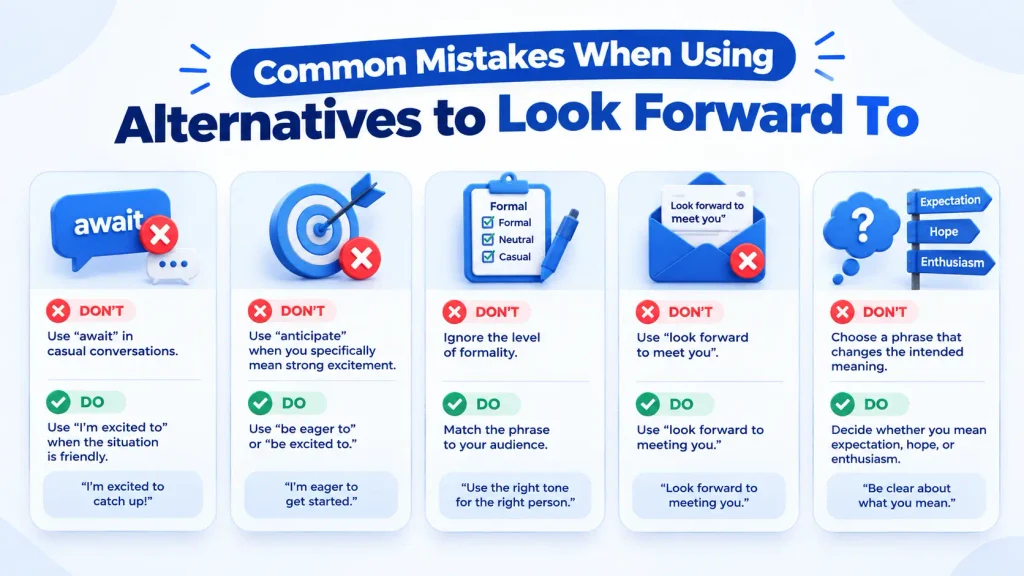
Words such as “await” can sound stiff when you are talking with a friend or colleague in a relaxed setting. A phrase such as “I’m excited to see you” will usually feel more natural.
Not every alternative is a direct replacement in every sentence. “Hope to” expresses a desire or possibility, while “anticipate” focuses more on expectation.
Always consider what you actually mean before replacing the original phrase.
“Anticipate” can sound neutral and businesslike. If you want to show genuine excitement, “be eager to” or “be excited to” may communicate your feeling more clearly.
Your relationship with the reader matters. A formal expression may be appropriate in a business letter but unnecessary in a text message to a close friend.
Think about who will read your message before choosing the alternative.
A common mistake is writing a base verb after “look forward to.”
The word “to” in this expression acts as a preposition, so a following verb should normally use the -ing form.
Professional alternatives include anticipate, await, be eager to, and be pleased to. “Anticipate” works well when discussing an expected event, while “be eager to” communicates stronger enthusiasm. “Await” is more formal and is often appropriate in official correspondence or business writing.
Anticipate and await are two formal alternatives. For example, “We anticipate your response” communicates a professional expectation. “We await your response” is even more formal and focuses on waiting. The best choice depends on whether you want to emphasize expectation or simply waiting for a response.
You can write “I hope to hear from you soon,” “I anticipate hearing from you,” or “I would be pleased to hear from you.” “Hope to hear from you” sounds polite and natural, while “anticipate hearing from you” has a more formal business tone.
Casual alternatives include “I’m excited to,” “I’m excited about,” and “I can’t wait to.” These expressions are common in conversations and friendly messages. They communicate enthusiasm more directly than formal words such as “anticipate” or “await.”
The expressions are related, but they are not always interchangeable. “Anticipate” generally means to expect something, while “look forward to” usually adds a positive feeling about a future event. A sentence may need a different alternative depending on whether expectation or enthusiasm is the main idea.
Yes, but “await” is more formal and does not always communicate the same positive emotion. “We await your response” emphasizes waiting, while “We look forward to your response” can sound more welcoming. Consider the relationship and purpose of the message before choosing between them.
You can say “I’m eager to work with you,” “I’m excited to work with you,” or “I’m pleased to have the opportunity to work with you.” Each version has a slightly different tone. “Eager” emphasizes enthusiasm, while “pleased” sounds more formal and restrained.
The appropriate alternative depends on your intended meaning. “I anticipate” works for professional expectation, “I’m eager to” shows enthusiasm, and “I hope to” expresses a polite possibility. If you want a formal and courteous tone, “I’m pleased to” can also work well.

There are many natural ways to say “look forward to,” but the right alternative depends on the meaning and tone you want to convey. Anticipate and await are useful for formal or professional writing, while be eager to and be excited to communicate stronger enthusiasm. Hope to is a softer choice when a future event is possible but not certain.
When writing an email, message, or professional document, do not replace “look forward to” simply for the sake of using different words. First decide whether you want to express expectation, enthusiasm, hope, politeness, or willingness. Then choose the phrase that communicates that meaning naturally. This approach keeps your writing clear, professional, and appropriate for the situation.

Our editorial team brings together decades of expertise in applied linguistics, lexicography, and educational publishing. Dedicated to clarity, precision, and tone, our experts ensure that every resource meets the highest standards of professional and academic excellence.