
Featured Snippet:
If you need another way to say catch up, you can use phrases such as reconnect, get together, touch base, meet up, talk soon, or get up to date. The best choice depends on whether you mean spending time with someone, sharing updates, or learning about recent events.
“Catch up” is a common American English phrase with several meanings. You might use it when you want to spend time with someone after being apart, exchange recent news, or become informed about something you missed.
For example, “Let’s catch up over coffee” usually means spending time together and talking about what has happened recently. In a work setting, “I need to catch up on emails” means becoming current with unfinished or missed information.
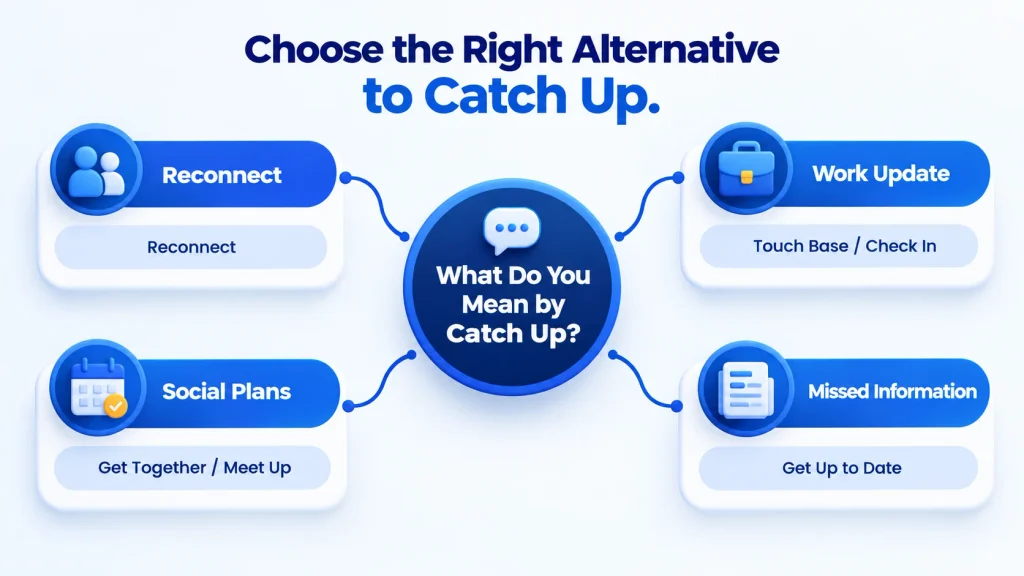
Because “catch up” has different meanings, the best alternative depends on the situation.
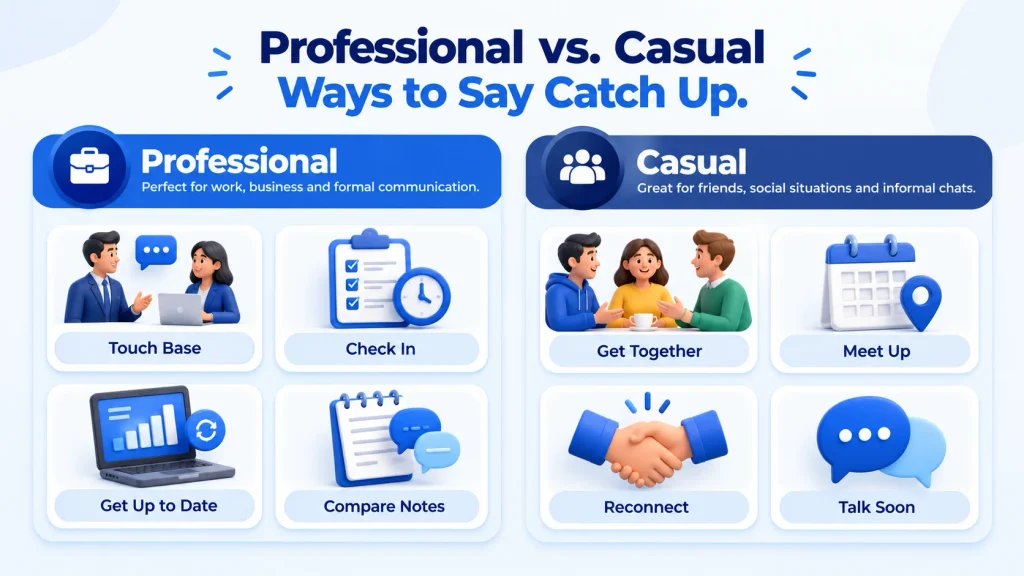
Using different expressions can make your English sound more natural and precise. It also helps you avoid repeating the same phrase in conversations, emails, and professional messages.
Other benefits include:
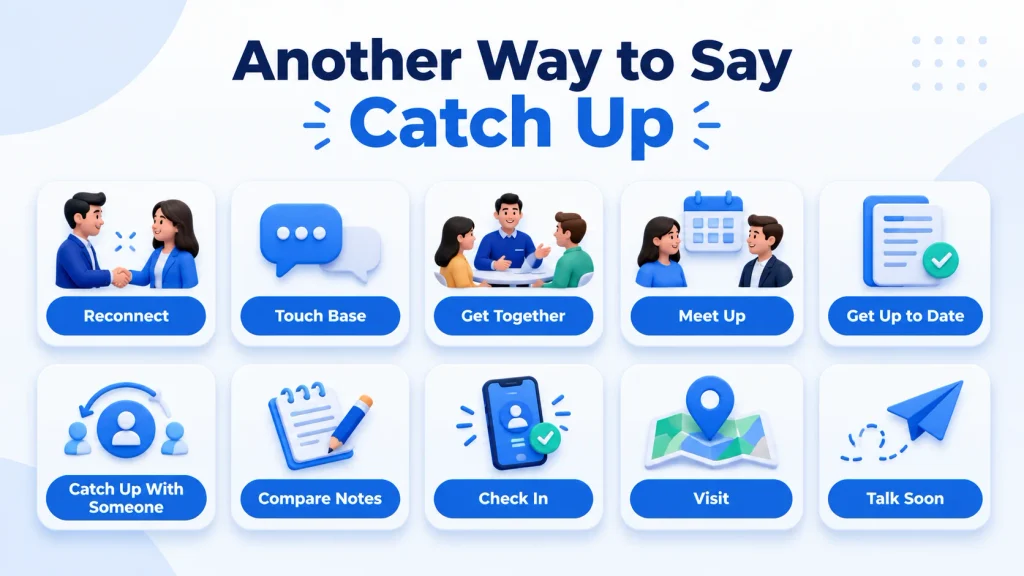
“Reconnect” means to communicate with someone again after spending time apart. It often suggests renewing a relationship or personal connection rather than simply exchanging information.
“It was great to reconnect with my college roommate after all these years.”
“I’d love to reconnect when you’re back in town.”
Use “reconnect” when the relationship itself is important, especially after a long period without contact.
“Touch base” means to communicate briefly to exchange information, discuss progress, or see if there are any updates. It is especially common in American workplace English.
“Let’s touch base tomorrow after you review the proposal.”
“I wanted to touch base and see how the project is coming along.”
Use “touch base” for short professional check-ins rather than social plans.
“Get together” means meeting someone in person, usually for conversation or social time. It sounds natural and relaxed, making it a useful replacement for “catch up” with friends or family.
“Are you free this weekend so we can get together?”
“We should get together for lunch sometime soon.”
Choose “get together” when your main idea is meeting socially rather than simply exchanging updates.
“Meet up” means arranging to meet someone at a particular place or time. It is informal and common in everyday American conversations.
“Let’s meet up downtown after work.”
“I’m visiting Chicago next month, so we should meet up.”
“Meet up” is ideal when you are making a simple social plan with friends, classmates, or acquaintances.
“Get up to date” means learning the latest information about something. Unlike “reconnect,” it focuses on information rather than spending time with another person.
“I spent the morning getting up to date on the latest company policies.”
“Please give me a few minutes to get up to date on the project.”
Use this expression when you mean becoming informed about something you have missed.
Although it is closely related to the original phrase, “catch up with someone” emphasizes talking to a person about recent events. It is one of the most natural expressions for friendly conversations.
“I ran into Sarah yesterday, and we caught up with each other.”
“I’d really like to catch up with you before you leave.”
Use this version when the focus is specifically on talking with a person after some time apart.
“Compare notes” means sharing information, observations, or experiences with another person. It works especially well when two people have been working on related tasks or experiencing similar situations.
“Let’s compare notes after both teams finish their research.”
“We met after the conference to compare notes about the sessions.”
Choose “compare notes” when both people have information to share, not simply when you want a social visit.
“Check in” means contacting someone to ask how things are going or to get an update. It can be friendly or professional depending on the context.
“I wanted to check in and see whether you need anything from me.”
“I’ll check in with you next week about the schedule.”
“Check in” is a strong choice when you want a brief update rather than a long conversation.
“Visit” means spending time with someone, usually in person. It can sound warmer and more personal than simply saying that you want to talk.
“We’re planning to visit our grandparents during the holidays.”
“Come by this weekend and visit for a while.”
Use “visit” when the physical act of spending time together matters.
“Talk soon” is a friendly way to say that you expect to communicate with someone again in the near future. It works well at the end of texts, emails, calls, and casual conversations.
“It was so nice hearing from you. Talk soon!”
“I have to run, but let’s talk soon and figure out the plans.”
Use “talk soon” as a friendly closing when you expect another conversation shortly.
| Alternative | Best Used In | Tone |
|---|---|---|
| Reconnect | Personal and professional relationships | Warm, Friendly |
| Touch Base | Workplace communication | Professional, Polite |
| Get Together | Social plans | Casual, Friendly |
| Meet Up | Informal plans | Casual |
| Get Up to Date | Information and work updates | Formal, Professional |
| Catch Up With Someone | Personal conversations | Friendly, Warm |
| Compare Notes | Work, school, shared experiences | Professional, Formal |
| Check In | Work and personal updates | Polite, Friendly |
| Visit | Spending time in person | Warm, Casual |
| Talk Soon | Texts, calls, casual closings | Friendly, Warm |
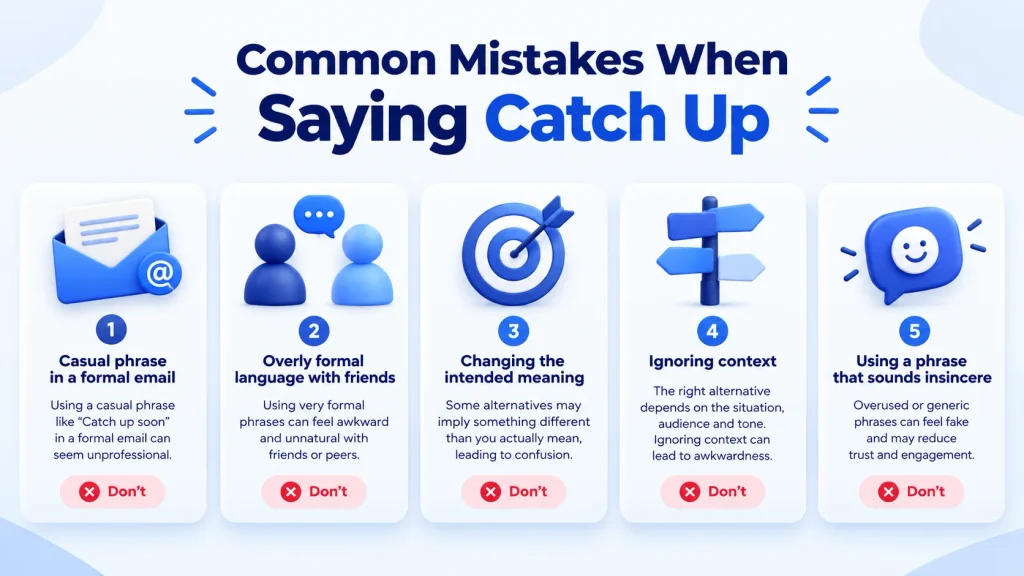
Expressions such as “meet up” may sound too informal for certain workplace messages. Consider “touch base” or “check in” when communicating with a manager, client, or business contact.
Not every synonym has the same meaning. “Get up to date” focuses on information, while “reconnect” focuses more on restoring communication or a relationship.
A phrase such as “compare notes” may sound unnatural if you simply want to invite a close friend for coffee. “Get together” or “meet up” would usually sound more natural.
Think about who you are speaking to and what you want to communicate. The right alternative can change depending on whether you are writing a business email, sending a text, or making weekend plans.
Some expressions can feel generic if used without a clear purpose. Instead of automatically saying “let’s catch up,” explain what you actually want, such as discussing a project, having lunch, or hearing someone’s news.
“Reconnect,” “get together,” “meet up,” and “talk soon” are natural choices when talking about friends. For example, you could say, “It would be great to reconnect” after a long period apart. If you are making a casual plan, “Let’s get together” or “Let’s meet up” sounds more conversational.
“Touch base,” “check in,” and “get up to date” are useful professional alternatives. “Touch base” works well when you want to communicate briefly with a colleague. “Get up to date” is better when you mean reviewing information, files, decisions, or developments that you missed.
“Reconnect” and “catch up” can overlap, but they are not always identical. “Reconnect” emphasizes communicating again and renewing a relationship. “Catch up” can mean reconnecting socially, but it can also mean exchanging recent news or becoming informed about something that happened while you were away.
Yes, especially in professional situations. “Touch base” usually means having a brief conversation or checking for updates, so it is a natural choice in workplace emails and meetings. However, it does not usually suggest the same relaxed social feeling as “catch up” with a friend.
“Get together” and “meet up” are two common casual alternatives. You can use them when suggesting that friends or acquaintances spend time together. For example, “Let’s get together this weekend” sounds relaxed and natural when you want to make a social plan.
At work, “catch up” can mean several things. It may refer to talking with a colleague about recent developments, reviewing information you missed, or completing delayed work. Context determines the meaning, so alternatives such as “touch base,” “check in,” or “get up to date” can make your message clearer.
You can say “Let’s reconnect,” “Let’s get together,” “Let’s meet up,” or “Let’s talk soon.” The best choice depends on your intention. “Let’s reconnect” highlights the relationship, while “Let’s meet up” focuses on making a casual plan to see each other.
“Catch up” is flexible and can work in both casual and professional English. However, its meaning changes with context. In a business email, “touch base” or “check in” may communicate the intended purpose more precisely, while “catch up” often sounds natural in everyday conversations.

“Catch up” is a flexible phrase, but choosing a more specific alternative can make your English clearer and more natural. If you want to reconnect with someone, reconnect is a warm choice. For workplace updates, touch base or check in may fit better. When making casual social plans, get together and meet up are easy, natural options. If you mean learning information you missed, get up to date is more precise. The key is to consider your audience, purpose, and tone before choosing an alternative. You do not need to avoid “catch up”—it is already natural American English. Instead, use these alternatives when a more specific expression better communicates what you mean.

English Language & Communication Specialist
Dr. Emily Carter is an English language and communication specialist focused on vocabulary, word choice, professional writing, and practical English usage. She helps readers understand the differences between similar words and choose expressions that sound natural, clear, and appropriate for different contexts.