

Looking for another way to say successful? Depending on the situation, you can use words such as accomplished, thriving, prosperous, effective, victorious, accomplished, flourishing, high-achieving, productive, or successful in achieving goals. The best choice depends on whether you are describing a person, project, business, career, or result.
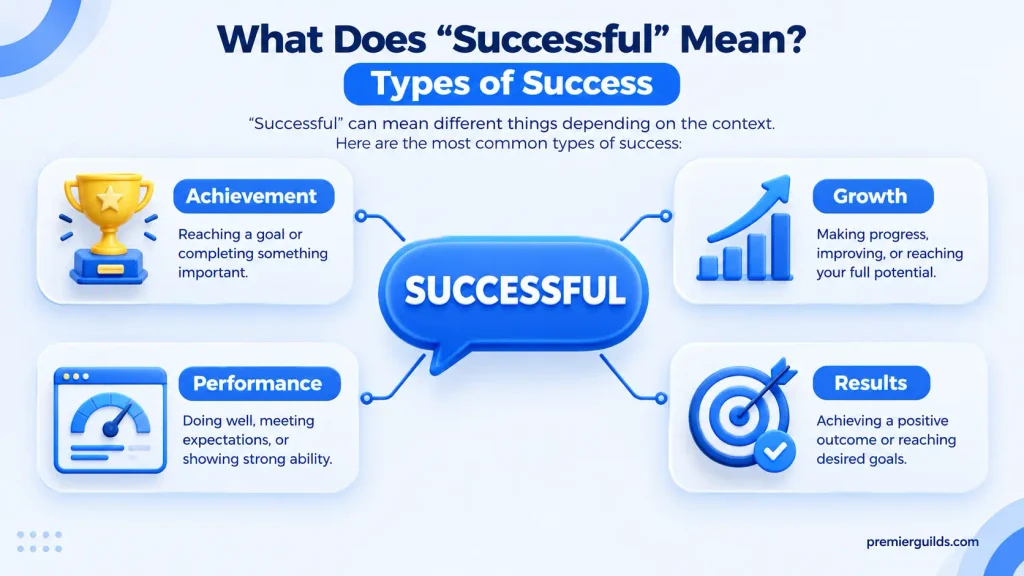
“Successful” describes someone or something that achieves a desired goal, produces a positive result, or performs well. It can describe a person, business, project, career, event, strategy, or decision.
For example, you might call someone successful because they reached an important career goal. You might also describe a marketing campaign as successful because it produced strong results.
People often search for another way to say “successful” because the word can become repetitive. Using a more specific synonym can make your writing clearer and show exactly how or why something succeeded.
You will commonly see alternatives to “successful” in resumes, business writing, academic work, professional emails, personal descriptions, and everyday conversations.
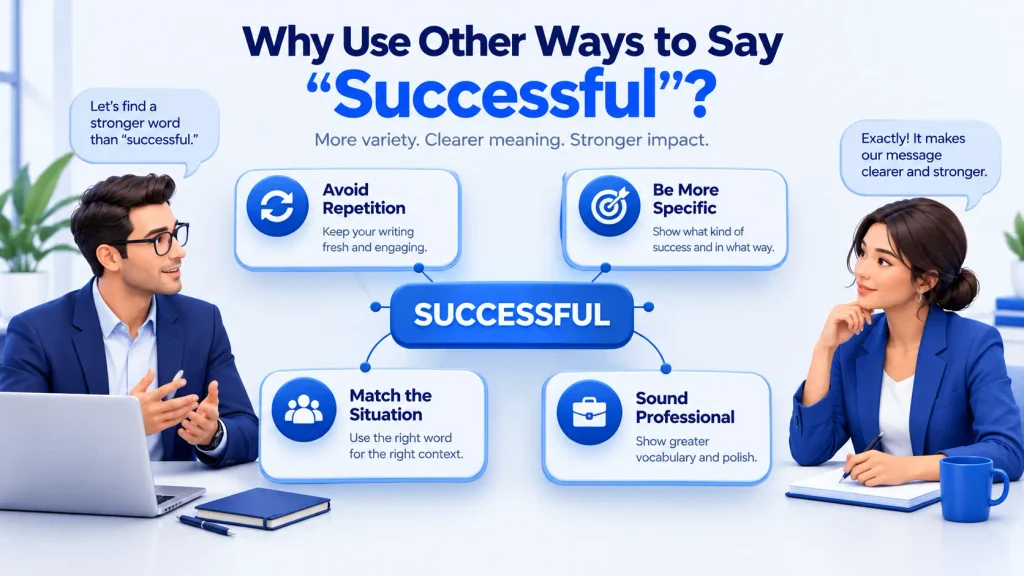
Using different words can make your writing more precise and engaging. Instead of repeatedly describing something as “successful,” you can choose a word that highlights growth, achievement, effectiveness, financial results, or personal accomplishment.
You may want another way to say “successful” to:
The key is to avoid choosing a synonym simply because it sounds impressive. The best alternative should accurately describe the kind of success you mean.
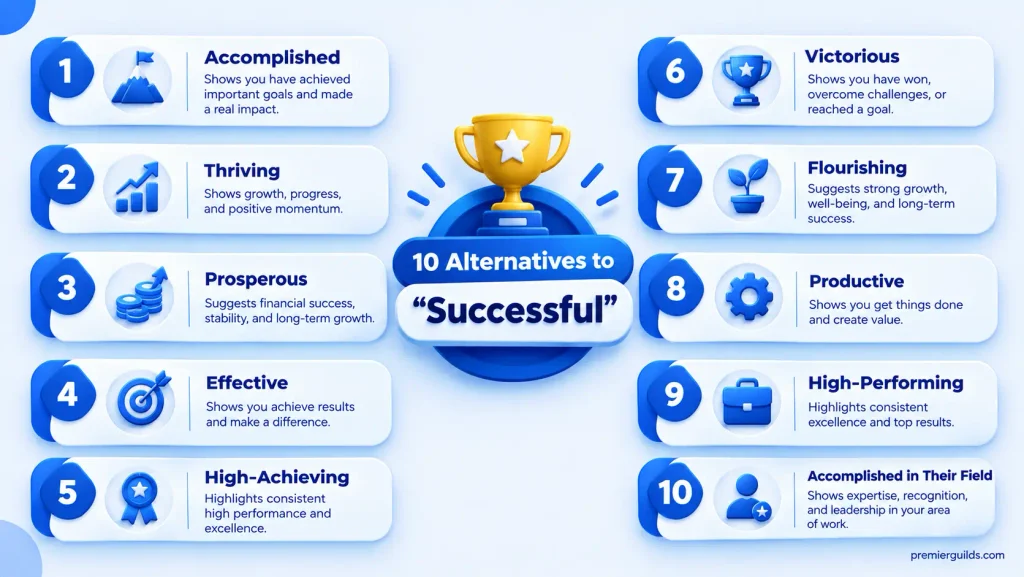
“Accomplished” describes someone who has achieved important goals or developed a high level of skill. It is especially useful when discussing a person’s career, education, experience, or professional achievements.
She is an accomplished marketing professional with more than ten years of industry experience.
The company hired an accomplished designer to lead its creative team.
Use “accomplished” when you want to emphasize a person’s achievements rather than simply saying they are successful.
“Thriving” means doing very well, growing strongly, or experiencing positive progress. It can describe a person, business, career, project, community, or organization.
Her consulting business is thriving after expanding into three new markets.
He is thriving in his new leadership position.
Use “thriving” when success involves noticeable growth, progress, or strong performance.
“Prosperous” describes a situation involving financial success, wealth, or favorable economic conditions. It is particularly suitable for businesses, communities, careers, and periods of financial growth.
The company had a prosperous year after expanding its customer base.
The region became more prosperous as new industries moved into the area.
Choose “prosperous” when money, financial stability, or economic growth is an important part of the success.
“Effective” means successful at producing the intended result. Unlike “successful,” it focuses more directly on whether a method, strategy, solution, or action achieved its purpose.
The team developed an effective strategy for reducing customer wait times.
Her communication style has been highly effective with remote teams.
Use “effective” when you want to emphasize results rather than overall achievement.
“High-achieving” describes a person who consistently reaches ambitious goals or performs at a high level. It is often used for students, employees, professionals, and other goal-oriented individuals.
The program attracts high-achieving students from across the country.
She is a high-achieving employee who consistently exceeds performance goals.
This phrase works especially well when describing people with a strong record of achievement.
“Victorious” means having won a competition, contest, conflict, or difficult challenge. It is more specific than “successful” because it usually involves overcoming an opponent or competing for a clear outcome.
The team returned home victorious after a closely contested final.
After months of negotiations, the organization emerged victorious in the competition.
Use “victorious” when success involves winning rather than simply reaching a goal.
“Flourishing” means growing, developing, or performing very well. It often suggests healthy and sustained progress rather than one isolated achievement.
The local arts community is flourishing thanks to increased public support.
Her career has been flourishing since she began working in the technology sector.
Use “flourishing” when you want to emphasize healthy development and continued progress.
“Productive” describes someone or something that produces useful results or accomplishes a significant amount of work. It focuses on output and efficiency rather than success in a broad sense.
The team had a productive meeting and finalized the project timeline.
She had a productive week and completed all of her major assignments.
Choose “productive” when the success you mean comes from useful work or strong output.
“High-performing” describes a person, team, organization, system, or product that performs at an above-average or consistently strong level. It is common in workplace and business communication.
The company is known for building high-performing sales teams.
He became part of a high-performing department with ambitious annual goals.
Use “high-performing” when discussing measurable performance, especially in professional or business settings.
“Accomplished in their field” highlights a person’s strong record of achievements within a particular profession or area of expertise. It sounds polished and specific.
She is an accomplished researcher in the field of environmental science.
He is an accomplished entrepreneur with several successful ventures.
This phrase is useful when introducing an expert, professional, speaker, researcher, or leader.
| Alternative | Best Used In | Tone |
|---|---|---|
| Accomplished | Careers, achievements, professional profiles | Professional |
| Thriving | Growth, careers, businesses | Positive |
| Prosperous | Financial and business success | Formal |
| Effective | Strategies, methods, solutions | Professional |
| High-Achieving | People, students, employees | Professional |
| Victorious | Competitions and winning | Strong |
| Flourishing | Continued growth and development | Positive |
| Productive | Work, projects, teams | Practical |
| High-Performing | Workplace and business | Professional |
| Accomplished in Their Field | Professional introductions and profiles | Formal |
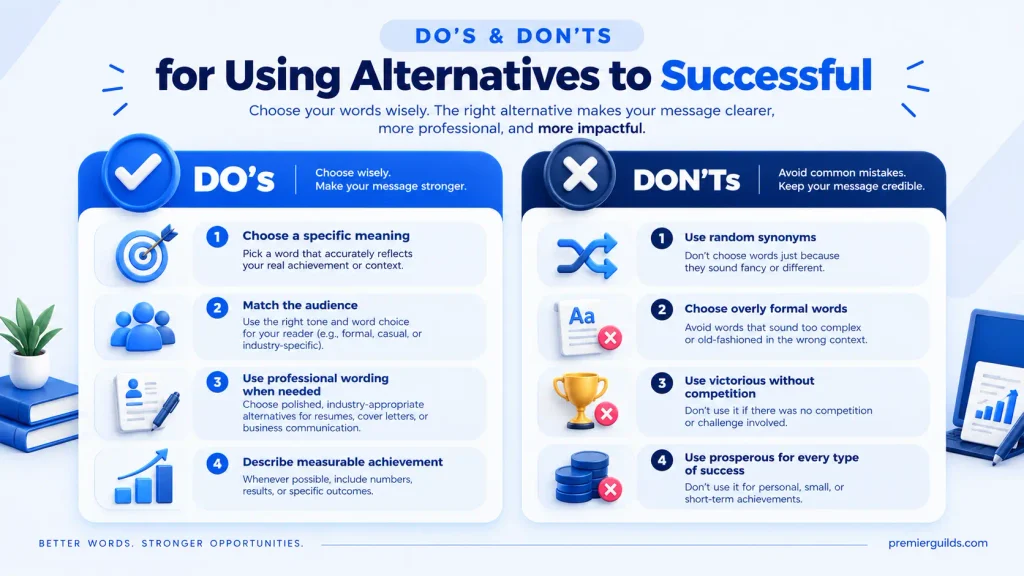
The word “successful” is broad. Repeating it throughout an article, resume, or business document can make your writing less specific. Choose a synonym that explains the type of success you mean.
“Prosperous” often relates to financial or economic well-being. It may sound unnatural when describing a successful presentation, exam, meeting, or strategy.
“Victorious” usually suggests winning against an opponent or overcoming a challenge. It is not always a natural replacement for “successful” in ordinary professional writing.
Words such as “accomplished” and “prosperous” can sound polished, but they may not fit casual conversations. For everyday communication, simpler words can sound more natural.
Success can mean achievement, growth, effectiveness, productivity, or financial progress. Always consider what actually happened before selecting a synonym.
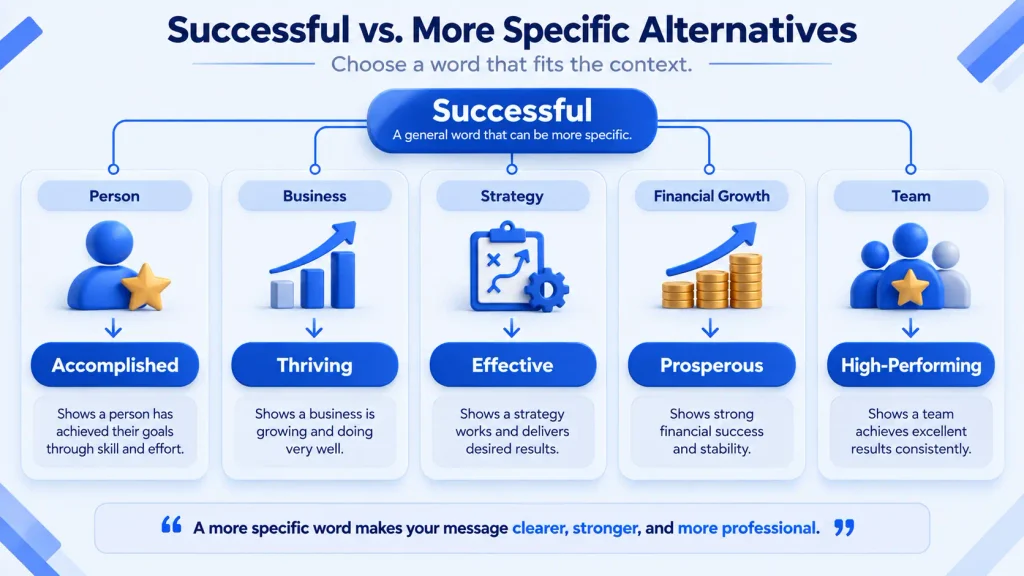
Common alternatives to “successful” include “accomplished,” “thriving,” “effective,” “prosperous,” “high-achieving,” “flourishing,” and “high-performing.” The right choice depends on context. For a person, “accomplished” often works well, while “effective” is better for a strategy or method that produces the desired result.
“Accomplished,” “high-performing,” and “effective” are strong professional alternatives. For example, you could describe someone as an accomplished professional or a team as high-performing. If you are describing a strategy, “effective” is often more precise because it focuses on the results produced.
On a resume, consider words such as “accomplished,” “high-performing,” “results-driven,” or “productive,” depending on the context. Instead of simply calling yourself successful, it is usually stronger to describe a specific achievement and support it with measurable results, such as revenue growth, completed projects, or improved efficiency.
“Accomplished” is one of the strongest choices for describing a person’s achievements. “High-achieving” emphasizes ambitious results, while “high-performing” focuses on consistent performance. “Thriving” works well when describing someone who is progressing strongly in a career or personal endeavor.
You can describe a successful business as “thriving,” “prosperous,” “flourishing,” or “high-performing.” Each word emphasizes something different. “Thriving” suggests strong growth, “prosperous” emphasizes financial success, and “flourishing” suggests healthy and sustained development.
In academic writing, alternatives such as “effective,” “accomplished,” “high-achieving,” and “productive” can work depending on the sentence. For example, a student may be “high-achieving,” while a research method may be “effective.” Academic writing benefits from choosing the word that describes the specific result.
“Accomplished” and “successful” are closely related, but they are not identical. “Successful” broadly means achieving a desired result, while “accomplished” usually emphasizes completed achievements, skills, or expertise. Calling someone accomplished often suggests they have a strong record of meaningful achievements.
In casual English, you might say someone is “doing well,” “doing great,” “killing it,” or “on a roll,” depending on the situation. “Doing well” is the safest everyday option. More informal expressions should be used with friends or people who are comfortable with casual language.
There are many ways to say “successful,” but the best alternative depends on what kind of success you want to describe. Accomplished works well for people with notable achievements, while thriving and flourishing highlight growth and progress. Effective is a better choice for strategies and solutions, and prosperous fits financial or economic success.
For workplace communication, high-performing can describe strong teams, employees, or organizations, while productive focuses on useful output. In competitive situations, victorious is more precise because it suggests winning.
Instead of replacing “successful” with a random synonym, identify the exact meaning you want to communicate. Choosing a more specific word makes your writing clearer, more natural, and more professional.

English Language & Communication Specialist
Dr. Emily Carter is an English language and communication specialist focused on vocabulary, word choice, professional writing, and practical English usage. She helps readers understand the differences between similar words and choose expressions that sound natural, clear, and appropriate for different contexts.