
Looking for another way to say up to date? Common alternatives include current, updated, latest, recent, modern, informed, and up to speed. The best choice depends on whether you mean current information, modern technology, recent details, or a person who knows the latest developments.
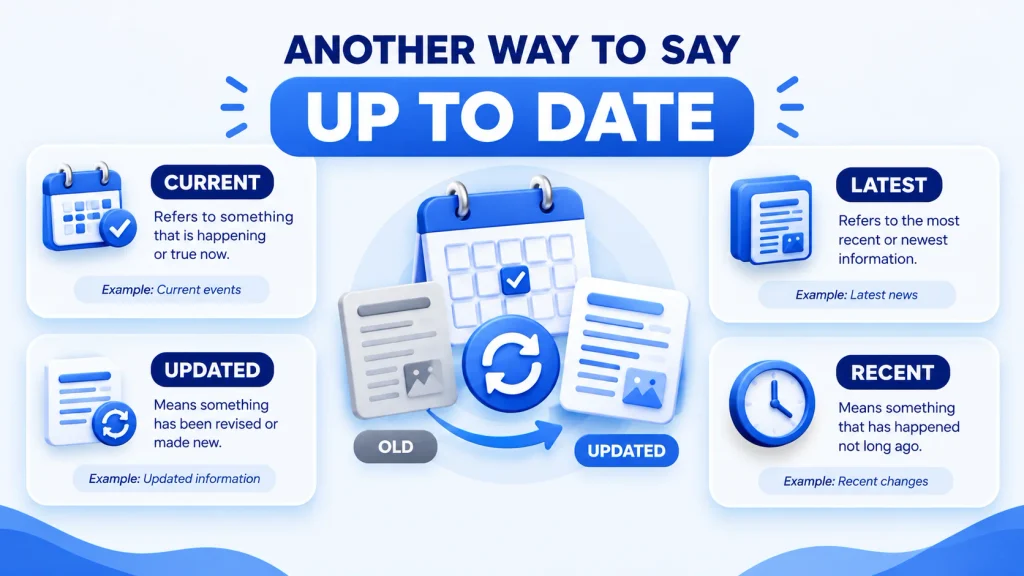
The phrase “up to date” generally means current, recent, or containing the latest information. It can describe information, records, technology, equipment, documents, or a person’s knowledge. Cambridge defines it as modern, recent, or containing the latest information.
For example, you can say, “Please make sure the report is up to date” when you want the report to contain the most recent information. You can also say, “She stays up to date with industry news” when referring to someone’s knowledge.
The phrase has two closely related uses. It can describe something that contains current information, or something that is modern and uses current methods or technology. Oxford gives both meanings, including current information and modern equipment.
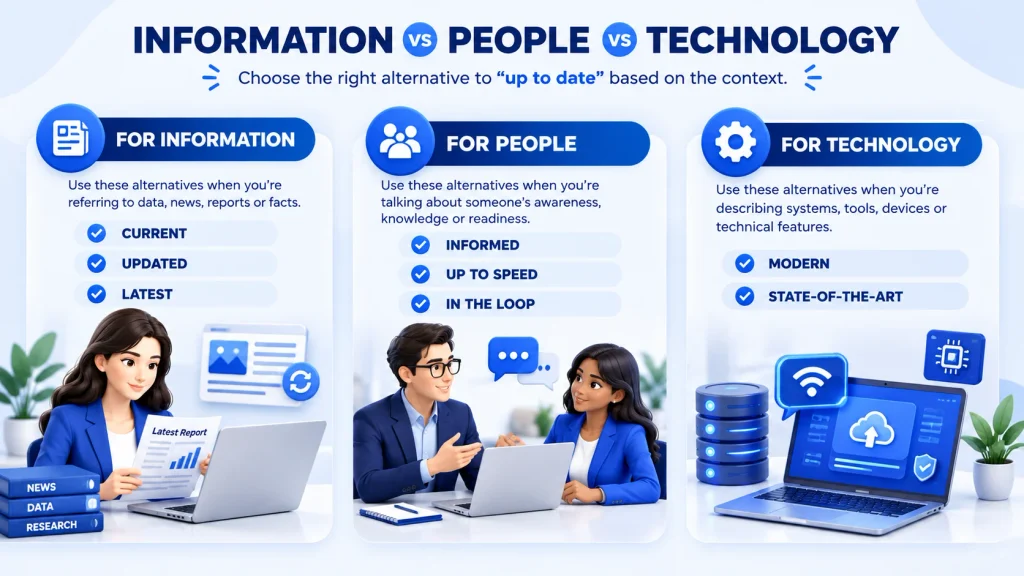
The best alternative depends on what you mean. Current and updated are useful for information, while modern works better for technology or design. For a person who knows recent developments, informed or up to speed may sound more natural.
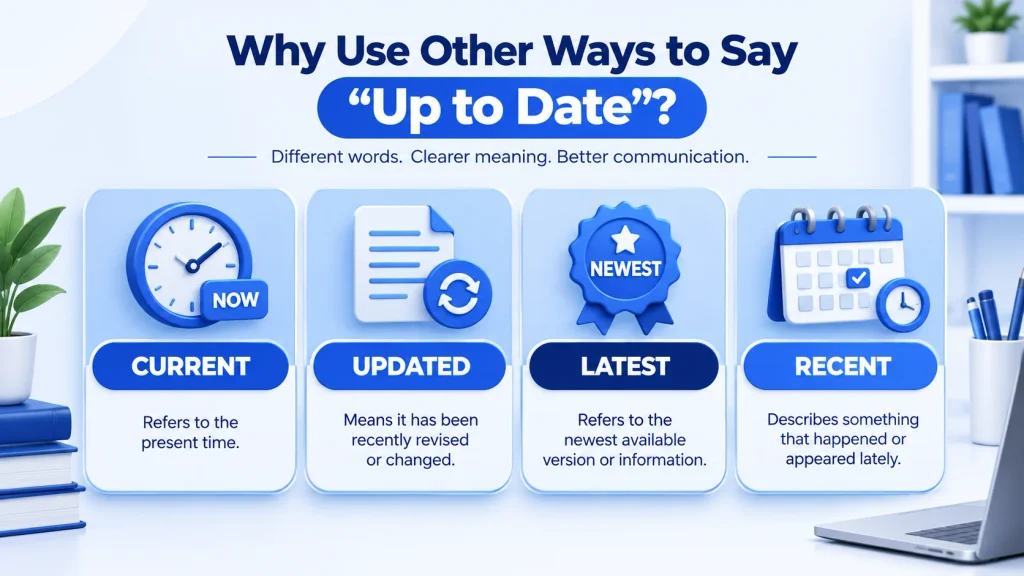
Using alternatives to “up to date” can make your writing more precise and prevent repetition. It also helps you choose a word that matches the exact meaning you want.
You might use another expression to:
For example, “Please send me the current figures” is more specific than simply saying “Please send me the up-to-date figures.” Similarly, “The software uses modern technology” focuses on technology rather than information.
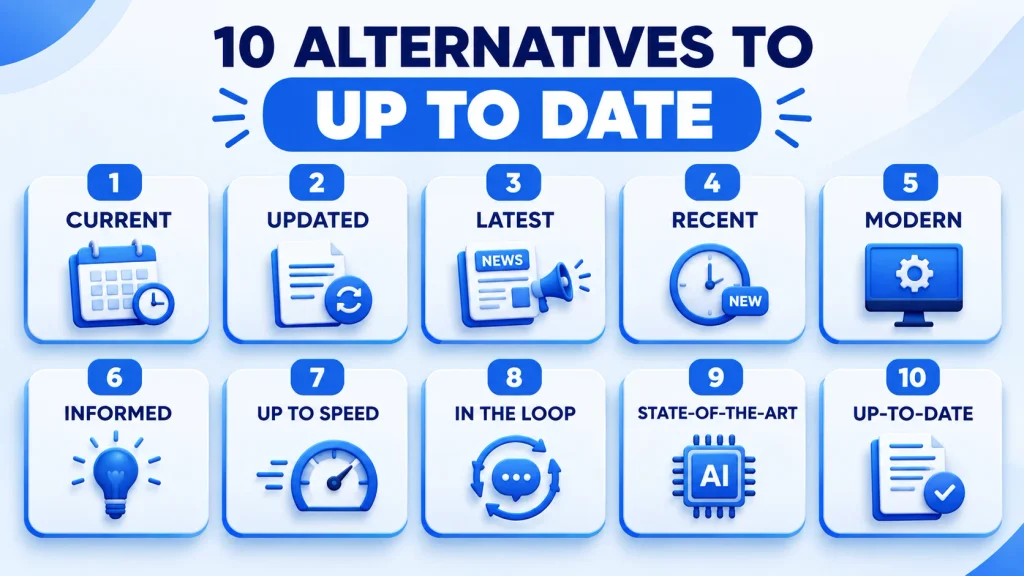
Current means belonging to the present time or reflecting the situation that exists now. It is one of the most natural alternatives when “up to date” refers to information, facts, records, or figures.
Please make sure the client information is current before the meeting.
The website contains current pricing and product details.
Use current when you want to emphasize that information reflects the present situation.
Updated means something has been changed or revised so that it includes newer information. It works especially well for documents, databases, records, websites, software, and reports.
I attached the updated version of the project timeline.
Our customer database is fully updated after this week’s review.
Choose updated when something has actually been revised or refreshed.
Latest refers to the newest information, version, development, or item available. It is useful when you want to stress recency rather than simply saying something is current.
The team reviewed the latest sales figures this morning.
You can find the latest version of the report in the shared folder.
Use latest when “newest” is more important than simply “current.”
Recent describes something that happened, appeared, or became available not long ago. Unlike “latest,” it does not always mean the newest item available.
The article includes several recent studies on the topic.
We discussed the company’s recent changes during the meeting.
Use recent when something happened or appeared lately, even if it is not the absolute newest.
Modern means current in style, design, methods, technology, or thinking. It is a better replacement when “up to date” refers to something contemporary rather than information.
The company invested in modern equipment for the new facility.
Their office has a modern design with flexible workspaces.
Use modern for technology, equipment, design, methods, and styles—not usually for factual records.
Informed describes a person who has enough current information to understand a subject or situation. It is useful when “up to date” refers to someone’s knowledge.
Managers should stay informed about changes to company policies.
She is well informed about the latest developments in the industry.
Use informed for people and their knowledge rather than documents or physical objects.
Up to speed means having the information or knowledge needed to understand what is happening. It is especially common in workplace conversations when someone needs to learn about recent developments.
I’ll bring you up to speed on the project before the meeting.
Once Maya is up to speed, she can handle the client calls independently.
This phrase is natural in workplace communication but sounds more conversational than “current” or “informed.”
In the loop means being kept informed about information, decisions, or developments. It is especially useful when talking about communication between coworkers or teams.
Please keep me in the loop about any changes to the schedule.
I’ll make sure the design team stays in the loop throughout the project.
Use in the loop when the focus is on receiving updates from other people.
State-of-the-art describes technology, equipment, systems, or methods that represent a very advanced level of development. It is stronger than simply saying something is modern.
The research center uses state-of-the-art laboratory equipment.
The company introduced a state-of-the-art security system at its headquarters.
Reserve this phrase for highly advanced technology, equipment, facilities, or methods rather than ordinary current information.
Up-to-date itself remains a clear and natural choice when something contains the newest information or reflects current methods. It is especially useful when precision matters more than variation.
Please use the up-to-date employee directory when sending invitations.
We need up-to-date information before making a final decision.
Before a noun, use the hyphenated form up-to-date, such as “up-to-date records.” After a linking verb, use up to date, as in “The records are up to date.”
| Alternative | Best Used In | Tone |
| Current | Information, records, figures, facts | Professional |
| Updated | Documents, databases, reports, records | Professional |
| Latest | News, figures, versions, developments | Neutral |
| Recent | Events, studies, changes, information | Neutral |
| Modern | Technology, design, equipment, methods | Neutral |
| Informed | People and their knowledge | Professional |
| Up to Speed | Workplace updates and conversations | Conversational |
| In the Loop | Team communication and updates | Friendly/Professional |
| State-of-the-Art | Advanced technology and equipment | Formal |
| Up-to-Date | Current information and modern resources | Neutral |
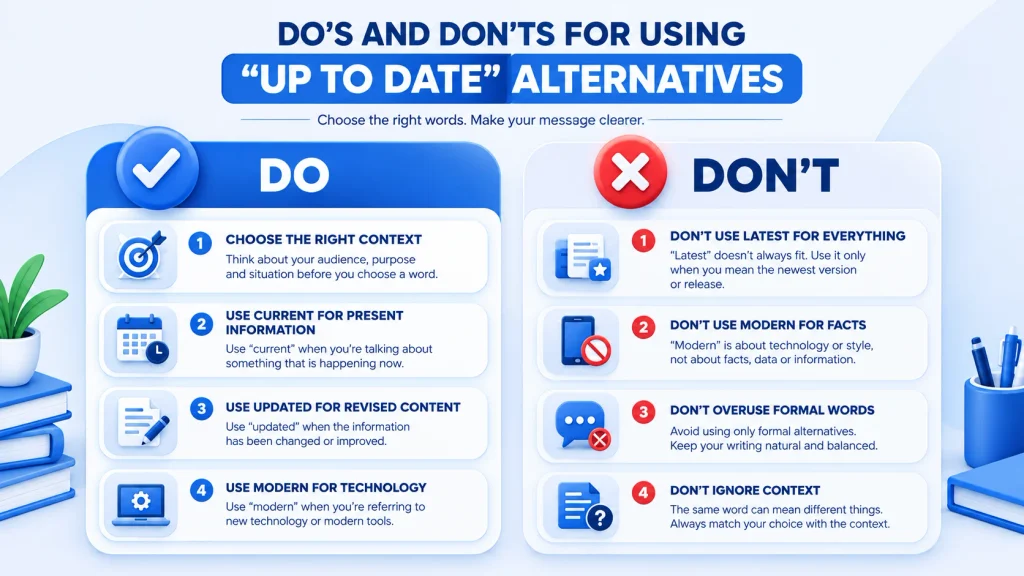
“Latest” usually emphasizes the newest available item, while “current” focuses on what applies now. They can overlap, but they are not always interchangeable.
Modern usually describes technology, design, methods, or style. If you are talking about records or facts, current or updated will usually be more precise.
“Up to speed” normally describes a person’s knowledge or understanding. For a report or database, updated or current is usually more appropriate.
Use up-to-date before a noun, such as “an up-to-date report.” When the phrase follows a linking verb, write up to date, as in “The report is up to date.”
“State-of-the-art” suggests an exceptionally advanced level. Using it for ordinary current information can make your writing sound exaggerated.
Common alternatives include current, updated, latest, recent, modern, and informed. The right choice depends on context. Use “current” for information that reflects the present, “updated” for revised information, “modern” for contemporary technology or design, and “informed” when describing someone’s knowledge.
Current and updated are strong professional alternatives. For example, “Please make sure the records are current” sounds clear and businesslike. “Please send the updated report” works when the document has been revised with newer information.
They are often interchangeable when discussing information, but their emphasis can differ. Current focuses on what applies now, while up to date often suggests that information has been kept current or includes the latest available details.
Depending on context, you can say stay informed, stay current, keep informed, stay up to speed, or remain in the loop. “Stay informed” works well for general knowledge, while “stay up to speed” is particularly natural in workplace conversations.
Updated often suggests that something has been changed or revised. Up to date means it currently contains the latest information or reflects current standards. For example, an updated report has been revised, while an up-to-date report contains information that is current.
Sometimes. Latest means the newest available, while up to date means current or containing current information. If several versions exist, “latest version” identifies the newest one. “Up-to-date information” emphasizes that the information is current.
For a person, informed, knowledgeable, up to speed, or in the loop may work depending on the situation. “Informed” is more formal, while “up to speed” and “in the loop” are more conversational and common in workplace communication.
Use up-to-date when it comes directly before a noun, such as “up-to-date information.” Use up to date after a verb, such as “The information is up to date.” Major dictionaries recognize both forms depending on grammatical position.
There are many useful ways to say up to date, but the best alternative depends on what you are describing. Use current when information reflects the present, updated when something has been revised, and latest when you want to emphasize the newest available version. For technology, equipment, or design, modern or state-of-the-art may be more precise.
When describing a person’s knowledge, informed, up to speed, or in the loop can sound more natural. In professional writing, choosing the most precise alternative helps your message stay clear without sounding repetitive. When no special nuance is needed, “up to date” remains a perfectly natural expression. The key is to match the word to the exact meaning you want to communicate.

Our editorial team brings together decades of expertise in applied linguistics, lexicography, and educational publishing. Dedicated to clarity, precision, and tone, our experts ensure that every resource meets the highest standards of professional and academic excellence.