
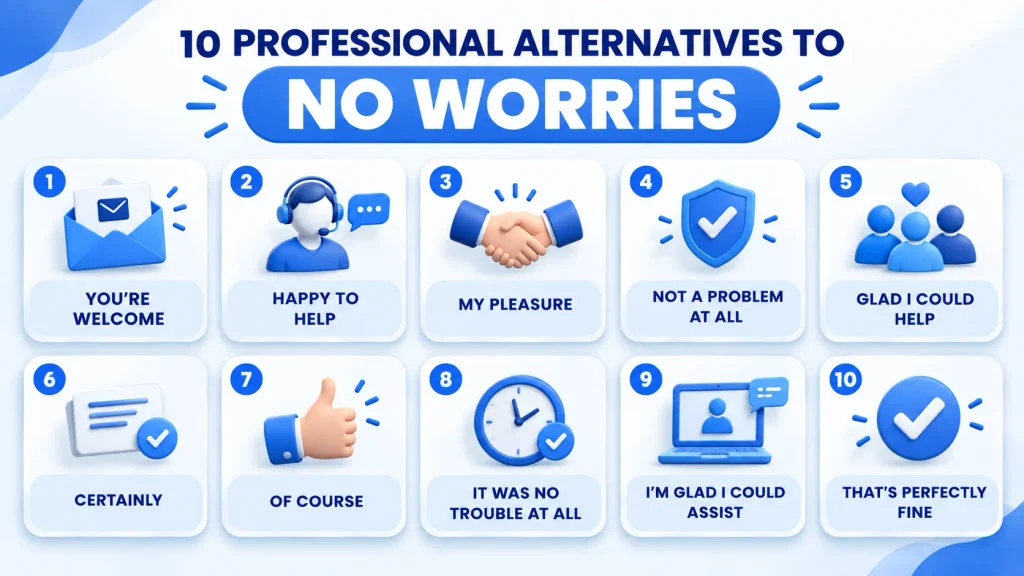
Looking for another way to say “no worries” professionally? Try “you’re welcome,” “happy to help,” “my pleasure,” “not a problem at all,” “glad I could help,” “certainly,” or “I’m happy to assist.” The best choice depends on whether you are responding to thanks, an apology, a request, or a concern.
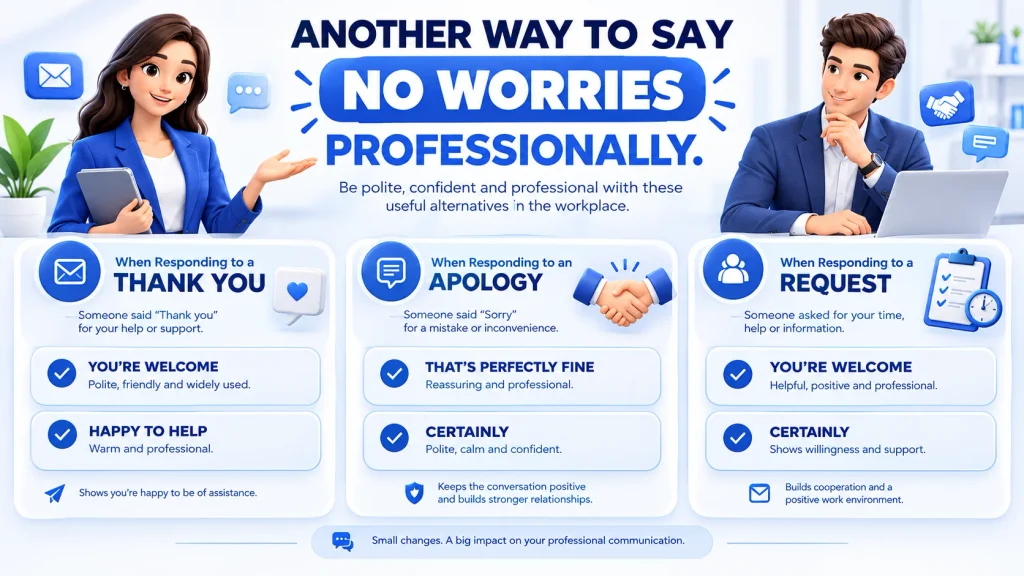
The phrase “another way to say no worries professionally” refers to finding a more polished expression for workplace communication. “No worries” is commonly used to reassure someone, respond to an apology, or answer a thank-you, but it is generally considered informal.
In professional emails, meetings, client conversations, and workplace messages, you may want wording that sounds courteous without being overly formal. For example, “you’re welcome” works well after someone thanks you, while “that’s perfectly fine” can reassure someone who has apologized.
The best alternative depends on what the other person said. A response to “Thank you” should not always be the same as a response to “I’m sorry.”

Using a more specific alternative can make your professional communication sound clearer and more intentional.
Importantly, “no worries” is not inherently rude or incorrect. It can work well in relaxed workplace chats, but more formal communication often benefits from clearer alternatives.
“You’re welcome” is one of the clearest professional alternatives to “no worries” when someone thanks you. It acknowledges their appreciation in a polite and neutral way.
“Thank you for sending the updated proposal so quickly.”
“You’re welcome. Please let me know if you have any questions.”
“I really appreciate your help with the presentation.”
“You’re welcome. I’m glad I could contribute.”
Use “you’re welcome” primarily when responding to thanks, rather than as a general response to every situation.
“Happy to help” shows that you were willing to assist and did not consider the task a burden. It sounds warm while remaining appropriate for professional communication.
“Thanks for walking me through the new software.”
“Happy to help. Let me know if anything else comes up.”
“Thank you for handling the client request.”
“Happy to help. I’m glad we got everything sorted out.”
This is especially useful for coworkers, clients, customer support, and team communication. Current professional-writing guidance frequently recommends it as a natural replacement.
“My pleasure” communicates that you were glad to provide assistance. It sounds warmer and somewhat more polished than “you’re welcome.”
“Thank you for taking the time to explain the process.”
“My pleasure. I’m glad the explanation helped.”
“We appreciate your quick response to our request.”
“My pleasure. I was happy to assist.”
Use “my pleasure” when you want to sound courteous and warm, particularly in client service or formal professional interactions.
“Not a problem at all” reassures someone that their request or minor inconvenience did not cause difficulty. It is a little more conversational than “you’re welcome.”
“Sorry for asking you to revise the schedule again.”
“Not a problem at all. I’ve updated it.”
“Thanks for staying late to finish the report.”
“Not a problem at all. We needed to get it done.”
This phrase works best for minor inconveniences or requests, but it may be less suitable when someone is apologizing about a serious issue.
“Glad I could help” directly communicates that you are pleased your assistance was useful. It sounds professional while maintaining a friendly tone.
“Thank you for helping me resolve the account issue.”
“Glad I could help. I’m pleased we got it resolved.”
“I appreciate you reviewing the document before the meeting.”
“Glad I could help. The final version looks good.”
Use this after you have completed a task or solved a problem for someone.
“Certainly” is a concise and professional way to confirm that you are willing to do something. Unlike “you’re welcome,” it works particularly well when responding to a request.
“Could you send me the revised contract this afternoon?”
“Certainly. I’ll send it before 3 p.m.”
“Would you be able to review these figures?”
“Certainly. I’ll take a look this morning.”
Choose “certainly” when agreeing to a reasonable request, especially in formal emails or client communication.
“Of course” expresses willingness and reassurance. It can sound natural and professional, although your tone matters because a short “of course” can sound abrupt in some situations.
“Could you add the new figures to the report?”
“Of course. I’ll update it before lunch.”
“Would you mind sending the meeting notes to the team?”
“Of course. I’ll send them shortly.”
Add a helpful follow-up when needed, such as “Of course. I’ll take care of it.” This makes the response feel more complete.
“It was no trouble at all” directly reassures someone that helping them was not inconvenient. It is a polished alternative when someone is apologizing or thanking you.
“Thank you for revising the presentation on such short notice.”
“It was no trouble at all. I’m glad we had time to review it.”
“I’m sorry for asking you to make another change.”
“It was no trouble at all. The update was straightforward.”
This phrase is particularly useful when you want to reassure someone without sounding overly casual.
“I’m glad I could assist” is a polished expression that emphasizes helpfulness. It works particularly well in client-facing and customer-service communication.
“Thank you for resolving the issue so quickly.”
“I’m glad I could assist. Please reach out if you need anything else.”
“We appreciate your help with our account.”
“I’m glad I could assist. Your request has now been completed.”
Use this phrase when writing to clients, customers, or external contacts where a more polished tone is appropriate.
“That’s perfectly fine” works best when someone apologizes or worries that they have caused a problem. It reassures them without simply dismissing the situation.
“I’m sorry for sending the document a little later than planned.”
“That’s perfectly fine. I received it and will review it today.”
“Apologies for needing to reschedule our meeting.”
“That’s perfectly fine. Thursday afternoon works for me.”
Use “that’s perfectly fine” for apologies, delays, small mistakes, or schedule changes, rather than as a direct response to “thank you.”
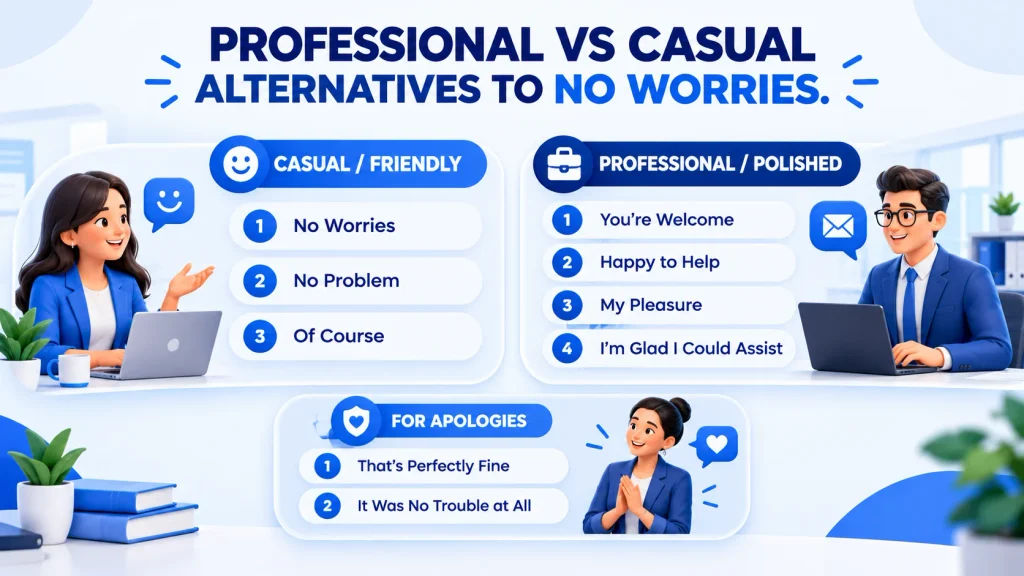
| Alternative | Best Used In | Tone |
| You’re Welcome | Emails, meetings, professional thanks | Professional / Polite |
| Happy to Help | Teamwork, clients, customer service | Warm / Professional |
| My Pleasure | Client service, formal interactions | Warm / Formal |
| Not a Problem at All | Minor requests or inconveniences | Friendly / Professional |
| Glad I Could Help | Completed tasks and assistance | Warm / Professional |
| Certainly | Requests and formal communication | Formal / Polite |
| Of Course | Requests, meetings, workplace chats | Friendly / Professional |
| It Was No Trouble at All | Reassurance after thanks or apologies | Formal / Polite |
| I’m Glad I Could Assist | Client and customer communication | Formal / Professional |
| That’s Perfectly Fine | Apologies, delays, minor mistakes | Warm / Polite |
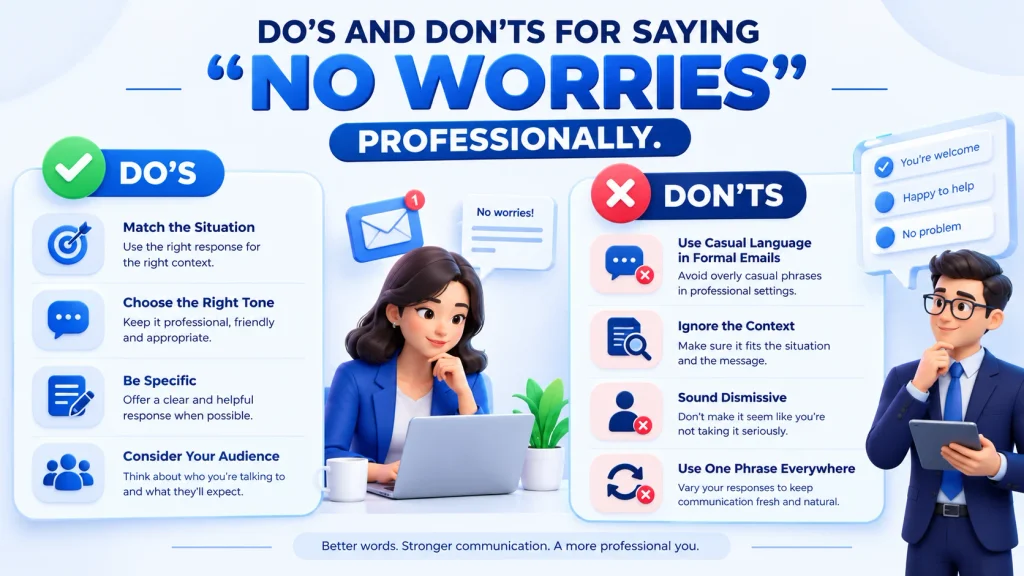
Although “no worries” can be acceptable in relaxed workplace communication, it may sound too casual in formal emails or client-facing messages. Consider your audience and the importance of the interaction before using it.
Not every professional replacement works equally well after someone expresses gratitude. “You’re welcome,” “happy to help,” and “my pleasure” naturally respond to thanks, while “certainly” is better suited to a request.
Professional does not have to mean stiff. Saying “I’m glad I could assist” can work well with a client, but using highly formal wording in a casual team chat may create unnecessary distance.
“No worries” can respond to both thanks and apologies, but your alternative should reflect the situation. “That’s perfectly fine” reassures someone after an apology, while “you’re welcome” responds naturally to gratitude.
Some short phrases can unintentionally minimize another person’s concern. For example, when someone has a legitimate problem, simply saying “no problem” may not acknowledge what happened. A more specific response can show that you understood the situation.
The best choice depends on the situation. “You’re welcome” is a reliable professional response to thanks, while “happy to help” adds warmth. For a formal client interaction, “I’m glad I could assist” can sound polished. For an apology, “that’s perfectly fine” may be more appropriate.
“No worries” is not grammatically wrong, but it is generally an informal expression. It can work in relaxed workplace chats or conversations with familiar colleagues. For formal emails, clients, or important business communication, a clearer option such as “you’re welcome,” “happy to help,” or “that’s perfectly fine” may fit better.
When someone thanks you, try “you’re welcome,” “happy to help,” “my pleasure,” or “glad I could help.” These phrases directly acknowledge their appreciation while keeping the conversation professional. “Happy to help” is especially natural when you assisted with a task or solved a problem.
If someone apologizes for a small mistake or delay, you can say “that’s perfectly fine,” “it was no trouble at all,” or “not a problem at all.” These responses reassure the person while sounding more intentional in professional communication. For serious issues, acknowledge the situation rather than automatically dismissing it.
They serve slightly different purposes. “Happy to help” emphasizes your willingness to assist and works especially well after someone thanks you. “No worries” is broader and can also reassure someone after an apology. In professional settings, “happy to help” often makes your positive intention clearer.
You can, especially in relaxed workplace conversations, but “no problem” is still somewhat conversational. For a formal email or client interaction, “you’re welcome,” “my pleasure,” or “I’m glad I could assist” may sound more polished. Always consider the relationship, communication channel, and seriousness of the situation.
For a more formal tone, consider “certainly,” “my pleasure,” “it was no trouble at all,” or “I’m glad I could assist.” The right choice depends on the context. “Certainly” is useful for requests, while the other options work better when responding to thanks or reassurance.
Yes, “of course” can be professional when used naturally. It is particularly useful when agreeing to a reasonable request or showing willingness to help. However, tone matters. In writing, adding a brief follow-up such as “Of course. I’ll take care of that today” can make your response sound more helpful and complete.
Finding another way to say “no worries professionally” is mainly about choosing language that fits the situation. “You’re welcome” is a reliable choice after someone thanks you, while “happy to help” adds warmth and works well in teamwork and customer service. “My pleasure” offers a more polished tone, and “I’m glad I could assist” suits formal client communication.
When someone apologizes, phrases such as “that’s perfectly fine” or “it was no trouble at all” may communicate reassurance more clearly. For requests, “certainly” or “of course” can show willingness to help.
The key takeaway is simple: don’t choose an alternative based only on formality. Choose the phrase that matches what happened, who you’re speaking to, and how professional or warm you want to sound.

English Language & Communication Specialist
Dr. Emily Carter is an English language and communication specialist focused on vocabulary, word choice, professional writing, and practical English usage. She helps readers understand the differences between similar words and choose expressions that sound natural, clear, and appropriate for different contexts.