
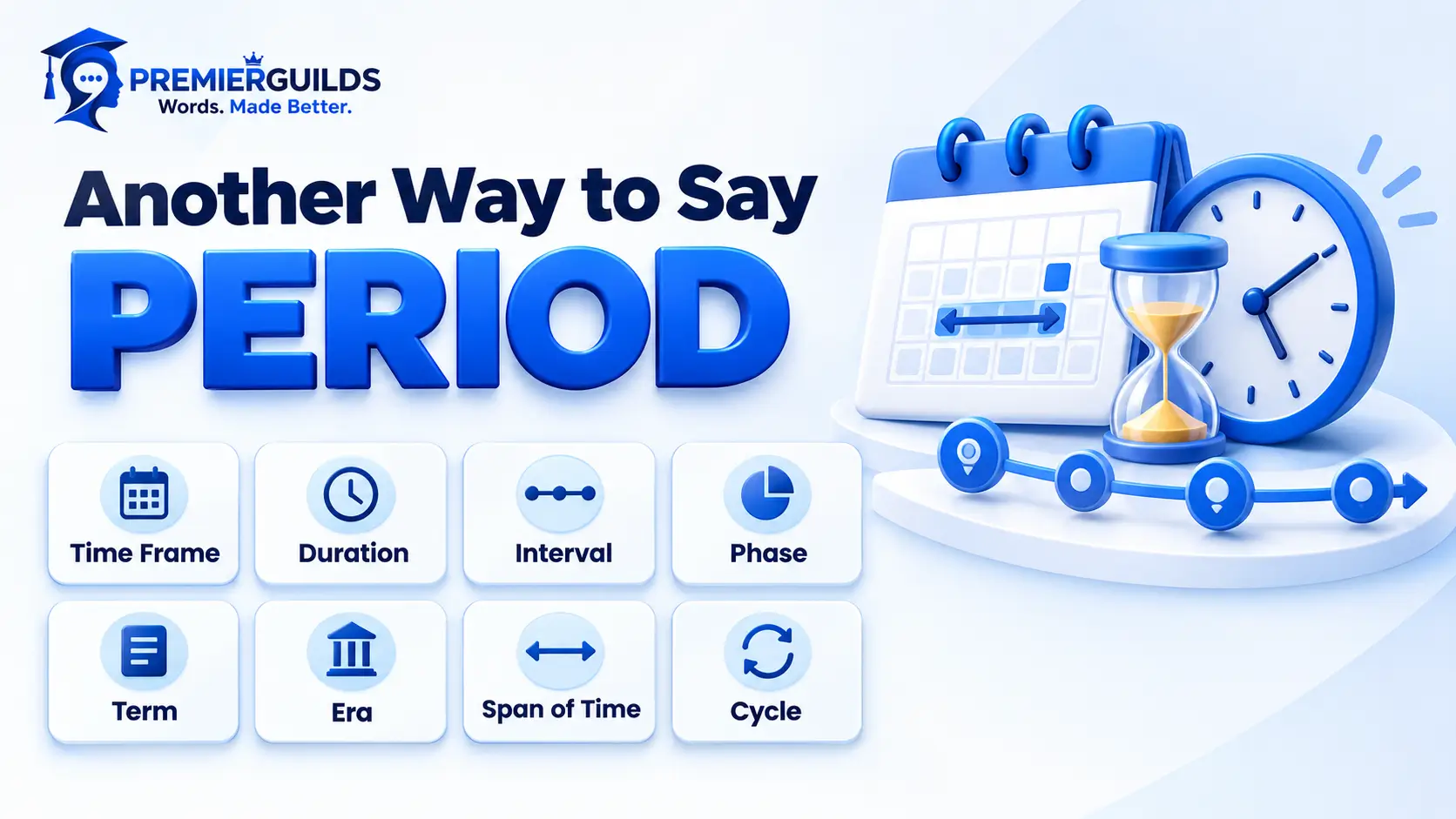
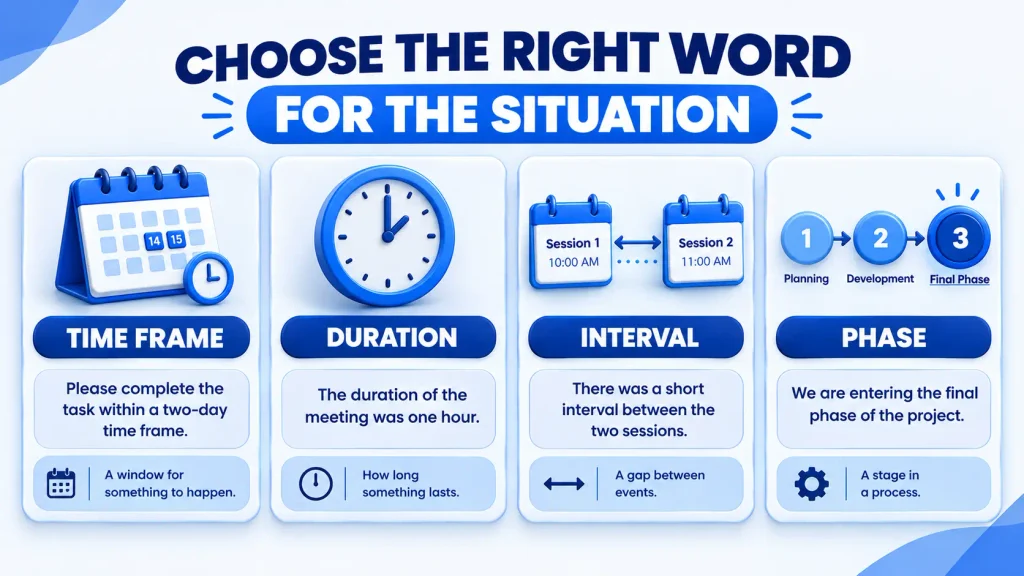
Another way to say “period” when referring to a length of time includes time frame, duration, span, interval, and time span. The best alternative depends on the context. Use “duration” for how long something lasts, “interval” for time between events, and “time frame” for a period set aside for an activity.
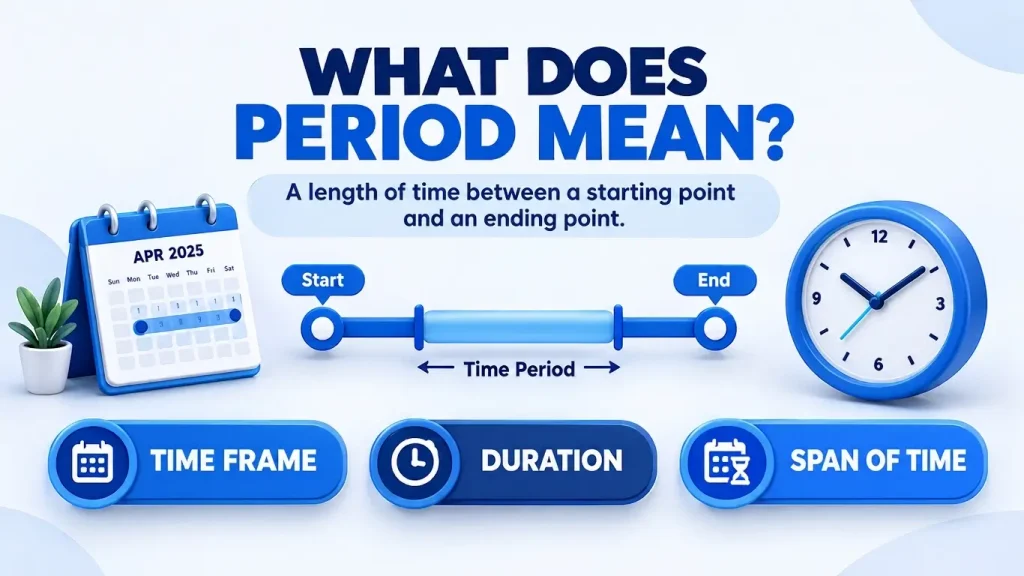
Looking for another way to say “period” means finding a different word or phrase that communicates a particular length of time. In this article, “period” refers to a stretch of time, not menstruation or a punctuation mark.
People use the word in everyday conversations, academic writing, workplace communication, and formal documents. For example, you might discuss a trial period at work, a waiting period before an appointment, or a period when sales increased.
The right alternative depends on the meaning you want to express. “Duration” emphasizes how long something lasts, while “time frame” often refers to the time allowed or planned for an activity.
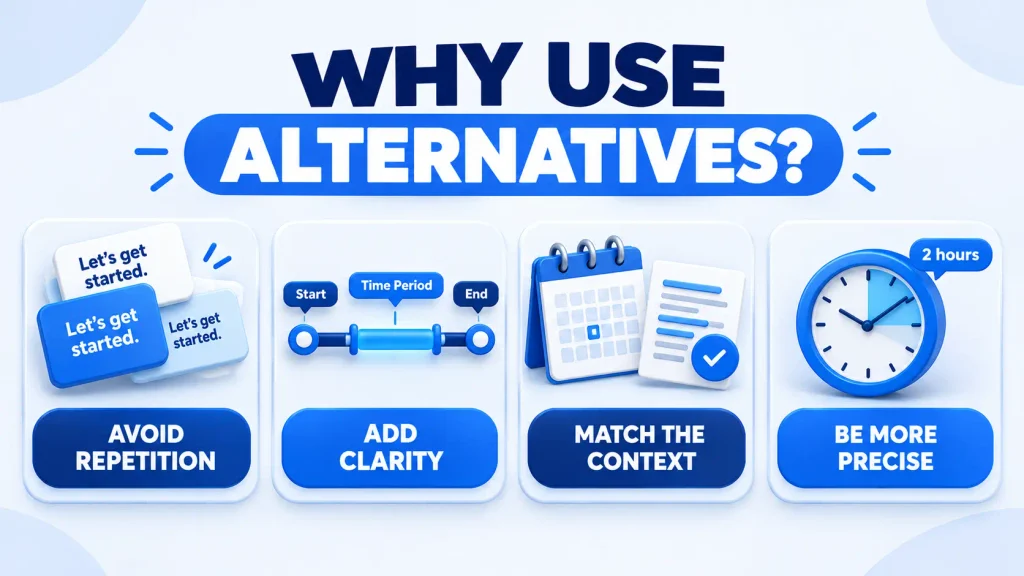
Using different expressions can make your writing more precise and help you avoid repeating the same word. It also allows you to match your language to the situation.
Here are some reasons to choose an alternative:
For example, “The project lasted for a short period” could become “The project lasted for a short time.” In a formal report, “The project had a six-month duration” may be more appropriate.
Meaning
A time frame is a period during which an activity is expected to happen or be completed. It is especially useful when discussing plans, schedules, goals, and deadlines.
Best For: Professional, Formal
Example 1: “We expect to finish the website redesign within a three-week time frame.”
Example 2: “The hiring team gave applicants a clear time frame for receiving interview results.”
Quick Tip: Use “time frame” when you want to emphasize when something should happen, rather than simply how long it lasts.
Meaning
Duration refers to the amount of time something continues. It is a precise choice for describing the length of a meeting, course, event, treatment, or activity.
Best For: Professional, Formal
Example 1: “The training session has a duration of two hours.”
Example 2: “Please mention the duration of your presentation when submitting the proposal.”
Quick Tip: Choose “duration” when the exact length of an activity matters. It often works well in reports, schedules, and instructions.
Meaning
A time span is the length of time between a beginning and an ending point. It can describe a brief interval or a period covering many years.
Best For: Professional, Formal, Casual
Example 1: “The research covers a time span of ten years.”
Example 2: “She developed her design skills over a short time span.”
Quick Tip: Use “time span” when discussing how much time a process, experience, or change covers.
Meaning
An interval is a space of time between two events or points. It can also refer to a set amount of time between repeated activities.
Best For: Professional, Formal
Example 1: “The software automatically saves your work at regular intervals.”
Example 2: “There was a brief interval between the two presentations.”
Quick Tip: Use “interval” when the gap between events matters. It is often more precise than “period” in schedules and technical explanations.
Meaning
“Span of time” refers to the amount of time covered by an event, experience, or process. It is similar to “time span” and can sound natural in explanatory writing.
Best For: Formal, Professional, Casual
Example 1: “The museum displays artifacts collected over a span of time.”
Example 2: “The neighborhood changed significantly over a short span of time.”
Quick Tip: This phrase works well when describing gradual changes or experiences that unfold over time.
Meaning
A phase is a distinct stage within a larger process or development. It does not simply mean any length of time; it highlights a particular part of a sequence.
Best For: Professional, Formal
Example 1: “The team will test the new checkout system during the final phase of development.”
Example 2: “During the early phase of the project, we focused on gathering customer feedback.”
Quick Tip: Use “phase” when the period represents a stage with a specific purpose or set of activities.
Meaning
A stretch of time describes a continuous amount of time, often longer than expected or noticeable in some way. It is more conversational than terms such as “duration” or “interval.”
Best For: Casual, Friendly
Example 1: “I spent a long stretch of time organizing the family photographs.”
Example 2: “The store remained quiet for a brief stretch of time before the evening rush.”
Quick Tip: Use this expression in stories and everyday conversation when you want to emphasize the experience of time passing.
Meaning
“Timeframe for completion” refers to the expected time in which a task or project should be finished. It is more specific than “period” because it focuses on completing an activity.
Best For: Professional, Formal, Polite
Example 1: “Could you confirm the timeframe for completion of the website updates?”
Example 2: “The contractor provided a realistic timeframe for completion of the repairs.”
Quick Tip: This phrase is useful in project planning and client communication. If possible, give an actual date or deadline to avoid confusion.
Meaning
A term can refer to a fixed or defined period, especially one associated with an agreement, position, course, or official arrangement. Its meaning depends on the context.
Best For: Formal, Professional
Example 1: “Her term as department chair ends in December.”
Example 2: “The agreement includes a six-month trial term.”
Quick Tip: Use “term” for established or defined periods. It is not a suitable replacement for “period” in every sentence.
Meaning
A season is a time of year associated with particular weather, activities, or events. More broadly, it can describe a recognizable stage in someone’s life or a recurring period of activity.
Best For: Casual, Friendly, Warm
Example 1: “The company experiences its busiest season during the winter holidays.”
Example 2: “She is entering a new season of learning and personal growth.”
Quick Tip: Use “season” when the period has a recognizable pattern, mood, or stage. Avoid it when you need to communicate an exact duration.
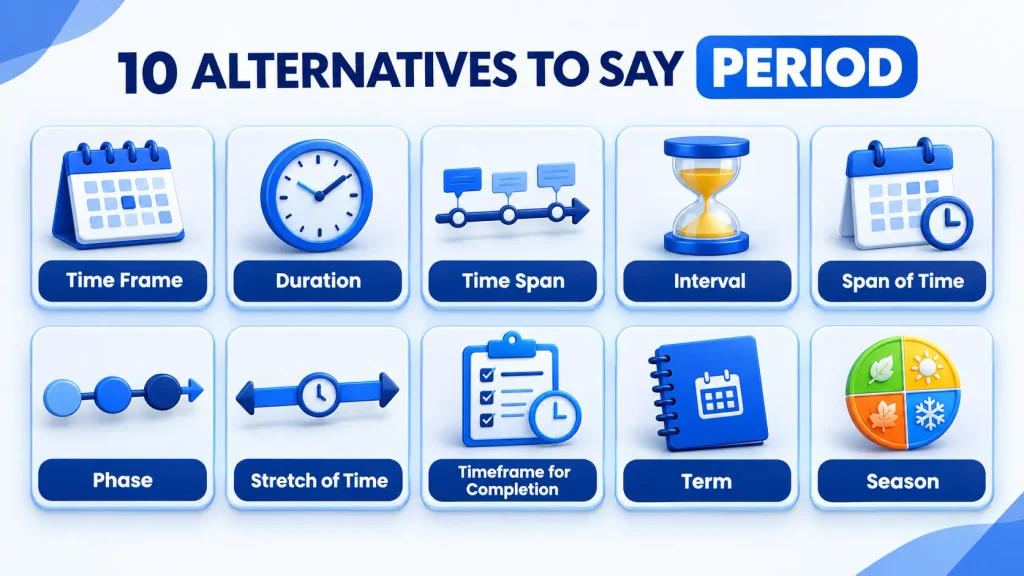
| Alternative | Best Used In | Tone |
|---|---|---|
| Time Frame | Schedules, plans, deadlines | Professional |
| Duration | Events, meetings, reports | Formal |
| Time Span | Research, history, changes | Neutral |
| Interval | Gaps between events | Precise |
| Span of Time | Describing changes over time | Neutral |
| Phase | Stages of a process | Professional |
| Stretch of Time | Stories and everyday conversation | Casual |
| Timeframe for Completion | Projects and work tasks | Professional |
| Term | Agreements, positions, courses | Formal |
| Season | Recurring activities and life stages | Warm |
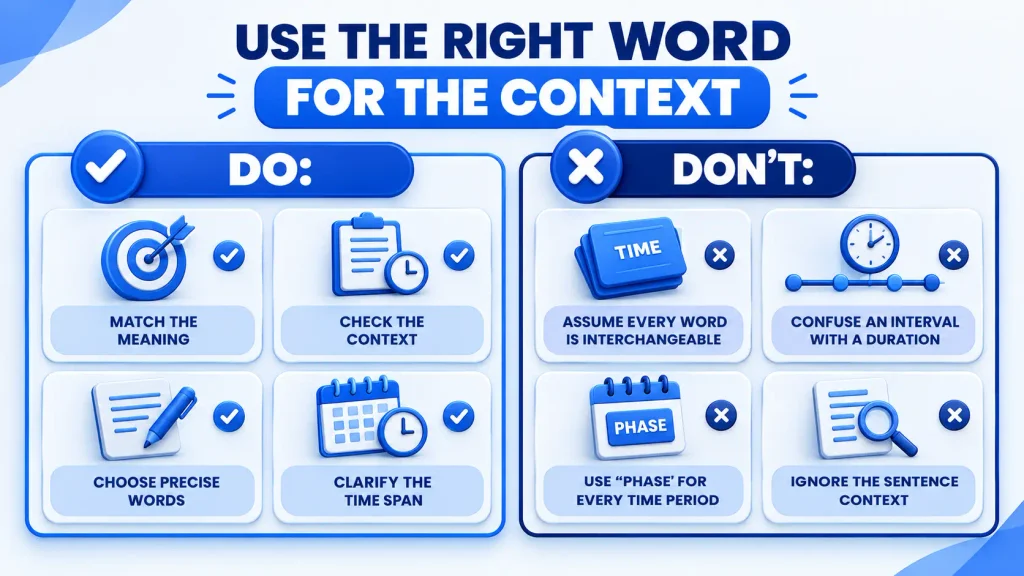
Not every word has the same meaning. A “phase” is a stage in a process, while an “interval” usually describes a gap between events. Choose the term that accurately reflects your intended meaning.
“Stretch of time” may sound natural in conversation, but “duration” is often more suitable for a formal report. Consider your audience and the purpose of the document.
Words such as “duration” and “interval” can make simple messages sound unnecessarily formal. In everyday writing, “a short time” may communicate the idea more clearly.
“Time frame” can refer to a planned window for an activity, while “duration” describes how long it lasts. If you are discussing a deadline, state the expected completion date whenever possible.
Using “period” several times in one paragraph can make writing feel repetitive. Vary your wording where appropriate, but never sacrifice accuracy just to use a synonym.
The best alternative depends on the sentence. “Duration” works well for the length of an event, “time frame” suits schedules and deadlines, and “interval” describes a gap between events. For everyday writing, “time” or “span of time” may sound more natural.
In professional writing, “time frame,” “duration,” and “term” are useful alternatives. For example, you might write “the project duration,” “the agreed time frame,” or “the contract term.” Choose the phrase that matches the subject instead of replacing “period” automatically.
Common alternatives include “brief interval,” “short time,” “short span,” and “moment.” “Brief interval” works well when describing the gap between events, while “moment” usually refers to a very short time. The most natural choice depends on what happens during that period.
You can use “extended period,” “long stretch of time,” “lengthy duration,” or “long span of time.” For historical or research writing, “over several decades” may be more precise. When possible, give a specific length, such as five years, rather than relying on a vague expression.
Not exactly. A period is a general stretch of time, while a time frame often refers to a planned or defined window in which something should happen. For example, a meeting may last one hour, but its time frame could be the entire afternoon scheduled for the event.
“Duration” describes how long an activity or event lasts. An “interval” usually describes the time between two events or points. A webinar may have a duration of 60 minutes, while a 15-minute interval may separate it from the next session.
Yes, when the time in question represents a distinct stage of a process. For example, “the testing phase” describes a specific part of product development. However, “phase” is not a direct substitute when you simply mean how long an event lasts or the gap between two activities.
First, identify what “period” means in each sentence. Use “duration” for length, “time frame” for planned timing, “interval” for a gap, or “phase” for a stage. You can also restructure a sentence to make it clearer rather than adding a synonym that changes its meaning.
Finding another way to say “period” can make your writing more natural, clear, and precise. The best choice depends on what you want to describe. Use “duration” when explaining how long something lasts, “time frame” when discussing schedules or deadlines, and “interval” when referring to the gap between events. If you are describing a stage in a process, “phase” may be the better option. For casual conversations, expressions such as “short time” or “stretch of time” often sound more relaxed.
Remember that synonyms are not always interchangeable. Think about your audience, the context, and the exact meaning you want to communicate before choosing a replacement.
Helpful takeaway: Choose the word that explains your meaning most accurately. Clear language is more useful than simply avoiding repetition.

Our editorial team brings together decades of expertise in applied linguistics, lexicography, and educational publishing. Dedicated to clarity, precision, and tone, our experts ensure that every resource meets the highest standards of professional and academic excellence.