

Another way to say “as such” depends on the context. Use “therefore,” “accordingly,” “consequently,” or “as a result” when showing a result. Use “in that capacity,” “in itself,” or “in its exact sense” when referring to a role, identity, or precise meaning.
The phrase “as such” can be useful, but it is often misunderstood. Depending on the sentence, it can refer to something previously identified, mean “in that capacity,” mean “in itself,” or be used as a transition to indicate a consequence.
For example:
She is the department manager and, as such, she approves the final reports.
Here, “as such” refers back to her role as department manager. A natural alternative is “in that capacity.”
However, consider:
The deadline was moved forward. As such, we need to finish the project sooner.
Here, the writer intends to express a result. In this context, “therefore” or “as a result” may communicate the relationship more directly.
The distinction matters because standard style guidance notes that “such” normally needs an antecedent—a noun or noun phrase it refers to—when “as such” is used in its traditional construction.
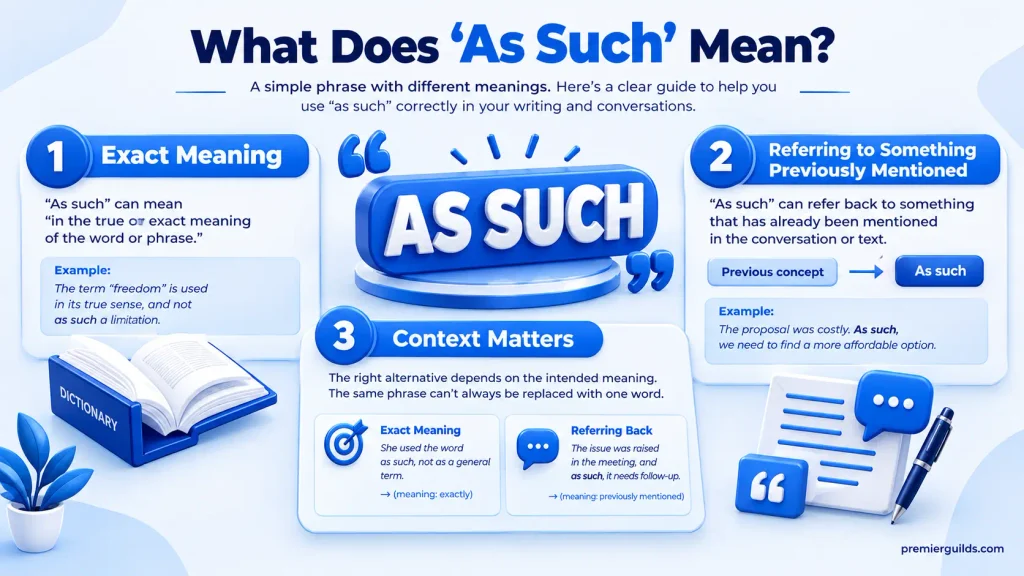
“As such” generally means “in that capacity,” “in itself,” or “in the exact sense of the word or phrase,” depending on context. Cambridge Dictionary, for example, defines one common use as referring to something in its true or exact meaning.
Consider these examples:
The first three uses have established meanings. The fourth reflects a widespread usage in which readers understand “as such” to mean “therefore” or “consequently,” although major style guidance warns writers not to assume that this construction always works.
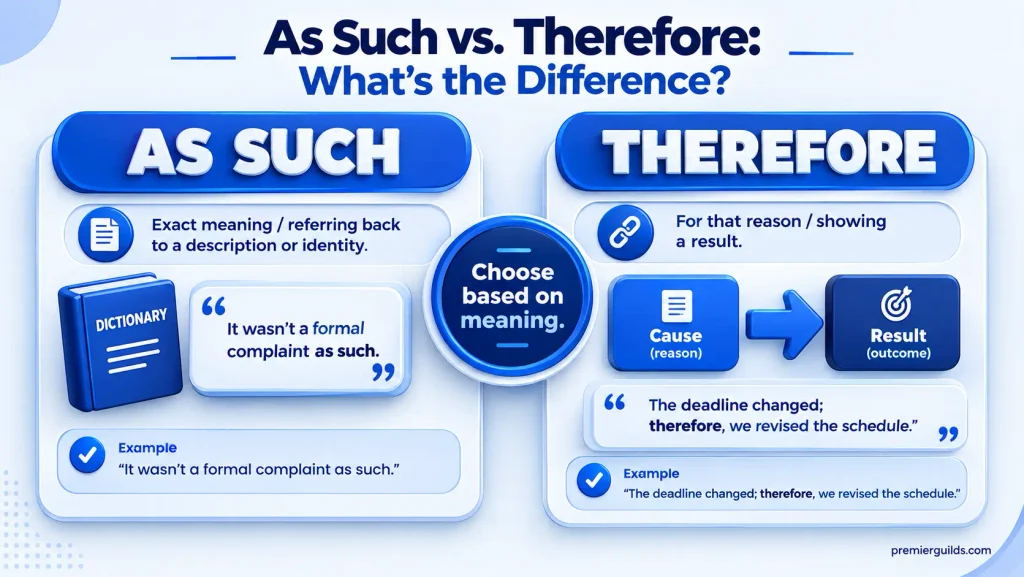
Replacing “as such” can make your writing clearer and more natural. This is especially useful when readers might have to stop and figure out what “such” refers to.
You may want an alternative to:
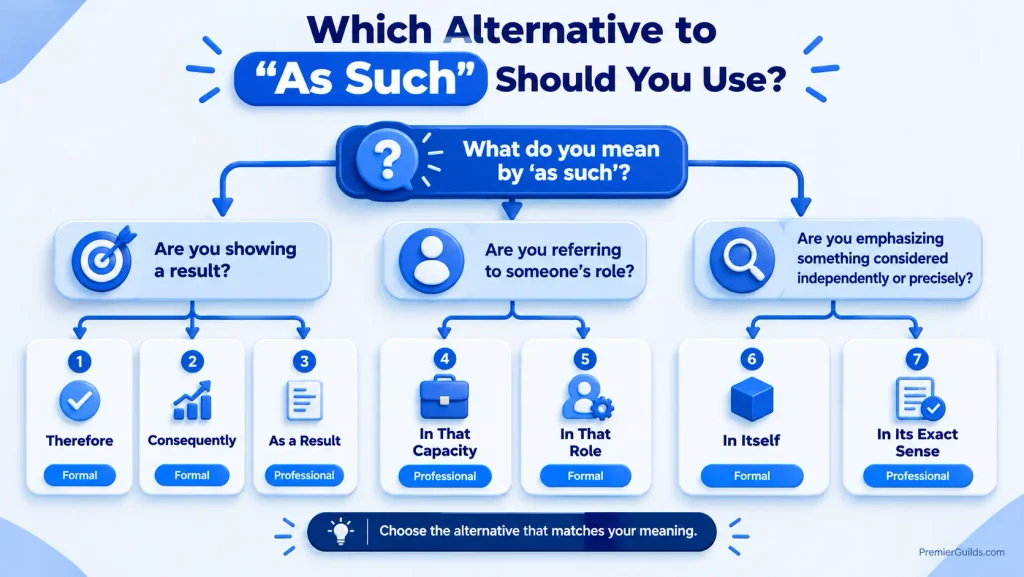
The best replacement depends on what you mean by “as such.” Do not automatically replace it with “therefore.”
Therefore means “for that reason” or “as a result.” It is a clear choice when “as such” is being used to connect a situation with its logical consequence.
The data was incomplete; therefore, the researchers repeated the survey.
The store received fewer deliveries this week and therefore reduced its inventory.
Use therefore when the second idea is a direct logical result of the first.
Accordingly means “in a way that is appropriate to the situation” or “as a result.” It works well when an action or decision follows from information that was previously stated.
The client changed the project requirements, and we adjusted the timeline accordingly.
The policy applies to all new employees, so the training materials were updated accordingly.
Use accordingly when the following action is an appropriate response to the circumstances.
Consequently introduces an outcome that follows from an earlier event or condition. It is more formal than “so” and works particularly well in reports and academic writing.
The supplier increased its prices; consequently, the company reviewed its purchasing strategy.
Several participants withdrew from the study, consequently reducing the available sample size.
Choose consequently when you want to emphasize a clear cause-and-effect relationship.
As a result directly tells readers that the next idea happened because of something previously mentioned. It is often clearer than “as such” when expressing a consequence.
The team identified several errors in the report. As a result, they conducted another review.
Heavy rain delayed the shipment, and as a result, the store received the products two days late.
Use as a result when clarity is more important than maintaining a highly formal tone.
For that reason explicitly connects an action or conclusion to the reason stated earlier. It is straightforward and easy for most readers to understand.
The position requires frequent travel. For that reason, we selected a candidate with a flexible schedule.
The instructions were unclear. For that reason, the teacher provided additional examples.
Use this phrase when you want the reason-and-result relationship to be unmistakable.
In that capacity is one of the closest alternatives when “as such” refers to someone’s role, position, or function. It means “in that role.”
Maria serves as the committee chair. In that capacity, she oversees the monthly meetings.
Daniel was appointed project coordinator and, in that capacity, manages communication between departments.
Use in that capacity only when “as such” refers to a specific role or function.
In itself means considered independently or without adding other factors to the discussion. It is useful when you want to focus on the thing alone.
The proposal is not unreasonable in itself, but its implementation could be difficult.
The software is not complicated in itself; the challenge comes from integrating it with older systems.
Use in itself when you mean “considered on its own.”
In its exact sense emphasizes the precise meaning of a word, label, or description. It can be useful when a term is being used loosely or when you need to distinguish its literal meaning.
The project was not a failure in its exact sense because most of its primary goals were achieved.
He was not a manager in its exact sense, although he supervised several employees.
Use this expression when discussing the precise meaning of a term rather than a result or consequence.
In that role is a simple, natural alternative to “as such” when referring to someone’s position or responsibility. It is usually easier to understand than the more formal “in that capacity.”
She became the team’s mentor. In that role, she helped new employees adjust to the workplace.
James was appointed safety officer. In that role, he conducts monthly workplace inspections.
Use in that role when you want a clear, conversational alternative for professional readers.
Because of this explains that the next situation happened due to something previously mentioned. It is a simple alternative when “as such” is being used to express cause and effect.
The instructions changed halfway through the project. Because of this, the team had to revise its plan.
The restaurant became extremely busy during lunch. Because of this, customers experienced longer wait times.
Choose because of this when you want to make the cause-and-effect relationship very easy to understand.
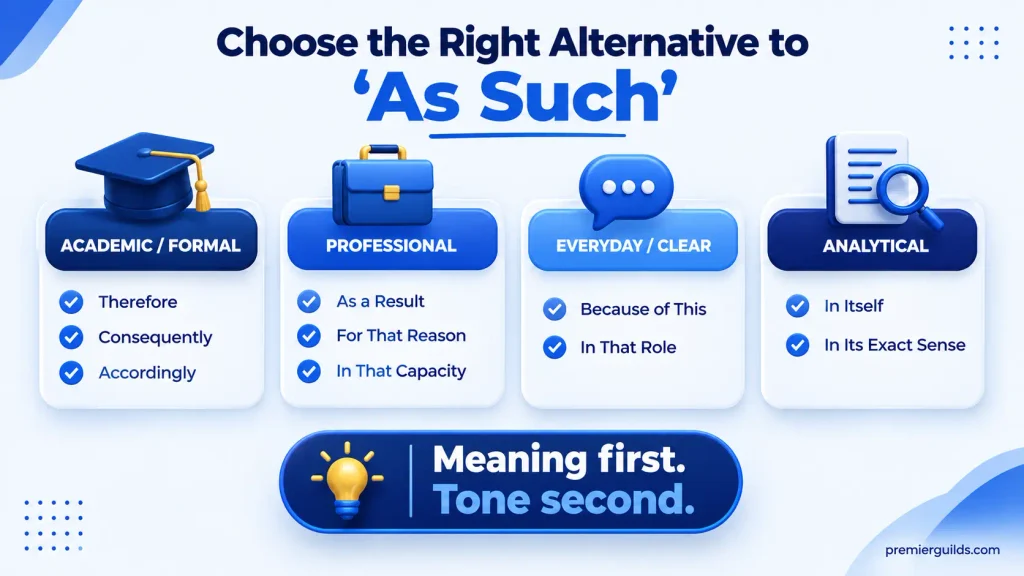
| Alternative | Best Used In | Tone |
| Therefore | Academic writing, reports, formal explanations | Formal |
| Accordingly | Professional decisions and responses | Formal |
| Consequently | Cause-and-effect writing | Formal |
| As a result | General cause-and-effect situations | Professional |
| For that reason | Explanations and conclusions | Neutral |
| In that capacity | Roles and professional positions | Formal |
| In itself | Academic or analytical writing | Formal |
| In its exact sense | Precise definitions and terminology | Formal |
| In that role | Job roles and responsibilities | Professional |
| Because of this | Clear cause-and-effect statements | Neutral |
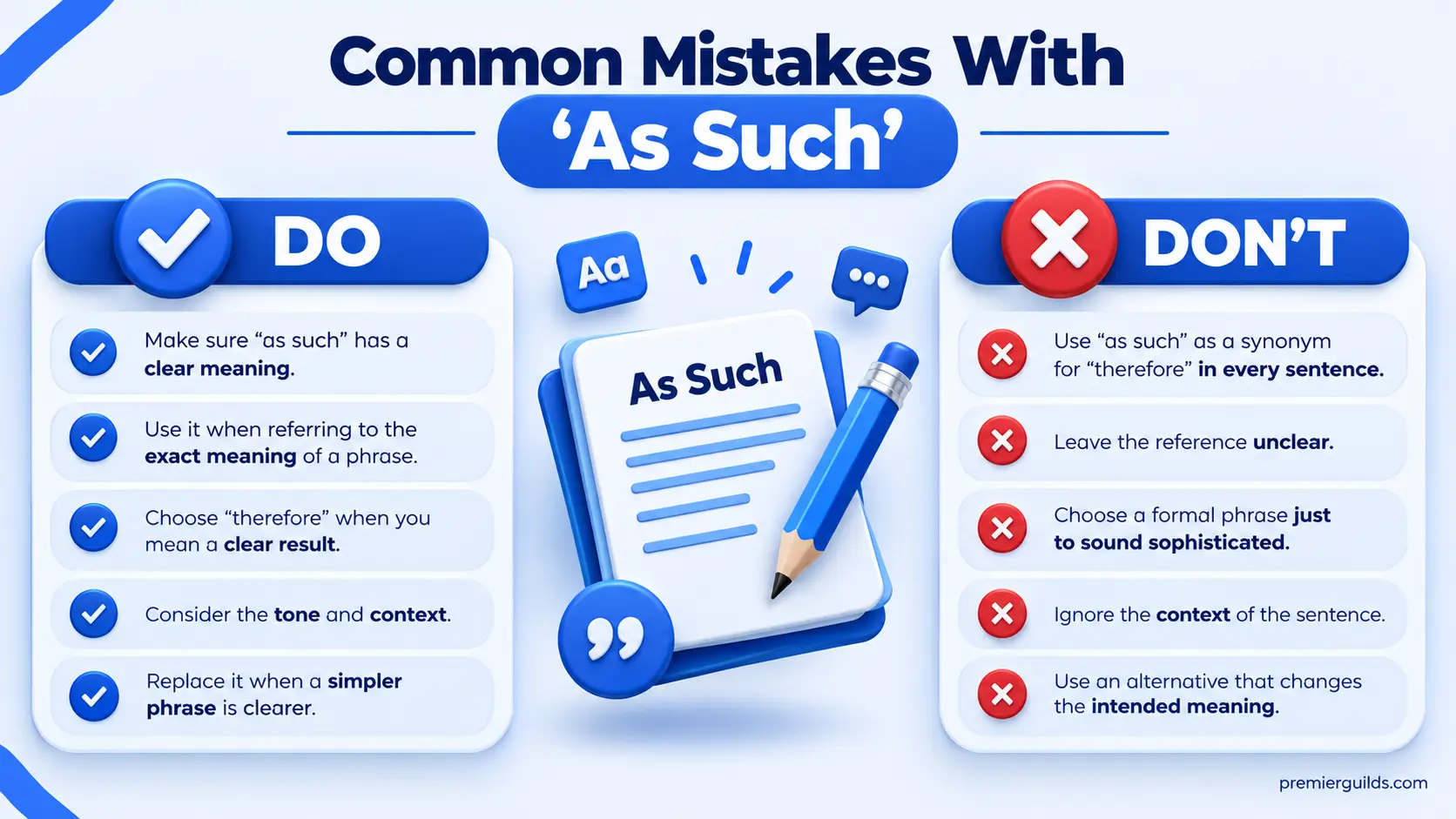
This is one of the most important mistakes to avoid. As such traditionally needs to point back to a noun or noun phrase in many constructions, while therefore directly expresses a logical result.
If “as such” refers to someone’s role, in that capacity may work. If it expresses a result, therefore or as a result may be more appropriate.
Words such as consequently and accordingly can work well in formal writing, but they may sound stiff in casual conversation. Sometimes so or because of this is clearer.
Readers should be able to tell what “such” refers to. The Chicago Manual of Style recommends asking yourself “as what?” to test whether the phrase has a clear antecedent.
Sometimes the phrase adds nothing. The MLA Style Center notes that even when “as such” is technically usable, it may unnecessarily complicate the sentence.
The best alternative depends on the meaning. Use “therefore,” “accordingly,” “consequently,” or “as a result” when expressing a consequence. Use “in that capacity” or “in that role” when referring to someone’s position. For “in itself,” use “in itself” or a similar phrase.
Not always. Therefore directly expresses a logical result, while the traditional use of as such refers back to a noun or noun phrase and means something like “in that capacity.” Some writers use “as such” to mean “therefore,” but major style guidance recommends checking whether “such” has a clear antecedent.
For professional writing, choose the alternative that matches your meaning. “Accordingly,” “therefore,” and “consequently” work well for results. If you are referring to someone’s position, “in that capacity” is a precise professional alternative.
In academic writing, options include “therefore,” “consequently,” “accordingly,” “as a result,” and “in itself.” The correct choice depends on the relationship between the ideas. Academic writing benefits from precise transitions, so avoid selecting a synonym simply because it sounds more formal.
Yes, but make sure its meaning is clear. If you are referring to a person’s role, “as such” can work well. If you mean “therefore,” however, “as a result,” “therefore,” or “accordingly” may make your message easier to understand.
“As such” generally has a formal or professional feel, especially when used to mean “in that capacity” or “in itself.” It is common in formal writing, but it can also appear in everyday English. Because some uses are easily misunderstood, simpler alternatives may sometimes be better.
In some modern usage, readers may interpret “as such” as meaning “because of this,” “therefore,” or “as a result.” However, this use is debated in formal style guidance. If you clearly mean cause and effect, “because of this” or “as a result” makes the relationship more explicit.
There is no single replacement that works in every sentence. “Therefore” is a simple choice when you mean “for that reason,” while “in that role” is clearer when discussing someone’s position. First identify what “as such” means in your sentence, then choose the alternative that expresses that meaning directly.
Choosing another way to say “as such” depends on what you want the phrase to accomplish. If you are expressing a result, therefore, consequently, accordingly, as a result, and for that reason can make the relationship between ideas clearer. If you are referring to a role, in that capacity or in that role may be more precise.
For analytical writing, in itself can work when you are considering something independently, while in its exact sense can clarify a word or description. Most importantly, do not treat every alternative as interchangeable. Check what “as such” refers to, identify the intended relationship, and choose the phrase that communicates that meaning naturally.

Senior English Editor & Stylistics Director
Michael Bennett is a veteran editor, lexicographer, and publishing consultant with more than two decades of experience in academic and educational publishing. Formerly a senior editorial director at major university presses, he specializes in structural editing, register refinement, and vocabulary development. Michael oversees tone, precision, and stylistic consistency across all publication channels, ensuring content meets rigorous editorial and pedagogical standards.