
Another way to say along with includes together with, in addition to, as well as, accompanied by, alongside, and plus. The best alternative depends on the context. Use “together with” for people or things occurring together, “in addition to” for formal writing, and “plus” for casual communication.
The phrase “along with” is commonly used when you want to add one person, thing, or idea to another. Depending on the sentence, it can mean together with, in addition to, as well as, or accompanied by.
For example, you might say, “She brought her laptop along with her notebook.” In this sentence, “along with” shows that the notebook was included with the laptop.
Although the phrase is natural and correct, using different alternatives can make your writing more precise. The best choice depends on whether you are writing a casual message, professional email, academic paper, or everyday sentence.
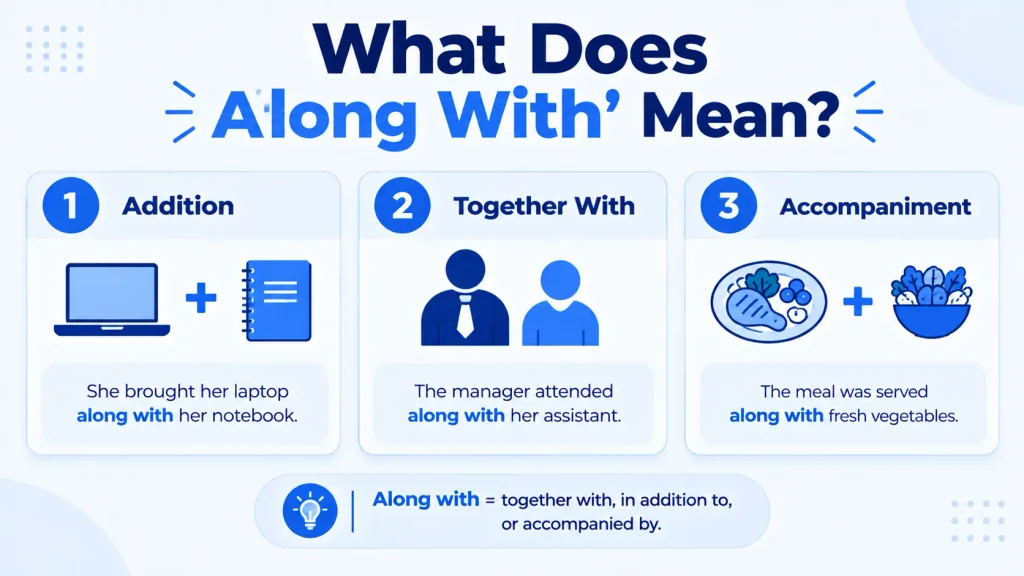
“Along with” generally means together with something or someone else. It can also introduce an additional item, person, action, or idea.
For example:
“The manager attended the meeting along with two team members.”
Here, “along with” tells the reader that the manager attended the meeting together with two team members.
The phrase is common in everyday conversations, emails, articles, reports, and other forms of writing. However, it can sometimes create ambiguity about whether two things are equally important or whether one is simply being added.
Choosing a more specific alternative can make your intended meaning clearer.
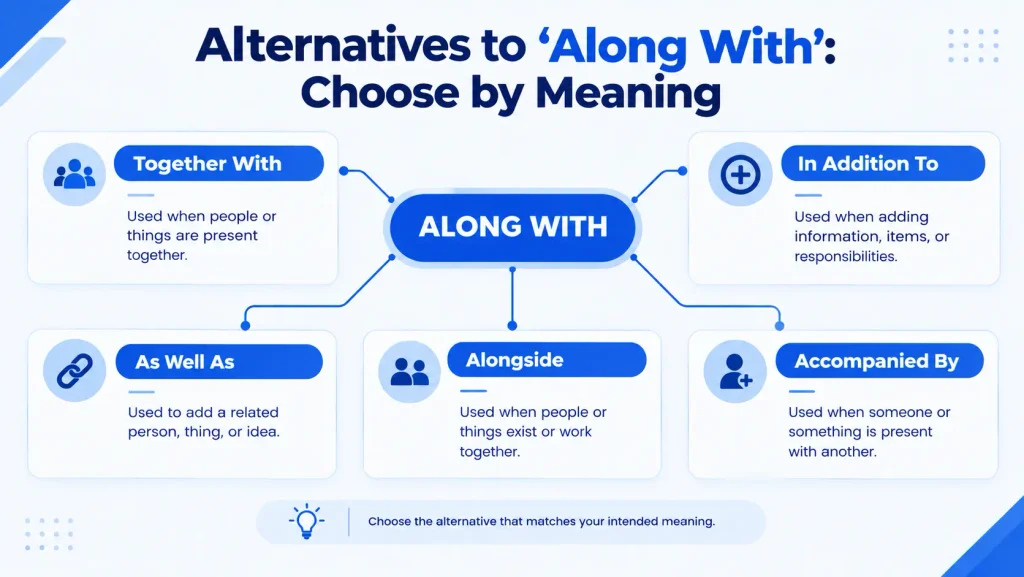
Using alternatives to “along with” can help you make your writing more natural and precise. Different expressions can also fit different levels of formality.
Consider another option when you want to:
The key is to choose an alternative based on what you mean, rather than replacing “along with” automatically.
Together with means that someone or something is included or present with another person or thing. It is one of the closest direct alternatives to “along with” and works naturally in many situations.
Sarah submitted the application together with all the required documents.
The director attended the conference together with several senior executives.
Use together with when you want to emphasize that people or things are present or involved as a group.
In addition to means that something is added to something else. It is especially useful when the second item is additional information, responsibility, feature, or activity.
In addition to teaching classes, Maria develops online learning materials.
The package includes a charger in addition to the standard accessories.
Choose in addition to when your main goal is to emphasize that something is being added.
As well as can mean “and” or “in addition to,” depending on the sentence. It is common in both everyday and formal English and provides a smooth way to connect related people, things, or actions.
The position requires strong writing skills as well as attention to detail.
The museum displays modern artwork as well as historical pieces.
Use as well as when you want to add information without making the sentence sound repetitive.
Accompanied by means that someone or something is present with another person or thing. It often emphasizes the idea of one person or thing being alongside or accompanying another.
The CEO arrived at the event accompanied by members of the executive team.
The report was released accompanied by a detailed explanation of the findings.
Use accompanied by when the idea of being physically or directly accompanied is important.
Alongside means beside or together with someone or something. It can describe physical position, but it is also commonly used to describe people, teams, ideas, or activities working together.
She worked alongside experienced engineers during the product development process.
The company introduced new software alongside updated training materials.
Use alongside when you want to suggest that two people, groups, or things operate or exist together.
Plus is an informal way to add another person, thing, benefit, or idea. It is short, natural, and common in casual conversation and less formal writing.
The hotel offers free breakfast plus access to the fitness center.
I need to bring my ID plus a copy of the confirmation email.
Use plus in casual writing or conversation, but choose a more formal alternative for academic or professional documents.
In combination with emphasizes that two or more things are used or considered together. It is especially useful when describing methods, products, strategies, ingredients, or factors that work together.
The new strategy, in combination with better training, improved employee performance.
The treatment is most effective when used in combination with regular exercise.
Choose this phrase when two or more elements work together to create an outcome.
Coupled with means that one thing is combined or associated with another. It often suggests that two factors work together to produce a particular result.
Strong customer service, coupled with competitive pricing, helped increase sales.
Her technical knowledge, coupled with strong communication skills, made her an effective project leader.
Use coupled with when you are explaining how two factors combine to influence a result.
In conjunction with means that two things are used or performed together. It has a more formal tone and is often appropriate for professional, technical, or academic writing.
The training program was developed in conjunction with several industry experts.
The new policy will be implemented in conjunction with updated safety procedures.
Use this expression when writing formally about coordinated actions, programs, procedures, or organizations.
Plus alongside can be used when adding something while also emphasizing that it exists or occurs beside another element. However, it is less common than the other alternatives and should be used only when the sentence naturally supports both meanings.
The store sells fresh produce plus alongside several prepared meal options.
The course offers video lessons plus alongside downloadable practice materials.
This expression is less natural in standard American English than the other choices. In most situations, plus, alongside, or in addition to will be a better choice.
| Alternative | Best Used In | Tone |
| Together with | People, things, and shared situations | Professional |
| In addition to | Adding information, duties, or items | Formal |
| As well as | Connecting related ideas or things | Professional |
| Accompanied by | Showing accompaniment | Formal |
| Alongside | People, teams, objects, or activities together | Professional |
| Plus | Casual additions | Casual |
| In combination with | Factors or elements working together | Formal |
| Coupled with | Two factors producing a result | Formal |
| In conjunction with | Coordinated actions or programs | Formal |
| Plus alongside | Informal additive contexts | Casual |
Editorial note: “Plus alongside” is grammatically possible in highly specific constructions, but it is not a natural general-purpose synonym for “along with.” For most readers, plus, alongside, or in addition to is preferable.
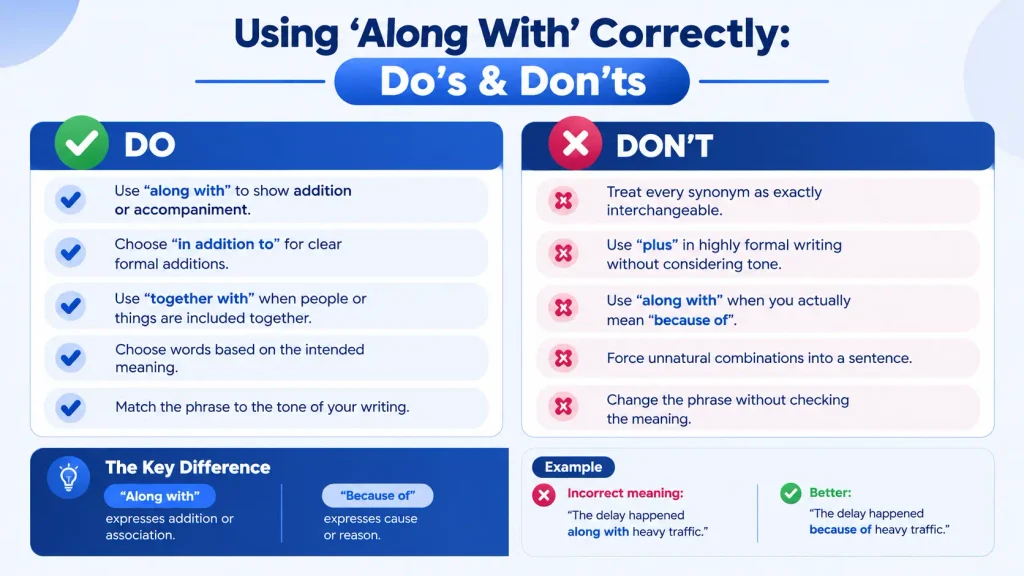
“Plus” is natural in conversation but can sound too casual in academic papers, formal reports, or business documents. In these settings, in addition to is usually a better choice.
The alternatives do not always have exactly the same meaning. Accompanied by emphasizes accompaniment, while in addition to focuses more strongly on adding information or an item.
Avoid forcing multiple alternatives into one sentence. Phrases such as “plus alongside” can make a sentence unnecessarily complicated when a simple alongside or plus would work better.
A phrase that sounds perfectly natural in conversation may not be the best choice for an academic paper. Consider your audience and choose vocabulary that fits the setting.
“Along with” shows addition or association; it does not normally express cause. If you want to explain why something happened, use a cause-and-effect expression such as because of, due to, or another phrase that accurately conveys your meaning.
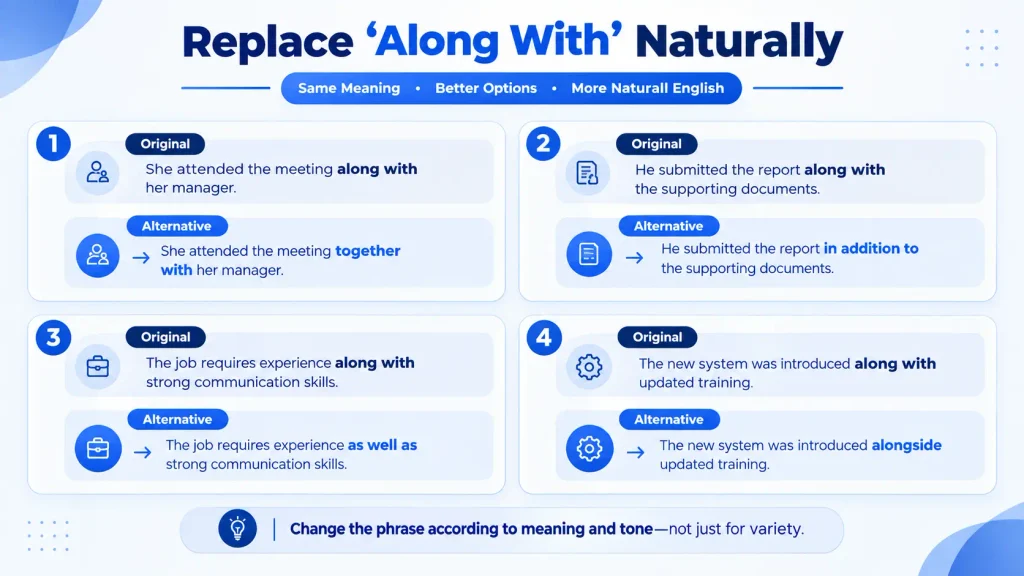
Together with is one of the closest direct alternatives to “along with.” However, in addition to, as well as, and alongside can be better depending on the sentence. If you are writing formally, “in addition to” is often a clear choice; for everyday English, “together with” and “as well as” sound natural.
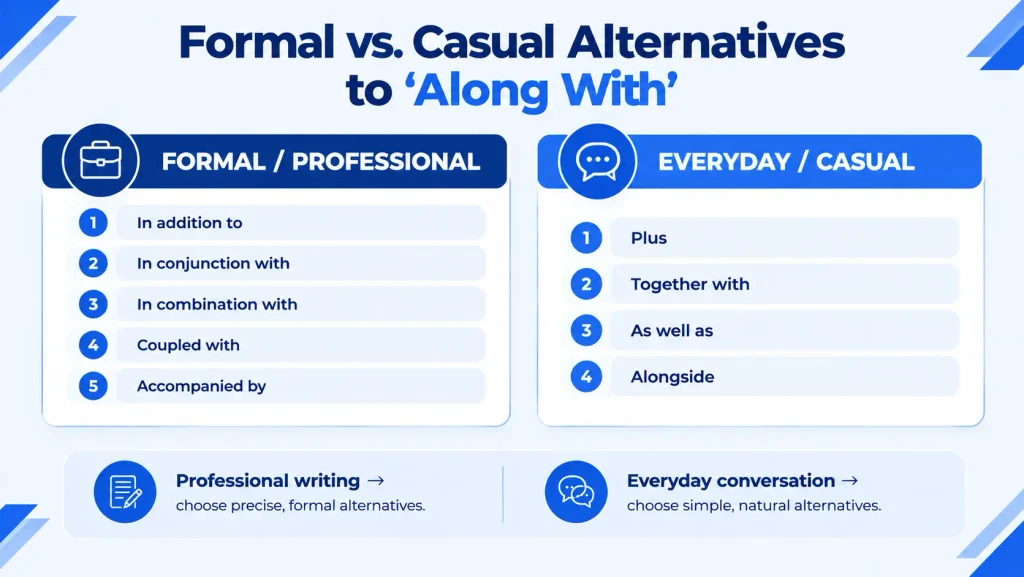
For formal writing, consider in addition to, in conjunction with, in combination with, coupled with, or accompanied by. The correct choice depends on your intended meaning. “In addition to” is useful for adding information, while “in conjunction with” is better when two activities, programs, or organizations operate together.
In many sentences, as well as and along with can communicate a similar idea of addition. However, they can have slightly different emphasis depending on sentence structure. “As well as” often connects related items or qualities, while “along with” commonly emphasizes that one person or thing is included with another.
Yes. Together with is a natural replacement when you mean that two or more people or things are present, involved, or included together. For example, “The manager attended together with her assistant” communicates essentially the same basic relationship as “The manager attended along with her assistant.”
Plus is a common casual alternative when you are simply adding another item or idea. Alongside can also sound natural in everyday English, although it may carry more of a “beside or working next to” meaning. Choose the option that best matches the relationship between the things you are connecting.
Depending on the context, you can use in addition to this, besides this, as well as this, or together with this. In polished writing, in addition to this is often the clearest option when you are introducing another point or piece of information.
You could say together with others, alongside others, with others, or as well as others. The best option depends on the sentence. “Alongside others” works particularly well when people are participating in the same activity, while “together with others” emphasizes joint participation.
Yes, “along with” is grammatically correct and widely used in American English. It functions as a prepositional phrase that can introduce an additional person, thing, or idea. The phrase does not need to be replaced simply because it is common; alternatives are useful mainly when you want greater variety, precision, or a different tone.
There are many useful ways to say along with, but the right choice depends on what you want your sentence to communicate. Together with is a close, natural substitute, while in addition to clearly emphasizes an added item or idea. As well as works smoothly in many everyday and professional sentences, and alongside is useful when people or things exist or operate together.
For more formal writing, phrases such as in conjunction with, in combination with, and coupled with can describe relationships between factors or coordinated activities. In casual communication, plus is often the simplest option.
The important thing is not to replace “along with” just for the sake of using a synonym. Choose the alternative that matches your meaning, audience, and tone so your writing stays clear and natural.

Senior English Editor & Stylistics Director
Michael Bennett is a veteran editor, lexicographer, and publishing consultant with more than two decades of experience in academic and educational publishing. Formerly a senior editorial director at major university presses, he specializes in structural editing, register refinement, and vocabulary development. Michael oversees tone, precision, and stylistic consistency across all publication channels, ensuring content meets rigorous editorial and pedagogical standards.