
Looking for another way to say the best? Try excellent, outstanding, superb, top-notch, first-rate, exceptional, unmatched, or unparalleled. The right alternative depends on context, tone, and what you are describing. Some work well in professional writing, while others sound more natural in casual conversations, compliments, reviews, and everyday English.
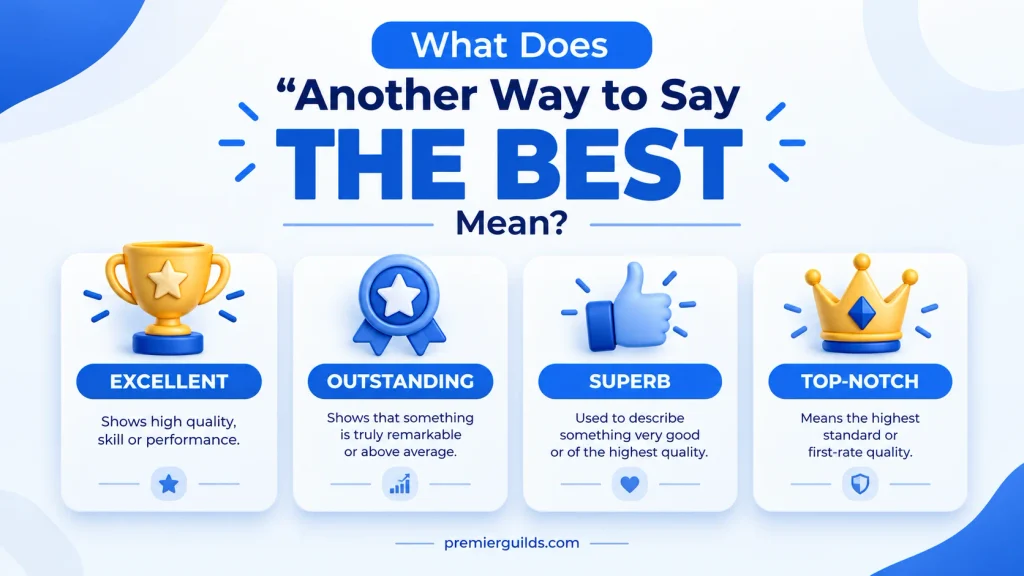
The phrase “the best” describes someone or something that is better than others in a particular group, category, or situation. It can refer to quality, performance, ability, experience, service, or personal preference.
People use “the best” in everyday conversations, compliments, reviews, professional writing, recommendations, and personal messages. For example, you might say, “This is the best restaurant in town,” or “You’re the best.”
However, repeating “the best” can sometimes sound basic or vague. More specific alternatives can help you express praise with the right level of enthusiasm and formality.

Using a different expression can make your writing more precise and natural. The right alternative can also help you communicate whether you mean excellent quality, exceptional performance, or simply strong personal appreciation.
You might use another phrase to:
For example, “excellent” can work well in professional writing, while “top-notch” has a more conversational feel. Cambridge identifies “top-notch” as an informal adjective meaning excellent or of very good quality.
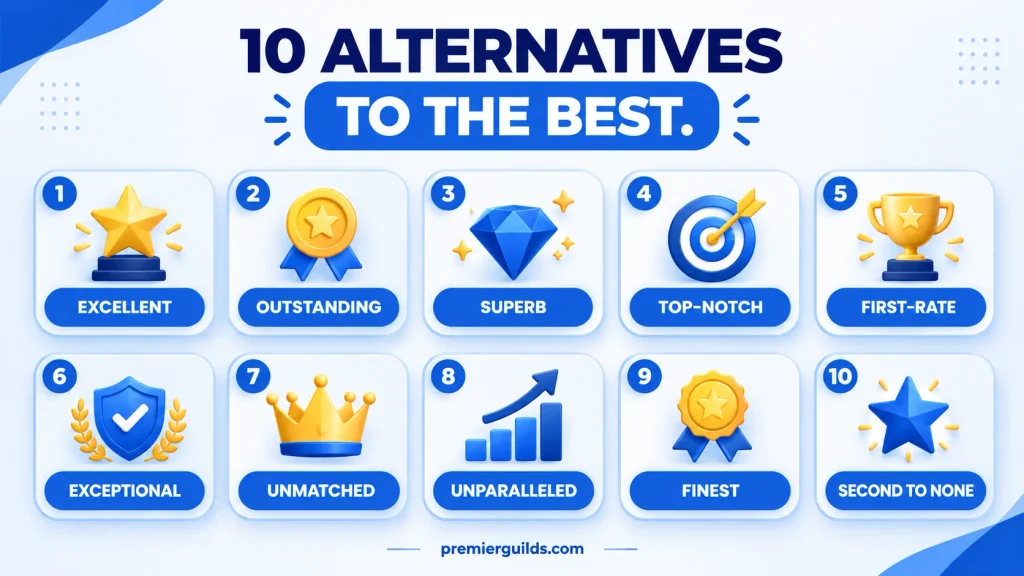
“Excellent” describes something that is extremely good or of very high quality. It is one of the most versatile alternatives to “the best” and can work in professional, academic, and everyday contexts.
“Your presentation was excellent and clearly explained the main points.”
“We received excellent service from the customer support team.”
Use “excellent” when you want strong praise without making the absolute claim that something is number one.
“Outstanding” describes someone or something that stands out because of exceptional quality, achievement, or ability. It is especially useful when praising performance or accomplishments.
“She received an award for her outstanding contribution to the project.”
“The restaurant is known for its outstanding customer service.”
Choose “outstanding” when you want to emphasize that something rises noticeably above the usual standard.
“Superb” means extremely good or excellent. It is a strong compliment that works naturally when describing food, service, performances, experiences, skills, and quality.
“The chef prepared a superb meal for the anniversary dinner.”
“Her attention to detail was superb throughout the entire project.”
Use “superb” when you want enthusiastic praise without sounding overly dramatic.
“Top-notch” means excellent or of very high quality. It has an informal tone, so it works particularly well in conversations, reviews, recommendations, and friendly professional communication.
“The new hotel has top-notch facilities and excellent customer service.”
“You did a top-notch job organizing the conference.”
Avoid using “top-notch” in highly formal documents where a more neutral term such as “excellent” may fit better.
“First-rate” describes someone or something of very high quality or standard. It can be used for people, services, products, performances, and professional work.
“The company provides first-rate training for new employees.”
“We hired a first-rate consultant to help with the expansion.”
Use “first-rate” when you want a polished compliment that sounds confident but not overly enthusiastic.
“Exceptional” suggests that something is unusually good or significantly better than what is normally expected. It is useful when you want to emphasize a distinctive quality or achievement.
“Her exceptional leadership helped the team complete the project ahead of schedule.”
“The candidate demonstrated exceptional problem-solving skills during the interview.”
Use “exceptional” when you have a specific quality or achievement that supports the praise.
“Unmatched” means that nothing else compares with the person, product, service, or quality being described. It makes a strong claim, so it should be used when the context supports that level of praise. Cambridge lists “unmatched” as a formal alternative related to “best.”
“The resort offers unmatched views of the Pacific coastline.”
“Her knowledge of the local market is unmatched within the organization.”
Reserve “unmatched” for situations where you genuinely want to communicate an extremely high level of superiority.
“Unparalleled” means having no equal or comparison. It is a strong, formal alternative that often appears in professional, promotional, and formal writing.
“The research team has developed an unparalleled level of expertise in the field.”
“The program provides unparalleled access to industry mentors.”
Because “unparalleled” is strong and formal, use it selectively rather than replacing every instance of “the best” with it.
“Finest” refers to the highest quality or most excellent example of something. It is especially natural when describing products, food, craftsmanship, services, or notable examples.
“The store specializes in some of the finest handmade furniture in the region.”
“She is considered one of the finest writers of her generation.”
“Finest” works especially well when talking about quality, craftsmanship, or a highly respected person or work.
“Second to none” means that someone or something is equal to or better than everything else in the relevant category. It is an idiomatic expression that delivers strong praise without directly repeating “the best.”
“Our customer service team is second to none when it comes to resolving complex issues.”
“Her dedication to the community is second to none.”
Use “second to none” when you want an emphatic compliment, but make sure the surrounding context supports such a strong statement.
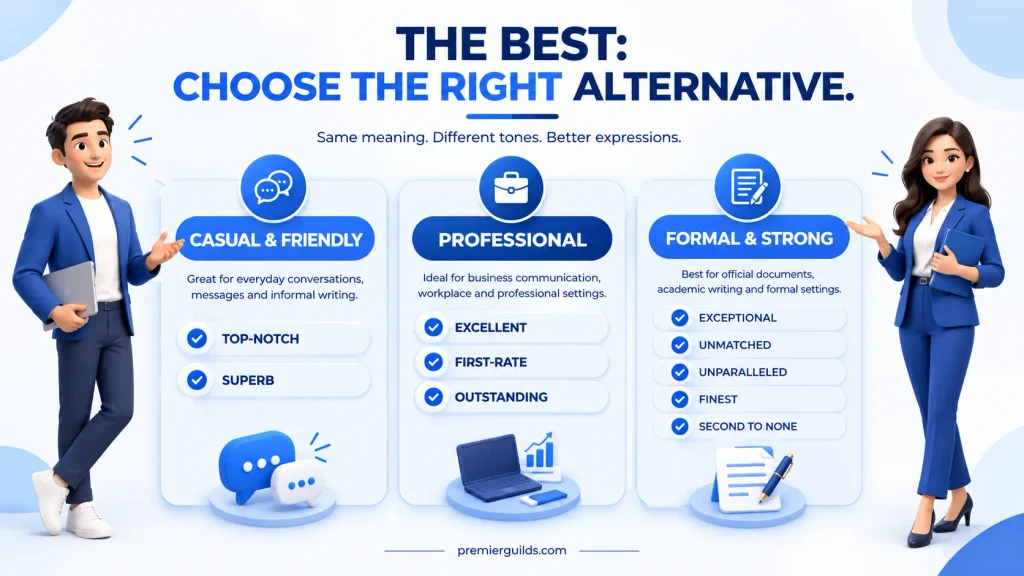
| Alternative | Best Used In | Tone |
| Excellent | Professional writing, reviews, everyday English | Professional |
| Outstanding | Achievements, work, performance | Formal |
| Superb | Experiences, service, performance | Warm |
| Top-Notch | Conversations, reviews, recommendations | Casual |
| First-Rate | Business, services, professional writing | Professional |
| Exceptional | Skills, achievements, performance | Formal |
| Unmatched | Strong praise, professional descriptions | Formal |
| Unparalleled | Formal and professional writing | Formal |
| Finest | Quality, craftsmanship, people, products | Polite |
| Second to None | Strong compliments and professional praise | Confident |

Words such as “unmatched” and “unparalleled” make very strong claims. If the evidence does not support the statement, “excellent” or “outstanding” may sound more natural.
“Top-notch” is useful in everyday and conversational communication, but it may feel too informal for certain formal documents. Consider “excellent” or “first-rate” when a more polished tone is needed.
Using “excellent” in every sentence can make your writing repetitive. Rotate between appropriate alternatives based on the exact meaning you want to communicate.
Not every synonym fits every situation. “Finest” may work naturally for craftsmanship, while “outstanding” may be better for an achievement or professional performance.
Constantly calling everything “the best” or “unparalleled” can weaken your message. Specific praise is often more believable because it tells the reader what makes something impressive.
Several alternatives can replace “the best,” including excellent, outstanding, superb, exceptional, first-rate, and finest. The right choice depends on your context. For everyday communication, “excellent” is versatile, while “outstanding” works well for achievements and “first-rate” suits professional descriptions. Stronger options include “unmatched” and “unparalleled.”
You can say “you’re amazing,” “you’re exceptional,” “you’re outstanding,” “you’re incredible,” or “you’re second to none.” For a professional message, “Your work has been outstanding” may sound more appropriate. For a warm personal message, “You’re amazing” or “I really appreciate everything you do” can feel more natural.
Professional alternatives include excellent, outstanding, exceptional, first-rate, and highly regarded. Your choice should match the subject. For example, “outstanding performance” works well in workplace communication, while “excellent service” is suitable for customer reviews and business writing. Avoid using overly dramatic terms unless you can support the claim.
Formal options include outstanding, exceptional, unmatched, unparalleled, and first-rate. “Unparalleled” and “unmatched” communicate especially strong praise, while “outstanding” and “exceptional” are more flexible. Cambridge includes several of these terms among words associated with “best” and the idea of being better than anyone or anything else.
In casual American English, you can use phrases such as top-notch, amazing, awesome, fantastic, or excellent. “Top-notch” is particularly useful for describing quality or performance in an informal way. Cambridge classifies “top-notch” as informal and defines it as excellent or of very good quality.
Choose alternatives based on what you are praising. Use “outstanding” for achievements, “excellent” for general quality, “superb” for strong positive reactions, “first-rate” for polished professional descriptions, and “exceptional” for unusually strong performance. This creates variety while keeping your meaning clear.
“Top-notch” can be used in professional communication, especially in conversational settings, business discussions, reviews, and informal workplace messages. However, it is classified as informal, so “excellent,” “outstanding,” or “first-rate” may be better choices for highly formal documents.
There is no single strongest alternative for every situation. Unmatched, unparalleled, second to none, and unsurpassed all communicate an extremely high level of praise. However, these phrases make strong claims. If you want a more measured compliment, “excellent,” “outstanding,” or “exceptional” may be more appropriate.
There are many natural ways to say “the best,” and the right alternative depends on your audience and purpose. Excellent is one of the most flexible choices, while outstanding works especially well for achievements and performance. Top-notch adds a casual, conversational feel, whereas first-rate sounds polished and professional.
For stronger praise, words such as exceptional, unmatched, and unparalleled can communicate a higher level of distinction. However, strong language works best when the context supports it. Instead of automatically choosing the most powerful synonym, consider what you are describing and how formal your message needs to be. The best word choice is the one that expresses your intended level of praise cleAnother Way to Say the Best: 10 Alternatives

Our editorial team brings together decades of expertise in applied linguistics, lexicography, and educational publishing. Dedicated to clarity, precision, and tone, our experts ensure that every resource meets the highest standards of professional and academic excellence.