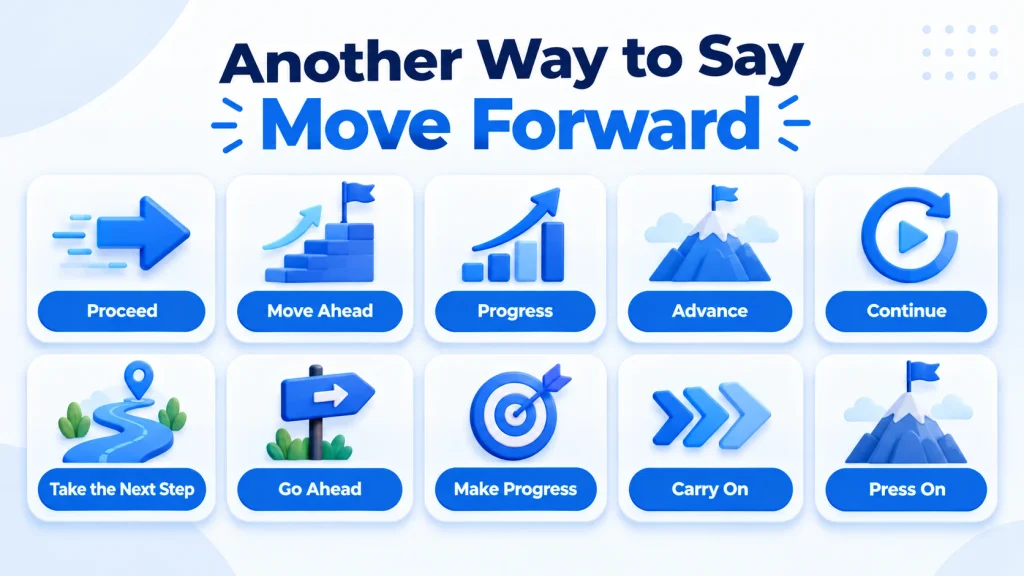
Another way to say “move forward” includes proceed, move ahead, progress, advance, continue, take the next step, go ahead, and make progress. The best alternative depends on context. In professional communication, “proceed” and “move ahead” sound natural, while “progress” and “advance” work well when discussing development, goals, or career growth.
“Move forward” generally means to continue, make progress, take the next step, or advance toward a goal. The exact meaning depends on the situation.
For example, a team may “move forward with a project,” meaning they will continue with the plan. Someone may also “move forward” after a difficult experience, meaning they are ready to focus on the future.
The phrase is common in workplace conversations, business emails, project discussions, career writing, personal communication, and formal documents. Because it has several meanings, choosing a more specific alternative can make your message clearer.
Although “move forward” is natural and widely understood, repeating it too often can make your writing sound predictable. More specific alternatives can also communicate exactly what you mean.
Using different expressions can help you:
For example, “proceed with the plan” emphasizes taking action, while “make progress” emphasizes development. Choosing the right phrase adds precision to your writing.
“Proceed” means to continue with an action, plan, or process. It is one of the strongest professional alternatives to “move forward,” especially when discussing decisions or planned actions.
The word sounds clear and professional without being unnecessarily complicated.
Once we receive the client’s approval, we can proceed with the project.
Please let me know if you would like us to proceed with the revised proposal.
Use “proceed” when you mean continue with a specific action or plan.
“Move ahead” has almost the same meaning as “move forward.” It suggests continuing with a plan, project, or decision after reaching a certain point.
It sounds natural in both workplace and everyday American English.
The team agreed to move ahead with the new marketing strategy.
If everyone is comfortable with the schedule, we can move ahead tomorrow.
“Move ahead” is a good direct replacement when you want to keep your sentence conversational.
“Progress” focuses on development or improvement over time. Unlike “proceed,” it usually emphasizes how much something has developed rather than simply continuing an action.
It works particularly well when discussing projects, goals, skills, or career development.
The project has continued to progress despite the initial delays.
She has made significant progress toward her professional goals.
Use “progress” when your main idea is development or improvement, not simply continuing.
“Advance” means to move toward a goal, stage, or higher level. It can describe projects, careers, ideas, technology, or plans.
The word has a polished tone and works well in professional and formal writing.
The company plans to advance its sustainability initiatives next year.
Her training helped her advance into a leadership position.
Choose “advance” when you want to emphasize movement toward a higher level or goal.
“Continue” means to keep doing something that has already started. It is a simple and direct alternative when “move forward” means maintaining progress or activity.
Because it is straightforward, it fits almost any context.
We will continue working on the proposal after the meeting.
The company plans to continue expanding its customer support services.
Use “continue” when you want the clearest possible wording without adding extra nuance.
“Take the next step” suggests moving from one stage of a process to another. It is especially useful when discussing decisions, plans, relationships, projects, or career goals.
The phrase sounds natural and action-oriented.
After reviewing the applications, we are ready to take the next step in the hiring process.
I think we have enough information to take the next step.
Use this phrase when you want to emphasize what should happen next.
“Go ahead” can mean to proceed with something after receiving approval or deciding that an action should happen. It is common in spoken American English and informal workplace communication.
It is shorter and more conversational than “proceed.”
You have my approval, so go ahead and send the proposal.
If the budget looks good, we can go ahead with the purchase.
Use “go ahead” when someone has permission or agreement to take action.
“Make progress” means to move closer to a goal or improve a situation. It focuses on results and development rather than simply continuing.
This phrase is especially useful when discussing projects, goals, work performance, or personal development.
The team is making steady progress on the new website.
We need to make more progress before we can launch the product.
Use “make progress” when you want to highlight measurable or meaningful improvement.
“Carry on” means to continue doing something. It is more conversational than “proceed” and can work well when talking about ongoing work or activities.
In American English, it can sometimes sound slightly informal, so consider your audience before using it in formal business writing.
Despite the unexpected delay, the team decided to carry on with the event.
You can carry on with the presentation while I prepare the next slide.
Use “carry on” mainly in conversational or less formal situations.
“Press on” means to continue despite difficulties, delays, or obstacles. It adds a sense of determination that “move forward” does not always express.
It can work in professional, motivational, and personal contexts when persistence is important.
Even after the first proposal was rejected, the team decided to press on.
We faced several challenges, but we chose to press on and complete the project.
Use “press on” when the situation involves persistence or overcoming obstacles.
| Alternative | Best Used In | Tone |
|---|---|---|
| Proceed | Business, formal communication | Professional, formal |
| Move Ahead | Workplace, everyday communication | Natural, conversational |
| Progress | Projects, goals, development | Professional |
| Advance | Career, business, formal writing | Formal, polished |
| Continue | General communication | Neutral |
| Take the Next Step | Plans, decisions, processes | Action-oriented |
| Go Ahead | Permission, decisions | Casual, conversational |
| Make Progress | Goals, projects, development | Professional |
| Carry On | Informal conversations | Casual |
| Press On | Challenges, persistence | Determined, positive |
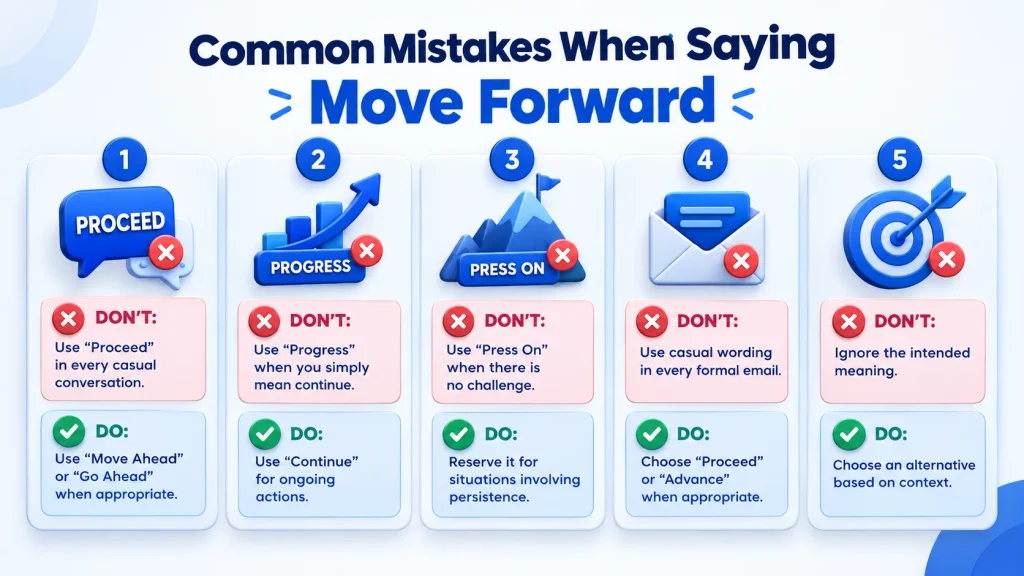
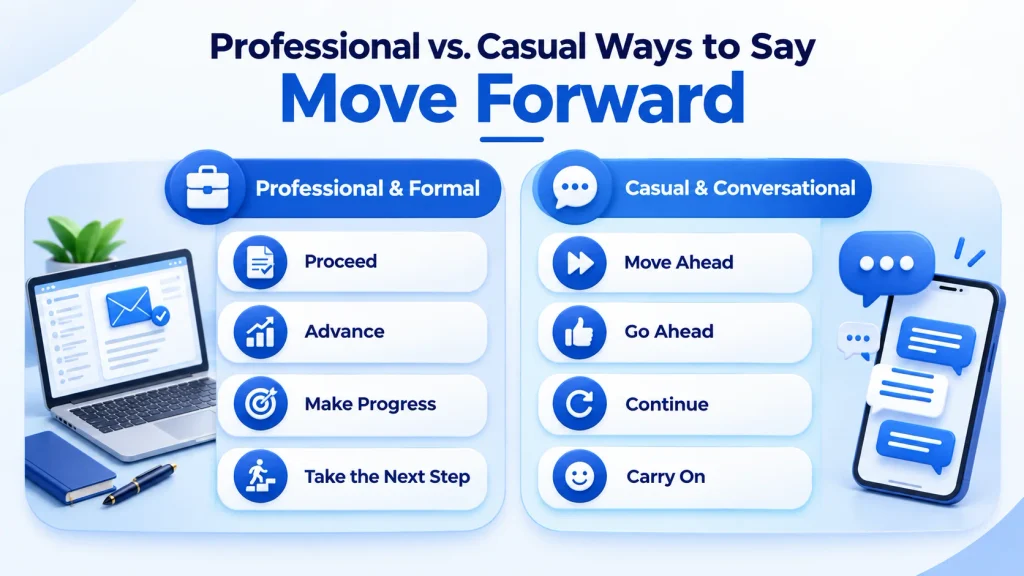
“Proceed” is professional, but it can sound overly formal in casual conversations. With friends or familiar coworkers, “move ahead” or “go ahead” may sound more natural.
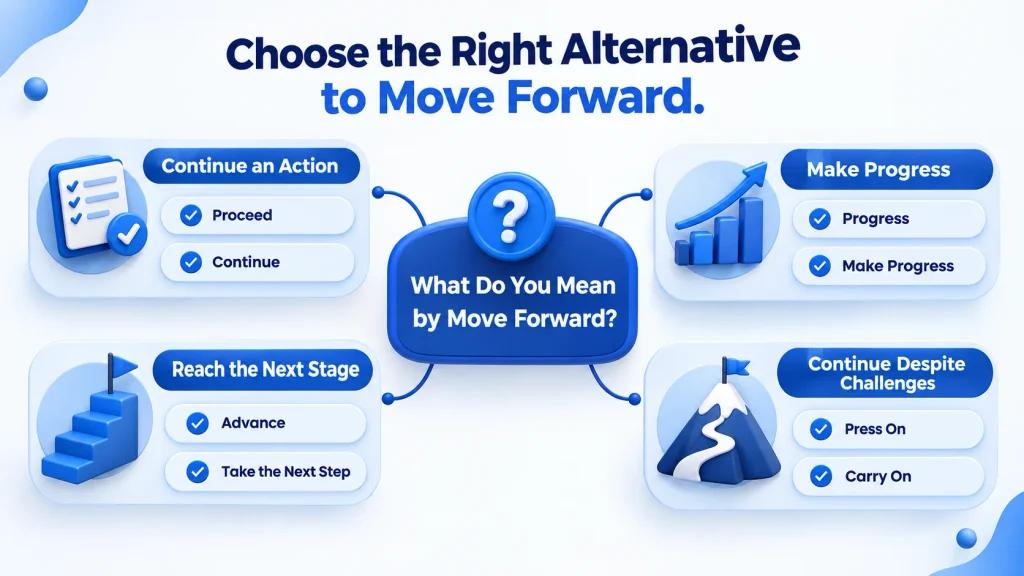
“Progress” usually suggests improvement or development, while “continue” simply means something keeps happening. Choose the word that matches the intended meaning.
“Press on” suggests overcoming difficulty, while “go ahead” often suggests permission. Replacing “move forward” without considering context can change the meaning of your sentence.
Expressions such as “carry on” and “go ahead” can work in casual workplace communication but may not fit every formal document. In those situations, “proceed” may be more appropriate.
Using the same phrase throughout an email, report, or article can make your writing repetitive. Choose alternatives based on whether you mean continuation, progress, advancement, or action.
“Proceed” is one of the clearest professional alternatives to “move forward.” You can also use “advance,” “continue,” “make progress,” or “take the next step,” depending on the context. For example, “We can proceed with the proposal” sounds precise when you are discussing an agreed business action.
In an email, you can say “proceed,” “move ahead,” “continue,” or “take the next step.” The best option depends on your meaning. “We can proceed with the plan” works well for a formal message, while “We can move ahead with the plan” sounds slightly more conversational.
Common workplace alternatives include “proceed,” “progress,” “advance,” “continue,” and “move ahead.” Each has a slightly different meaning. “Proceed” emphasizes taking action, “progress” emphasizes development, and “advance” often suggests movement toward a higher stage or goal.
“Move ahead” and “move forward” are very similar and can often be used interchangeably. Both can mean continuing with a plan or activity. However, “move forward” can also describe emotional or personal progress, while “move ahead” is more commonly associated with taking action or continuing a plan.
“Proceed” and “advance” are useful formal alternatives. “Proceed” works particularly well when referring to an action, process, or decision, such as “We can proceed with the agreement.” “Advance” is useful when discussing development, progress, careers, research, or goals.
You can say “proceed with the project,” “move ahead with the project,” “continue with the project,” or “take the next step with the project.” “Proceed with the project” is especially suitable for professional emails, while “move ahead with the project” sounds more conversational.
“Make progress,” “take the next step,” and “press on” can all communicate a positive sense of moving forward. “Make progress” highlights improvement, while “take the next step” focuses on action. “Press on” is especially useful when someone is continuing despite challenges.
In a meeting, natural options include “let’s proceed,” “let’s move ahead,” “let’s take the next step,” or “let’s continue.” For example, “Let’s proceed with the next item” sounds professional, while “Let’s move ahead with the plan” feels more conversational and collaborative.
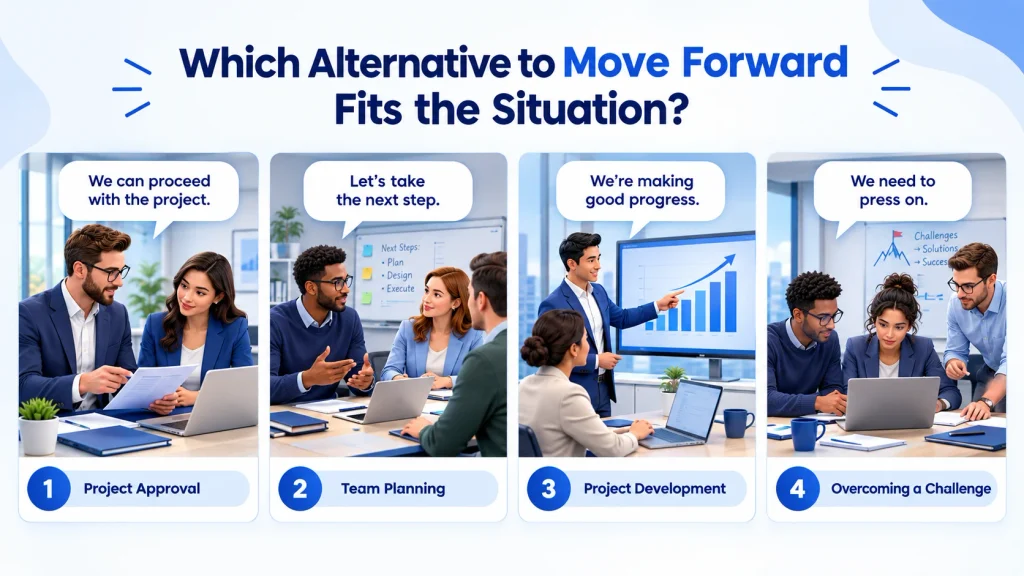
There are many effective ways to say “move forward,” but the best choice depends on what you want to communicate. Proceed is a strong professional option when you mean taking action, while move ahead is a natural choice for everyday workplace conversations.
If you want to emphasize development, choose progress or make progress. For a new stage in a process, take the next step works well. When permission has already been given, go ahead is concise and conversational.
For situations involving challenges, press on adds a sense of determination. The key is to choose a phrase that matches your intended meaning rather than simply replacing words. A precise alternative makes your writing clearer, more natural, and more effective.

Senior English Editor & Stylistics Director
Michael Bennett is a veteran editor, lexicographer, and publishing consultant with more than two decades of experience in academic and educational publishing. Formerly a senior editorial director at major university presses, he specializes in structural editing, register refinement, and vocabulary development. Michael oversees tone, precision, and stylistic consistency across all publication channels, ensuring content meets rigorous editorial and pedagogical standards.