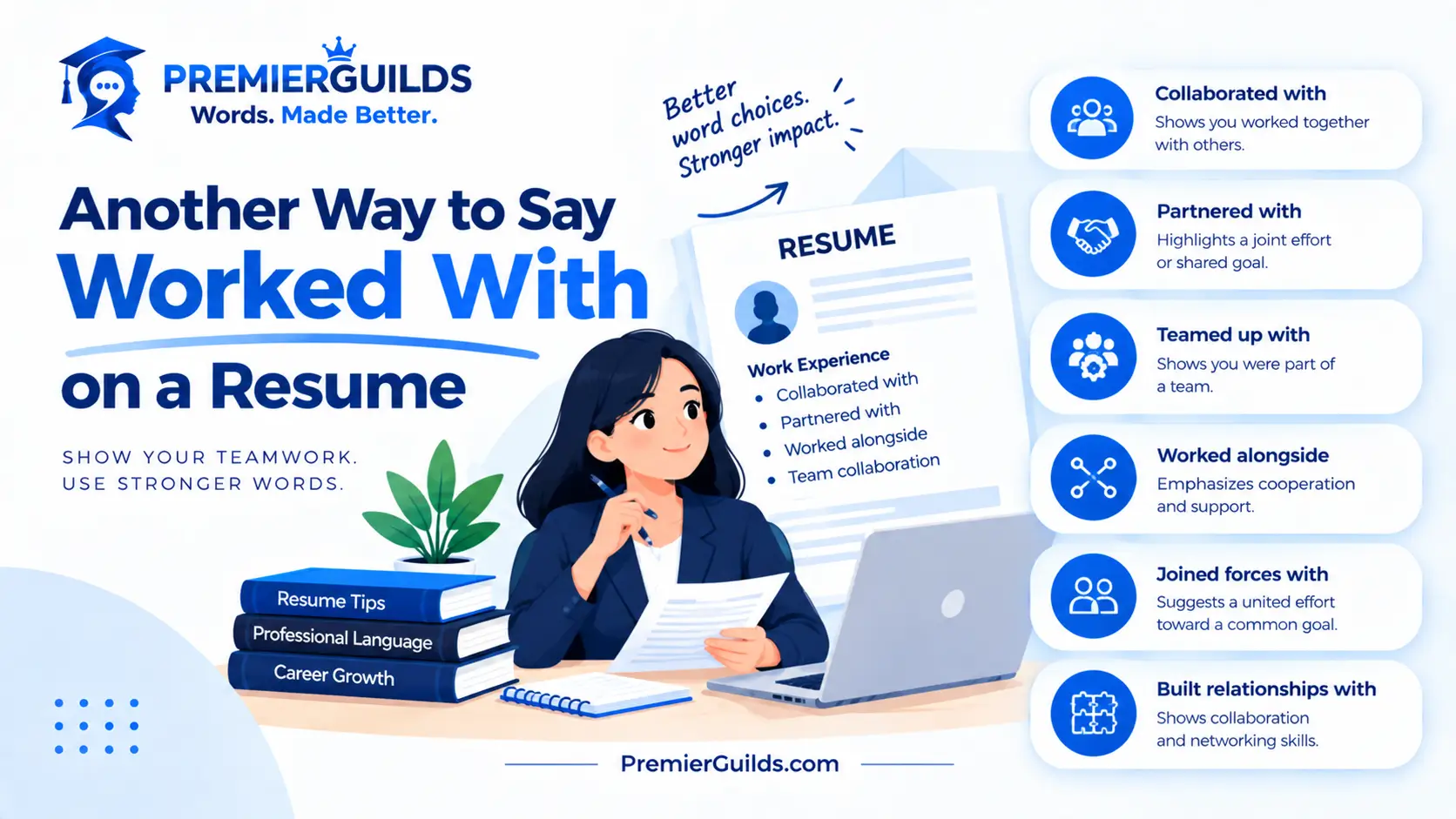
If you need another way to say worked with on a resume, use a more specific phrase such as collaborated with, partnered with, coordinated with, contributed to, supported, or liaised with. The best choice depends on your actual role, such as teamwork, coordination, support, or communication.
The phrase “worked with” is common on resumes, but it can be too vague when you want to show exactly what you contributed. Career-writing guidance commonly recommends replacing generic wording with a more precise action verb that explains your role in the work.
The right alternative depends on what you actually did. If you shared responsibility with a team, collaborated with may be best; if you organized people or tasks, coordinated with may be stronger.
On a resume, “worked with” means you performed tasks, completed projects, or solved problems alongside other people, teams, departments, clients, or organizations.
For example, you might write:
Worked with the marketing team to develop promotional campaigns.
The meaning is clear, but the phrase does not explain your specific contribution. A more precise verb can show whether you collaborated, coordinated, supported, or led part of the work.
People often use “worked with” because it is simple and accurate. However, resume bullets are stronger when they quickly communicate your action, responsibility, and result.
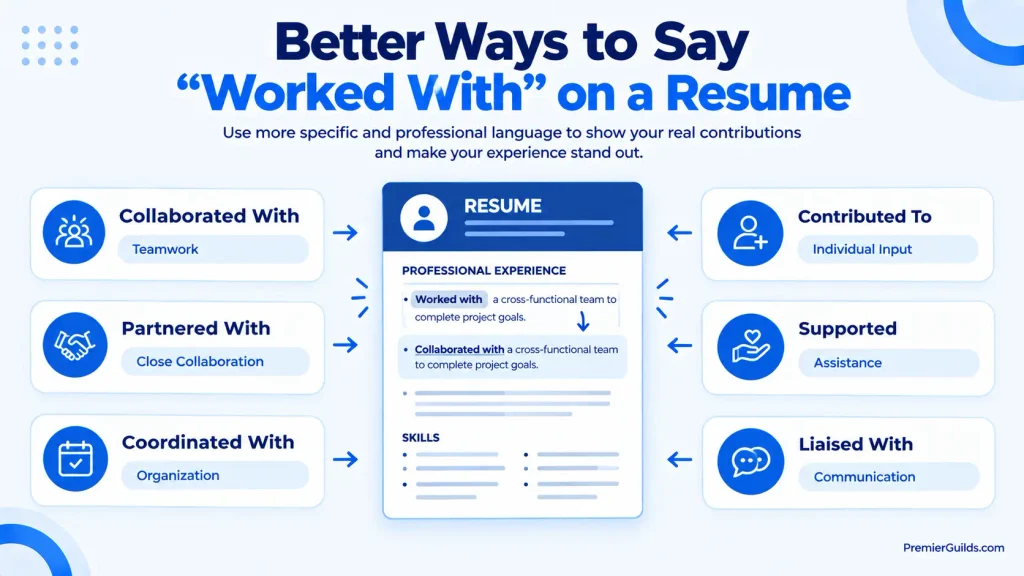
Replacing “worked with” can make your resume more specific and easier for a hiring manager to understand. Current resume guidance emphasizes choosing the verb that matches the actual nature of your contribution rather than simply replacing a phrase with a stronger-sounding word.
Using alternatives can help you:
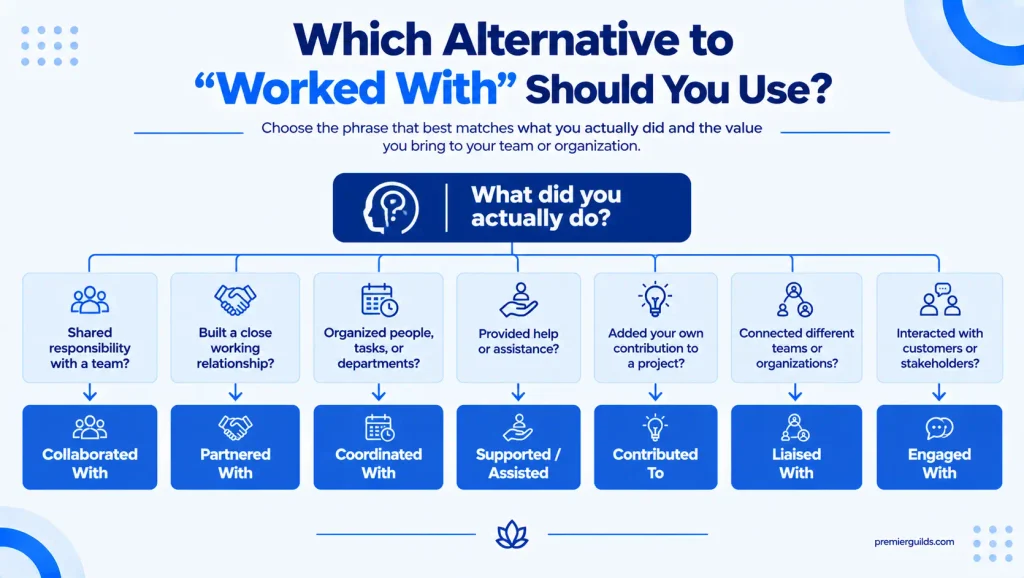
Collaborated with shows that you actively worked with other people toward a shared goal. It is one of the best general alternatives when teamwork and shared responsibility are important.
Collaborated with the sales team to develop strategies that improved customer retention.
Collaborated with designers and developers to create user-friendly digital products.
Use collaborated with when the work involved genuine teamwork rather than simply communicating with another person.
Partnered with suggests a close working relationship in which both sides contributed to a shared objective. It can sound especially effective when describing work with clients, departments, vendors, or business leaders.
Partnered with department managers to improve employee onboarding procedures.
Partnered with key clients to identify service improvements and resolve recurring concerns.
Choose this phrase when the relationship was active and cooperative, rather than limited to occasional communication.
Coordinated with emphasizes organization, communication, and making sure different people or groups worked effectively together. It is useful when your role involved schedules, resources, processes, or multiple teams.
Coordinated with vendors and event staff to ensure smooth conference operations.
Coordinated with three departments to streamline the product launch process.
Use this alternative when you helped organize people, activities, deadlines, or information.
Contributed to focuses on your individual input to a larger project or team effort. It works well when you played an important role but did not own or lead the entire project.
Contributed to the development of a new employee training program.
Contributed to a cross-functional project that reduced customer response times.
Use contributed to when you want to show involvement without overstating your level of responsibility.
Supported is useful when your role involved helping a person, team, department, or project succeed. It clearly communicates assistance without suggesting that you were the project leader.
Supported the finance team with monthly reporting and data analysis.
Supported project managers by preparing schedules, reports, and client updates.
Use this word when your contribution was primarily assistance, resources, information, or operational support.
Liaised with means you acted as a communication link between people, teams, clients, or organizations. It is particularly useful for roles involving communication across different groups.
Liaised with external vendors to resolve delivery issues and maintain project timelines.
Liaised with department leaders to communicate project requirements and deadlines.
This phrase is strongest when your job involved connecting different parties and keeping information moving between them.
Worked alongside keeps the collaborative meaning of “worked with” while making the relationship sound more direct and natural. It emphasizes that you performed tasks side by side with another person or team.
Worked alongside senior designers to develop marketing materials for new product launches.
Worked alongside customer service representatives to identify common client concerns.
Use this phrase when you want a natural alternative without making your role sound more senior than it actually was.
Teamed with highlights teamwork and shared effort. It is concise and useful when you want to show that you joined forces with another person or group to accomplish a specific objective.
Teamed with software developers to test and improve new application features.
Teamed with regional managers to implement updated customer service procedures.
Use teamed with for straightforward collaborative work, but choose a more precise verb when your role involved leadership or coordination.
Assisted indicates that you helped another person or team complete a task or achieve a goal. It is especially useful when your role was supportive rather than independently responsible for the outcome.
Assisted the HR department with candidate interviews and employee onboarding.
Assisted project leaders with research, documentation, and client communications.
Use assisted only when you genuinely provided support. If you independently handled the task, choose a more direct action verb.
Engaged with emphasizes active interaction with people, customers, teams, or stakeholders. It can be useful when your work involved communication, relationship building, consultation, or customer interaction.
Engaged with customers to understand their needs and recommend appropriate solutions.
Engaged with internal stakeholders to gather feedback on the proposed workflow.
Use this phrase when the important part of your experience was meaningful interaction rather than simply being part of the same team.
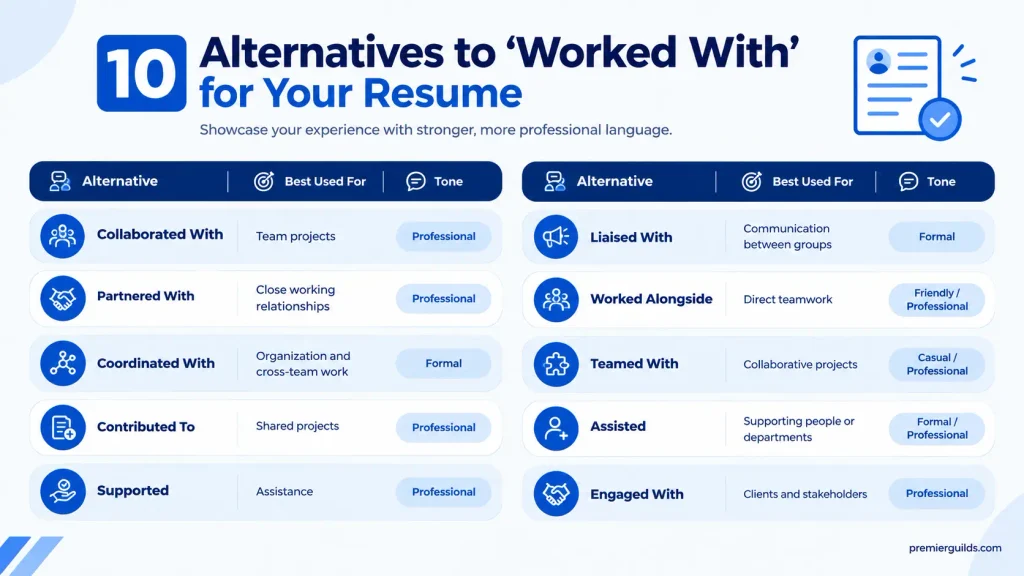
| Alternative | Best Used In | Tone |
| Collaborated with | Team projects and shared responsibilities | Professional |
| Partnered with | Clients, teams, vendors, strategic projects | Professional |
| Coordinated with | Scheduling, organization, cross-team work | Formal |
| Contributed to | Shared projects and team achievements | Professional |
| Supported | Assistance and operational responsibilities | Professional |
| Liaised with | Communication between groups | Formal |
| Worked alongside | Direct teamwork | Friendly/Professional |
| Teamed with | Collaborative projects | Casual/Professional |
| Assisted | Supporting people or departments | Formal/Professional |
| Engaged with | Customers, stakeholders, and communication | Professional |
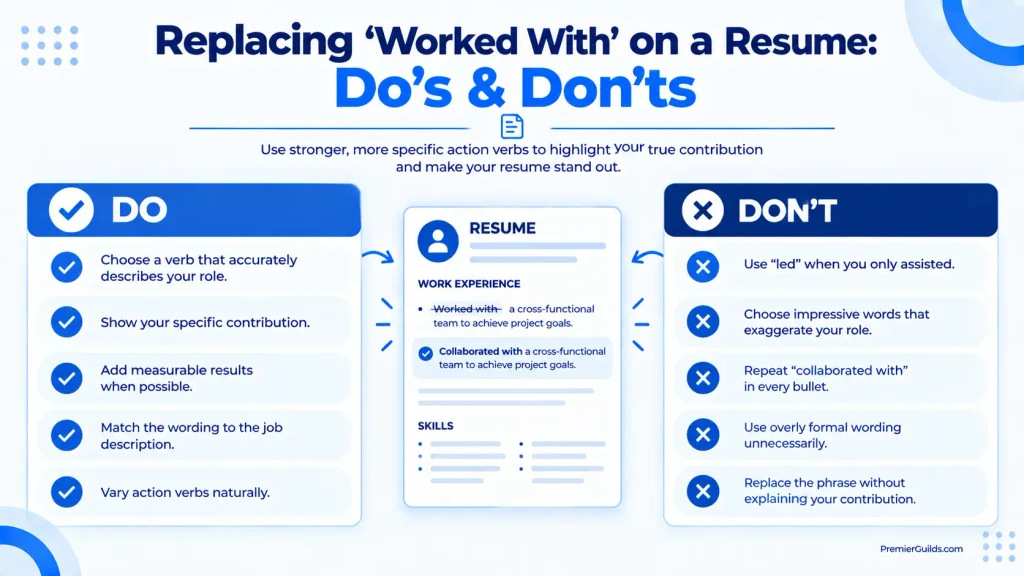
Do not replace “worked with” with led or spearheaded unless you actually had leadership responsibility. Strong wording should remain truthful.
Writing “collaborated with” in every bullet does not automatically make a resume stronger. Vary your language based on the actual responsibility described.
Words such as liaised can be appropriate in professional contexts, but they may sound unnatural when a simple word like collaborated communicates the idea more clearly.
Simply changing “worked with” to “collaborated with” may not fix a weak bullet. Explain what you did and, when possible, show the result.
Weak:
Collaborated with the marketing team.
Stronger:
Collaborated with the marketing team to launch email campaigns that increased customer engagement.
Avoid choosing a word simply because it sounds impressive. Supported, assisted, and contributed to may be more accurate than managed or directed when you were not responsible for the entire project.
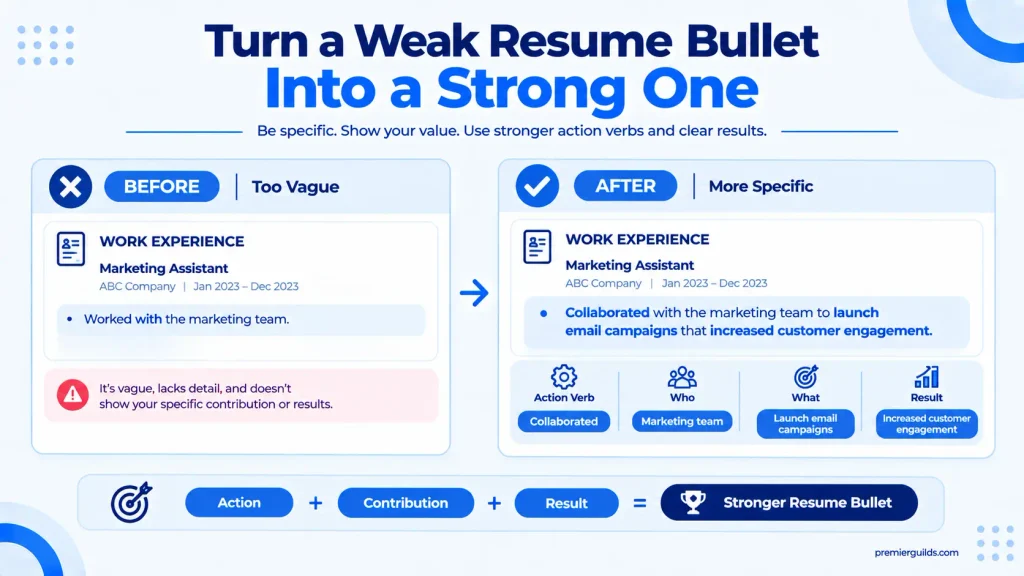
Collaborated with is one of the best general alternatives because it clearly communicates teamwork and shared responsibility. However, the best choice depends on your actual role. Use coordinated with for organization, partnered with for close collaboration, and supported when your primary responsibility was helping another person or team.
Yes, “worked with” is grammatically correct and can be appropriate on a resume. The issue is that it can be too general and may not show what you actually contributed. If a more precise action verb accurately describes your role, using that verb can make the bullet clearer and more informative.
You can say collaborated with a team, teamed with a team, or worked alongside a team. If you organized the team’s activities, coordinated with the team may be more accurate. If you contributed to a larger project, you could also use contributed to and describe the specific result.
Collaborated with is a strong professional synonym for “worked with.” Other options include partnered with, coordinated with, liaised with, contributed to, supported, and engaged with. Select the phrase based on your actual responsibility instead of choosing an alternative only because it sounds more impressive.
The best replacement depends on what you did with the clients. Use partnered with clients for close business relationships, engaged with clients for customer interaction, supported clients for assistance, or liaised with clients when you served as a communication link between the client and your organization.
Yes. Collaborated with is a clear, standard phrase for describing teamwork and can work well in resume bullet points. Still, ATS optimization should not be the only goal. Use terminology that accurately reflects the job description and combine the action verb with specific responsibilities, skills, and measurable outcomes when available.
You can write collaborated with cross-functional teams, coordinated with multiple departments, or partnered with teams across the organization. Choose the phrase according to your role. If you served as a communication bridge between groups, liaised with multiple teams may be the most precise option.
No. You do not need to remove every instance simply because the phrase is common. The goal is clarity, not replacing words for the sake of variety. If “worked with” accurately describes your responsibility and the rest of the bullet clearly explains your contribution and results, keeping it can be perfectly reasonable.
Finding another way to say worked with on a resume can help you describe your experience with greater precision. The best alternative is not necessarily the most powerful-sounding word; it is the one that accurately reflects what you did.
Use collaborated with for general teamwork, partnered with for close working relationships, and coordinated with when organization was a major part of your role. Choose supported or assisted when you helped another person or team, while liaised with works well for communication between different groups.
Most importantly, do more than swap one phrase for another. Follow your action verb with the task you performed and, when possible, the result you achieved. That approach makes your resume clearer, more credible, and more useful to hiring managers.

English Language & Communication Specialist
Dr. Emily Carter is an English language and communication specialist focused on vocabulary, word choice, professional writing, and practical English usage. She helps readers understand the differences between similar words and choose expressions that sound natural, clear, and appropriate for different contexts.