
If you’re looking for another way to say have fun, you can use phrases such as enjoy yourself, have a great time, enjoy, have a blast, make the most of it, or have a wonderful time. The best choice depends on the situation, relationship, and tone you want to convey.
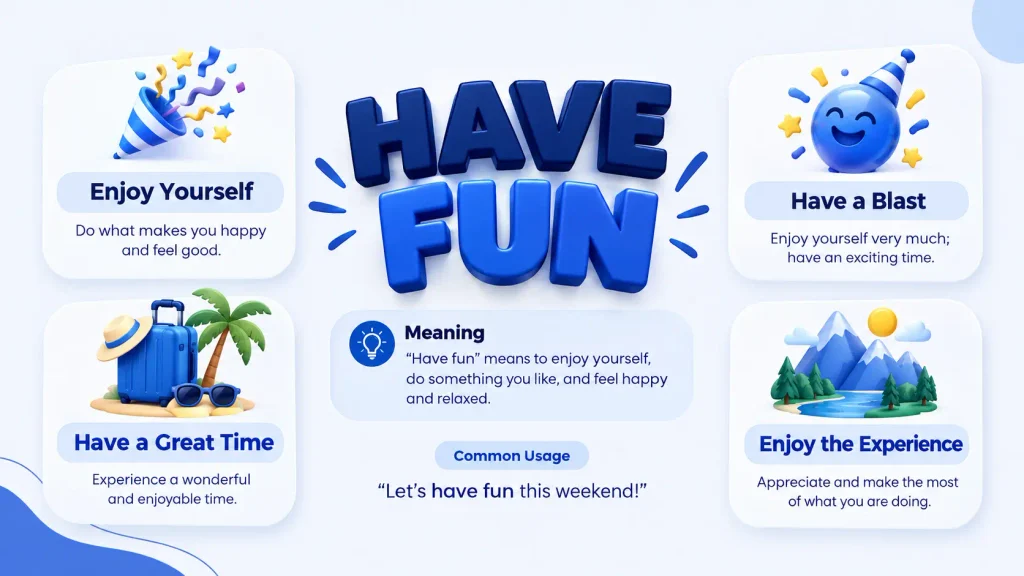
The phrase “another way to say have fun” refers to different expressions you can use instead of telling someone to enjoy themselves.
“Have fun” is a friendly expression used when someone is going somewhere, attending an event, starting an activity, traveling, or spending time with others. For example, you might say it to a friend before a party or to a coworker before a weekend trip.
People often search for alternatives because they want their message to sound more natural, warm, enthusiastic, or specific. The right expression can also help you avoid repeating “have fun” in everyday conversations.
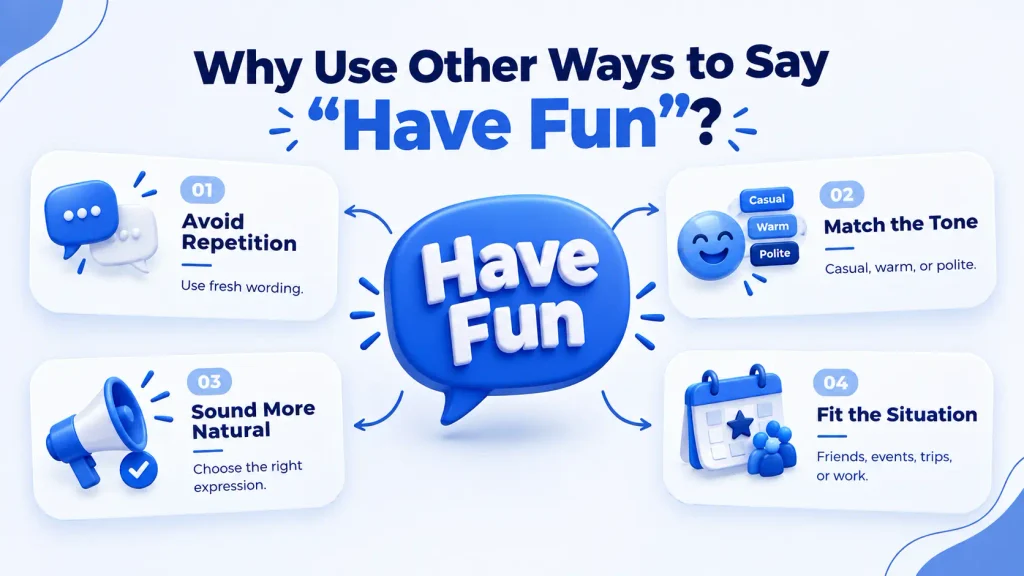
Although “have fun” is perfectly natural, changing the wording can make your message better suited to the situation.
Different alternatives can help you:
For example, “Have a blast!” feels more energetic than “Have fun,” while “Enjoy yourself” sounds slightly more polished.
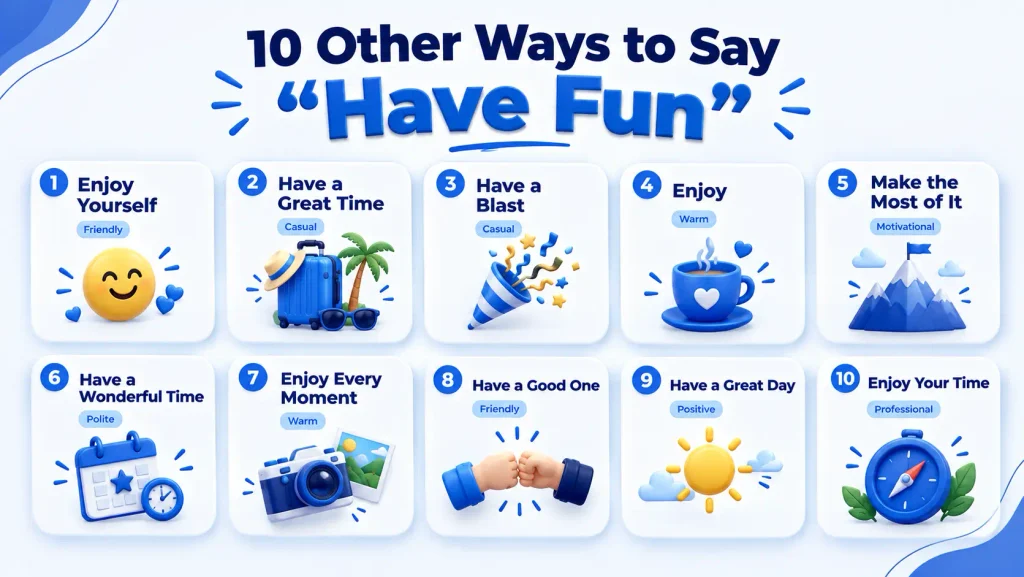
Enjoy yourself is one of the closest alternatives to “have fun.” It is friendly, natural, and appropriate when you want someone to enjoy an event, activity, trip, or experience.
Enjoy yourself at the concert tonight!
You’ve worked hard all week, so enjoy yourself this weekend.
Use enjoy yourself when you want a warm expression that works in both casual and slightly polished conversations.
Have a great time is a natural way to wish someone an enjoyable experience. It is slightly more expressive than “have fun” while still sounding completely conversational.
Have a great time at your cousin’s wedding!
Have a great time on your trip to California.
This is a safe choice when you’re unsure which alternative fits because it works in many everyday situations.
Have a blast means to have a very enjoyable or exciting time. It has a cheerful, energetic tone and is especially common in casual American English.
Have a blast at the birthday party tonight!
I hope you have a blast at the amusement park.
Use this phrase with friends, family, or people you know well rather than in highly formal communication.
Enjoy is a short and flexible alternative that works especially well when the activity or experience is already clear from the conversation. It can sound warm without being overly enthusiastic.
Enjoy the rest of your weekend!
Enjoy your vacation, and don’t forget to take plenty of pictures.
Pair enjoy with a specific event, activity, meal, or occasion when possible.
Make the most of it encourages someone to get as much enjoyment or value as possible from an experience. It can sound more thoughtful than a simple “have fun.”
You only have one day in the city, so make the most of it!
Make the most of your summer break before classes start again.
This phrase works especially well when someone has limited time or a special opportunity.
Have a wonderful time is a warm and positive way to wish someone an enjoyable experience. It sounds a little more heartfelt than the simple phrase “have fun.”
Have a wonderful time celebrating your anniversary!
I hope you have a wonderful time visiting your family.
Choose this expression when you want your message to sound especially kind or sincere.
Enjoy every moment encourages someone to appreciate an experience fully. It is particularly suitable for meaningful occasions such as vacations, celebrations, graduations, and major life events.
Enjoy every moment of your first trip to New York!
Congratulations on your graduation—enjoy every moment of this exciting day.
Save this phrase for experiences that feel special rather than ordinary daily activities.
Have a good one is a casual expression often used when saying goodbye. Depending on the context, it can mean “have a good day,” “have a good evening,” or simply “enjoy yourself.”
Thanks for stopping by. Have a good one!
I’m heading home now. Have a good one!
This is best for relaxed conversations and casual interactions rather than formal business writing.
Have a great day is a common way to end a conversation while wishing someone a positive rest of their day. It is not an exact synonym for “have fun,” but it can serve a similar purpose in everyday farewells.
Thanks for your help today. Have a great day!
It was nice talking with you. Have a great day!
Use this when you’re saying goodbye and want to leave the conversation on a positive note.
Enjoy your time is useful when someone is spending time somewhere or with particular people. It focuses on the experience rather than simply using the general phrase “have fun.”
Enjoy your time with your family while you’re visiting home.
I hope you enjoy your time at the conference.
Use it when the context already identifies where or with whom the person will be spending time.
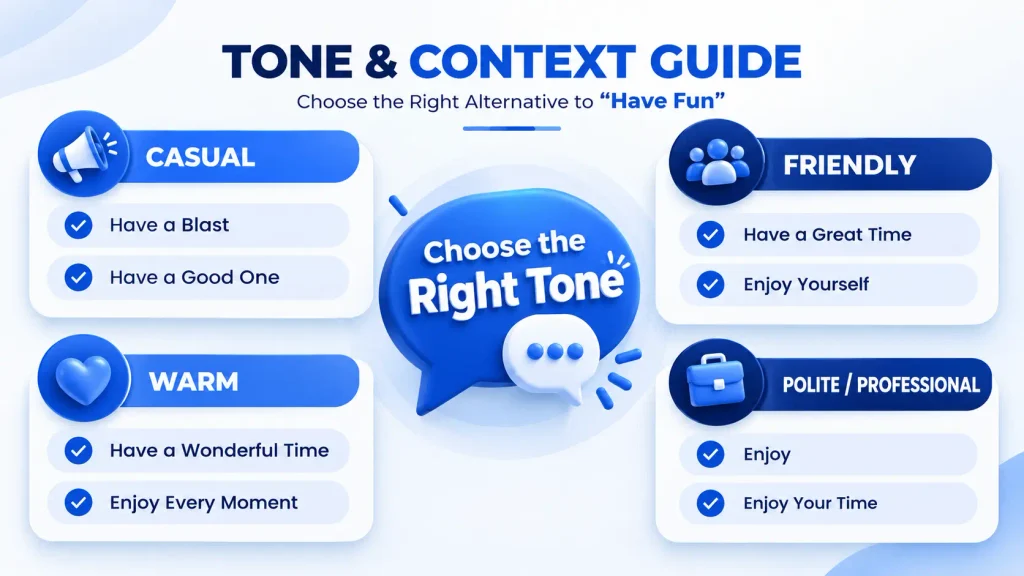
| Alternative | Best Used In | Tone |
| Enjoy yourself | Events, outings, activities | Friendly, Warm |
| Have a great time | Trips, parties, events | Friendly, Warm |
| Have a blast | Parties, concerts, exciting activities | Casual, Energetic |
| Enjoy | Activities, meals, vacations | Polite, Friendly |
| Make the most of it | Special opportunities, limited time | Warm, Encouraging |
| Have a wonderful time | Celebrations, trips, special occasions | Warm, Polite |
| Enjoy every moment | Milestones and memorable events | Warm, Heartfelt |
| Have a good one | Casual goodbyes | Casual, Friendly |
| Have a great day | Everyday farewells | Polite, Friendly |
| Enjoy your time | Visits, events, trips | Warm, Polite |
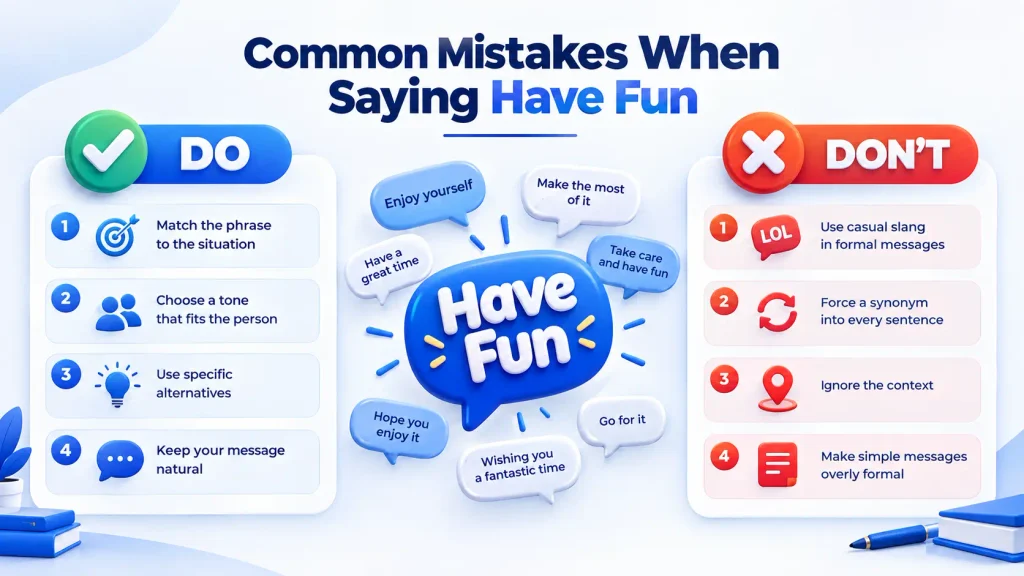
Expressions such as “have a blast” are great for friends but may feel too casual in a formal email. Choose “have a wonderful time” or “enjoy your time” when a more polished tone is appropriate.
Not every phrase has precisely the same meaning. For example, “have a great day” is mainly a farewell, while “enjoy every moment” suggests appreciating a special experience.
Your relationship with the other person should guide your choice. A playful expression may work with a close friend but sound unusual when addressing a client or senior colleague.
Words such as “have a blast” and “enjoy every moment” add emotion. If the situation is simple, a straightforward phrase such as “enjoy” may sound more natural.
Sometimes the activity gives you a chance to make the message more personal. Instead of simply saying “have fun,” you could say “Enjoy the concert!” or “Have a wonderful time at the wedding!”
A polite way to say “have fun” is “enjoy yourself,” “have a wonderful time,” or “enjoy your time.” These phrases communicate the same general idea while sounding warm and considerate. For professional situations, “enjoy your time” can work particularly well when the activity or event is already known.
For professional communication, “enjoy your time,” “have a wonderful time,” or simply “enjoy” can work well. The exact choice depends on the situation. For example, you could tell a coworker, “Enjoy the conference,” or wish a client, “Have a wonderful time at the event.”
In a text message, you have many natural options, including “have a great time,” “have a blast,” “enjoy yourself,” and “enjoy!” Choose based on your relationship. “Have a blast!” feels playful and energetic, while “Have a great time!” is more neutral and works in most everyday conversations.
You can say “Have a great time tonight,” “Enjoy yourself tonight,” “Have a blast tonight,” or “Enjoy your evening.” For a close friend, “Have a blast tonight!” sounds upbeat. For someone you do not know as well, “Enjoy your evening” offers a warmer but more polished alternative.
A cute or warm alternative could be “Enjoy every moment,” “Have the best time,” or “Have a wonderful time.” The best choice depends on the relationship and occasion. For example, “Have the best time!” can sound affectionate and enthusiastic when texting a close friend.
Neither phrase is universally better. “Have fun” is shorter and very common, while “enjoy yourself” can sound slightly more polished or personal. Both are natural in American English. Choose the one that fits the situation, relationship, and tone of your message.
In a professional email, consider the specific occasion instead of using a very casual phrase. You could write “Enjoy the conference,” “Have a wonderful time at the event,” or “I hope you enjoy your trip.” These options remain friendly while fitting professional communication more comfortably.
Before a trip, natural options include “Have a great trip,” “Enjoy your trip,” “Have a wonderful time,” and “Make the most of your trip.” If you are speaking to a close friend, “Have a blast!” can also work when the trip is expected to be especially exciting.
There are many natural ways to say “have fun,” and the best alternative depends on the situation. “Enjoy yourself” and “have a great time” are versatile choices for everyday conversations, while “have a blast” adds an energetic and casual feel.
For special occasions, “have a wonderful time” or “enjoy every moment” can make your message warmer. If you are saying goodbye, “have a good one” or “have a great day” may sound more natural. Meanwhile, “enjoy” is short and flexible when the activity is already clear.
The key is to match your words to the person, occasion, and tone. You do not need a complicated expression to sound natural—sometimes the simplest alternative is the most effective.

Our editorial team brings together decades of expertise in applied linguistics, lexicography, and educational publishing. Dedicated to clarity, precision, and tone, our experts ensure that every resource meets the highest standards of professional and academic excellence.