

Another way to say that’s good includes “that’s great,” “sounds good,” “that’s excellent,” “that’s wonderful,” and “that’s fantastic.” Use these alternatives to show approval, respond positively to an idea, or share enthusiasm. The best phrase depends on your situation, relationship with the listener, and how strongly you want to express your approval.
“That’s good” is a common phrase in American English. People use it to show approval, agree with a suggestion, or respond to positive news. However, repeating the same expression can make conversations sound predictable.
Learning another way to say that’s good helps you sound more natural and express your feelings more clearly. For example, you might say “sounds good” when agreeing to a plan or “that’s fantastic” when sharing someone’s excitement.
This guide covers 10 useful alternatives, with meanings, examples, and tips to help you choose the right phrase for everyday conversations, friendly messages, and workplace communication.
“That’s good” is a simple expression used to show that something is acceptable, positive, useful, or pleasing. Its meaning depends on the situation and the speaker’s tone.
You might say it when a friend shares good news, a coworker suggests a plan, or someone tells you that a problem has been solved. It can express approval, agreement, or mild happiness.
The phrase is useful because it is short and easy to understand. Still, alternatives can help you show stronger enthusiasm, sound more supportive, or explain exactly what you like about an idea.
Using different expressions helps you communicate your thoughts with more variety and meaning. A phrase that works with a friend may not be the best choice for a client or manager.
Here are a few reasons to use alternatives:
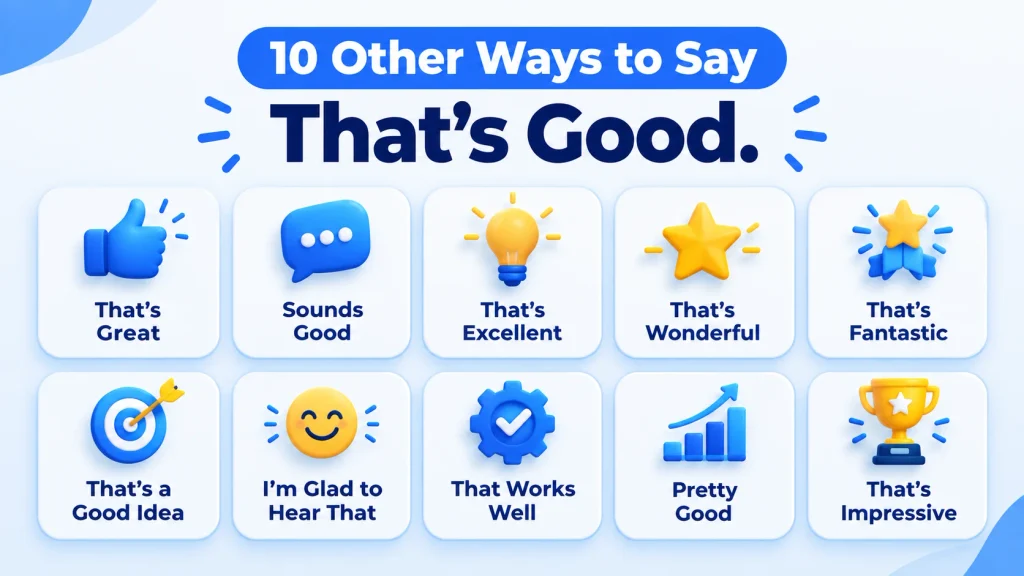
Meaning: “That’s great” is a friendly, upbeat way to show approval or happiness. It expresses more enthusiasm than “that’s good” and works in many everyday situations.
Best For: Casual, Friendly, Warm, Professional
Example 1: You got the job? That’s great! I knew your hard work would pay off.
Example 2: That’s great news about your new apartment.
Quick Tip: Use this phrase when you want to sound positive without being overly excited or formal.
Meaning: “Sounds good” usually means you agree with a suggestion, plan, or arrangement. It is especially common in American English conversations, text messages, and workplace chats.
Best For: Casual, Friendly, Professional, Polite
Example 1: We can meet outside the library at noon. Sounds good to me.
Example 2: I’ll send you the revised document this afternoon. Sounds good!
Quick Tip: Use “sounds good” to confirm plans. For important decisions, add a clear confirmation or next step when needed.
Meaning: “That’s excellent” expresses strong approval and suggests that something meets a high standard. It sounds a little more formal than “that’s great,” making it useful in professional settings.
Best For: Professional, Formal, Polite
Example 1: Your team finished the project ahead of schedule. That’s excellent work.
Example 2: That’s excellent progress on your research paper.
Quick Tip: Choose this phrase when you want to recognize a strong result, achievement, or performance.
Meaning: “That’s wonderful” communicates warmth and genuine happiness about something positive. It is particularly suitable when someone shares personal news, reaches a goal, or experiences an important milestone.
Best For: Friendly, Warm, Polite
Example 1: You’re expecting a baby? That’s wonderful news!
Example 2: That’s wonderful that your parents can visit you this summer.
Quick Tip: Use this expression for happy personal news when you want your response to feel caring and sincere.
Meaning: “That’s fantastic” shows strong excitement and approval. It works when something exceeds expectations or gives you a reason to celebrate.
Best For: Casual, Friendly, Warm
Example 1: You finished your first marathon? That’s fantastic!
Example 2: That’s fantastic that the whole family can join us for the holiday.
Quick Tip: Save this phrase for moments that deserve extra enthusiasm. For ordinary updates, “that’s great” may sound more natural.
Meaning: “That’s a good idea” shows that you approve of someone’s suggestion. Unlike a general compliment, it makes your response specific to a plan, solution, or recommendation.
Best For: Professional, Casual, Polite
Example 1: Let’s create a shared calendar for the project. That’s a good idea.
Example 2: That’s a good idea—we could bring snacks for everyone on the trip.
Quick Tip: Use this phrase when responding to suggestions. If appropriate, explain what makes the idea useful.
Meaning: “I’m glad to hear that” shows that you are pleased about information someone has shared. It sounds thoughtful and personal because it focuses on your positive reaction to their news.
Best For: Friendly, Warm, Polite, Professional
Example 1: You said your headache is finally gone. I’m glad to hear that.
Example 2: I’m glad to hear that your presentation went smoothly.
Quick Tip: Use it when responding to updates about someone’s well-being, progress, or recent experiences.
Meaning: “That works well” indicates that a plan, option, or arrangement is suitable. It focuses on practicality rather than excitement, so it can sound calm and professional.
Best For: Professional, Formal, Polite
Example 1: Moving our check-in to Thursday works well for me.
Example 2: That works well for our budget and project timeline.
Quick Tip: Choose this phrase when confirming schedules, arrangements, or practical solutions.
Meaning: “Pretty good” is an informal expression that means something is satisfactory or better than average. Depending on your tone, it can communicate mild approval rather than strong excitement.
Best For: Casual, Friendly
Example 1: How was the new restaurant? The food was pretty good.
Example 2: My first week at the new job has been pretty good so far.
Quick Tip: Use this phrase in relaxed conversations. If you want to express strong praise, choose “excellent” or “fantastic” instead.
Meaning: “That’s impressive” shows admiration for a person’s achievement, skill, effort, or result. It is more specific than “that’s good” because it suggests that something deserves recognition.
Best For: Professional, Friendly, Formal
Example 1: You learned to build that website on your own? That’s impressive.
Example 2: Your team reduced delivery times by 20 percent. That’s impressive work.
Quick Tip: Use this expression when you want to recognize a meaningful achievement. Mention the specific accomplishment to make your praise more sincere.
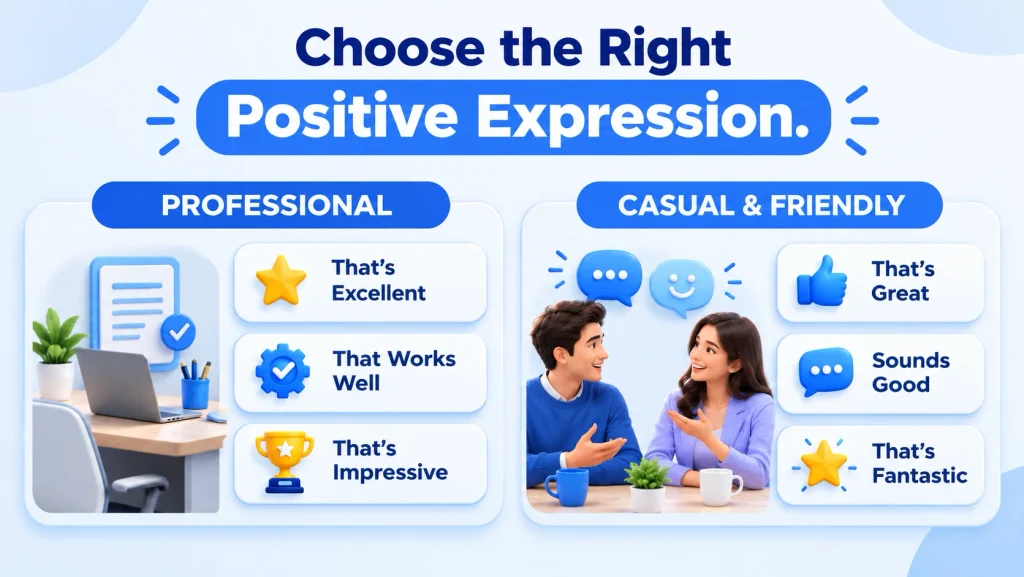
| Alternative | Best Used In | Tone |
|---|---|---|
| That’s Great | Everyday conversations | Positive, friendly |
| Sounds Good | Plans and agreements | Casual, cooperative |
| That’s Excellent | Work and achievements | Professional, approving |
| That’s Wonderful | Personal good news | Warm, caring |
| That’s Fantastic | Celebrations and exciting news | Enthusiastic |
| That’s a Good Idea | Suggestions and solutions | Supportive, practical |
| I’m Glad to Hear That | Personal updates | Warm, thoughtful |
| That Works Well | Schedules and arrangements | Calm, professional |
| Pretty Good | Casual reviews and updates | Relaxed, moderate |
| That’s Impressive | Skills and accomplishments | Admiring, positive |
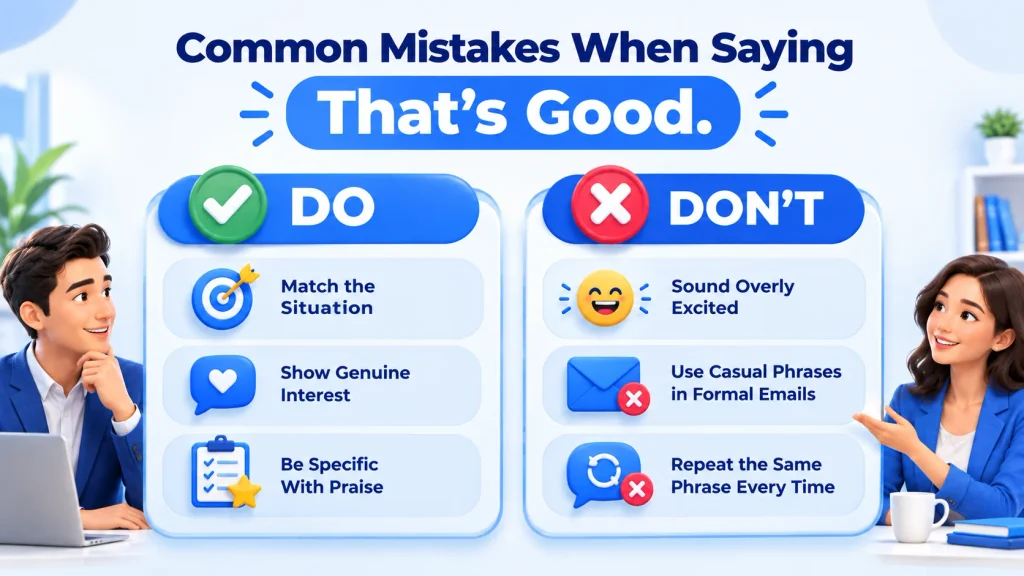
“Pretty good” may sound too informal in a formal business message. Choose “excellent,” “that works well,” or another phrase that matches the professional setting.
Words such as “fantastic” and “wonderful” express strong enthusiasm. If your reaction is neutral, a simpler phrase may sound more honest.
“Sounds good” is excellent for agreeing to plans, but it may not fully acknowledge someone’s personal achievement or difficult experience. Choose a response that addresses the actual news.
A phrase that works with friends may not fit a client email. Consider your relationship with the listener and the purpose of your response before choosing an alternative.
Saying “that’s good” after someone completes a difficult task may sound less meaningful than specific feedback. When possible, explain what you appreciate, such as their effort, creativity, or results.

You can say “that’s great,” “that’s excellent,” “sounds good,” or “that’s wonderful.” Each phrase communicates approval in a slightly different way. Use “sounds good” to agree to a plan, “that’s excellent” to praise strong work, and “that’s wonderful” to respond warmly to personal news.
Professional alternatives include “that’s excellent,” “that works well,” and “that’s impressive.” The best choice depends on what you want to communicate. Use “that works well” to confirm an arrangement, “that’s excellent” to recognize quality, and “that’s impressive” to acknowledge an achievement.
For a text message, try “that’s great,” “sounds good,” “awesome,” or “love that.” These expressions are short and natural in casual American English. Choose one that matches your relationship with the person and the situation. For a professional text, “sounds good” is often a safe choice.
They are similar, but they are not always interchangeable. “Sounds good” usually means you agree with a plan or suggestion, while “that’s good” can express general approval or a positive reaction. For example, you might say “sounds good” to confirm a meeting time and “that’s good” when hearing that a problem has been resolved.
You can say “that’s wonderful,” “that’s fantastic,” or “I’m glad to hear that.” These phrases show happiness and interest in someone’s news. For a more personal response, mention the specific achievement or ask a thoughtful follow-up question to show that you care.
Words such as “excellent,” “fantastic,” “outstanding,” and “exceptional” express stronger approval than “good.” The right word depends on the situation. “Excellent” works well in professional feedback, while “fantastic” often suits celebrations and “outstanding” can describe exceptional performance.
Yes, “pretty good” generally expresses approval, but it often sounds moderate rather than highly enthusiastic. Someone might use it to describe a meal, a movie, or how their week is going. If you want to show strong excitement or praise, “great” or “excellent” may communicate more.
Pay attention to what you are responding to. Use “sounds good” for plans, “that’s impressive” for achievements, and “I’m glad to hear that” for positive personal updates. Matching your response to the situation helps you sound natural without forcing unusual words into everyday conversations.
Learning another way to say that’s good can make everyday conversations more natural, expressive, and engaging. “That’s great” works in many situations, while “sounds good” is ideal for agreeing to plans. For professional feedback, try “that’s excellent” or “that’s impressive.” If someone shares personal news, “that’s wonderful” and “I’m glad to hear that” can make your response feel warmer.
You do not need to replace “that’s good” every time you use it. The phrase is clear and useful, especially in casual conversation. Instead, choose an alternative when you want to show a particular emotion, recognize an achievement, or communicate more precisely.
Helpful takeaway: Focus on what you mean, then choose the phrase that best expresses your reaction. Natural wording is more effective than using complicated vocabulary just for variety.

Senior English Editor & Stylistics Director
Michael Bennett is a veteran editor, lexicographer, and publishing consultant with more than two decades of experience in academic and educational publishing. Formerly a senior editorial director at major university presses, he specializes in structural editing, register refinement, and vocabulary development. Michael oversees tone, precision, and stylistic consistency across all publication channels, ensuring content meets rigorous editorial and pedagogical standards.












