
Looking for another way to say get rid of? Depending on the context, you can say remove, eliminate, discard, dispose of, let go of, clear out, do away with, or get rid of. The best alternative depends on whether you mean physically removing something, ending a problem, or moving on from something.
“Get rid of” is a common English phrase that means to remove, throw away, eliminate, or stop having something. It is natural in everyday American English, but the best alternative changes depending on what you are talking about.
For example, you might remove an unwanted file, eliminate a problem, discard an old item, or let go of a negative feeling. Choosing a more specific phrase can make your writing clearer and more natural.
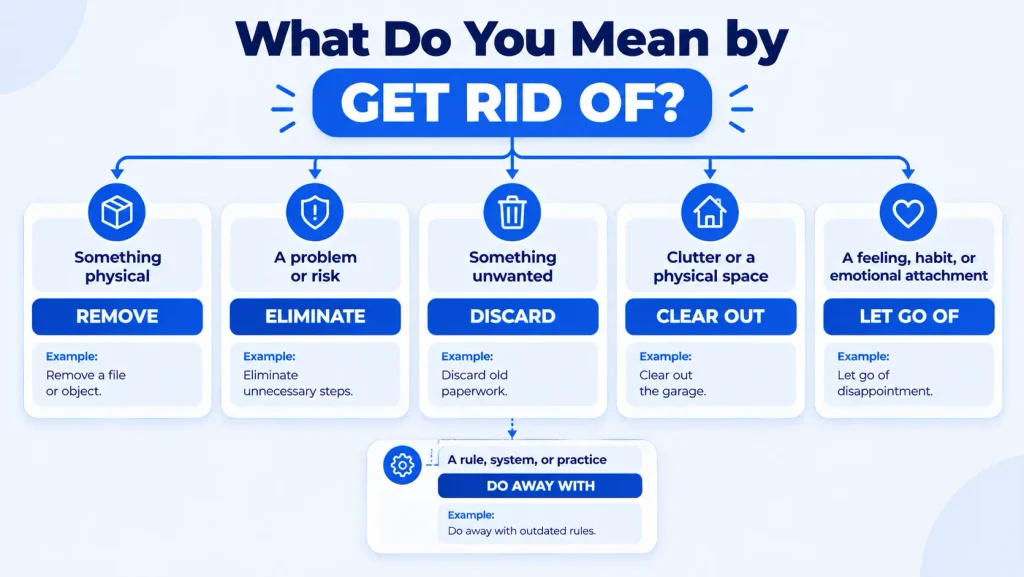
Get rid of generally means to remove something unwanted or no longer needed. It can describe physical objects, problems, habits, responsibilities, or even emotions.
For example:
I need to get rid of these old clothes.
Here, “get rid of” means to remove or discard the clothes. In another sentence, “We need to get rid of unnecessary expenses” means to eliminate those expenses.
The phrase is especially common in everyday conversations, emails, casual writing, and general communication. However, more precise alternatives may be better for formal or professional writing.
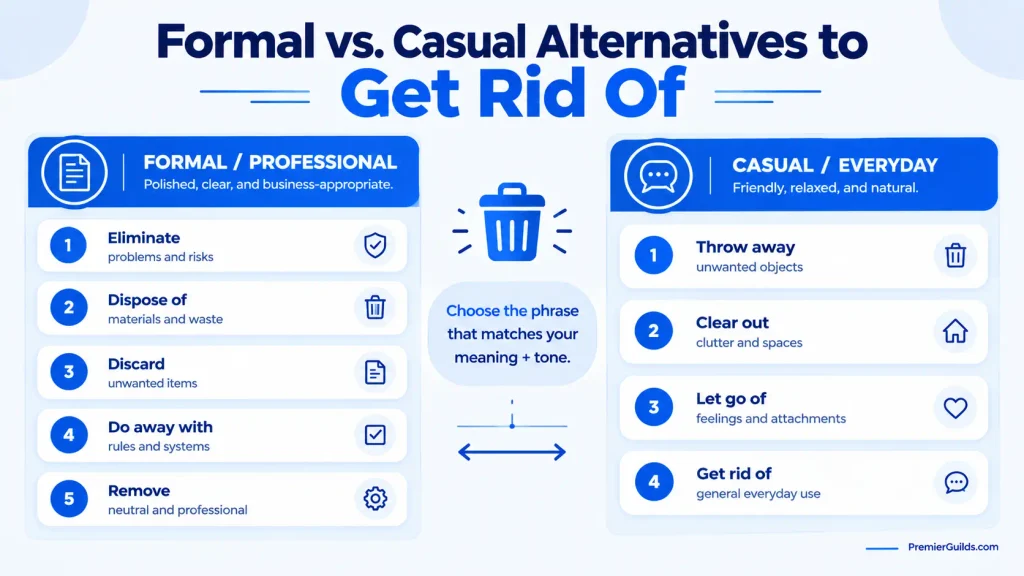
Using different expressions helps you match your wording to the exact meaning and situation.
You may want to use an alternative to:
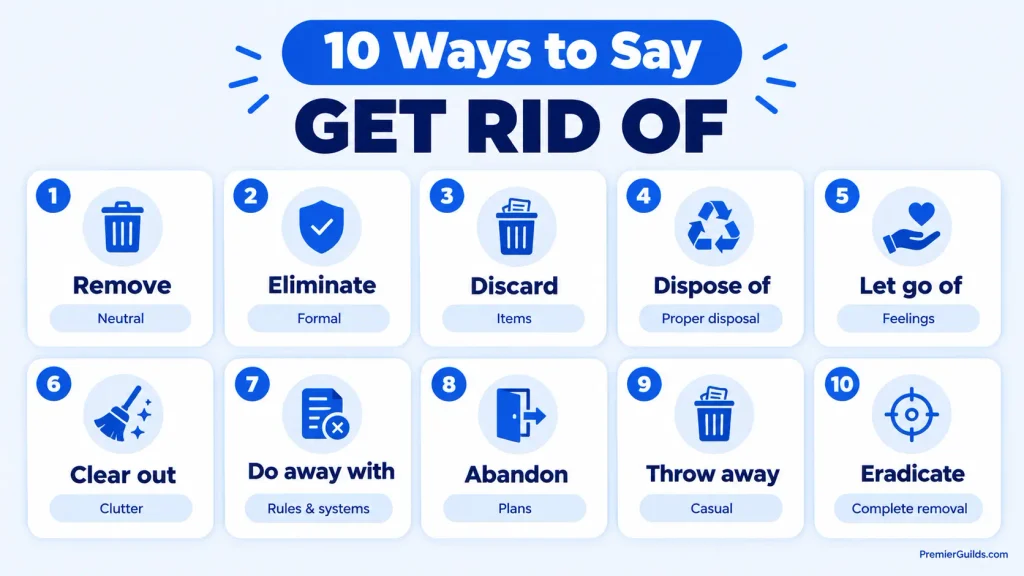
Remove means to take something away from a particular place or situation. It is one of the most versatile alternatives and works in both everyday and professional English.
Please remove the outdated files from the shared folder.
She removed the stain from her jacket before leaving.
Use remove when something is physically taken away or separated from something else.
Eliminate means to completely remove something, especially a problem, risk, obstacle, or unwanted condition. It often sounds more formal and purposeful than “get rid of.”
The new system helped eliminate unnecessary paperwork.
We need to eliminate the main source of the problem.
Use eliminate when you want to emphasize completely removing something undesirable.
Discard means to throw something away because you no longer need or want it. It is commonly used for physical objects, documents, materials, and items that have become unnecessary.
Discard any damaged packaging before storing the products.
He discarded the old receipts after checking his records.
Use discard when the meaning specifically involves throwing something away.
Dispose of means to get rid of something, usually by throwing it away or handling it through an appropriate disposal process. It can sound more formal than “throw away.”
Please dispose of the empty containers in the recycling bin.
The facility must properly dispose of hazardous materials.
Use dispose of when proper handling or disposal is important.
Let go of can mean physically releasing something, but it is also commonly used for emotions, memories, habits, or situations. It often has a personal or emotional meaning.
It took her time to let go of her disappointment.
Sometimes you have to let go of old habits to make progress.
Use let go of when you are talking about emotional, personal, or psychological release.
Clear out means to remove unwanted things from a place, space, or collection. It is especially natural when talking about cleaning, organizing, or making room.
We need to clear out the garage before the weekend.
She cleared out several boxes of old paperwork.
Use clear out when the focus is on making a physical space less crowded or cluttered.
Do away with means to completely stop or remove something, such as a rule, practice, system, or unnecessary process. It is more idiomatic than “remove.”
The company decided to do away with the outdated approval process.
The school plans to do away with paper registration forms.
Use this phrase for systems, rules, practices, or procedures rather than ordinary physical objects.
Abandon means to leave something behind or stop supporting, using, or continuing it. It can describe plans, projects, ideas, places, or activities.
The team abandoned the original plan after reviewing the new data.
They decided to abandon the project because the costs were too high.
Use abandon when you mean stopping or leaving something rather than simply removing it.
Throw away is a direct, informal way to say that you no longer want something and will put it in the trash. It is especially common in everyday conversation.
Don’t throw away those boxes; we may need them later.
I finally threw away the broken headphones.
Use throw away for ordinary conversations, but choose discard or dispose of when a more formal tone is appropriate.
Eradicate means to completely destroy or remove something, especially something harmful or unwanted. It is much stronger than “get rid of” and is usually used for serious or widespread problems.
The program aims to eradicate the spread of the invasive species.
Researchers are working to eradicate the disease from affected areas.
Use eradicate only when complete removal or destruction is genuinely intended.
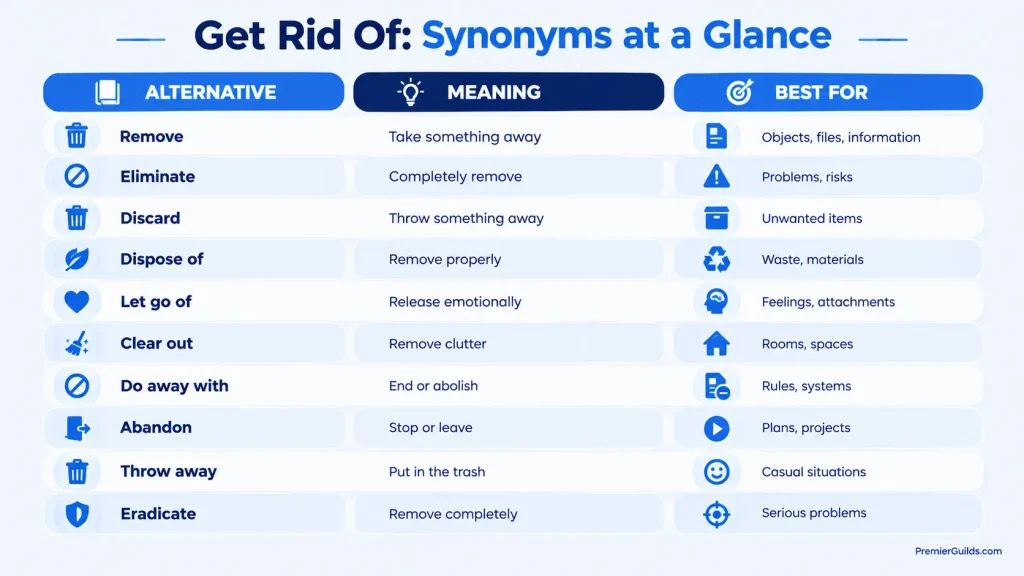
| Alternative | Best Used In | Tone |
| Remove | Objects, files, items, unwanted things | Professional/Neutral |
| Eliminate | Problems, risks, obstacles | Formal |
| Discard | Unwanted objects or materials | Formal/Neutral |
| Dispose of | Waste, materials, unwanted items | Formal |
| Let go of | Feelings, habits, memories | Warm/Casual |
| Clear out | Rooms, spaces, clutter | Casual |
| Do away with | Rules, systems, procedures | Formal |
| Abandon | Plans, projects, ideas | Formal |
| Throw away | Physical objects | Casual |
| Eradicate | Serious or widespread problems | Formal |
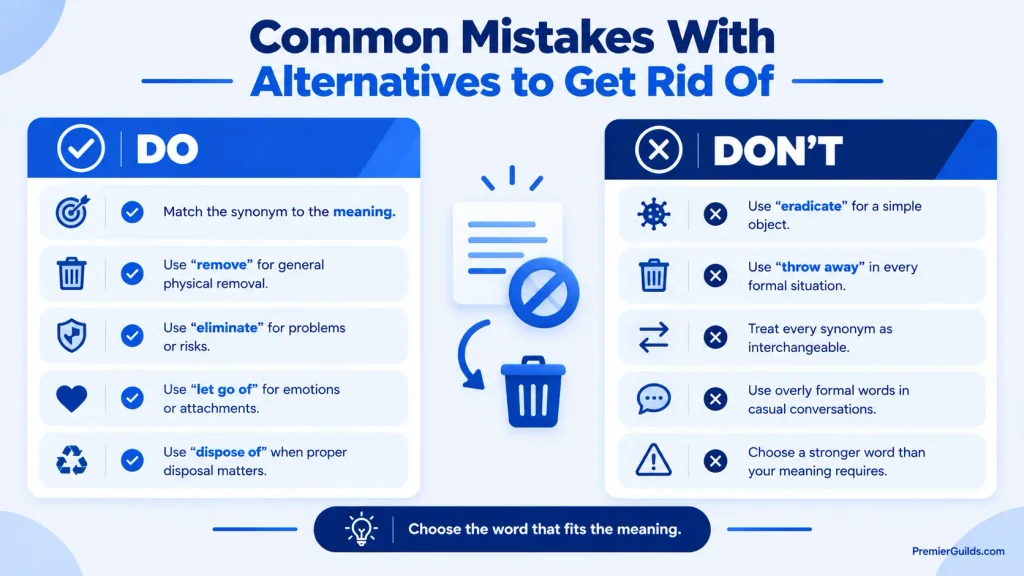
“Discard” works naturally for an old document, but it may not fit an emotion or long-term problem. Choose let go of, eliminate, or another phrase that matches the meaning.
Words such as eradicate can sound excessive when you simply mean throwing something away. In everyday situations, throw away or remove may sound more natural.
The alternatives do not all mean exactly the same thing. Abandon suggests leaving something behind, while dispose of focuses on proper removal or handling.
“Do away with” is usually more natural for rules, systems, practices, or procedures. For an old chair, discard or throw away would generally be clearer.
Eradicate suggests complete removal or destruction. If you only need to take something away, remove is usually more accurate.
Common alternatives include remove, eliminate, discard, dispose of, let go of, clear out, do away with, abandon, throw away, and eradicate. The right choice depends on context. For example, “remove” works broadly, while “let go of” is better for emotions and “discard” is more suitable for unwanted physical items.
For professional writing, remove, eliminate, discard, and dispose of are useful choices. The best option depends on what you mean. For example, you can eliminate unnecessary costs, remove outdated information, or dispose of unwanted materials. These expressions can sound more precise than the conversational phrase “get rid of.”
A polite alternative depends on the situation. Remove, clear out, or dispose of can work when discussing objects or materials. If you are discussing emotions or personal situations, let go of sounds gentler. Avoid choosing a harsh word when the situation calls for a softer tone.
Depending on the meaning, you can use remove, discard, eliminate, dispose of, clear out, or throw away. If you mean stopping something, do away with or abandon may be more accurate. The context matters because these expressions describe slightly different kinds of removal.
They can have similar meanings, but they are not always interchangeable. Eliminate usually emphasizes completely removing a problem, risk, obstacle, or unwanted condition. “Get rid of” is broader and more conversational. For example, you can eliminate a problem, but you would normally discard or throw away an unwanted object.
Throw away, clear out, and let go of can work in casual situations, depending on the meaning. “Throw away” is natural for unwanted objects, “clear out” works well for clutter or spaces, and “let go of” is commonly used for feelings, memories, or habits.
Yes. “Get rid of” is grammatically correct and is not automatically inappropriate in professional writing. However, a more specific word can make your meaning clearer. For example, eliminate unnecessary steps or remove outdated information may communicate your intended meaning more precisely.
Remove usually focuses on taking something away from a place or situation, while get rid of can also mean eliminating, discarding, or stopping something. “Remove the file” is more precise in many professional contexts, while “get rid of these old files” sounds more conversational.
Knowing another way to say get rid of helps you choose language that fits your exact meaning and audience. For a broad, neutral option, remove is a reliable choice. Use eliminate for problems or unwanted conditions, discard for items you no longer need, and dispose of when proper handling matters.
For personal situations, let go of can express emotional release more naturally. Meanwhile, clear out fits clutter, do away with works well for rules or systems, and throw away is ideal for casual conversations about unwanted objects.
The key is to avoid treating every synonym as interchangeable. Choose the word that accurately describes what you mean, then adjust the tone to suit your reader. The most effective alternative is the one that makes your meaning clear without overstating the situation.

Senior English Editor & Stylistics Director
Michael Bennett is a veteran editor, lexicographer, and publishing consultant with more than two decades of experience in academic and educational publishing. Formerly a senior editorial director at major university presses, he specializes in structural editing, register refinement, and vocabulary development. Michael oversees tone, precision, and stylistic consistency across all publication channels, ensuring content meets rigorous editorial and pedagogical standards.