
Looking for another way to say let you know? You can say “inform you,” “keep you updated,” “keep you posted,” “give you an update,” or “get back to you.” The best alternative depends on whether you are writing a professional email, sharing an update, responding to a request, or speaking casually.
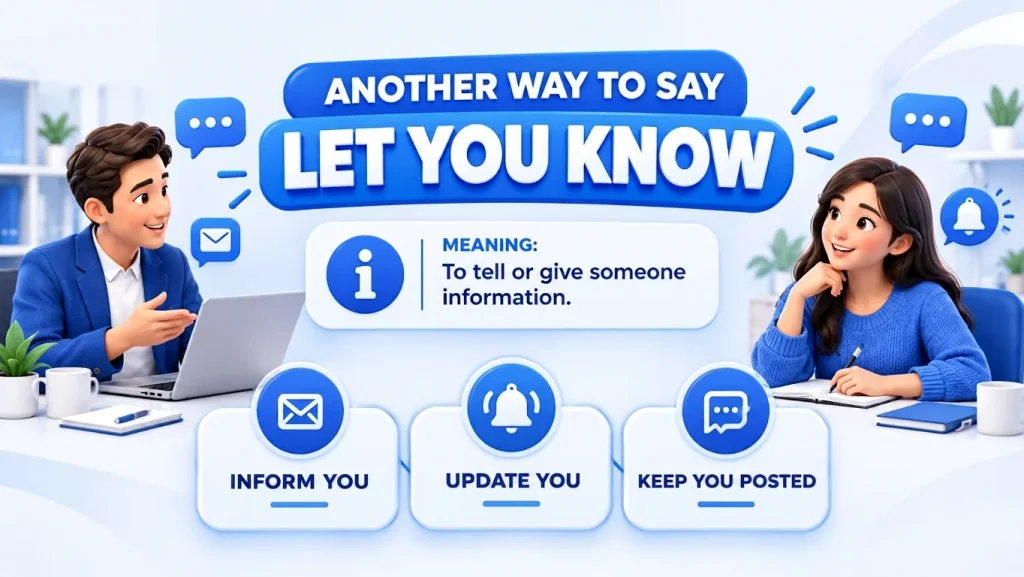
“Let you know” means to give someone information, an answer, update, or decision. It is one of the most common phrases in American English and appears in casual conversations, text messages, workplace emails, and professional communication.
For example, you might say, “I’ll let you know when I hear back from the client.” The phrase is useful because it sounds natural and does not require a formal tone.
However, repeating “let you know” can make emails and other professional writing sound repetitive. Choosing another way to say let you know can help you match your wording to the situation, especially when you need to sound more formal, polite, or specific.
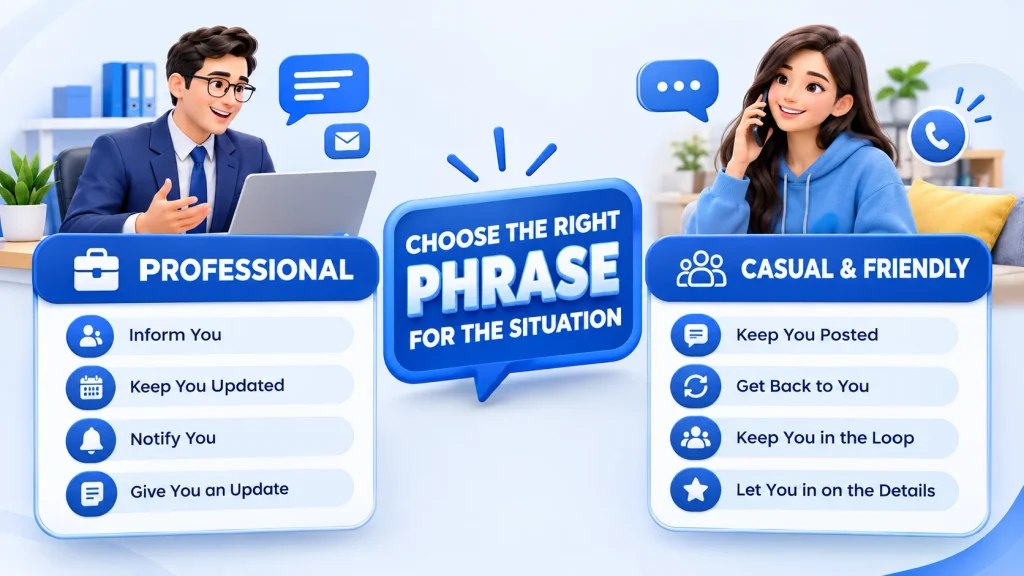
Using different expressions can make your communication more natural and precise. The best alternative depends on whether you are sharing one piece of information, providing ongoing updates, or promising to respond later.
Other alternatives can help you:
For example, “I’ll inform you” sounds more formal than “I’ll let you know,” while “I’ll keep you posted” sounds more relaxed and conversational.
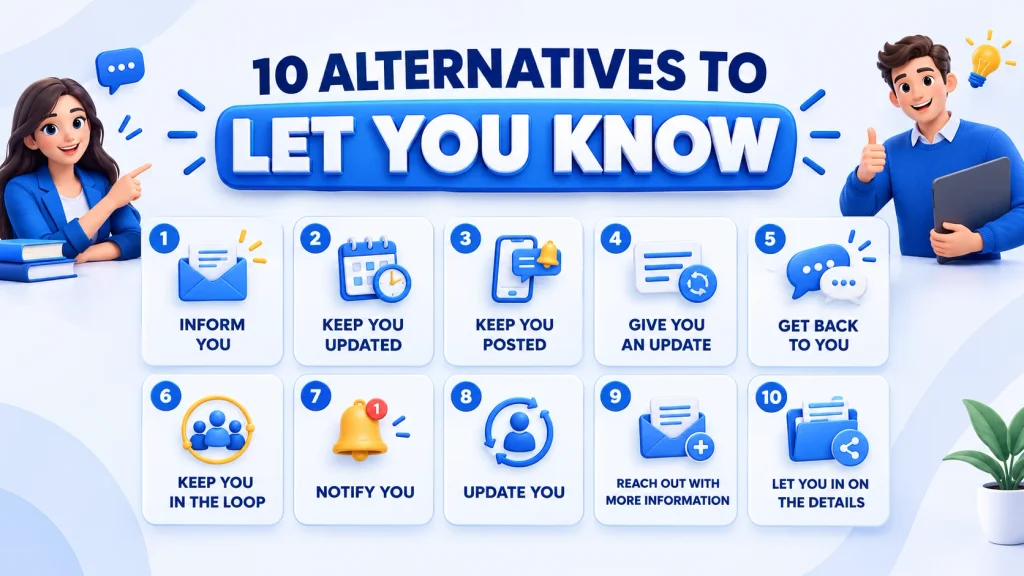
“Inform you” means to provide someone with information about something. It is more formal than “let you know” and is often used in professional emails, business notices, and official communication.
Professional, Formal, Polite
We will inform you once your application has been reviewed.
Please allow us to inform you of any changes to the schedule.
Use “inform you” when writing formal business messages or communicating important information professionally.
“Keep you updated” means to continue providing someone with new information as a situation develops. It is useful when you expect multiple updates rather than one final response.
Professional, Friendly, Polite
I’ll keep you updated as we make progress on the project.
Our team will keep you updated about the delivery schedule.
Choose this phrase when the person needs ongoing information rather than a single update.
“Keep you posted” is a friendly and natural expression meaning that you will continue to share important updates. It is common in workplace conversations and casual professional communication.
Casual, Friendly, Professional
I’ll keep you posted after I speak with the hiring manager.
We’ll keep you posted if anything changes before Friday.
This phrase sounds more conversational than “inform you,” so it works best when the situation does not require highly formal language.
“Give you an update” means to provide new information about a situation, task, project, or decision. It is clear, natural, and suitable for both professional and everyday communication.
Professional, Friendly, Polite
I’ll give you an update after our meeting this afternoon.
Let me give you an update on the customer’s request.
Use this when you want to emphasize that the information you are sharing is a new development.
“Get back to you” means to respond to someone after you have had time to find information, consider a question, or complete a task. It is especially common in workplace emails and conversations.
Professional, Friendly, Polite
I need to confirm the details, and I’ll get back to you tomorrow.
Let me check with the finance team and get back to you shortly.
Use this when you cannot provide an answer immediately but intend to respond later.
“Keep you in the loop” means to make sure someone continues receiving relevant information about a situation. It often suggests that the person should remain informed as decisions or events develop.
Professional, Friendly, Casual
I’ll keep you in the loop as we finalize the new project plan.
Please keep me in the loop if the client changes the requirements.
This phrase is especially natural when several people are involved in the same project or decision.
“Notify you” means to officially tell someone about an event, decision, change, or important piece of information. It sounds more formal and direct than “let you know.”
Professional, Formal, Polite
We will notify you when your order is ready for pickup.
The company will notify you if your application moves to the next stage.
Use “notify you” for official announcements, status changes, policies, applications, and business procedures.
“Update you” means to provide someone with the latest information about a situation. It is concise and works well in workplace communication, project discussions, and customer service messages.
Professional, Formal, Friendly, Polite
I’ll update you as soon as I have confirmation from the supplier.
Our manager will update you on the next steps during tomorrow’s meeting.
“Update you” is a strong choice when you want a concise and professional alternative.
“Reach out with more information” means that you plan to contact someone again when you have additional details to share. It sounds polite and professional, particularly in emails and customer communication.
Professional, Friendly, Polite
I’ll reach out with more information once we receive the final report.
Our team will reach out with more information about the available options.
Use this phrase when the next step involves contacting the person again with additional details.
“Let you in on the details” means to share information with someone, often information they are interested in knowing. It is more conversational than formal alternatives such as “inform you.”
Casual, Friendly, Warm
I’ll let you in on the details once everything has been finalized.
She promised to let us in on the details after the announcement.
Use this expression in relaxed conversations rather than formal business emails or official notices.
| Alternative | Best Used In | Tone |
|---|---|---|
| Inform You | Formal emails and business communication | Formal |
| Keep You Updated | Ongoing workplace updates | Professional |
| Keep You Posted | Casual professional conversations | Friendly |
| Give You an Update | Everyday and workplace communication | Neutral |
| Get Back to You | Responses and follow-ups | Professional |
| Keep You in the Loop | Team projects and collaboration | Friendly |
| Notify You | Official notices and decisions | Formal |
| Update You | Workplace and customer communication | Professional |
| Reach Out With More Information | Professional follow-ups | Polite |
| Let You In on the Details | Casual conversations | Friendly |
“Notify you” and “inform you” can sound stiff when talking with a friend or coworker about a simple matter. In casual situations, “I’ll let you know” or “I’ll keep you posted” usually sounds more natural.
“Get back to you” suggests that you will respond later. If you are simply sharing information immediately, “update you” or “give you an update” may be clearer.
“Keep you updated” and “keep you in the loop” suggest continued communication. If you only need to share one piece of information, “inform you” or “notify you” may be more precise.
Using the same phrase repeatedly can make workplace writing feel predictable. Vary your wording with alternatives such as “update you,” “get back to you,” or “keep you posted” when they fit the context.
Phrases such as “keep you posted” are natural in friendly communication but may not fit a formal notice or official business document. In those situations, “notify you” or “inform you” is usually more appropriate.
“Inform you,” “update you,” and “notify you” are professional alternatives to “let you know.” The best choice depends on the situation. “Inform you” works well for formal communication, while “update you” sounds more natural in everyday workplace emails and project discussions.
“Inform you” is one of the most direct formal alternatives. “Notify you” is also appropriate when you are officially communicating a decision, change, deadline, or status. For example, “We will notify you once your application has been processed” sounds professional and clear.
For casual communication, you can say “keep you posted,” “keep you in the loop,” or simply “I’ll tell you.” “Keep you posted” is especially common when you expect to share updates as a situation develops.
The two expressions are similar, but they are not always interchangeable. “Let you know” can refer to one future piece of information, while “keep you posted” usually suggests that you will provide multiple updates over time.
In a professional email, you can write “I’ll get back to you,” “I’ll keep you updated,” “I’ll update you,” or “I’ll inform you.” Choose “I’ll get back to you” when you need time to find an answer, and “I’ll keep you updated” when ongoing communication is expected.
Yes. “I’ll get back to you” is widely used in professional American English, especially in emails, meetings, and customer service conversations. It tells the recipient that you need additional time before providing an answer. For very formal writing, “I will respond once I have the necessary information” may sound more official.
Use alternatives that describe the exact type of communication you mean. Try “update you” for new information, “keep you posted” for ongoing updates, “notify you” for official information, and “get back to you” when you need time before responding.
“Update you” is one of the most versatile choices for business communication because it sounds professional without being overly formal. For official notices, “notify you” may be better, while “keep you updated” is useful when the recipient expects continued information.
There are many natural ways to say “let you know,” and the right choice depends on your audience and purpose. For formal communication, “inform you” and “notify you” provide a professional tone. In everyday workplace messages, “update you,” “give you an update,” and “get back to you” sound clear and natural.
For ongoing communication, “keep you updated” and “keep you in the loop” make it clear that more information will follow. If you are speaking casually with a coworker or friend, “keep you posted” is a relaxed and familiar choice.
The key is to choose an expression that accurately describes what you plan to communicate. A simple change in wording can make your emails, messages, and conversations sound clearer, more natural, and better suited to the situation.

Senior English Editor & Stylistics Director
Michael Bennett is a veteran editor, lexicographer, and publishing consultant with more than two decades of experience in academic and educational publishing. Formerly a senior editorial director at major university presses, he specializes in structural editing, register refinement, and vocabulary development. Michael oversees tone, precision, and stylistic consistency across all publication channels, ensuring content meets rigorous editorial and pedagogical standards.













