
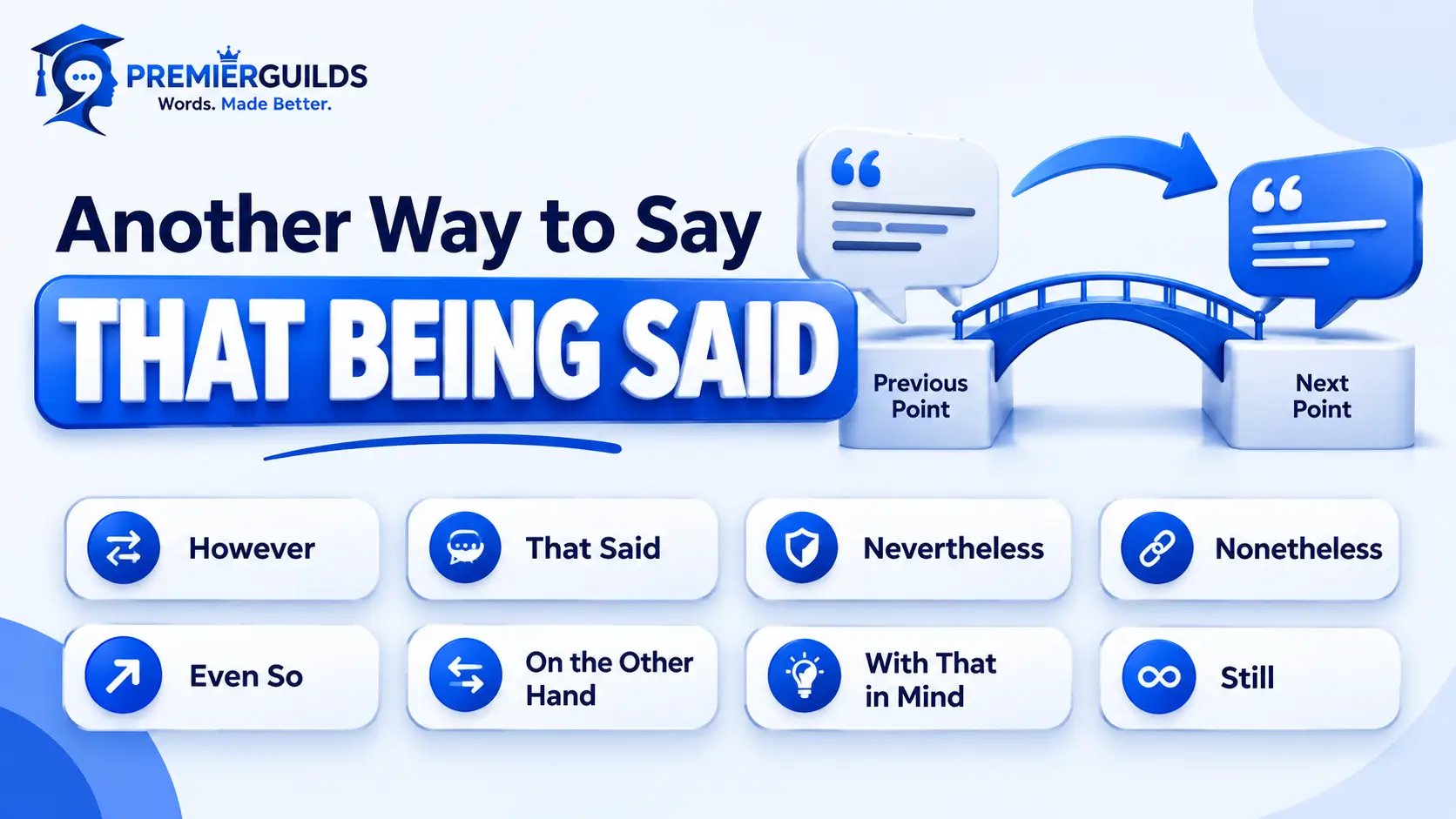
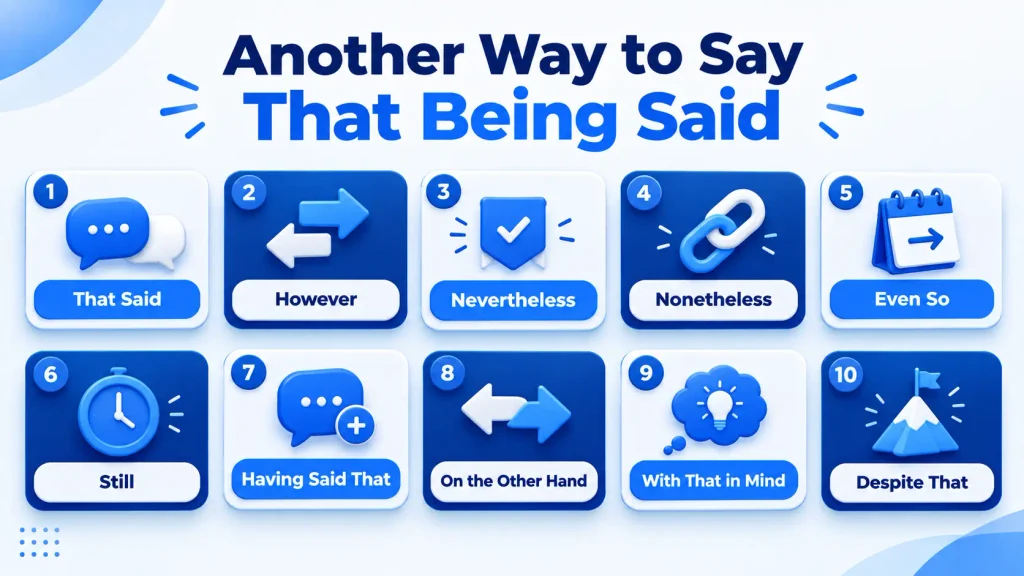
Looking for another way to say that being said? You can use however, that said, nevertheless, even so, still, having said that, on the other hand, with that in mind, nonetheless, or despite that. The right choice depends on whether you want to show contrast, add a qualification, or smoothly shift to another point.
“That being said” is a transition phrase used to introduce a statement that qualifies, contrasts with, or adds another perspective to something mentioned previously. It often signals that the writer recognizes a previous point but wants to present an important exception or different consideration.
For example, you might write, “The project was challenging. That being said, the team completed it on time.” The first sentence acknowledges difficulty, while the second provides a contrasting positive point.
The phrase commonly appears in essays, articles, emails, reports, presentations, reviews, and everyday conversations. It can make a transition feel smoother, although repeating it too often can make writing sound formulaic.
Using different transition phrases helps you create smoother and more precise writing. Not every alternative expresses exactly the same type or strength of contrast.
Other benefits include:
“That said” has nearly the same meaning as “that being said” and introduces a contrasting or qualifying point. It is shorter and often sounds more natural in modern American English.
The proposal needs more work. That said, the overall strategy is promising.
The restaurant is a little expensive. That said, the service was excellent.
Use that said when you want a concise replacement that preserves the original meaning.
“However” introduces a contrast between two ideas. It is one of the most versatile choices and works well when the second statement differs from or limits the first.
The software is easy to use. However, some advanced features require additional training.
We expected a larger turnout. However, the event generated several useful leads.
“However” is an excellent choice when you want a clean, direct transition in professional or academic writing.
“Nevertheless” introduces a point that remains true despite what was just stated. It often gives the second idea a stronger sense of persistence or contrast.
The deadline was extremely tight. Nevertheless, the team delivered the final report on schedule.
The evidence is limited. Nevertheless, the findings provide a useful starting point for further research.
Choose nevertheless when the second point remains valid despite a difficulty, limitation, or opposing fact.
“Nonetheless” is similar to “nevertheless” and signals that the next point remains relevant despite the previous statement. It has a polished and formal tone.
The first attempt produced mixed results. Nonetheless, it helped us identify several important issues.
The course requires significant effort. Nonetheless, students often find the material rewarding.
Use nonetheless when you want a formal transition that emphasizes persistence or contrast.
“Even so” introduces an idea that remains true despite something previously mentioned. It tends to sound more conversational than “nevertheless” or “nonetheless.”
The commute is long. Even so, I enjoy working at the company.
The instructions were confusing. Even so, we managed to complete the setup.
Choose even so when you want contrast without making the sentence sound overly formal.
“Still” can introduce a contrasting thought or acknowledge a previous point while presenting another consideration. It is brief and natural in both conversation and informal writing.
The apartment is smaller than we expected. Still, the location is excellent.
The task took longer than planned. Still, we learned a lot from the process.
Use still when you want a simple, conversational transition rather than a formal one.
“Having said that” introduces a qualification or contrasting thought after acknowledging something previously stated. It is very close in meaning to “that being said.”
The position requires frequent travel. Having said that, the flexible schedule is a major benefit.
The book is quite technical. Having said that, the examples make the main concepts easier to understand.
Use having said that when you want to acknowledge the previous point before adding a different perspective.
“On the other hand” presents another side, perspective, or option. It is especially useful when comparing two different considerations rather than simply adding a qualification.
Working remotely saves commuting time. On the other hand, some employees miss face-to-face interaction.
The downtown apartment is convenient. On the other hand, the suburban option offers more space.
Use on the other hand when you are deliberately presenting another side of an issue.
“With that in mind” connects a previous idea to a conclusion, decision, recommendation, or next step. It does not always express direct opposition, so it is useful when the relationship is more about consideration than contrast.
The team has limited time before launch. With that in mind, we should focus on the most important features.
Customer feedback highlighted concerns about pricing. With that in mind, the company is reviewing its current plans.
Choose with that in mind when the second statement follows logically from a point you have just acknowledged.
“Despite that” introduces an idea that remains true even though the previous statement might suggest otherwise. It creates a clear relationship between a condition and an unexpected result.
The weather forecast predicted heavy rain. Despite that, the outdoor event continued as planned.
The project faced several delays. Despite that, the team met its final objective.
Use despite that when you specifically want to emphasize that something happened or remained true in spite of a previous condition.
| Alternative | Best Used In | Tone |
| That Said | Emails, articles, everyday writing | Natural |
| However | Academic and professional writing | Formal |
| Nevertheless | Essays, reports, formal writing | Formal |
| Nonetheless | Academic and professional writing | Formal |
| Even So | Conversations, emails, informal writing | Conversational |
| Still | Everyday communication and casual writing | Casual |
| Having Said That | Conversations, emails, articles | Natural |
| On the Other Hand | Comparisons, essays, discussions | Neutral |
| With That in Mind | Recommendations, reports, business writing | Professional |
| Despite That | Formal explanations and contrast | Formal |
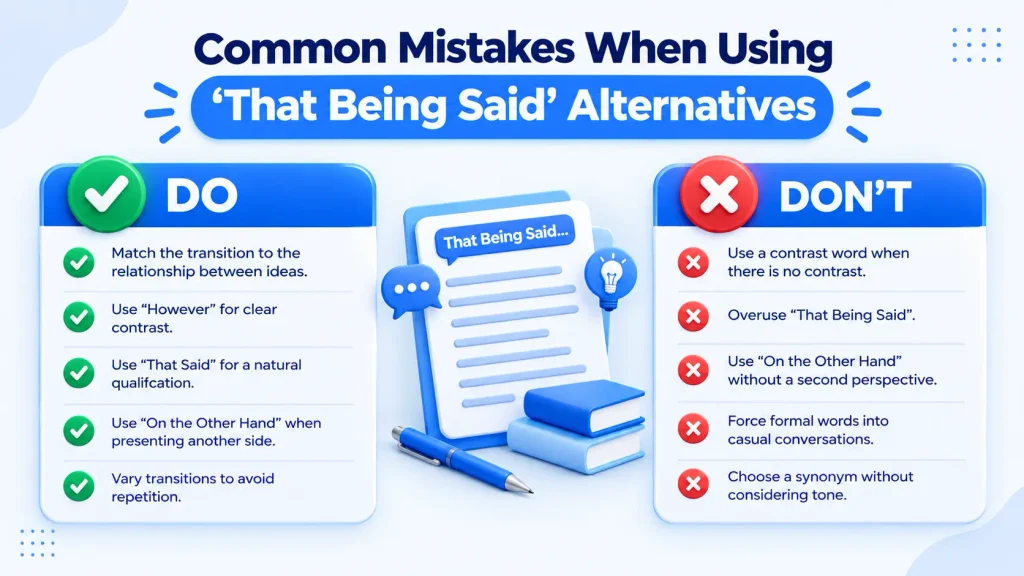
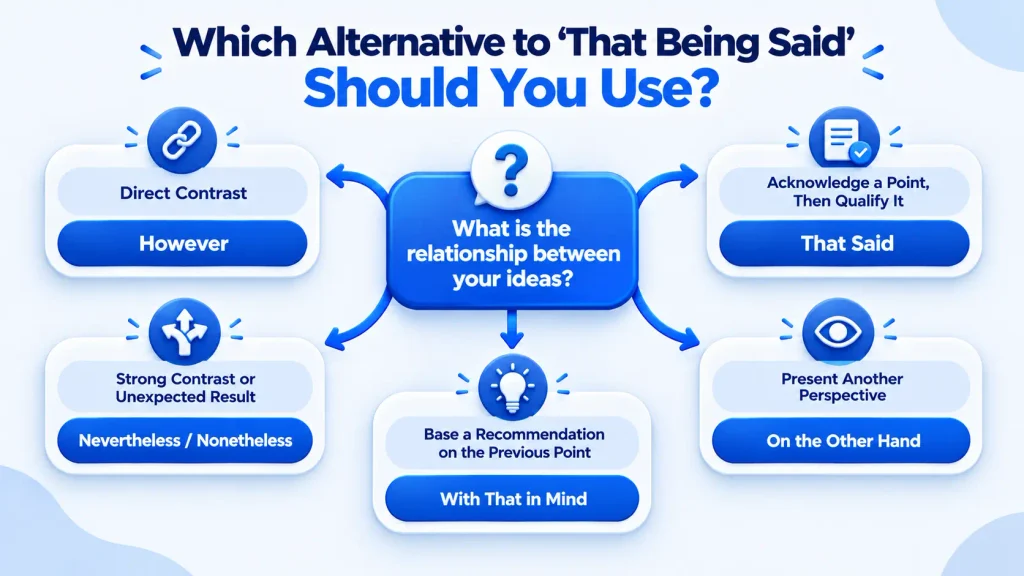
These phrases overlap, but they do not all perform the same job. For example, “on the other hand” usually introduces another perspective, while “with that in mind” often connects an observation to a decision or recommendation.
Repeating the same transition in every paragraph can make your writing feel predictable. Vary your transitions when the relationship between ideas genuinely changes.
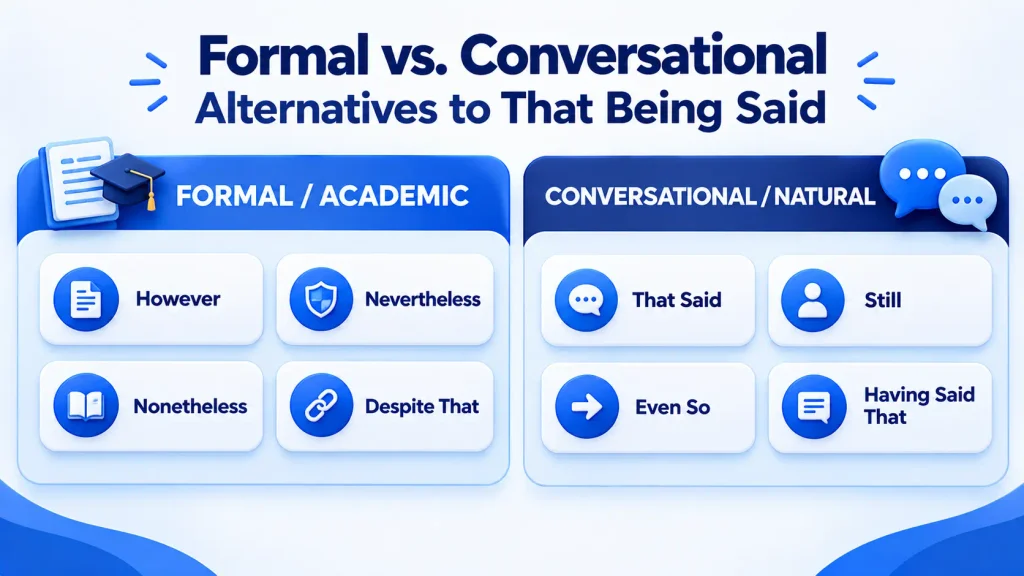
Words such as “nevertheless” and “nonetheless” can sound more formal than necessary in everyday speech. In casual situations, “still,” “even so,” or “that said” may feel more natural.
A transition such as “however” should connect ideas that actually contrast. If the second sentence simply adds information, a phrase like “in addition” or “also” may be more appropriate.
“On the other hand” works best when you are presenting another option, perspective, advantage, disadvantage, or consideration. Do not use it merely because you want a transition between two unrelated sentences.

Common alternatives include that said, however, nevertheless, nonetheless, even so, still, having said that, and on the other hand. The best choice depends on your intended meaning. “That said” is closest to the original phrase, while “however” is particularly useful for concise professional and academic writing.
Yes, “that said” generally serves the same purpose as “that being said.” Both acknowledge a previous point before introducing a qualification or contrasting idea. “That said” is shorter and often feels more direct, so it can be a useful choice when you want smoother, less wordy writing.
However, nevertheless, nonetheless, and with that in mind can all work in professional communication, depending on the relationship between your ideas. For a direct contrast, “however” is often suitable. If you want to acknowledge a limitation but maintain your main point, “nevertheless” or “nonetheless” may fit better.
Formal alternatives include nevertheless, nonetheless, however, and, in some contexts, despite that. These phrases can work well in academic papers, reports, business documents, and formal correspondence. The correct choice depends on whether you are showing direct contrast, persistence despite a problem, or a qualification.
Yes, but the sentence structure may need to change. “However” is a flexible contrast word, while “that being said” often sounds like an acknowledgment followed by a qualification. For example, “The plan is expensive. However, it could produce strong results” creates a direct contrast without needing the longer transition.
For casual communication, try that said, still, even so, or having said that. These expressions sound natural in conversations, texts, emails, and informal writing. “Still” is particularly simple, while “that said” provides a concise transition without sounding overly formal.
“Nevertheless” is grammatically natural in conversation, but it can sound more formal or deliberate than alternatives such as “still” or “even so.” If you are talking with friends or writing a casual message, a simpler transition may feel more natural and conversational.
“That being said” usually qualifies or slightly contrasts with a previous statement. “On the other hand” more clearly introduces another side, option, or perspective. If you are weighing two different viewpoints, “on the other hand” is often more precise; if you are acknowledging a point before adding a qualification, “that being said” may fit better.
Knowing another way to say “that being said” can make your writing smoother, clearer, and less repetitive. Although many alternatives express contrast, each has a slightly different purpose and tone.
Use that said when you want the closest and most concise replacement. Choose however for a clean professional or academic contrast, while nevertheless and nonetheless create a more formal sense of persistence. For casual writing, still and even so often sound more natural. When presenting two different perspectives, on the other hand is a better fit, while with that in mind works when an earlier point leads to a recommendation or decision.
The key is to focus on the relationship between your ideas, not simply replace one phrase with another. Choose the transition that accurately communicates your meaning and suits your audience.

Senior English Editor & Stylistics Director
Michael Bennett is a veteran editor, lexicographer, and publishing consultant with more than two decades of experience in academic and educational publishing. Formerly a senior editorial director at major university presses, he specializes in structural editing, register refinement, and vocabulary development. Michael oversees tone, precision, and stylistic consistency across all publication channels, ensuring content meets rigorous editorial and pedagogical standards.













