

Looking for another way to say worked with? Common alternatives include collaborated with, partnered with, worked alongside, coordinated with, liaised with, supported, assisted, contributed to, teamed up with, and cooperated with. The best choice depends on whether you are describing teamwork, professional collaboration, support, or a specific project.

“Worked with” means having a professional, academic, or personal connection with someone while completing a task, project, activity, or shared goal. It can describe working alongside coworkers, assisting customers, collaborating with a team, or cooperating with another organization.
The phrase is common because it is simple and flexible. However, repeating “worked with” too often can make a resume, cover letter, report, or professional profile sound less specific.
For example, instead of saying, “I worked with the marketing team,” you can say, “I collaborated with the marketing team.” The second version gives the reader a clearer idea of the working relationship.
Using different expressions can make your writing more precise and engaging. The right alternative can also show whether you led, supported, coordinated, or jointly completed something.
Other benefits include:
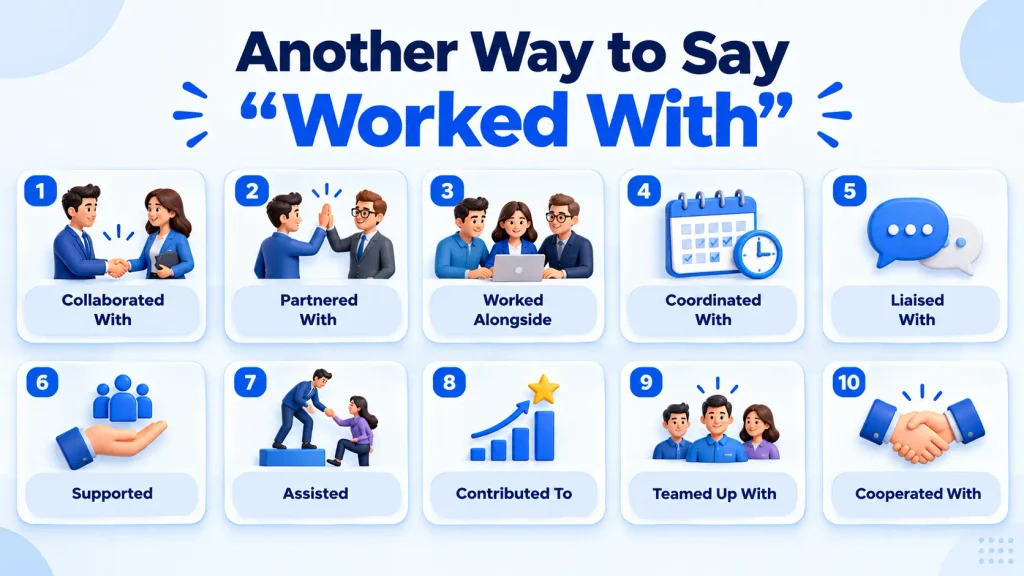
“Collaborated with” means working together with another person or group to achieve a shared objective. It usually suggests active participation, communication, and a joint effort.
I collaborated with the design team to create a new customer onboarding process.
She collaborated with regional managers to improve employee training materials.
Use collaborated with when you want to emphasize teamwork and shared responsibility.
“Partnered with” suggests that two people, teams, or organizations worked together toward a common goal. It can imply a closer or more strategic relationship than the general phrase “worked with.”
Our sales department partnered with the customer success team to reduce response times.
The nonprofit partnered with local businesses to support the community event.
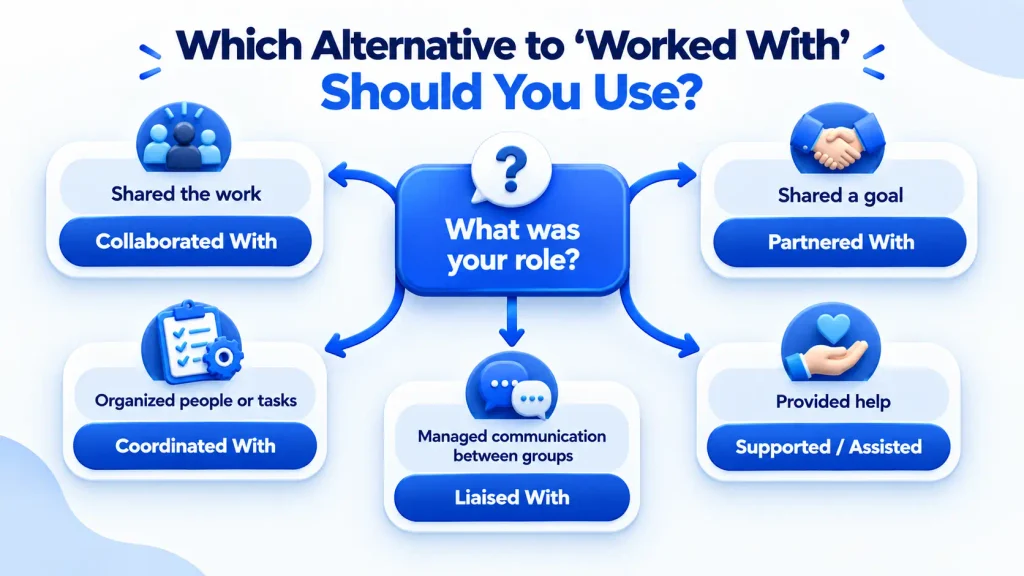
Choose partnered with when the relationship involved a shared goal, initiative, or business objective.
“Worked alongside” means working closely with another person or group, often in the same environment or on related tasks. It sounds natural while still being professional.
I worked alongside senior analysts to prepare monthly financial reports.
She worked alongside experienced teachers during her classroom training.
Use this phrase when you want to highlight close day-to-day teamwork without overstating your level of responsibility.
“Coordinated with” means communicating and organizing activities with another person or group so that work happens efficiently. It often suggests planning, scheduling, or managing different parts of a task.
I coordinated with the logistics team to ensure all orders were delivered on schedule.
The project manager coordinated with several departments before launching the new system.
Use coordinated with when your role involved organizing people, information, schedules, or tasks.
“Liaised with” means acting as a communication link between people, teams, departments, or organizations. It is especially useful when your role involved maintaining communication between different groups.
I liaised with clients and internal teams to resolve project concerns.
The coordinator liaised with vendors to confirm event requirements.
Use liaised with when communication and relationship management were important parts of your role.
“Supported” means helping another person, team, or department complete a task or reach a goal. Unlike “collaborated with,” it can indicate that your role was primarily to provide assistance.
I supported the accounting team with monthly reporting and data entry.
She supported senior managers during the implementation of a new training program.
Choose supported when you contributed to someone else’s work rather than sharing equal responsibility.
“Assisted” means helping someone complete a task, solve a problem, or perform a responsibility. It is useful when you want to clearly describe a supporting role.
I assisted the human resources team with employee onboarding activities.
He assisted customers with product questions and account requests.
Use assisted when you provided direct help and want your specific contribution to remain clear.
“Contributed to” focuses on the part you played in achieving a result rather than simply stating that you worked with someone. It is especially useful when describing accomplishments on a resume.
I contributed to a company-wide project that improved customer response times.
She contributed to the research team’s analysis of consumer behavior trends.
Use contributed to when you want to emphasize your individual input or impact.
“Teamed up with” means joining another person or group to accomplish something together. It has a friendly and conversational tone compared with “collaborated with” or “partnered with.”
I teamed up with a colleague to organize the company’s volunteer day.
The two departments teamed up to create a more useful customer guide.
This phrase works well in conversational writing, but collaborated with or partnered with may sound more polished on a formal resume.
“Cooperated with” means working with others in a helpful and coordinated way to achieve a shared result. It emphasizes willingness to work together and maintain a positive working relationship.
I cooperated with other departments to ensure the transition went smoothly.
The research participants cooperated with the study team throughout the project.
Use cooperated with when mutual assistance and a positive working relationship are central to the situation.
| Alternative | Best Used In | Tone |
| Collaborated With | Resumes, projects, business communication | Professional |
| Partnered With | Business, strategic projects, organizations | Professional |
| Worked Alongside | Teamwork, workplace descriptions | Natural |
| Coordinated With | Project management, scheduling, operations | Professional |
| Liaised With | Client, department, and vendor communication | Formal |
| Supported | Resumes, team assistance, workplace tasks | Professional |
| Assisted | Customer service, support roles, resumes | Formal |
| Contributed To | Resumes, achievements, academic work | Professional |
| Teamed Up With | Everyday and casual communication | Friendly |
| Cooperated With | Formal, academic, and workplace contexts | Polite |
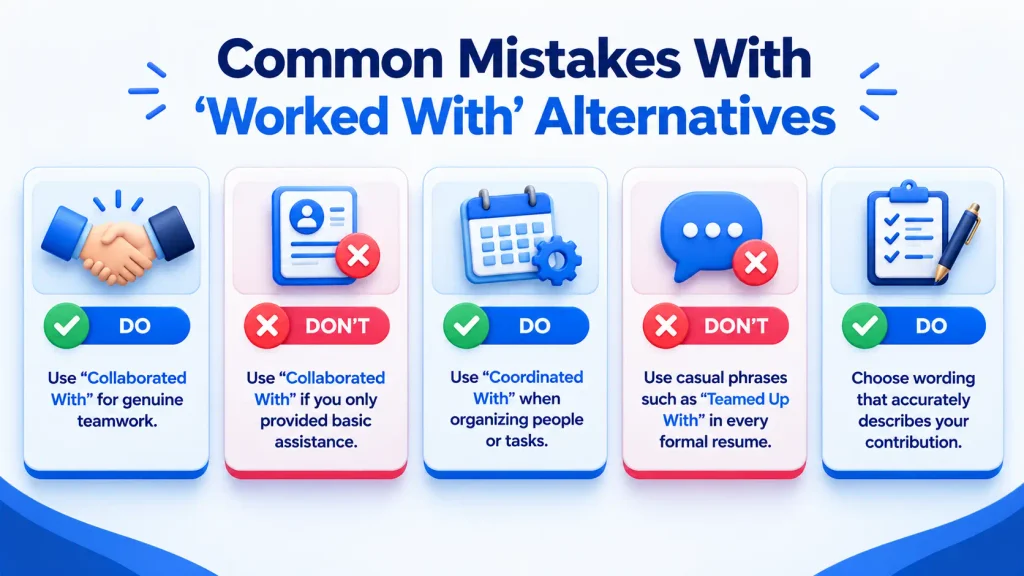
Avoid using “led,” “managed,” or “partnered with” if your role was mainly supportive. Choose a word that accurately represents what you did.
“Teamed up with” sounds natural in conversation but may feel less polished in a formal resume. Consider “collaborated with” or “contributed to” instead.
“Liaised with” usually highlights communication between groups. If you simply worked closely with coworkers, “worked alongside” or “collaborated with” may be more accurate.
Although “collaborated with” is professional, using it throughout an entire resume can become repetitive. Vary your wording when the context genuinely changes.
Simply replacing “worked with” does not automatically make a sentence stronger. Focus on what you actually did, such as coordinating schedules, supporting a team, contributing research, or communicating with clients.
Collaborated with is one of the most useful alternatives for a resume because it clearly communicates teamwork. Depending on your actual role, you can also use partnered with, coordinated with, supported, assisted, contributed to, or liaised with. Choose the phrase that accurately describes your contribution rather than simply choosing the most impressive-sounding option.
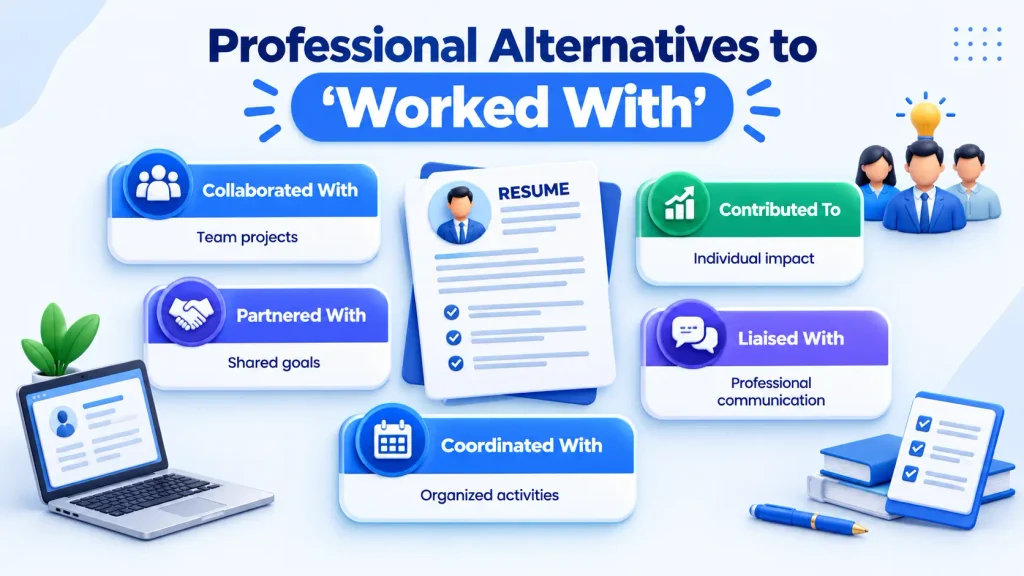
Professional alternatives include collaborated with, partnered with, coordinated with, liaised with, contributed to, and worked alongside. The best choice depends on what happened. For example, “coordinated with” fits a role involving organization, while “liaised with” works when communication between different groups was central to the job.
You can say collaborated with a team, worked alongside a team, contributed to a team, partnered with a team, or supported a team. Each phrase communicates something slightly different. “Collaborated with a team” emphasizes joint work, while “supported a team” suggests that you provided assistance to other members.
Start by identifying your actual contribution. If you shared responsibility, use collaborated with; if you organized activities, use coordinated with; if you provided assistance, use supported or assisted; and if you contributed to a measurable result, consider contributed to.
“Collaborated with” is more specific than “worked with” when the situation involved active teamwork toward a shared goal. However, it is not appropriate for every situation. If you mainly provided assistance or coordinated communication, alternatives such as supported or liaised with may describe your role more accurately.
Depending on your responsibility, you could say supported clients, assisted clients, communicated with clients, partnered with clients, or liaised with clients. For a resume, choose the wording that reflects what you actually did, such as solving customer problems, managing relationships, or coordinating project requirements.
Yes. Worked alongside is professional and natural, especially when describing close teamwork. For example, “I worked alongside senior engineers to test new equipment” clearly shows that you were part of the same working environment without implying that you managed or led the other professionals.
There is no single alternative that fits every resume sentence. Collaborated with works well for shared projects, coordinated with for organized activities, supported for assistance, liaised with for communication, and contributed to for highlighting your role in an achievement. Match the phrase to the specific work you performed.
Finding another way to say “worked with” can make your writing more precise without making it sound unnatural. The key is to choose a phrase that reflects the actual relationship and contribution involved.
Use collaborated with for active teamwork, partnered with for shared goals, and worked alongside for close day-to-day cooperation. If you organized activities, coordinated with may fit better, while liaised with is useful for communication between groups. For supporting roles, consider supported or assisted, and use contributed to when you want to highlight your input.
The most effective alternative is not necessarily the most formal one. Choose the phrase that accurately explains what you did and fits your audience, whether you are writing a resume, email, report, or everyday message.

English Language & Communication Specialist
Dr. Emily Carter is an English language and communication specialist focused on vocabulary, word choice, professional writing, and practical English usage. She helps readers understand the differences between similar words and choose expressions that sound natural, clear, and appropriate for different contexts.













