
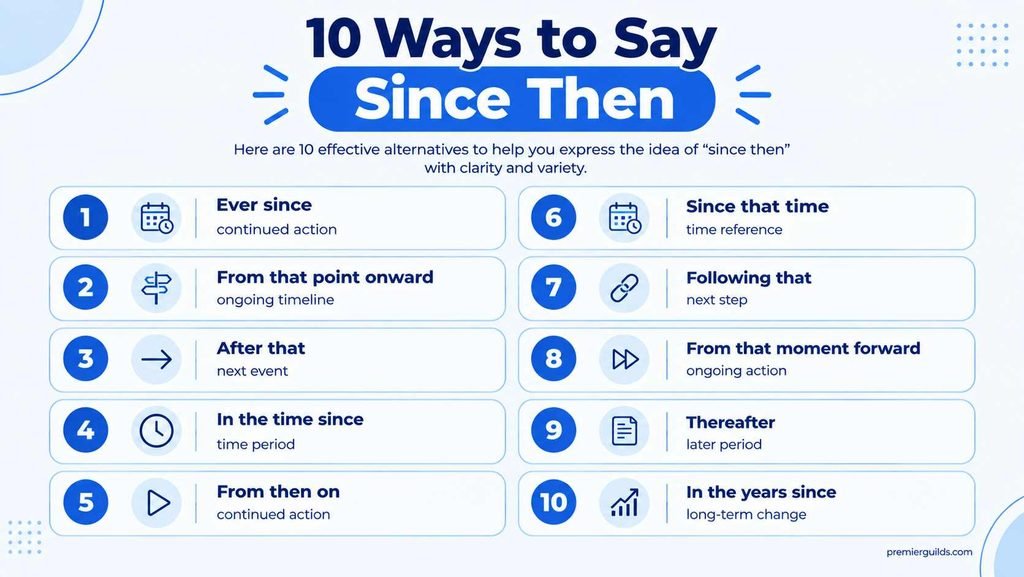
Looking for another way to say “since then”? Try “ever since,” “from that point onward,” “after that,” “in the time since,” or “subsequently.” These alternatives help describe events that happened after a particular moment. The best choice depends on whether you are writing casually, explaining a timeline, or communicating professionally.
The phrase “since then” is useful when you want to explain what happened after a particular event or point in time. However, using the same expression repeatedly can make your writing sound predictable.
Whether you are writing an email, telling a story, describing a personal experience, or explaining a timeline, the right alternative can make your meaning clearer. Some expressions emphasize continued change, while others simply show that one event followed another.
This guide explores 10 natural ways to say “since then,” including their meanings, examples, and best uses in American English.
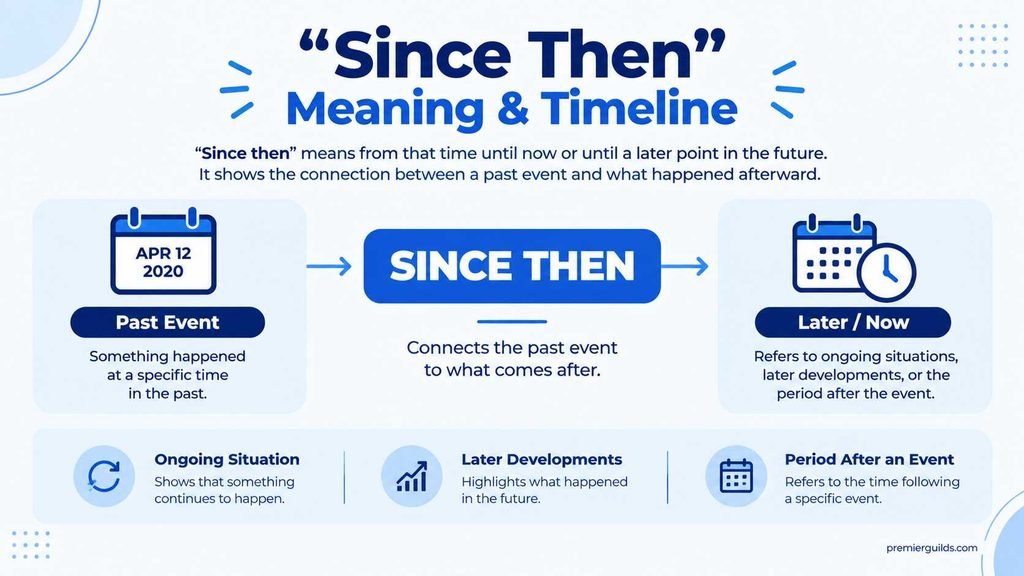
The phrase “another way to say since then” refers to alternative expressions that describe a period or events following a particular time in the past.
“Since then” usually connects a past event with something that happened afterward. It can describe an ongoing situation, a later development, or a change that occurred after a specific moment.
For example:
The phrase is commonly used in:
The best replacement depends on whether you want to emphasize continuity, sequence, or the passage of time.
Although “since then” is grammatically correct and widely used, alternatives can make your writing more precise and engaging.
You may want to use another expression to:
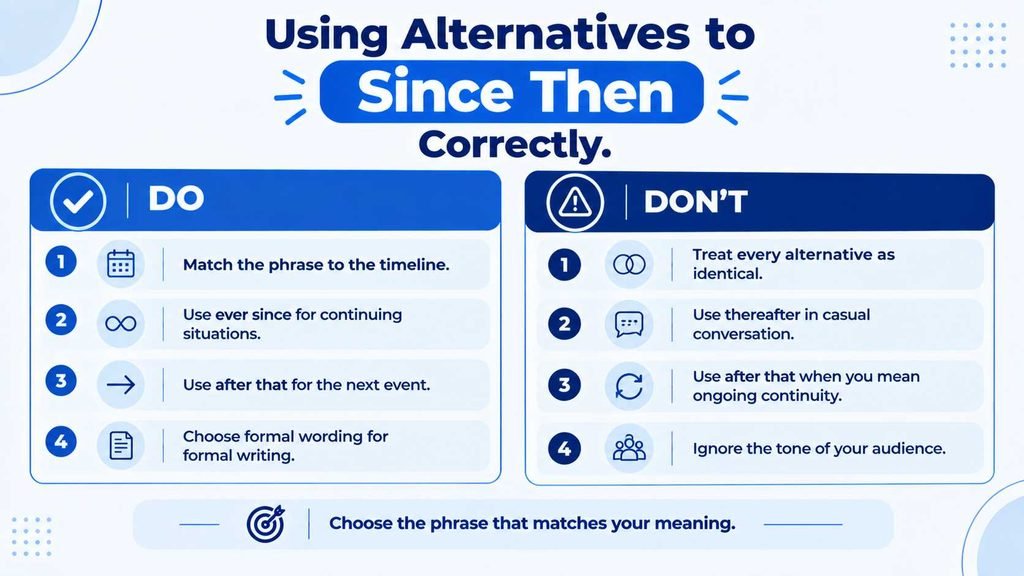
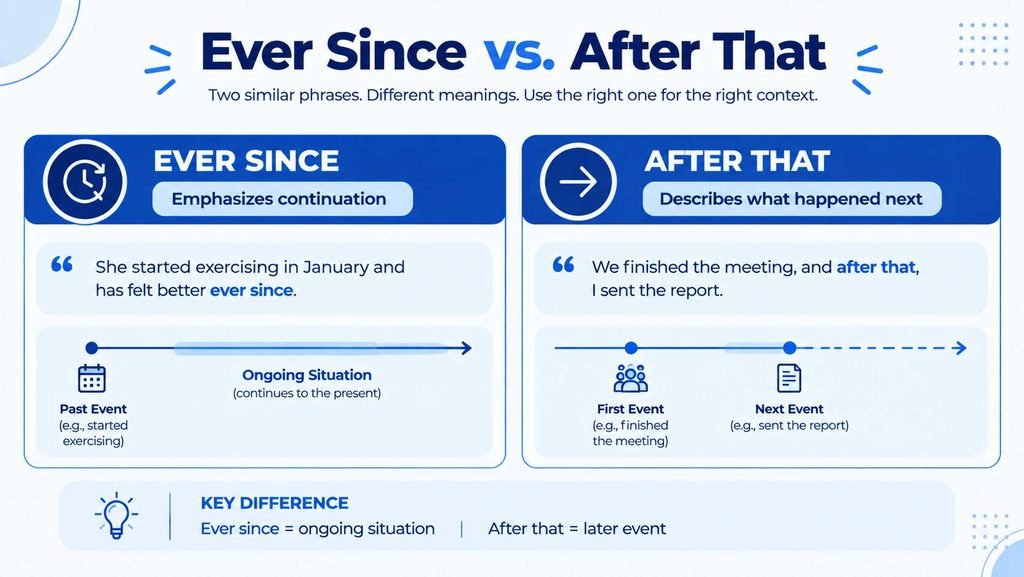
For example, “ever since” suggests that something has continued, while “after that” simply identifies what happened next. Understanding this difference helps you choose the right expression.
“Ever since” means continuously from a particular time in the past until now or another stated point in time. It often emphasizes that a situation, habit, feeling, or activity began after an event and has continued.
This phrase is especially natural when describing personal experiences, lasting changes, or ongoing situations.
I started learning Spanish in college and have practiced it ever since.
She adopted a healthier routine after the surgery and has felt more energetic ever since.
Use “ever since” when you want to highlight continuity. It often works naturally with the present perfect tense, such as “have lived” or “has worked.”
“From that point onward” describes everything that happened after a particular moment or event. It emphasizes a clear starting point and the period that follows.
This expression is useful when explaining a change in behavior, a new policy, or a turning point in a story.
The company introduced a new security policy, and from that point onward, all employees used two-factor authentication.
He realized that preparation mattered, and from that point onward, he reviewed every presentation carefully.
Choose this phrase when you want to make the starting point of a change especially clear.
“After that” is a simple and flexible alternative to “since then.” It refers to something that happened following a previously mentioned event.
Unlike “ever since,” it does not necessarily suggest that the situation continued until now. It is often used to move a story or explanation forward.
We finished the client meeting, and after that, I organized the project notes.
The team tested the new software on Monday. After that, they reported several improvements.
Use “after that” when describing the next event in a sequence rather than an ongoing situation.
“In the time since” refers to the period between a past event and another point in time, often the present. It commonly introduces changes, developments, or experiences that occurred during that period.
This phrase is particularly useful when comparing how things were before with how they are now.
In the time since we launched the website, our monthly visitors have increased significantly.
In the time since her first novel was published, she has written three more books.
Use this expression when you want to focus on what has changed or happened during the period after an event.
“From then on” means beginning at a particular time in the past and continuing afterward. It often appears in stories or explanations about a decision, habit, or change in behavior.
It is similar to “from that point onward,” but it usually sounds more natural and concise.
He missed the deadline once, so from then on, he set reminders several days in advance.
We discovered a faster way to organize the files, and from then on, everyone followed the same system.
Use “from then on” when referring to a previously mentioned moment without repeating the exact date or event.
“Since that time” is a more explicit and slightly formal alternative to “since then.” It refers to the period beginning at a particular past moment.
It can be useful when you want to make the time reference clear, especially in reports, formal explanations, or historical writing.
The organization changed its hiring policy in 2021. Since that time, it has expanded its training programs.
The town experienced severe flooding that year. Since that time, local officials have improved the drainage system.
Use “since that time” when you want a clear, formal reference to a previously mentioned date or event.
“Following that” means after the event, action, or situation just mentioned. It is useful for connecting related events and showing what happened next.
The expression often sounds polished in professional writing, reports, and explanations. It can refer to one later event or a series of developments.
The committee reviewed the proposal. Following that, it requested several revisions.
The company completed its internal audit. Following that review, management introduced new procedures.
Use “following that” to create a smooth transition between events, especially in formal writing.
“From that moment forward” emphasizes that something began after a specific moment and continued afterward. It often highlights a major decision, realization, or turning point.
This phrase can add a more reflective or dramatic tone to personal stories and narratives.
She decided to pursue her passion for photography, and from that moment forward, she made time for creative work every week.
The team understood the importance of communication, and from that moment forward, they held regular planning meetings.
Choose this phrase when the past event represents a meaningful turning point.
“Thereafter” means after that event or time. It is a concise, formal expression that shows a later action or development in relation to something previously mentioned.
It is common in business documents, legal writing, academic texts, and formal reports. In everyday conversation, simpler alternatives may sound more natural.
The contract was signed in June, and the parties thereafter followed the agreed payment schedule.
The researcher collected the initial results and thereafter began analyzing the data.
Use “thereafter” when you need a concise formal transition. Avoid using it in casual conversations where “after that” would be clearer.
“In the years since” refers to the period that has passed after a particular event, especially when several years have gone by. It often introduces changes, achievements, or developments over a longer period.
This phrase works well when discussing careers, businesses, historical events, or personal growth.
In the years since she graduated, she has built a successful career in environmental science.
In the years since the museum reopened, it has welcomed thousands of new visitors.
Use “in the years since” when the period involves several years or when you want to emphasize long-term development.
| Alternative | Best Used In | Tone |
| Ever since | Ongoing situations and personal experiences | Natural, warm |
| From that point onward | Changes and turning points | Formal, professional |
| After that | Everyday stories and sequences | Casual, clear |
| In the time since | Progress and developments | Professional, reflective |
| From then on | Habits and decisions | Natural, conversational |
| Since that time | Reports and historical explanations | Formal, precise |
| Following that | Professional transitions and reports | Polished, formal |
| From that moment forward | Major decisions and turning points | Reflective, expressive |
| Thereafter | Business, academic, and legal writing | Formal, concise |
| In the years since | Long-term changes and achievements | Professional, reflective |
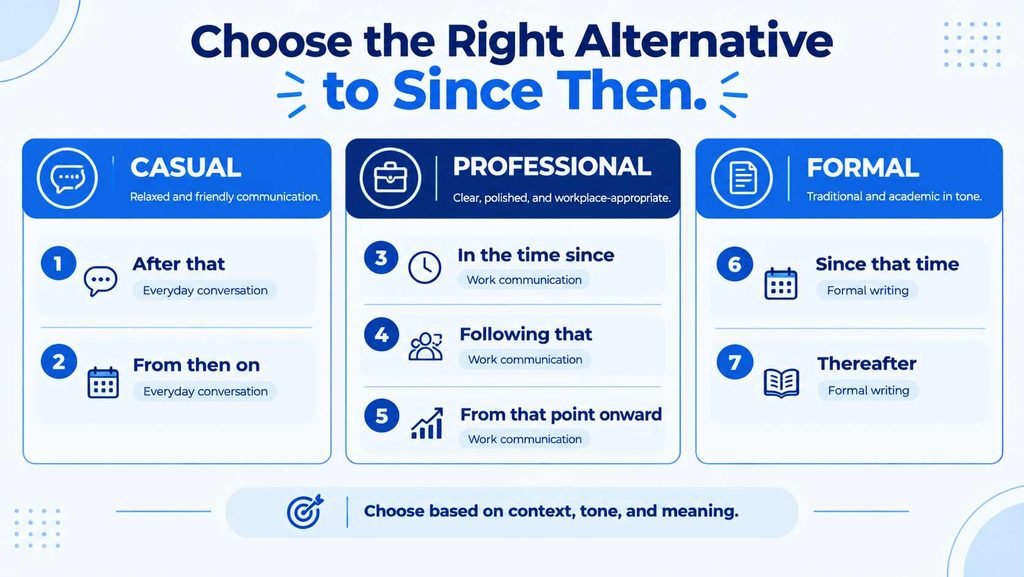
“After that” usually identifies a later event, while “ever since” often shows that something has continued. Choose the phrase that matches whether you mean a sequence or an ongoing condition.
Words such as “thereafter” may sound stiff in a text to a friend. In everyday American English, “after that” or “from then on” is often more natural.
Not every alternative fits every timeline. “In the years since” suggests a longer period, while “from that moment forward” may emphasize a particular turning point.
Using “since then” in every paragraph can make your writing feel repetitive. Vary your wording when the meaning stays accurate, but do not replace it with an expression that changes the timeline.
“Following that” and “after that” generally show what happened next. They do not automatically mean that an activity continued until the present, as “ever since” often does.
“Since that time,” “from that point onward,” and “thereafter” are useful formal alternatives. The best choice depends on your sentence. “Since that time” emphasizes an ongoing period, while “thereafter” usually points to a later action or development.
“After that,” “from then on,” and “ever since” are natural choices in everyday American English. Use “after that” when describing the next event, “from then on” for a continuing change in behavior, and “ever since” when something has continued.
They are closely related, but they can have slightly different emphasis. “Ever since” often highlights continuity from a past event until now. “Since then” can also describe that period, but it may sound more neutral and can fit a wider range of timelines.
Yes, but the meaning may change. “After that” generally refers to an event that happened later, while “since then” often describes what has happened during the period following an earlier event. Choose “after that” when you mean “next,” not necessarily “continuously afterward.”
For an essay, consider “in the time since,” “since that time,” “from that point onward,” or “thereafter.” These expressions can help create a clear timeline. However, “since then” is already appropriate for academic writing when it accurately communicates your intended meaning.
You can use “since that time,” “following that,” “in the time since,” or “from that point onward.” For example, instead of “We updated the system and have had fewer errors since then,” you could write, “We updated the system, and error rates have declined in the time since.”
Both expressions describe what happens after a particular time. “From then on” is shorter and more conversational, while “from that point onward” sounds more deliberate and formal. Either can describe a continuing change, depending on the context.
“Thereafter” is grammatically correct, but it is more common in formal writing than in everyday speech. In casual conversations, “after that” or “from then on” usually sounds more natural. Use “thereafter” when a concise, formal transition suits the document.
There are several natural ways to say “since then,” and each one serves a slightly different purpose. Use “ever since” when you want to emphasize that something has continued, or choose “after that” when simply describing what happened next. For professional writing, “in the time since,” “since that time,” and “following that” can make timelines clear and polished.
If you are describing a major change, “from that point onward” or “from that moment forward” can highlight the turning point. Meanwhile, “thereafter” works well in formal documents, and “in the years since” is ideal for long-term developments.
The most effective alternative is the one that matches your intended meaning and audience. For more guidance on how to use “since” and “since then” correctly, see this grammar guide. Choose clarity first, then vary your wording naturally.

Senior English Editor & Stylistics Director
Michael Bennett is a veteran editor, lexicographer, and publishing consultant with more than two decades of experience in academic and educational publishing. Formerly a senior editorial director at major university presses, he specializes in structural editing, register refinement, and vocabulary development. Michael oversees tone, precision, and stylistic consistency across all publication channels, ensuring content meets rigorous editorial and pedagogical standards.