
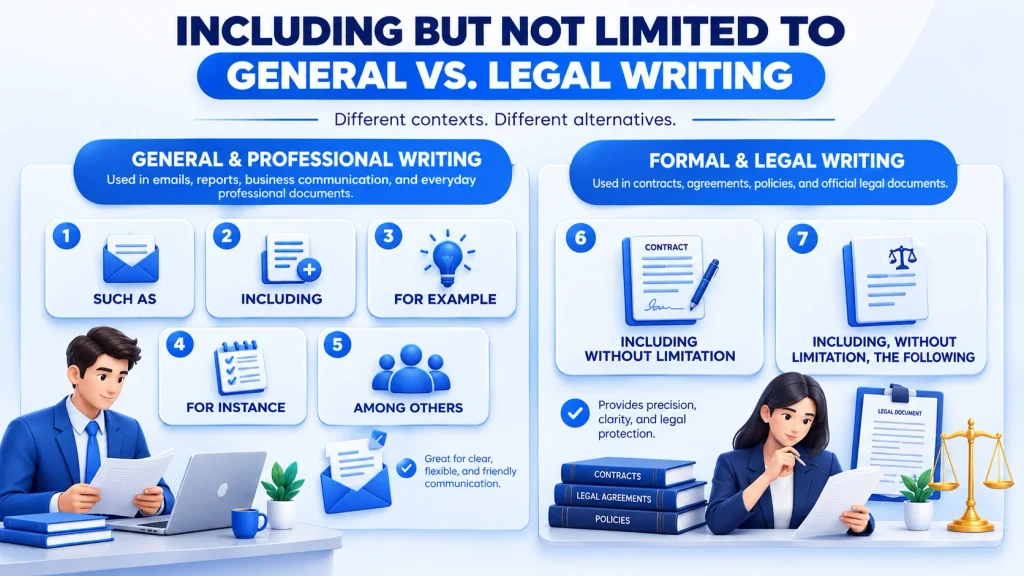
Looking for another way to say including but not limited to? Common alternatives include such as, including, for example, among others, among other things, and including without limitation. The best choice depends on whether you need casual, professional, formal, or legal wording.
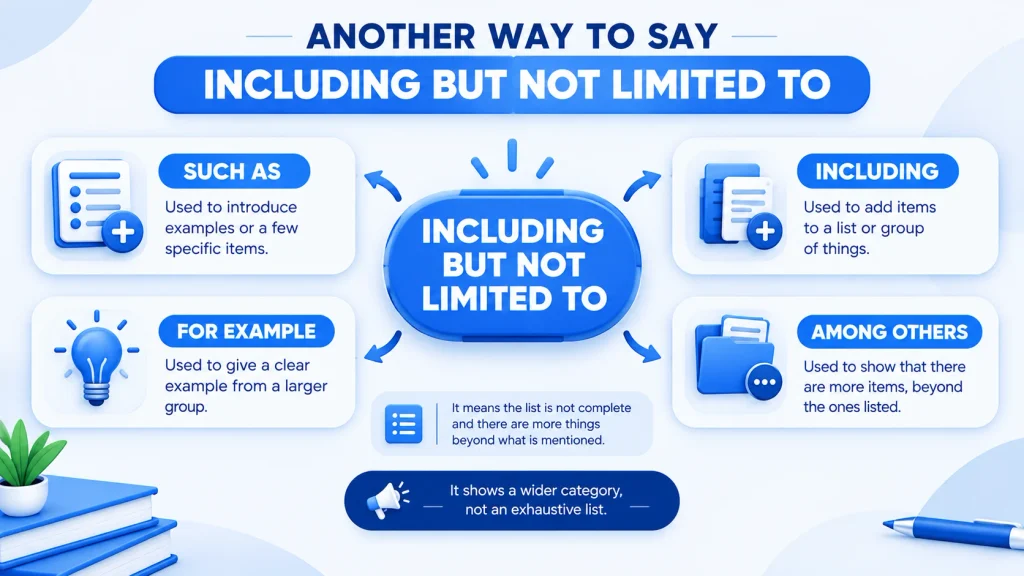
The phrase “including but not limited to” introduces examples while making clear that the list does not contain every possible item. In other words, the examples that follow are part of a broader category.
For example, “The position involves duties including but not limited to training, reporting, and scheduling” means those duties are included, but other responsibilities may also apply.
You will often see this phrase in contracts, policies, agreements, employment documents, business writing, and formal documents. Its purpose is usually to prevent readers from treating a list as exhaustive.
The phrase can be useful when precision matters, but it may sound long or legalistic in ordinary writing. In many situations, simpler wording such as “such as,” “including,” or “for example” can communicate the idea more naturally.
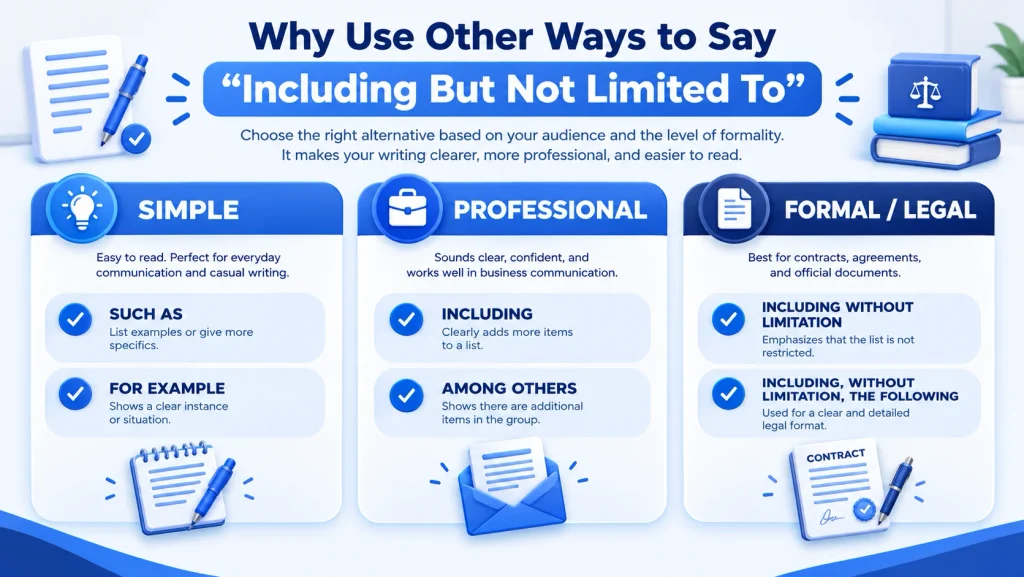
Writers often look for alternatives because the original phrase can make a sentence feel formal, repetitive, or unnecessarily long. Simpler wording can improve readability while still showing that the examples are not necessarily exhaustive.
You might use an alternative to:
The key is to choose an alternative that preserves the intended meaning. This matters most in contracts, policies, and other documents where wording can carry specific consequences.
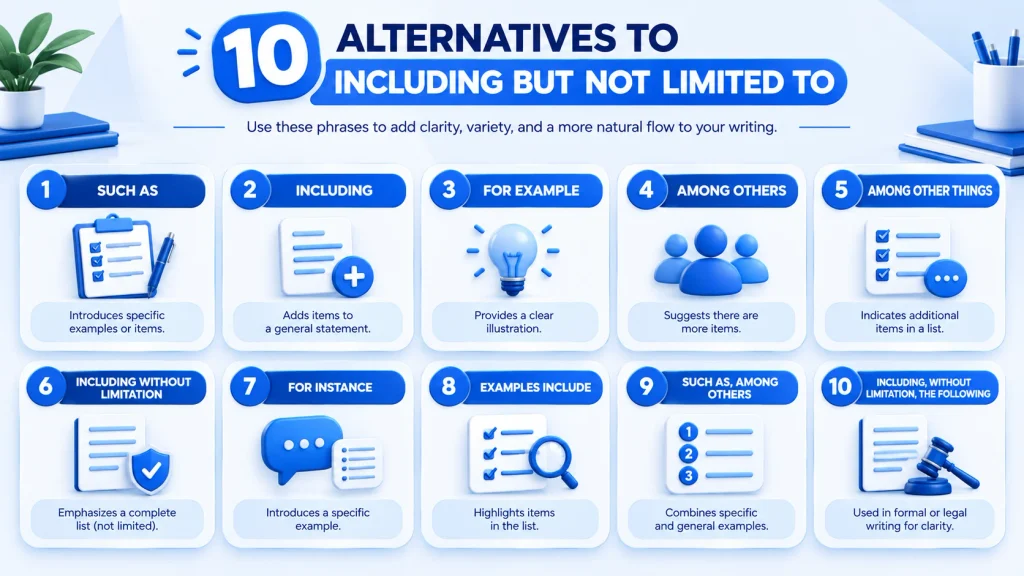
Such as introduces examples from a larger category. It is shorter and more natural than “including but not limited to” in many general and professional contexts.
We offer services such as website design, SEO, and content development.
The training covers skills such as communication, teamwork, and problem-solving.
Use such as when you want to provide examples without making the sentence unnecessarily formal.
Including introduces items that form part of a broader group. It is one of the simplest alternatives and often removes unnecessary wording from a sentence.
The package includes several features, including automated reports and data backups.
The meeting covered several topics, including staffing and project timelines.
“Including” is often enough when the surrounding sentence already makes it clear that the list is not exhaustive.
For example directly signals that the following information is an illustration rather than a complete list. It is clear, familiar, and easy for readers to understand.
Several communication tools can improve teamwork. For example, shared project platforms can centralize updates.
You can reduce operating costs in several ways. For example, reviewing recurring subscriptions may help.
Use for example when your main goal is to explain or illustrate an idea.
Among others indicates that the items mentioned are only some of the possibilities. It works well when you want to keep a sentence concise while signaling that additional items exist.
The committee reviewed marketing, finance, and staffing issues, among others.
Her responsibilities include client communication and project planning, among others.
Place “among others” after a list when you want to signal that additional examples have not been named.
Among other things communicates that the points mentioned are only part of a broader set of matters. It sounds natural in general and professional communication.
The meeting covered the new budget, staffing plans, and deadlines, among other things.
His role involves reviewing reports and supporting customers, among other things.
This phrase is useful when the list is intentionally brief and you do not need to identify every category.
Including without limitation is a formal expression that indicates the listed examples do not restrict the broader scope. It is particularly associated with legal and contractual language.
The agreement covers all company property, including without limitation equipment and inventory.
The policy applies to business records, including without limitation invoices and personnel files.
Use this expression carefully in legal or formal documents rather than ordinary emails or casual writing.
For instance has essentially the same practical function as “for example.” It introduces one or more examples without making the sentence sound overly technical.
Several factors can affect productivity; for instance, unclear priorities may slow a project.
Some workplace benefits are available to eligible employees; for instance, flexible scheduling may be offered.
Use for instance when you want a polished alternative to “for example.”
Examples include directly tells readers that the items that follow are examples of a broader category. It is particularly useful in reports, guides, presentations, and explanatory writing.
Common project risks include missed deadlines, unclear requirements, and limited resources.
Examples of eligible expenses include travel, lodging, and approved business meals.
Use this construction when clarity matters more than preserving the original legal-style wording.
Such as, among others combines an example-introducing phrase with wording that signals additional items exist. It can work in professional writing when you want both ideas stated clearly.
The program teaches business skills such as budgeting and negotiation, among others.
The role requires technical abilities such as data analysis and reporting, among others.
Avoid adding unnecessary qualifiers if such as alone already communicates your intended meaning.
Including, without limitation, the following is a highly formal construction used to introduce examples while explicitly stating that the list is not exhaustive. It is most appropriate for formal agreements and legal-style documents.
The covered expenses include, without limitation, the following: travel, lodging, and approved transportation.
The policy addresses, without limitation, the following areas: security, privacy, and data retention.
Reserve this construction for documents where broad scope and formal precision are important.
| Alternative | Best Used In | Tone |
| Such as | General, professional, academic writing | Neutral |
| Including | Business documents, reports, emails | Professional |
| For example | Explanations, articles, emails | Neutral |
| Among others | Professional lists and statements | Formal |
| Among other things | General and workplace communication | Neutral |
| Including without limitation | Contracts and legal documents | Formal |
| For instance | Academic and professional writing | Polished |
| Examples include | Reports, guides, presentations | Professional |
| Such as, among others | Formal and professional lists | Formal |
| Including, without limitation, the following | Legal agreements and policies | Very Formal |
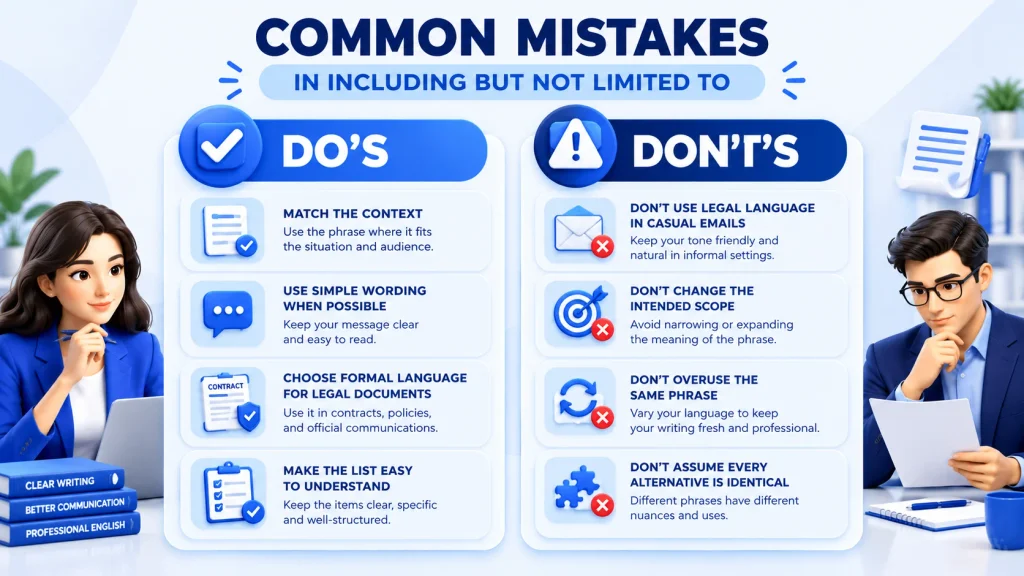
Phrases such as “including without limitation” can sound unnecessarily formal in a friendly email. Use simpler options like such as or for example when legal precision is not needed.
Some alternatives introduce examples without explicitly emphasizing that the list is unlimited. Choose wording based on whether completeness, simplicity, or legal precision matters.
Repeating “including but not limited to” throughout one document can make the writing feel heavy. Vary your wording where the context allows.
Namely generally introduces specific or exact items rather than an open-ended list. It may therefore narrow the meaning instead of preserving the original intent.
A simpler synonym may be fine in an email or article but inappropriate for a contract without careful review. Legal documents should be drafted according to the applicable legal requirements and the intended scope.
Common alternatives include such as, including, for example, among others, among other things, for instance, and including without limitation. The best choice depends on your context. “Such as” works well for general writing, while “including without limitation” is more suitable for formal or legal documents.
For most professional writing, such as, including, for example, or among others can sound cleaner. If you are drafting a contract or formal agreement, including without limitation may be more appropriate because it explicitly maintains a broad scope.
Often, yes, but context matters. “Including” commonly introduces examples rather than an exhaustive list, and some legal drafting authorities argue that “including but not limited to” can be redundant. However, legal interpretation can vary, so contractual wording should be chosen carefully.
Such as is one of the simplest alternatives. For example is another clear choice when you want to introduce illustrations. Both generally sound more natural than the longer phrase in everyday, academic, and many professional contexts.
Including without limitation is a formal alternative commonly found in contracts and other legal documents. Another formal construction is including, without limitation, the following. These expressions emphasize that the listed items do not restrict the broader category.
In many general and professional contexts, yes. “Such as” naturally introduces examples and usually sounds simpler. However, if the exact scope of a contract or legal provision matters, do not replace established drafting language without considering the document’s legal purpose.
It can sound formal, particularly in casual conversations, emails, and simple explanatory writing. However, it remains common in legal, contractual, policy, and formal business documents. The issue is usually not correctness but whether the level of formality fits the audience and purpose.
No. The phrase is generally used to indicate that the listed items are examples within a broader category. Additional items may fall within the scope even though they are not specifically named. This open-ended function is one reason the expression appears frequently in contracts and policies.
Choosing another way to say including but not limited to depends on your audience, purpose, and level of formality. For everyday and professional writing, such as, including, and for example usually make sentences shorter and easier to understand. Among others and among other things work well when you want to show that additional items exist.
For legal or highly formal documents, expressions such as including without limitation may be more appropriate. Still, legal wording deserves extra care because changing a phrase can affect how readers interpret the scope of a provision. The best approach is simple: use plain language when you can, but preserve precision when the document requires it.

Senior English Editor & Stylistics Director
Michael Bennett is a veteran editor, lexicographer, and publishing consultant with more than two decades of experience in academic and educational publishing. Formerly a senior editorial director at major university presses, he specializes in structural editing, register refinement, and vocabulary development. Michael oversees tone, precision, and stylistic consistency across all publication channels, ensuring content meets rigorous editorial and pedagogical standards.