

Looking for another way to say something? You can use phrases such as “How else can I say this?”, “How can I phrase this differently?”, or “What’s another way to express this?” The best choice depends on your purpose, tone, audience, and whether you are writing casually, professionally, or formally.
“What’s another way to say” is a question people use when they want a different word, phrase, or expression for the same idea. It often appears when someone wants to improve their wording, avoid repetition, or make a sentence sound more natural.
For example, you might ask, “What’s another way to say ‘thank you’?” when you want a more polished expression such as “I appreciate it” or “Many thanks.”
The phrase is common in everyday conversations, writing, emails, school assignments, workplace communication, and language learning. It can also be used when someone wants to find a more polite, professional, casual, or precise way to communicate an idea.
Because the phrase itself is a question about wording, there is no single replacement that works in every situation. The right alternative depends on what you are trying to express and who will read or hear it.

People use different versions of this question for several practical reasons. A small change in wording can make your request sound more natural, specific, or appropriate for the situation.
Using alternatives can help you:
For example, “How else can I say this?” sounds conversational, while “What’s a more professional way to say this?” clearly tells the listener what type of wording you need.
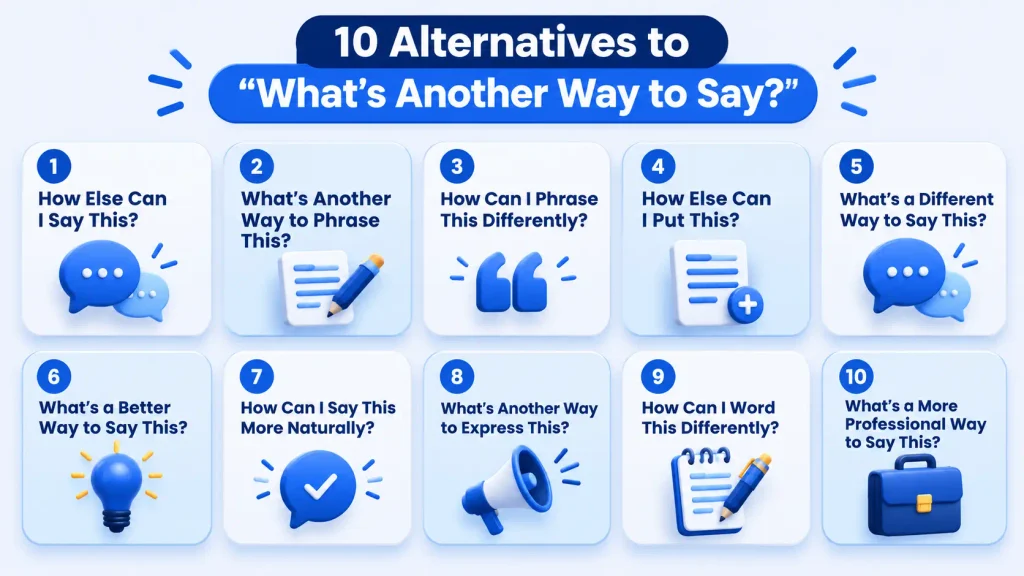
“How else can I say this?” is a natural way to ask for a different expression of the same idea. It sounds conversational and is easy to use when you are speaking with a friend, coworker, teacher, or writing partner.
“How else can I say this without making the email sound too formal?”
“I know what I mean, but I’m struggling with the wording. How else can I say this?”
Use this option when you want a simple and natural question in everyday communication.
“What’s another way to phrase this?” focuses specifically on sentence construction or wording. It works well when you already have an idea but want to express it more clearly.
“What’s another way to phrase this so the client understands the request?”
“Can you suggest another way to phrase this paragraph?”
This is especially useful when discussing emails, reports, essays, or other written content.
“How can I phrase this differently?” asks for an alternative way to structure an existing statement. It sounds thoughtful and works well when you want to improve clarity without changing the original meaning.
“How can I phrase this differently so it sounds more confident?”
“I want to keep the message polite. How can I phrase this differently?”
Choose this phrase when your main concern is sentence structure or tone.
“How else can I put this?” is a conversational expression used when someone wants another way to communicate an idea. It is relaxed and often appears in spoken English.
“I don’t want to sound negative. How else can I put this?”
“That explanation feels confusing. How else can I put this?”
Use this option in informal conversations or relaxed writing rather than highly formal documents.
“What’s a different way to say this?” directly asks for another expression with a similar meaning. It is straightforward and easy for almost any audience to understand.
“What’s a different way to say this without using the word ‘important’?”
“Do you know a different way to say this in everyday English?”
This is a safe general-purpose option when you do not need a highly formal tone.
“What’s a better way to say this?” suggests that the current wording may not be the clearest or most effective choice. It can be useful when you want feedback on tone, clarity, or word choice.
“What’s a better way to say this in a cover letter?”
“Can you tell me if there’s a better way to say this?”
Use “better” when you are looking for an improvement, not simply another wording.
“How can I say this more naturally?” is useful when the wording is grammatically correct but does not sound like natural American English. It is particularly helpful for language learners and writers.
“How can I say this more naturally when talking to a coworker?”
“I understand the grammar, but how can I say this more naturally?”
Choose this phrase when your main goal is natural, fluent-sounding English.
“What’s another way to express this?” focuses on communicating an idea rather than simply replacing individual words. It can work for opinions, emotions, messages, and more complex thoughts.
“What’s another way to express this concern without sounding critical?”
“I want to express appreciation more clearly. What’s another way to express this?”
Use “express” when the idea involves feelings, opinions, concerns, or broader messages.
“How can I word this differently?” is a practical way to ask for help with written language. It is particularly appropriate when you want to revise a sentence, email, message, or document.
“How can I word this differently so the request sounds more professional?”
“Could you help me word this differently for a business email?”
This phrase is a strong choice when discussing professional or academic writing.
“What’s a more professional way to say this?” clearly asks for workplace-appropriate wording. It is useful when your original expression sounds too casual, vague, or conversational for a professional setting.
“What’s a more professional way to say this in an email to my manager?”
“Is there a more professional way to say this on my resume?”
Use this option when your main goal is to make your wording suitable for work, business, or career documents.
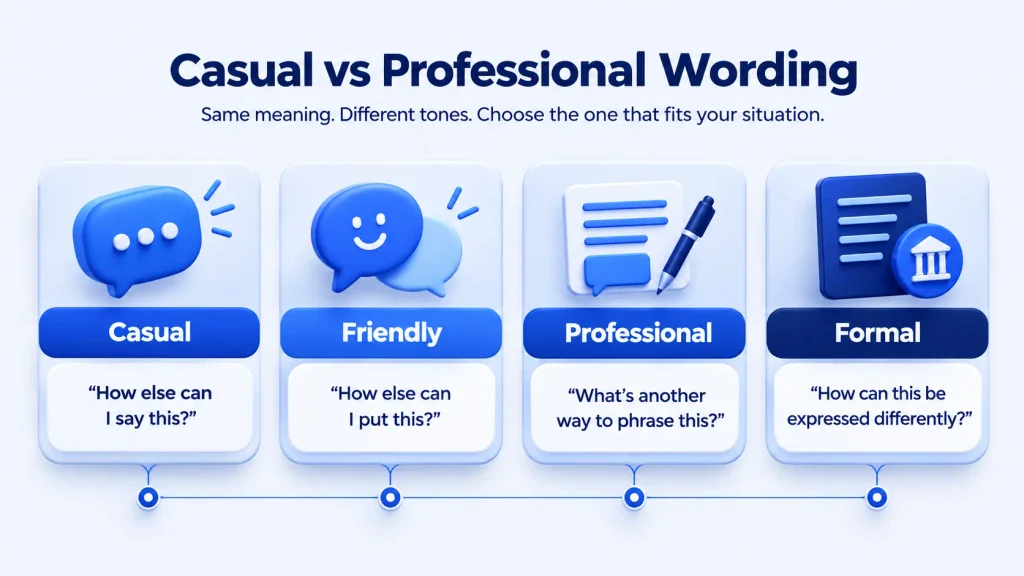
| Alternative | Best Used In | Tone |
|---|---|---|
| How Else Can I Say This? | Everyday conversations | Friendly |
| What’s Another Way to Phrase This? | Writing and editing | Professional |
| How Can I Phrase This Differently? | Emails and documents | Polite |
| How Else Can I Put This? | Casual conversations | Warm |
| What’s a Different Way to Say This? | General communication | Casual |
| What’s a Better Way to Say This? | Editing and feedback | Professional |
| How Can I Say This More Naturally? | Language learning and conversation | Friendly |
| What’s Another Way to Express This? | Ideas and emotions | Formal |
| How Can I Word This Differently? | Written communication | Professional |
| What’s a More Professional Way to Say This? | Workplace writing | Formal |
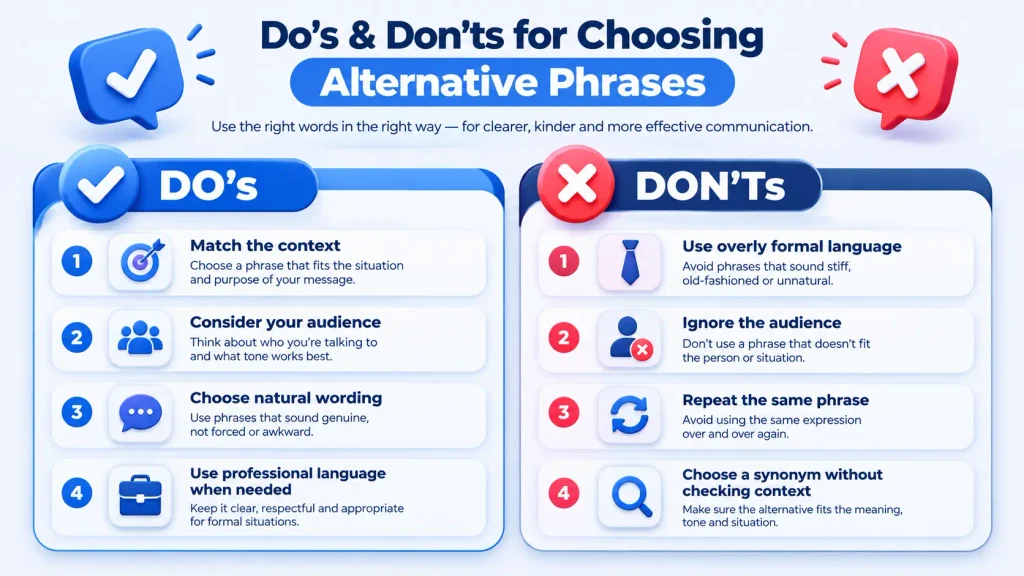
Expressions such as “How else can I put this?” can sound too conversational in certain workplace situations. When writing to a client or senior colleague, a more polished option may be appropriate.
Not every situation requires formal wording. Asking a friend, “What’s another way to express this?” may sound unnecessarily serious when “How else can I say this?” would feel more natural.
Using “What’s another way to say” in every paragraph can make your writing repetitive. Rotate naturally between alternatives when the context supports it.
The best alternative depends on your audience and purpose. A phrase that works well in casual conversation may not be the right choice for a business email, resume, or academic paper.
The word “better” implies that the original wording has a problem. If you simply want another option, “What’s a different way to say this?” may be more accurate.
You can say “How else can I say this?”, “What’s another way to phrase this?”, or “How can I word this differently?” For professional situations, “What’s a more professional way to say this?” is especially useful. The best choice depends on whether you are asking about casual conversation, writing, tone, or workplace communication.
A professional option is “What’s another way to phrase this?” You can also ask, “How can I phrase this differently?” or “What’s a more professional way to say this?” These expressions work well when requesting help with emails, reports, presentations, resumes, or other workplace documents.
“How else can I say this?” is one of the most natural casual options. “How else can I put this?” also works in relaxed conversations. Both expressions sound conversational without being unclear, making them useful when talking with friends, classmates, or coworkers you know well.
You can say, “What’s a better way to say this?” or “How can I phrase this differently?” If your goal is natural English rather than simply different wording, try “How can I say this more naturally?” Each option communicates a slightly different purpose.
Try “Could you suggest another way to phrase this?” or “How could I word this differently?” These questions make your request sound respectful without being overly formal. Adding “please” can make the request warmer when you are asking someone directly for writing or language help.
You can ask, “How can I say this more naturally?” This is particularly useful when English is not your first language or when a sentence sounds technically correct but unnatural. It tells the listener that you want wording that people commonly use in real conversations.
“What’s another way to phrase this?” is a strong choice for email-related questions. If the message needs to sound more polished, ask, “What’s a more professional way to say this?” Both options clearly communicate that you want help improving the wording rather than changing the underlying message.
Yes, but it is usually more natural as a question about language rather than as part of formal prose. For formal communication, alternatives such as “What’s another way to phrase this?” or “How can this idea be expressed differently?” may sound more polished depending on the context.
There are many natural ways to ask for a different way to express an idea. “How else can I say this?” works well for everyday conversations, while “What’s another way to phrase this?” and “How can I word this differently?” are useful for professional and written communication.
If you want natural American English, “How can I say this more naturally?” is a helpful choice. When your goal is specifically workplace language, “What’s a more professional way to say this?” makes your purpose clear.
The key is to match the phrase with your audience, setting, and reason for asking. Instead of automatically choosing the most formal expression, select the one that sounds natural for the situation and clearly communicates what kind of wording you need.

English Language & Communication Specialist
Dr. Emily Carter is an English language and communication specialist focused on vocabulary, word choice, professional writing, and practical English usage. She helps readers understand the differences between similar words and choose expressions that sound natural, clear, and appropriate for different contexts.