

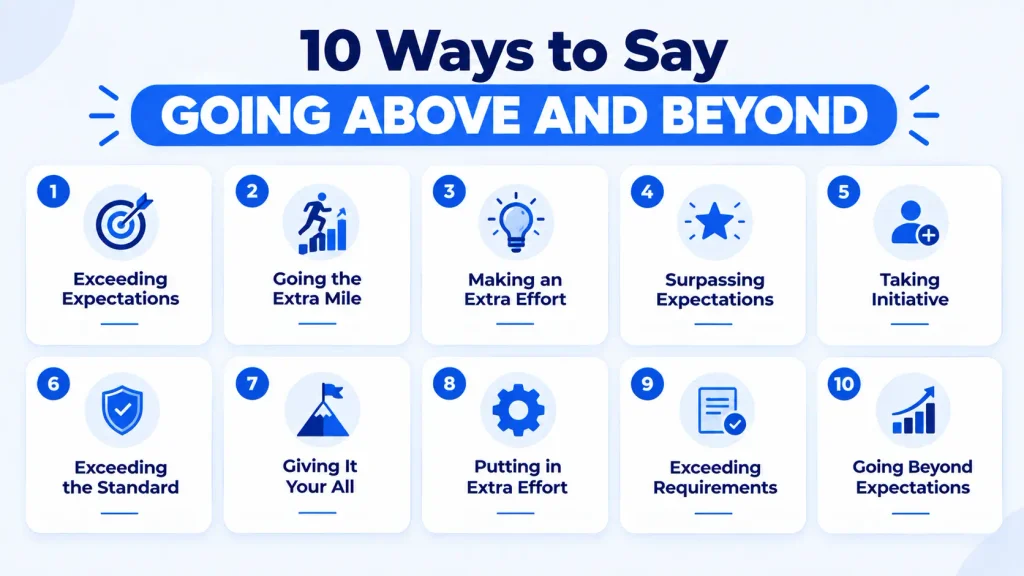
If you need another way to say going above and beyond, you can use phrases such as exceeding expectations, going the extra mile, making an extra effort, surpassing expectations, taking initiative, or giving it your all. The right expression depends on whether you are describing professional performance, dedication, effort, or personal commitment.
“Going above and beyond” means doing more than what is normally expected or required. People commonly use the phrase to praise someone who makes an extra effort, delivers exceptional service, takes initiative, or shows strong commitment to a task.
For example, a manager might say, “Maria went above and beyond to help the client.” The phrase sounds positive and natural, but repeating it too often can make professional writing feel predictable.
The good news is that several alternatives can communicate the same general idea while emphasizing slightly different qualities. Some focus on results, while others highlight effort, initiative, dedication, or personal commitment.
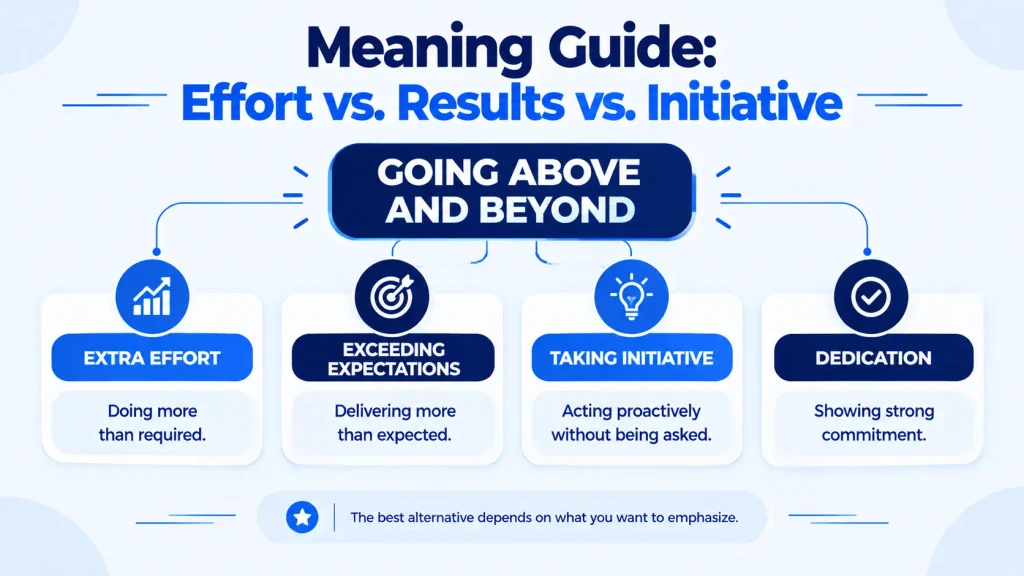
“Going above and beyond” means doing more than the basic expectations of a situation. It suggests that someone provided additional effort, support, attention, or value beyond what was required.
The expression is especially common in workplace English, including employee recognition, performance reviews, recommendation letters, customer service, resumes, interviews, and professional emails.
For example:
The customer service representative went above and beyond to resolve the issue.
This means the representative did more than the normal level of service expected.
The phrase can also be used outside work. Someone might go above and beyond when helping a friend, preparing for an event, or supporting a family member.
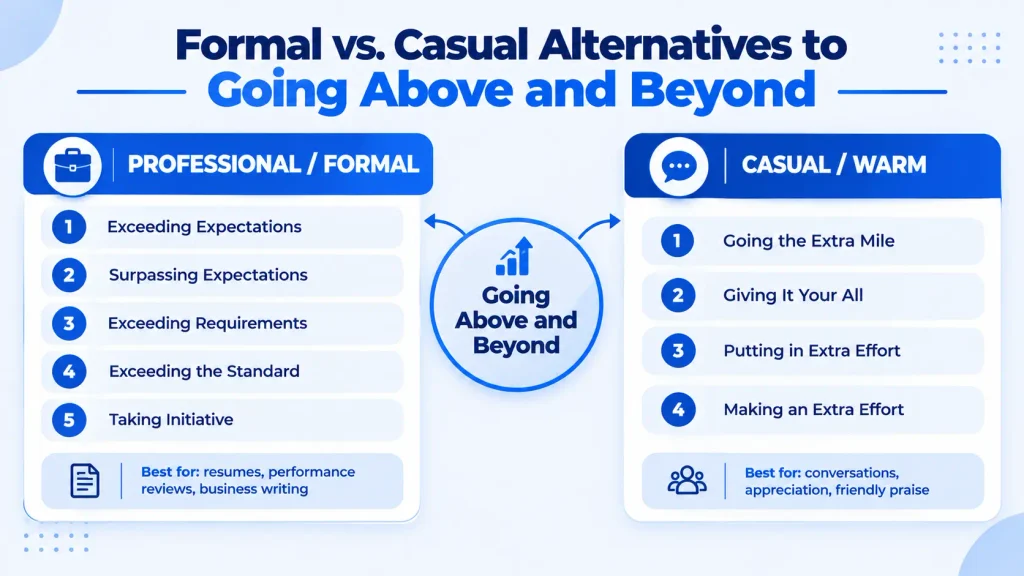
Using different expressions can help you communicate the specific type of effort or achievement you want to describe.
You may want an alternative to:
Exceeding expectations means performing at a level higher than what was expected. It is especially useful when you want to emphasize the quality or results of someone’s performance.
Jordan consistently exceeded expectations by completing projects ahead of schedule.
Her attention to detail helped her exceed client expectations throughout the project.
Use exceeding expectations when the main focus is on strong results or performance.
Going the extra mile means making additional effort to help someone or accomplish something. It is a natural idiom that closely matches the meaning of “going above and beyond.”
Our support team went the extra mile to make the transition easier for new customers.
Sam always goes the extra mile when helping new employees learn the system.
This is an excellent choice for conversational workplace writing, but use a more direct phrase when writing a highly formal document.
Making an extra effort focuses specifically on the additional work someone puts into a task. Unlike “exceeding expectations,” it emphasizes the effort rather than necessarily proving an exceptional result.
Thank you for making an extra effort to accommodate the customer’s schedule.
She made an extra effort to ensure every team member understood the new process.
Choose this phrase when you want to recognize someone’s effort without overstating the outcome.
Surpassing expectations means performing beyond the level that others anticipated. It has a polished, professional tone and works well when discussing measurable achievements or strong performance.
The project team surpassed expectations by delivering the final product two weeks early.
His sales results surpassed expectations during the first quarter.
Use surpassing expectations when you want to emphasize that actual performance went beyond a specific standard.
Taking initiative means acting proactively instead of waiting to be told what to do. It highlights independence, responsibility, and the ability to recognize what needs to be done.
Maya took initiative by creating a streamlined process for handling customer requests.
He took initiative to train new team members during a period of rapid growth.
Use this phrase when “going above and beyond” involved identifying a need and acting on it independently.
Exceeding the standard means performing above an established level of quality or performance. It works particularly well when discussing workplace expectations, service standards, or professional benchmarks.
The team consistently exceeded the standard for customer response times.
Her work exceeded the standard required for the certification project.
This phrase is useful when there is a clear standard, benchmark, or requirement to compare performance against.
Giving it your all means putting maximum effort and commitment into something. It is more personal and conversational than many professional alternatives.
He gave it his all while preparing the team for the final presentation.
She gave it her all to make the community event successful.
Use this phrase for encouragement, appreciation, or personal communication rather than highly formal business documents.
Putting in extra effort means doing more work or investing more energy than the situation normally requires. It directly emphasizes dedication and additional effort.
The interns put in extra effort to organize the research before the deadline.
Carlos put in extra effort to make sure the presentation was ready for the client meeting.
Use this phrase when the additional effort itself is more important than the final result.
Exceeding requirements means doing more than the minimum conditions or specifications demand. It is particularly useful for projects, technical work, compliance standards, and professional responsibilities.
The new system exceeded the project’s original performance requirements.
She consistently exceeded the requirements of her role while maintaining excellent accuracy.
Use this expression when you have clearly defined requirements to reference.
Going beyond expectations is a direct alternative that preserves the meaning of the original expression. It communicates that someone’s performance, service, or effort was greater than anticipated.
The hotel staff went beyond expectations to accommodate the large group.
Her dedication to the project went beyond expectations and earned praise from the leadership team.
Use this phrase when you want a close substitute for “going above and beyond” without changing the basic meaning.
| Alternative | Best Used In | Tone |
| Exceeding expectations | Performance, results, reviews | Professional |
| Going the extra mile | Workplace praise, customer service | Friendly/Professional |
| Making an extra effort | Appreciation and teamwork | Warm/Professional |
| Surpassing expectations | Achievements and measurable results | Formal |
| Taking initiative | Proactive workplace behavior | Professional |
| Exceeding the standard | Performance standards and quality | Formal |
| Giving it your all | Personal praise and encouragement | Casual/Warm |
| Putting in extra effort | Effort and dedication | Friendly/Professional |
| Exceeding requirements | Projects, roles, specifications | Formal |
| Going beyond expectations | General professional praise | Professional/Warm |
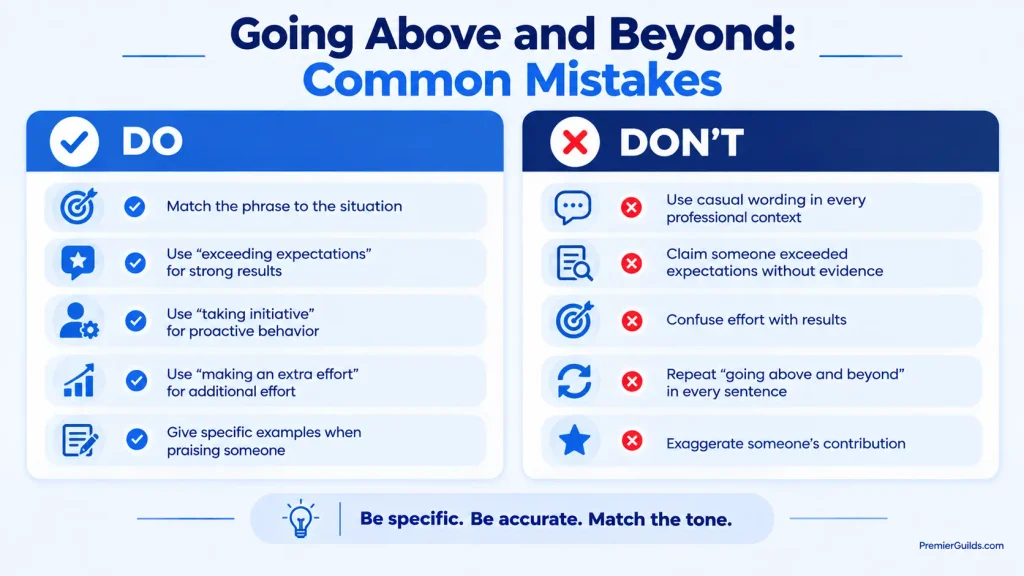
Expressions such as giving it your all can sound friendly and natural, but they may not fit a formal performance review or business document. Choose language that matches the audience.
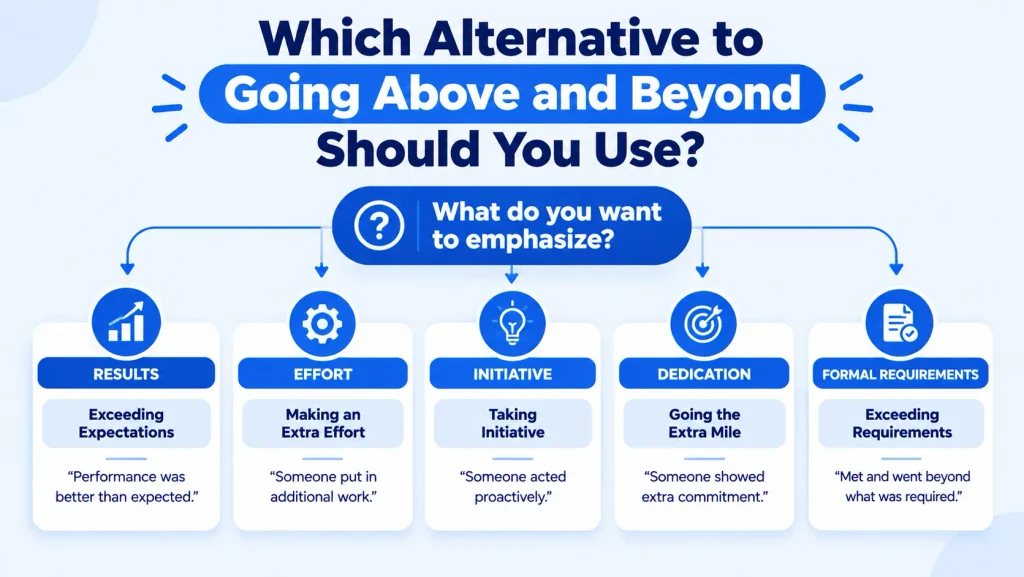
“Making an extra effort” focuses on how hard someone worked, while “exceeding expectations” focuses more on performance. Choose the expression that accurately describes what happened.
Taking initiative suggests proactive behavior. If someone only completed an assigned responsibility, another phrase may be more accurate.
Using the same phrase repeatedly can weaken your writing. Vary the expression based on whether you are describing effort, results, dedication, or initiative.
Not every successful task means someone went beyond expectations. Use these expressions when the person’s effort or results genuinely exceeded the normal requirements.
Professional alternatives include exceeding expectations, surpassing expectations, exceeding requirements, exceeding the standard, and taking initiative. The right choice depends on what you want to emphasize. Use “exceeding expectations” for performance, “taking initiative” for proactive behavior, and “exceeding requirements” when specific responsibilities or standards were involved.
Common alternatives include going the extra mile, exceeding expectations, making an extra effort, surpassing expectations, going beyond expectations, and putting in extra effort. These expressions are similar but not identical. Some emphasize results, while others focus on effort or initiative, so the context should guide your choice.
On a resume, use a specific action phrase instead of relying only on “going above and beyond.” Depending on your experience, you might say exceeded performance targets, took initiative to improve a process, surpassed project requirements, or delivered results beyond expectations. Specific accomplishments are generally more informative than a general statement about effort.
You can say exceeded expectations, surpassed requirements, delivered exceptional results, took initiative, or made an extra effort. Choose the wording based on the actual contribution. For example, “took initiative” highlights proactive behavior, while “exceeded expectations” focuses on performance that was higher than anticipated.
The two expressions have very similar meanings, particularly when describing effort or service. Both suggest doing more than what is normally expected. However, “going the extra mile” often emphasizes additional effort, while “exceeding expectations” can place more emphasis on the resulting level of performance.
A performance review can use phrases such as consistently exceeded expectations, demonstrated initiative, surpassed performance goals, or made significant contributions beyond core responsibilities. Whenever possible, connect the phrase to a specific behavior or result. This makes the review more concrete than simply stating that an employee went above and beyond.
For casual conversations, you can say going the extra mile, giving it your all, putting in extra effort, or doing more than expected. “Going the extra mile” is especially natural in American English. The best option depends on whether you are praising someone’s effort, dedication, or willingness to help.
Use a phrase that describes the specific behavior rather than making a broad claim. Instead of simply saying someone “went above and beyond,” explain that they took initiative, completed the project early, helped a customer resolve an issue, or made an extra effort. Specific details make the praise sound more credible and meaningful.
Knowing another way to say going above and beyond gives you more flexibility when writing professional messages, performance reviews, resumes, recommendations, or everyday praise. The right alternative depends on the quality you want to emphasize.
Use exceeding expectations or surpassing expectations when performance or results are the focus. Choose going the extra mile or making an extra effort when you want to highlight additional effort. If someone acted proactively, taking initiative may communicate the idea more precisely.
For casual and personal situations, giving it your all can sound warmer and more natural. Meanwhile, exceeding requirements works well when you are discussing clearly defined responsibilities or standards.
The key is to choose language that accurately reflects what the person did. Specific wording makes praise clearer, more credible, and more useful than simply repeating a familiar expression.

English Language & Communication Specialist
Dr. Emily Carter is an English language and communication specialist focused on vocabulary, word choice, professional writing, and practical English usage. She helps readers understand the differences between similar words and choose expressions that sound natural, clear, and appropriate for different contexts.