

Looking for another way to say thank you for understanding? Try I appreciate your understanding, thank you for your patience, I appreciate your flexibility, thank you for being understanding, or I’m grateful for your understanding. The best choice depends on whether you are writing a professional email, making an apology, or speaking casually.
“Thank you for understanding” is a polite way to show appreciation when someone accepts a difficult situation, delay, request, decision, or explanation. It is common in professional emails, customer service messages, workplace communication, and everyday conversations.
Although the phrase is natural and widely understood, repeating it can make your messages sound predictable. Choosing a more specific alternative can help you communicate appreciation while matching the tone of the situation.
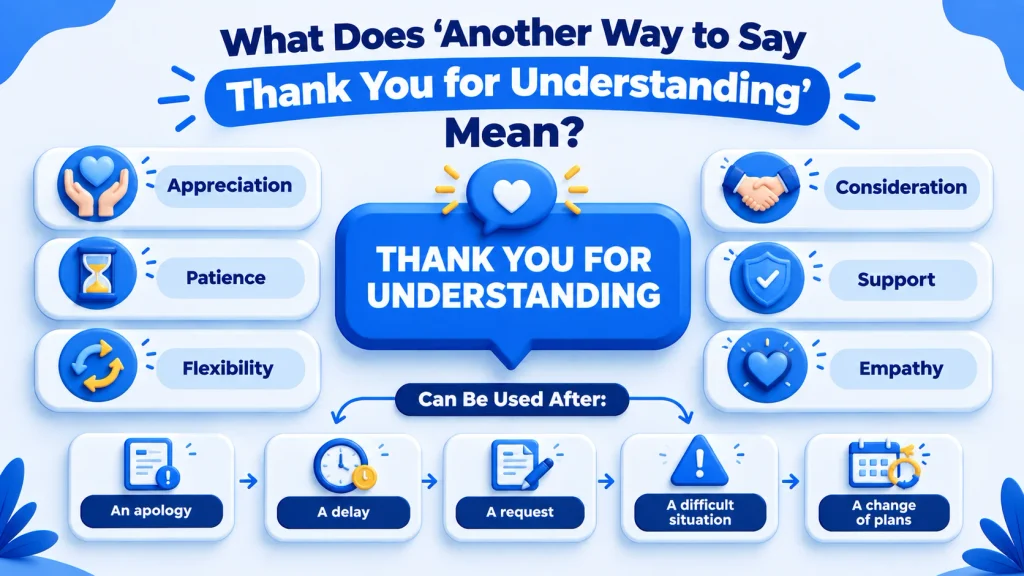
“Another way to say thank you for understanding” means finding a different expression to show appreciation when someone has accepted or respected your situation, needs, decision, or explanation.
For example, you might use this phrase after apologizing for a delayed response, explaining a schedule change, requesting additional time, or discussing a personal matter.
The best alternative depends on what the other person has actually done. If they waited patiently, “thank you for your patience” is more specific. If they adjusted their plans, “I appreciate your flexibility” may be a better fit.
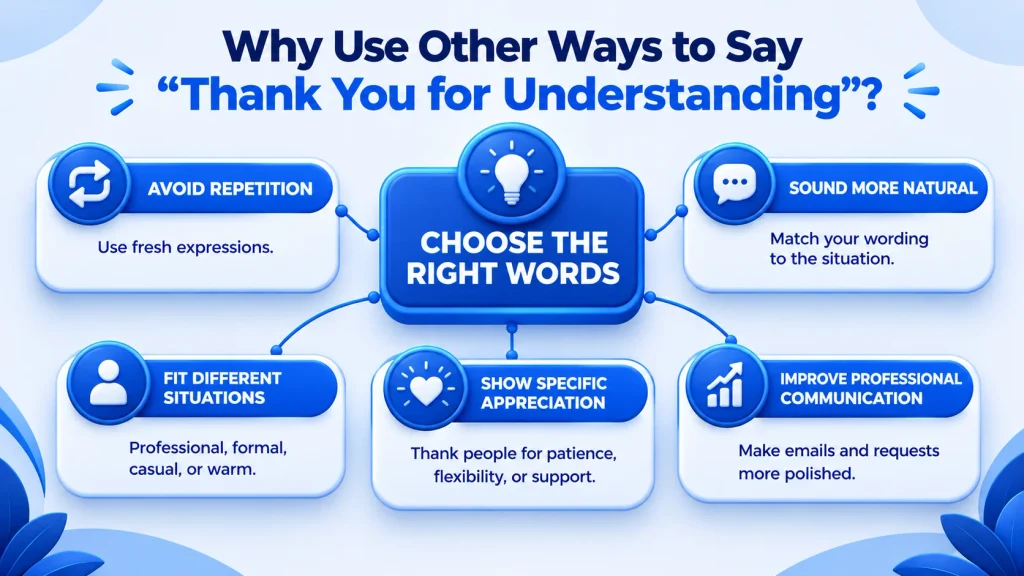
Using alternatives helps you make your communication more precise and natural. Instead of relying on one standard expression, you can choose wording that reflects the exact kind of support or consideration you received.
Other expressions can help you:
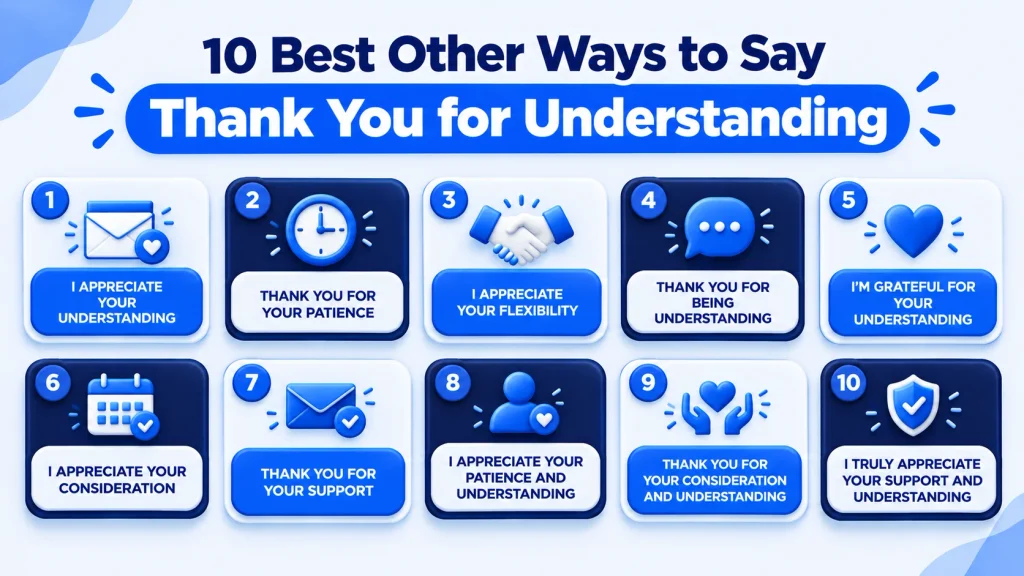
“I appreciate your understanding” is one of the closest and most versatile alternatives to “thank you for understanding.” It communicates sincere gratitude while maintaining a professional and respectful tone.
I appreciate your understanding as we work through this unexpected scheduling issue.
I appreciate your understanding regarding the additional time needed to complete the review.
Use this option when you want a polished phrase that works well in professional emails and formal communication.
“Thank you for your patience” is ideal when someone has had to wait for a response, service, decision, or resolution. It recognizes the time they have given you rather than simply acknowledging their understanding.
Thank you for your patience while our support team investigates the issue.
Thank you for your patience as we finalize the updated schedule.
Choose this phrase when a delay or waiting period is the main reason you are expressing gratitude.
“I appreciate your flexibility” thanks someone for adapting to a change or accommodating a different arrangement. It is especially useful when schedules, deadlines, meetings, or plans have changed.
I appreciate your flexibility with the revised meeting time.
We appreciate your flexibility as we adjust the project timeline.
Use this expression when the person has changed their plans or adapted to your circumstances.
“Thank you for being understanding” has a warm and personal tone. It recognizes the other person’s willingness to consider your situation with patience, empathy, or kindness.
Thank you for being understanding while I take care of this family matter.
I really appreciate you being understanding about the last-minute change.
This phrase works particularly well when you want your appreciation to feel personal rather than strictly professional.
“I’m grateful for your understanding” expresses stronger personal appreciation than the standard phrase. It is appropriate when someone has shown meaningful support during a challenging or sensitive situation.
I’m grateful for your understanding during this difficult transition.
I’m truly grateful for your understanding and continued support.
Use “grateful” when you want to communicate deeper appreciation rather than routine courtesy.
“I appreciate your consideration” is useful when someone has thoughtfully reviewed your request, circumstances, or needs. It is especially common in professional and formal communication.
I appreciate your consideration of my request to extend the deadline.
Thank you for reviewing the proposal, and I appreciate your consideration.
Use this phrase when the person is considering a request, proposal, option, or special circumstance.
“Thank you for your support” focuses on the help or encouragement someone has provided. It works well when their response involves more than simply understanding your situation.
Thank you for your support while we manage this temporary change.
Your encouragement has meant a lot to me, so thank you for your support.
Choose this alternative when the person has actively helped, encouraged, or stood by you.
“I appreciate your patience and understanding” combines two forms of consideration. It is particularly effective when someone has both waited for a resolution and accepted the circumstances behind the delay.
I appreciate your patience and understanding while we work to resolve the billing issue.
We appreciate your patience and understanding during this temporary service interruption.
Use this phrase when both waiting and acceptance are important parts of the situation.
This expression combines appreciation for someone’s thoughtful consideration with gratitude for their acceptance of your circumstances. It has a formal, respectful tone that suits business and official communication.
Thank you for your consideration and understanding regarding my request for additional time.
We appreciate your consideration and understanding as we review the proposed changes.
This phrase works best when you are making a formal request and want to acknowledge the reader’s thoughtful response.
“I truly appreciate your support and understanding” adds warmth and sincerity to a standard expression of gratitude. It is useful when someone has shown both empathy and practical or emotional support.
I truly appreciate your support and understanding while I work through this situation.
We truly appreciate your support and understanding during this transition.
Use “truly” when you want to make your appreciation sound more heartfelt without becoming overly emotional.
| Alternative | Best Used In | Tone |
| I Appreciate Your Understanding | Professional emails, requests | Professional |
| Thank You for Your Patience | Delays, customer service | Polite |
| I Appreciate Your Flexibility | Schedule or plan changes | Professional |
| Thank You for Being Understanding | Personal conversations | Warm |
| I’m Grateful for Your Understanding | Sensitive situations | Heartfelt |
| I Appreciate Your Consideration | Formal requests | Formal |
| Thank You for Your Support | Help and encouragement | Warm |
| I Appreciate Your Patience and Understanding | Delays and disruptions | Professional |
| Thank You for Your Consideration and Understanding | Formal requests | Formal |
| I Truly Appreciate Your Support and Understanding | Personal or professional support | Warm |
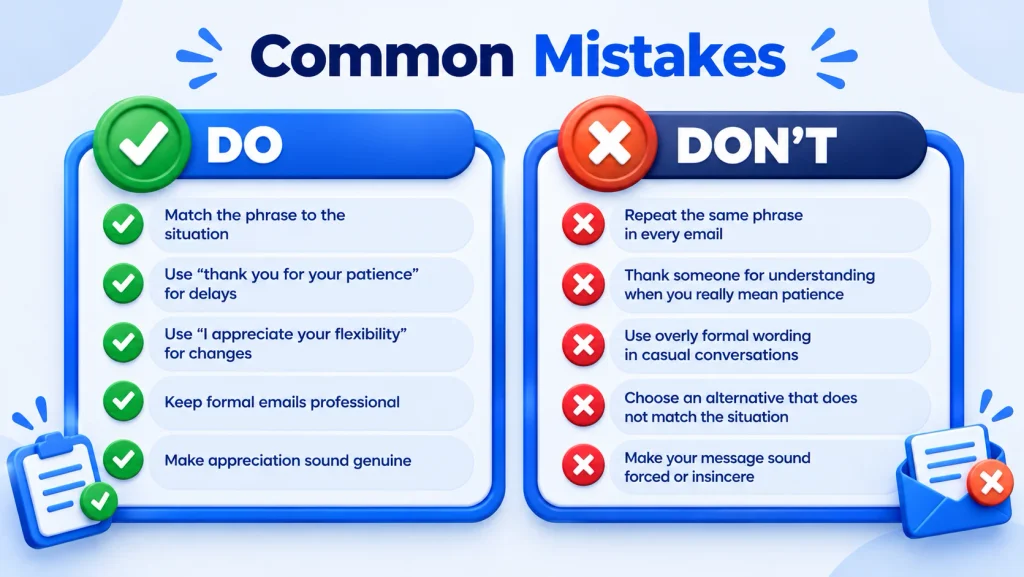
Repeating “thank you for understanding” in every message can make your communication sound formulaic. Choose a more specific expression when the situation involves patience, flexibility, support, or consideration.
If the person has been waiting for a response or resolution, “thank you for your patience” may be more accurate. It directly recognizes the time they have given you.
Phrases such as “thank you for your consideration and understanding” can sound stiff in a text to a friend. In casual situations, “thanks for understanding” or “thanks for being understanding” may feel more natural.
Consider what the person actually did before choosing your words. Someone who changed their schedule deserves thanks for their flexibility, while someone who waited deserves thanks for their patience.
Avoid adding unnecessary words simply to make your message sound more formal. A short, genuine expression of appreciation is often more effective than an overly elaborate sentence.
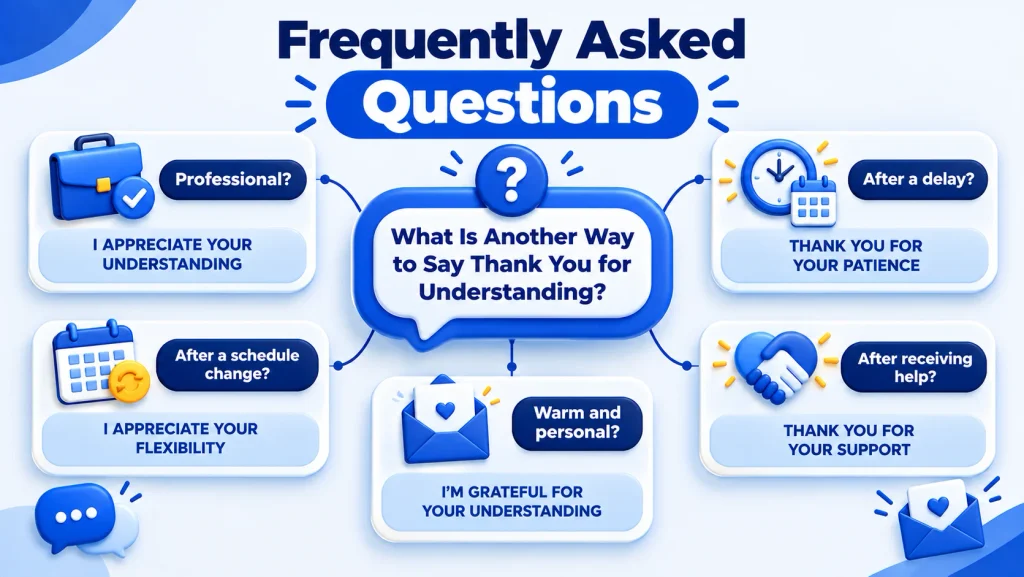
“I appreciate your understanding” is one of the most natural professional alternatives. Depending on the situation, you can also say “thank you for your patience,” “I appreciate your flexibility,” or “I appreciate your consideration.” The right choice depends on whether the person understood your situation, waited for you, or accommodated a change.
For a professional email, you can write “I appreciate your understanding” or “Thank you for your patience and understanding.” If you are discussing a schedule change, “I appreciate your flexibility” may be more precise. Choose the phrase that reflects what the recipient actually did.
“I appreciate your understanding” is a polite and versatile alternative. Other options include “I’m grateful for your understanding,” “I appreciate your consideration,” and “thank you for your patience.” Each expression adds a slightly different meaning, so consider the circumstances before choosing one.
After an apology, “I appreciate your understanding” works naturally and respectfully. You can also say “Thank you for your patience” if the issue caused a delay. For a more personal situation, “I’m grateful for your understanding” can communicate deeper appreciation.
Neither expression is universally better. “I appreciate your understanding” often sounds slightly more polished and professional, while “thank you for understanding” is simple, direct, and natural. Your choice should depend on the audience and context rather than formality alone.
In a business email, consider “I appreciate your understanding,” “I appreciate your flexibility,” or “Thank you for your patience.” If you are asking someone to review or approve something, “I appreciate your consideration” may be more appropriate because it directly matches the action you are thanking them for.
“I’m grateful for your understanding” and “thank you for being understanding” both sound warm and sincere. If the person has also provided emotional or practical help, “I truly appreciate your support and understanding” adds a stronger sense of personal gratitude.
Yes. “Thank you for understanding” is polite and commonly used in customer communication. However, when a customer has experienced a delay, “thank you for your patience” is often more specific. If the customer has accommodated a change, “we appreciate your flexibility” may communicate your gratitude more clearly.
There are many natural ways to say “thank you for understanding,” and the best choice depends on what you want to acknowledge. “I appreciate your understanding” is a reliable option for professional emails, while “thank you for your patience” works better when someone has waited through a delay.
For schedule changes or adjustments, “I appreciate your flexibility” is more precise. In personal situations, “thank you for being understanding” or “I’m grateful for your understanding” can sound warmer and more sincere.
The key is to connect your appreciation to the other person’s actual response. When you choose words that match the situation, your message feels more genuine, thoughtful, and effective—whether you are writing a business email, responding to a customer, apologizing for a delay, or thanking someone personally.

Senior English Editor & Stylistics Director
Michael Bennett is a veteran editor, lexicographer, and publishing consultant with more than two decades of experience in academic and educational publishing. Formerly a senior editorial director at major university presses, he specializes in structural editing, register refinement, and vocabulary development. Michael oversees tone, precision, and stylistic consistency across all publication channels, ensuring content meets rigorous editorial and pedagogical standards.













