
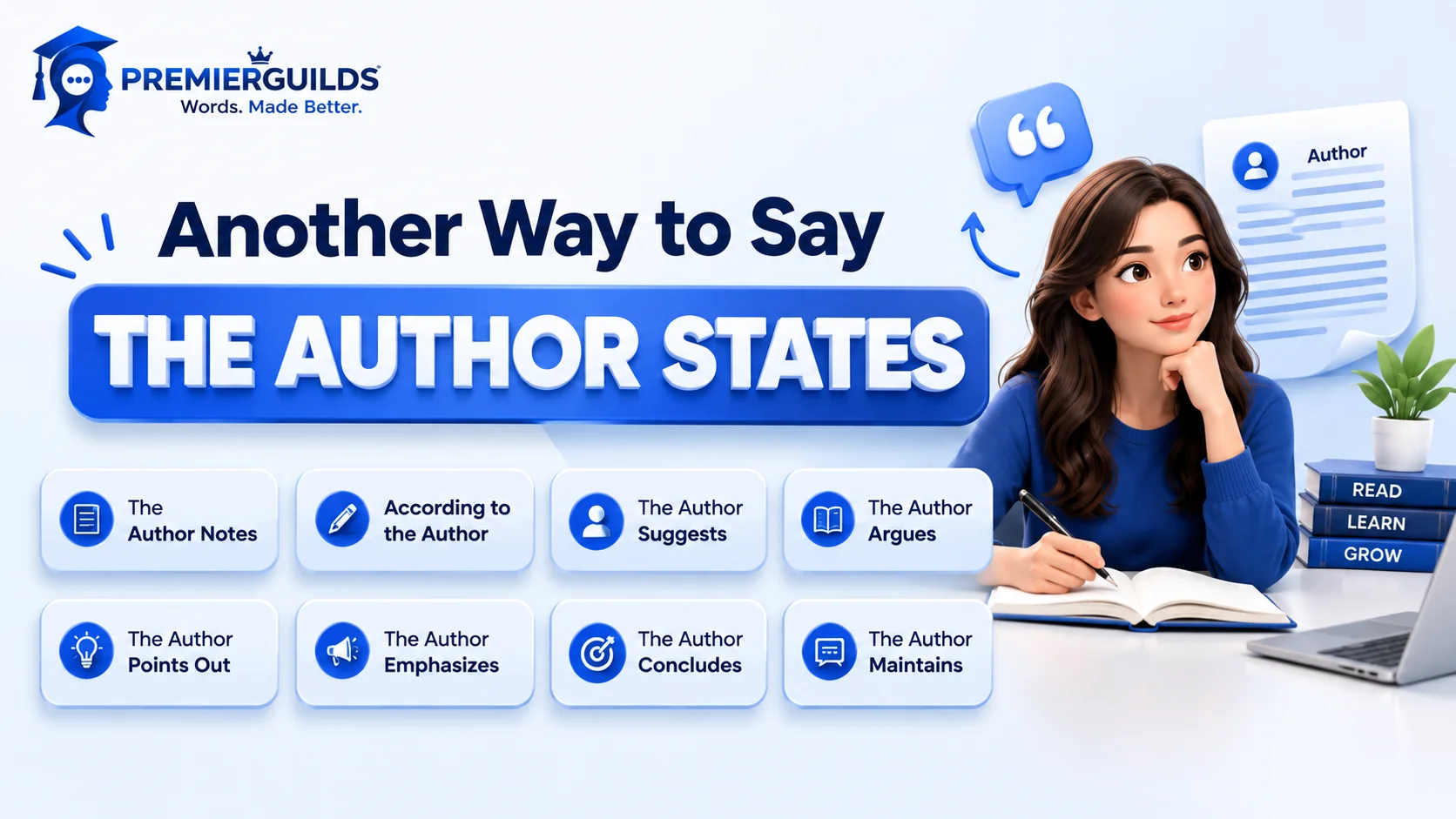
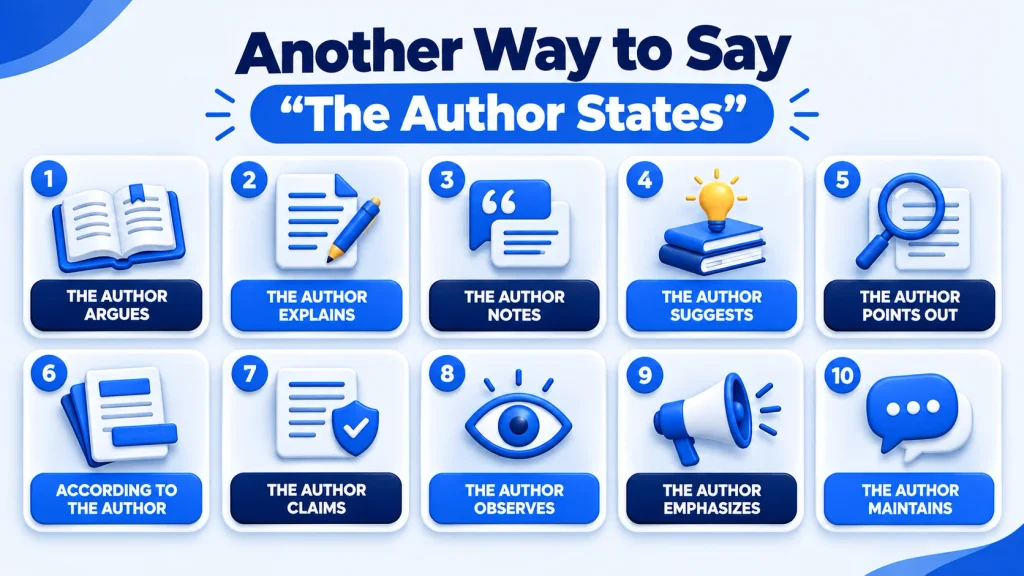
Looking for another way to say the author states? Try phrases such as the author argues, the author explains, the author notes, the author suggests, the author points out, or according to the author. The best choice depends on whether the writer presents an argument, gives information, makes an observation, or expresses an opinion.
“The author states” is a common phrase used to introduce information, opinions, arguments, or claims from a writer. You will often see it in essays, research papers, literary analysis, book reviews, and academic discussions.
Writers use this phrase to show that a particular idea comes from the source rather than from the person discussing it. However, repeating “the author states” throughout an essay can make the writing sound predictable.
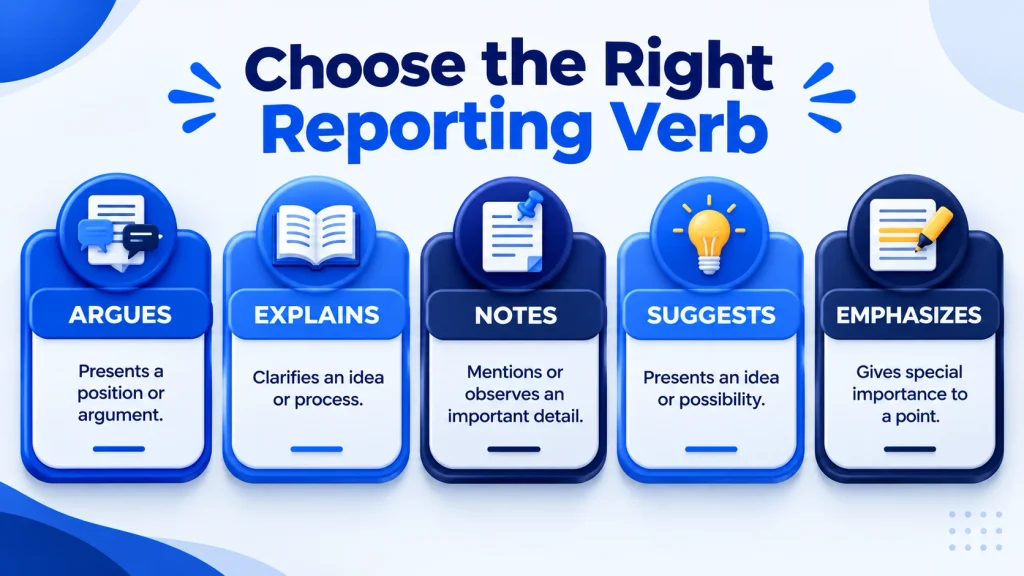
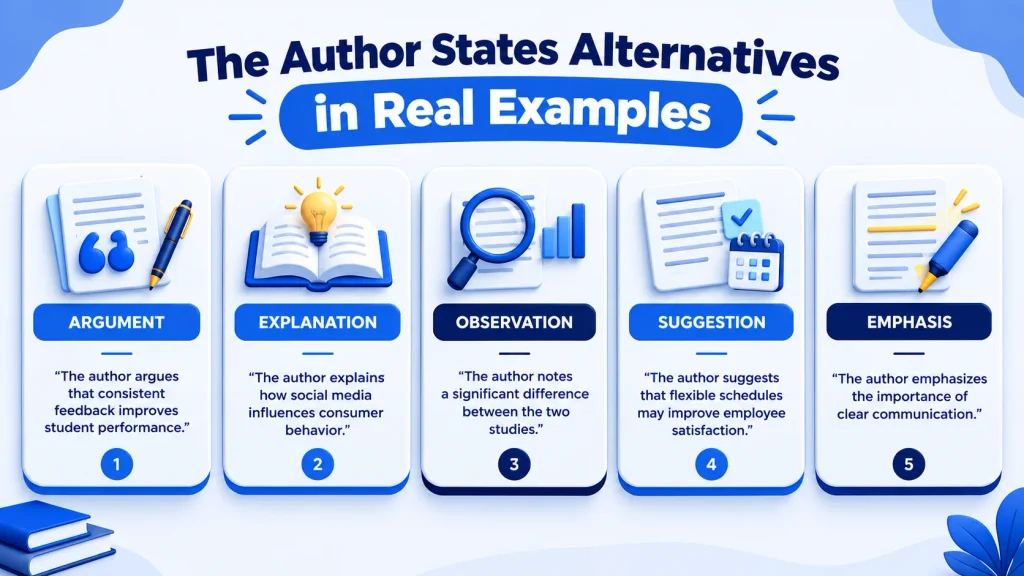
Using alternatives helps you describe the writer’s purpose more precisely. For example, the author argues suggests a position, while the author explains suggests clarification.
Using different reporting verbs can make academic and professional writing more precise and natural. The right verb also tells readers how the author presents an idea.
You may want to use an alternative to:
“The author argues” indicates that the writer presents a position, claim, or viewpoint and supports it with reasoning or evidence. It is especially useful when analyzing persuasive or argumentative writing.
The author argues that early education plays a major role in long-term academic success.
In the final section, the author argues that companies should invest more in employee training.
Use the author argues when the writer is making a claim that readers could reasonably debate.
“The author explains” works when a writer provides information, clarification, or details that help readers understand a subject. It sounds natural in academic writing and is less forceful than “the author argues.”
The author explains how changes in technology have affected modern communication.
Throughout the chapter, the author explains why the experiment produced unexpected results.
Choose this phrase when the source is primarily clarifying or teaching, rather than trying to persuade.
“The author notes” introduces an observation or detail that the writer considers relevant. It is concise and commonly used in academic papers, reports, and analytical writing.
The author notes that rural communities often have fewer transportation options.
The author notes several differences between traditional and modern teaching methods.
Use “notes” for an observation or supporting detail instead of a major argument.
“The author suggests” indicates that the writer presents an idea, possibility, or interpretation without necessarily stating it as an absolute fact. This wording is useful when the author’s meaning is implied or tentative.
The author suggests that flexible schedules may improve employee satisfaction.
By comparing the two characters, the author suggests that fear can influence personal decisions.
Use this phrase when you want to avoid making the author’s claim sound stronger or more certain than it is.
“The author points out” emphasizes a specific fact, detail, or issue that the writer wants readers to notice. It is clear and direct while still working well in analytical writing.
The author points out that many small businesses struggle with rising operating costs.
The author points out several limitations in the current research.
This phrase is useful when the writer draws attention to something important that readers might otherwise overlook.
“According to the author” clearly attributes information to the writer. Unlike some reporting verbs, it does not necessarily describe whether the author argues, explains, or suggests the idea.
According to the author, regular feedback can help students improve their writing.
According to the author, community involvement strengthens relationships between residents.
Use this option when you want to attribute information without interpreting the author’s specific purpose.
“The author claims” introduces a statement or position made by the writer. It can sound neutral, but depending on context, it may also suggest that the claim requires evidence or further examination.
The author claims that social media has changed how consumers evaluate products.
The author claims that the policy could reduce unnecessary administrative costs.
Use “claims” carefully when discussing an argument that you are analyzing or evaluating rather than presenting as established fact.
“The author observes” is useful when the writer makes an observation based on events, evidence, behavior, or patterns. It often creates a thoughtful and analytical tone.
The author observes that younger employees often prefer more flexible communication methods.
The author observes a clear connection between sleep habits and classroom performance.
Choose “observes” when the writer is describing something noticed rather than actively defending an argument.
“The author emphasizes” shows that the writer gives particular importance to an idea or point. It works especially well when a concept appears repeatedly or receives strong attention in the source.
The author emphasizes the importance of clear communication in successful teamwork.
In the conclusion, the author emphasizes the need for long-term environmental planning.
Use this phrase when the source gives an idea special importance, rather than simply mentioning it.
“The author maintains” means that the writer continues to support a particular position or belief. It is more formal than many everyday alternatives and works especially well in argumentative analysis.
The author maintains that public transportation should receive greater investment.
Despite opposing evidence, the author maintains that the original approach remains effective.
Use “maintains” when the writer consistently defends a position throughout the text.
| Alternative | Best Used In | Tone |
| The Author Argues | Essays, argumentative writing | Formal, analytical |
| The Author Explains | Research, educational writing | Clear, informative |
| The Author Notes | Essays, reports, analysis | Formal, concise |
| The Author Suggests | Interpretive and analytical writing | Cautious, neutral |
| The Author Points Out | Reports, essays, analysis | Direct, professional |
| According to the Author | Academic and professional writing | Neutral, formal |
| The Author Claims | Argument analysis | Formal, analytical |
| The Author Observes | Research and literary analysis | Thoughtful, formal |
| The Author Emphasizes | Essays, reports, analysis | Strong, focused |
| The Author Maintains | Argumentative and academic writing | Formal, assertive |
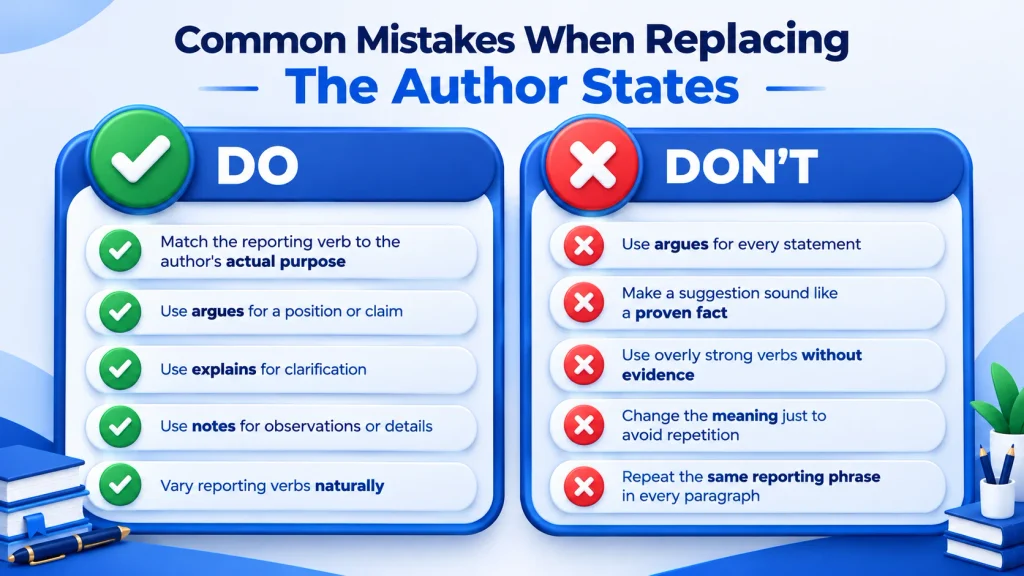
Not every sentence in a source represents an argument. If the writer simply provides background information, the author explains or the author notes may be more accurate.
Using strong verbs can change the meaning. For example, “the author proves” suggests a much higher level of certainty than “the author suggests.”
Words such as “maintains” can sound appropriate in academic writing but may feel unnecessarily formal in casual discussion. Match the reporting verb to your audience and purpose.
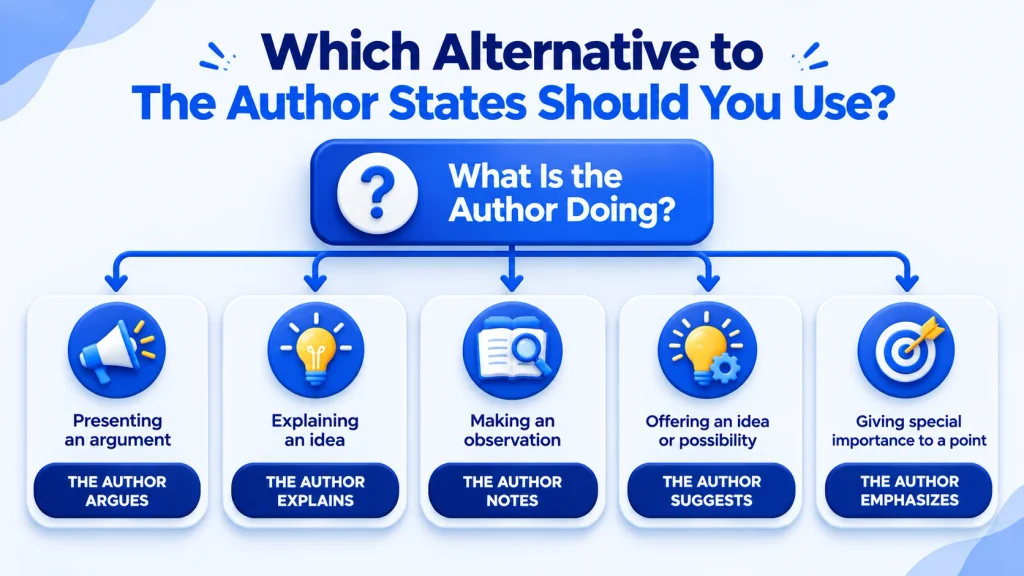
The same author may explain one idea, argue another, and emphasize a third. Look at what the writer is actually doing before selecting a reporting phrase.
Using “the author states” in every paragraph can make an essay feel repetitive. Vary your reporting verbs while keeping the meaning accurate.
Common alternatives include the author argues, the author explains, the author notes, the author suggests, the author points out, and according to the author. The best option depends on what the writer is doing. Use “argues” for a position, “explains” for clarification, and “notes” for an observation or detail.
For academic writing, you can use the author argues, the author maintains, the author observes, the author emphasizes, or the author suggests. These verbs provide more information about the writer’s purpose instead of simply reporting that the writer made a statement.
You can use the author explains, argues, notes, suggests, observes, claims, points out, or emphasizes. Choose the verb based on the meaning. For example, “the author argues” fits a debatable position, while “the author explains” works better when the writer provides clarification.
They are related, but they are not identical. “The author states” simply reports that the writer presented an idea, while “the author argues” indicates that the writer is making a position or claim, usually with reasoning or evidence.
According to the author, the author notes, and the author explains are professional choices. For more analytical writing, the author argues or the author maintains can work well when the source presents and supports a particular position.
Yes. “The author suggests” is widely useful in essays, especially when discussing an interpretation, possibility, or implied idea. It is also helpful when you want to avoid overstating the writer’s position. Make sure the surrounding evidence supports your interpretation of what the author suggests.
There is no single choice for every research paper. The author notes works for observations, the author explains works for clarification, the author argues works for claims, and the author suggests works for tentative conclusions or interpretations. Choose the reporting verb that accurately reflects the source.
First, identify the purpose of the source sentence. Then choose a reporting verb that matches it, such as argues, explains, notes, suggests, observes, or emphasizes. You can also restructure sentences with phrases such as “According to the author” to create more natural variety.
There are many useful alternatives to “the author states,” but the best choice depends on what the writer actually communicates. The author argues works for a supported position, while the author explains suits clarification. The author notes introduces an observation, and the author suggests works for a less certain interpretation.
For stronger academic writing, avoid replacing “the author states” randomly. Instead, choose a reporting verb that accurately reflects the source’s purpose and level of certainty. This approach makes your writing more precise, varied, and easier to understand.
Whether you are writing an essay, research paper, book review, or professional report, thoughtful word choice can make your source analysis much clearer. The key takeaway is simple: describe what the author is doing, not just what the author is saying.

Our editorial team brings together decades of expertise in applied linguistics, lexicography, and educational publishing. Dedicated to clarity, precision, and tone, our experts ensure that every resource meets the highest standards of professional and academic excellence.