

Another way to say “attention to detail” on a resume includes detail-oriented, meticulous, thorough, highly accurate, quality-focused, precise, and detail-conscious. Choose the phrase that best matches your experience and combine it with a specific achievement or result to make the skill more credible to employers.

“Attention to detail” describes the ability to notice small errors, follow instructions carefully, maintain accuracy, and produce high-quality work. On a resume, this phrase is often used to show employers that you can work carefully without overlooking important information.
However, repeating “attention to detail” can make a resume sound generic. Using alternatives such as detail-oriented, meticulous, precise, thorough, or accuracy-focused can help you describe the same strength in a more specific and natural way.
This skill is commonly mentioned in resumes, cover letters, performance reviews, job applications, and professional profiles. It can be especially useful for roles involving data, finance, administration, writing, research, customer service, quality control, or project management.

Using a different phrase can make your resume more precise and help you avoid repetitive language. The best alternative also depends on what you actually did in your previous roles.
Consider using another expression to:
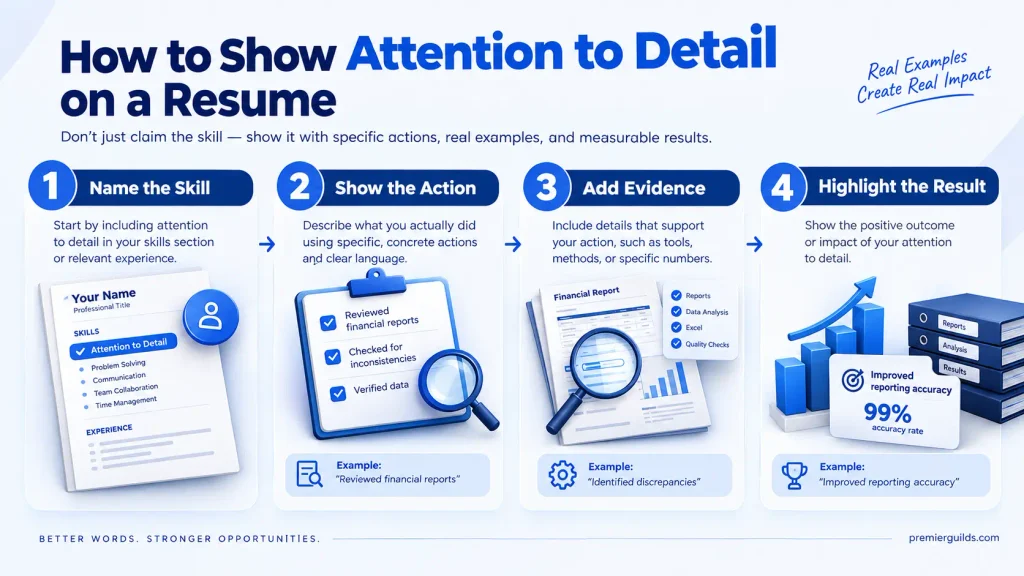
A useful rule is to show the skill instead of simply naming it. For example, “Reviewed 200+ monthly invoices and reduced data-entry errors by 15%” provides stronger evidence than simply writing “Excellent attention to detail.”
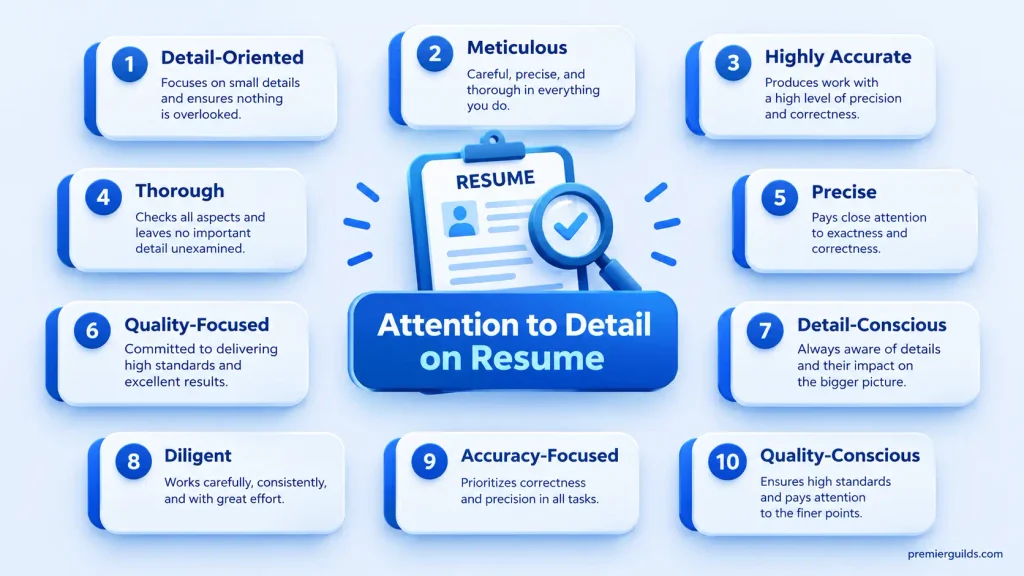
“Detail-oriented” describes someone who pays close attention to small but important aspects of a task. It is one of the most natural and widely understood alternatives to “attention to detail” on a resume.
Use “detail-oriented” as a skill, but support it with a specific accomplishment whenever possible.
“Meticulous” means extremely careful and precise when completing work. It works well when your role requires thorough reviews, careful documentation, or strict quality standards.
Use “meticulous” when careful work is a major part of your professional responsibilities.
“Highly accurate” emphasizes correctness rather than simply being careful. It is particularly useful when your work involves numbers, data, reports, records, or technical information.
Pair this phrase with a measurable result when your accuracy directly affected business performance.
“Thorough” shows that you complete tasks carefully and examine relevant information before reaching a conclusion. It is a simple alternative that fits many professional settings.
“Thorough” works especially well with action verbs such as reviewed, analyzed, prepared, checked, and documented.
“Precise” highlights accuracy and exactness. It is a strong choice for resumes in fields where small errors can affect results, including engineering, finance, research, technology, and operations.
Choose “precise” when you want to emphasize exact results rather than your general working style.
“Quality-focused” emphasizes your commitment to producing reliable, polished, and consistent work. It shifts attention from simply noticing details to maintaining a high standard.
This phrase is useful when the job description emphasizes quality assurance, standards, customer satisfaction, or continuous improvement.
“Detail-conscious” describes someone who remains aware of small details throughout a task. It can sound more natural and descriptive than repeatedly using “attention to detail.”
Use this phrase selectively because “detail-oriented” is more common and immediately familiar to most recruiters.
“Diligent” describes someone who consistently puts careful effort into completing responsibilities correctly. It communicates reliability as well as careful work.
“Diligent” is especially effective when you want to communicate both care and consistency.
“Accuracy-focused” emphasizes your priority of keeping information correct and minimizing mistakes. It is particularly relevant to positions involving data, financial records, documentation, or compliance.
Use this phrase when accuracy is directly connected to an important responsibility in the target position.
“Quality-conscious” describes someone who actively considers the standard and reliability of their work. It can communicate care without relying on the exact phrase “attention to detail.”
This phrase works best when your resume also demonstrates how your focus on quality improved a process, product, or customer experience.
| Alternative | Best Used In | Tone |
| Detail-Oriented | General professional resumes | Professional |
| Meticulous | Finance, research, administration | Formal |
| Highly Accurate | Data, finance, reporting | Professional |
| Thorough | Administration, writing, research | Professional |
| Precise | Technical, analytical, engineering | Formal |
| Quality-Focused | Operations, service, management | Professional |
| Detail-Conscious | Editing, communications, administration | Formal |
| Diligent | Administration, operations, support | Professional |
| Accuracy-Focused | Accounting, data, compliance | Formal |
| Quality-Conscious | Content, service, production | Professional |
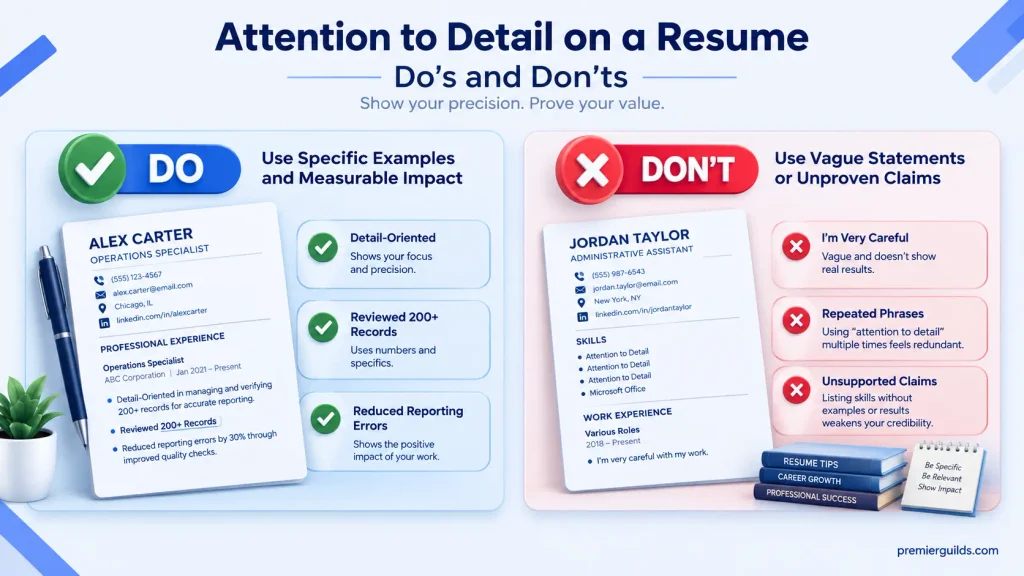
Expressions such as “I’m really careful” or “I catch every little thing” may sound conversational rather than professional. Choose concise language that fits a workplace document.
Simply calling yourself “meticulous” does not prove the skill. Whenever possible, follow the claim with an accomplishment, responsibility, number, or result that demonstrates your accuracy.
Using “detail-oriented” in your summary, skills section, and every job description can make your resume repetitive. Vary your wording only when each phrase adds a different meaning.
A resume should reflect the requirements of the position you want. If a job emphasizes accuracy, quality control, or data integrity, choose wording that clearly connects your experience to that requirement.
Not every alternative is appropriate for every resume. Words such as “meticulous” and “precise” can be useful, but forcing sophisticated language into simple statements may make your writing feel unnatural.
Common alternatives include “detail-oriented,” “meticulous,” “thorough,” “precise,” “highly accurate,” and “quality-focused.” The best choice depends on the position. For example, “highly accurate” may fit a data-related role, while “detail-oriented” works across many professional fields.
“Detail-oriented” is one of the most widely used professional alternatives. Other options include “meticulous,” “thorough,” “precision-focused,” and “accuracy-focused.” Choose wording that accurately reflects how you work and, when possible, support it with a specific achievement.
Show attention to detail by describing actions and results instead of relying only on a skill label. For example, explain how you reviewed reports, identified errors, improved data accuracy, maintained records, or created a quality-check process.
Yes, “detail-oriented” is a clear and familiar resume phrase. However, because many applicants use it, it becomes stronger when supported by evidence. A specific accomplishment can show employers what your attention to detail actually helped you accomplish.
There is no single replacement that fits every resume. “Meticulous,” “precise,” “thorough,” “diligent,” and “accuracy-focused” can work depending on the role. Select the word that describes the specific quality you want employers to notice.
Replace the phrase with a more specific description of your work. Instead of saying you have “attention to detail,” write that you “reviewed financial reports for discrepancies” or “maintained accurate client records.” Concrete descriptions often communicate the skill more effectively.
Yes. “Meticulous” is appropriate when your work requires careful checking, documentation, organization, or precision. It is especially useful when you can demonstrate that careful approach through responsibilities or measurable accomplishments.
You can include it if the job values accuracy and careful work, but avoid relying on the phrase alone. A stronger resume shows the skill through work experience, accomplishments, and results while using the skills section as a concise summary.
Finding another way to say “attention to detail” on a resume can make your professional writing more specific and engaging. Options such as detail-oriented, meticulous, highly accurate, thorough, precise, and quality-focused each emphasize a slightly different aspect of careful work.
Choose your wording based on the position and the skill you want to highlight. For data-heavy roles, “highly accurate” or “accuracy-focused” may fit naturally. For broader professional roles, “detail-oriented” or “thorough” can be effective.
Most importantly, do not simply claim that you pay attention to details. Show it through real responsibilities and measurable accomplishments. A clear example of how your careful work improved accuracy, quality, efficiency, or results will give your resume much more credibility.

Senior English Editor & Stylistics Director
Michael Bennett is a veteran editor, lexicographer, and publishing consultant with more than two decades of experience in academic and educational publishing. Formerly a senior editorial director at major university presses, he specializes in structural editing, register refinement, and vocabulary development. Michael oversees tone, precision, and stylistic consistency across all publication channels, ensuring content meets rigorous editorial and pedagogical standards.