

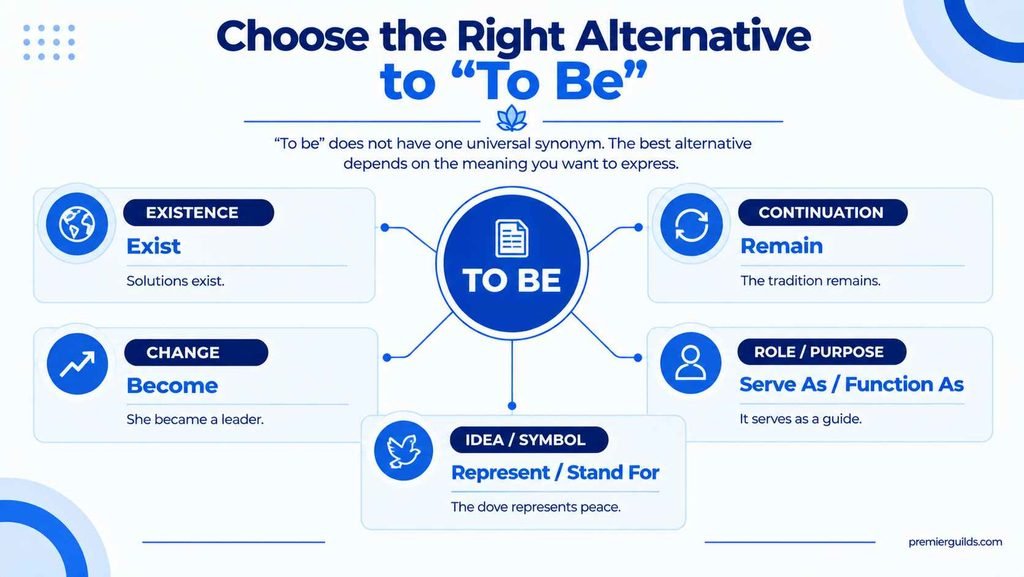
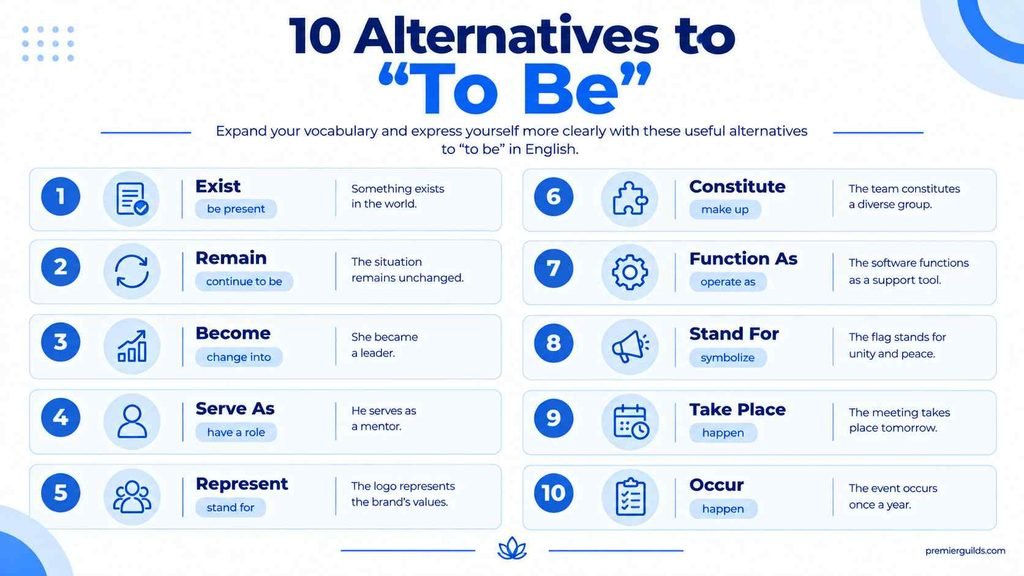
Looking for another way to say “to be”? The best alternative depends on the sentence. Depending on context, you can use phrases such as exist, remain, become, serve as, represent, constitute, occur, take place, function as, or stand for. Because “to be” has several grammatical meanings, no single synonym works in every sentence.
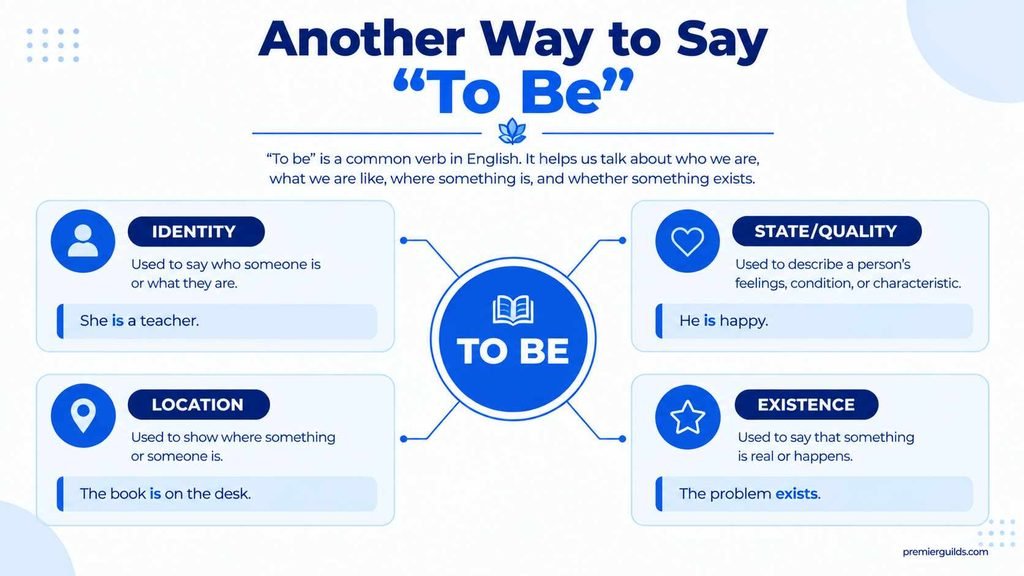
“To be” is one of the most common and important verbs in English. It can describe a state, identity, existence, location, condition, or relationship between a subject and a description.
For example, “She is a teacher” identifies her profession, while “The keys are on the table” describes location. In “They are happy,” the verb describes a current state.
Because “to be” performs several jobs, there is no single replacement that works in every sentence. The right alternative depends on what you actually mean.
People often look for another way to say “to be” when they want to avoid repetition, make their writing more specific, or choose a verb that communicates an action or relationship more clearly.
Replacing “to be” can make a sentence more precise, but you should not replace it simply because you think the verb is weak. In many sentences, “to be” is the clearest and most natural choice.
An alternative can be helpful when you want to:
The key is meaning before variety. A replacement should preserve the original idea rather than simply use a more complicated word.
“Exist” is a useful alternative when “to be” means that something is present, real, or alive. It focuses specifically on existence rather than identity or description.
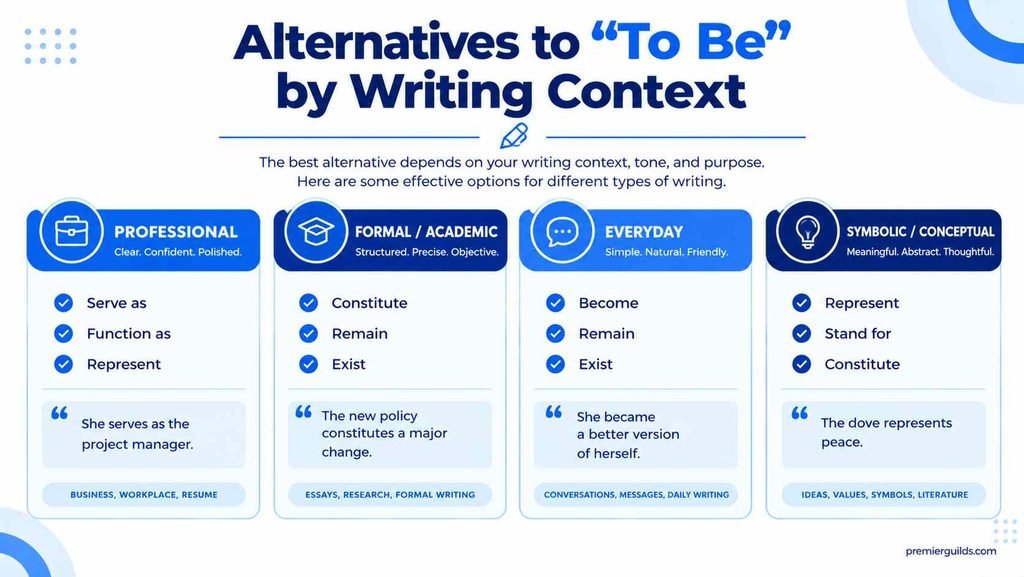
Formal, Professional
Many challenges still exist within the current system.
Several possible solutions exist for this problem.
Use “exist” when you are talking about whether something is present or real. Do not use it as a general replacement for every form of “to be.”
“Remain” works when “to be” describes something that continues in the same condition, position, or state. It emphasizes continuity over time.
Professional, Formal
The building remains closed until further notice.
She remained calm during the difficult conversation.
Choose “remain” when the important idea is that something continues to be the way it was.
“Become” is appropriate when “to be” describes a change from one condition or identity to another. It shows a transition rather than a fixed state.
Professional, Formal, Casual
The small business became a major regional employer.
He hopes to become a licensed architect.
Use “become” when the sentence involves a change. It should not replace “to be” when nothing is changing.
“Serve as” is useful when someone or something has a particular role, purpose, or function. It is more specific than simply saying that something “is” a particular thing.
Professional, Formal
This document serves as a record of the agreement.
The community center serves as a meeting place for local residents.
Use “serve as” when you want to emphasize the role or purpose of something.
“Represent” works when “to be” means to symbolize, stand for, or express something. It can also describe how one person or group speaks or acts on behalf of another.
Professional, Formal
The blue color represents trust and stability in the company’s branding.
These figures represent the total sales for the quarter.
Use “represent” when there is a clear connection between one thing and the idea, group, value, or information it stands for.
“Constitute” means to form or make up something. It can replace certain uses of “to be” when the subject and its parts have a clear relationship.
Formal, Professional
These three departments constitute the company’s core operations.
Women constitute nearly half of the organization’s workforce.
“Constitute” is more formal than everyday “to be.” Use it mainly when discussing parts, groups, or components that form a whole.
“Function as” describes the practical role something performs. It is especially useful when an object, system, person, or process has a particular purpose.
Professional, Formal
The garage functions as a workshop during the summer.
The software functions as a central hub for managing customer information.
Choose “function as” when you want to highlight what something does, rather than simply what it is called.
“Stand for” is commonly used when something represents an idea, abbreviation, symbol, or value. It is more conversational than “represent” in many situations.
Casual, Friendly, Professional
The letters “USA” stand for United States of America.
For our team, the logo stands for creativity and collaboration.
Use “stand for” when explaining a symbol, abbreviation, principle, or idea that something represents.
“Take place” can replace certain uses of “to be” when the sentence describes an event occurring at a particular time or location. It focuses on the event rather than simply its existence.
Professional, Formal, Casual
The annual conference will take place in Chicago this year.
The ceremony took place on Saturday afternoon.
Use “take place” for scheduled or actual events. It is not a general synonym for “to be.”
“Occur” means to happen or take place. It works when “to be” is being used to describe an event or situation that happens at a particular time.
Formal, Professional
The error occurred during the final stage of testing.
Most power outages occur during severe storms.
“Occur” is useful in formal or technical writing, but “happen” is usually more natural in everyday conversation.
| Alternative | Best Used In | Tone |
| Exist | Describing presence or reality | Formal |
| Remain | Describing continued states | Professional |
| Become | Describing change | Neutral |
| Serve as | Describing a role or purpose | Professional |
| Represent | Describing symbolism or meaning | Formal |
| Constitute | Describing parts of a whole | Formal |
| Function as | Describing practical purpose | Professional |
| Stand for | Explaining symbols or abbreviations | Casual |
| Take place | Describing events | Neutral |
| Occur | Describing events or situations | Formal |
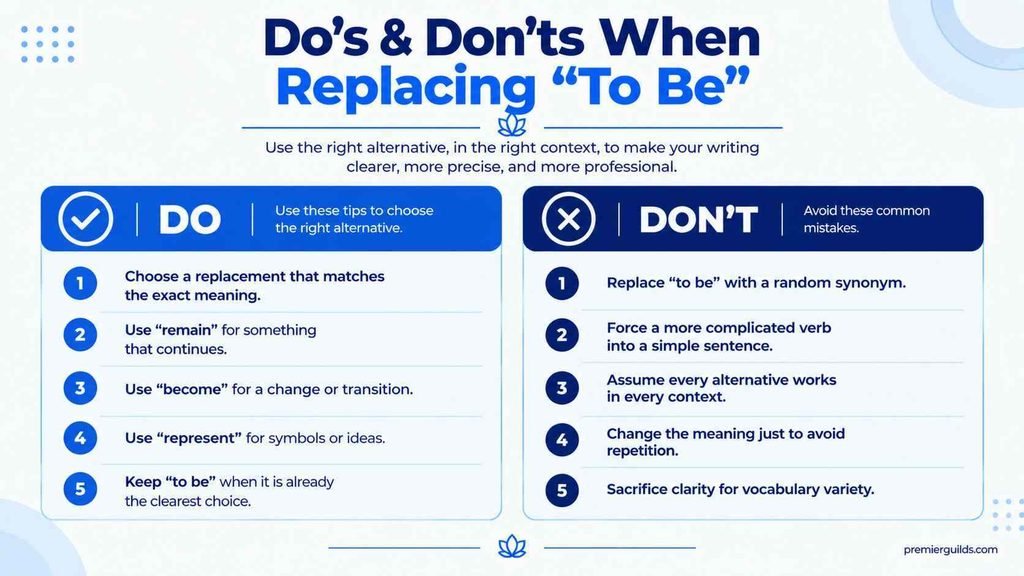
The biggest mistake is assuming that every alternative can replace “to be” in every sentence. These verbs have different meanings, so changing the verb without checking the sentence can create an inaccurate statement.
“Exist” describes presence or reality, while “become” describes change. For example, “She became a doctor” cannot naturally be changed to “She existed a doctor.”
Words such as “constitute” and “occur” can be useful, but they may sound unnecessarily formal in casual conversation. Sometimes “to be” is already the best choice.
“To be” can function as a linking verb or an auxiliary verb. A replacement that works in one grammatical structure may not work in another.
Changing a verb simply to avoid repetition can weaken your writing. Always choose the word that communicates your intended meaning most clearly.
There is no single word that replaces “to be” in every situation. Depending on the meaning, alternatives can include exist, remain, become, represent, serve as, constitute, and occur. The correct choice depends on whether “to be” describes existence, continuity, change, identity, purpose, or an event.
In professional writing, the best alternative depends on the sentence. Remain, represent, constitute, serve as, and function as can make specific statements more precise. However, “to be” itself is completely professional and often remains the clearest option.
You can sometimes replace “is” with a more specific verb, but the right choice depends on context. For example, “The building is a community center” could become “The building serves as a community center.” If you mean continued status, “remains” may work better.
“Are” can sometimes be replaced with verbs such as exist, remain, represent, constitute, or function as, depending on the sentence. For example, “Several problems are present” could become “Several problems exist.” The replacement should preserve the original meaning.
No. “Become” describes a change into a new condition, role, or identity, while “to be” can describe an existing state. For example, “She is a teacher” describes her current identity, while “She became a teacher” tells us that she changed into that role.
“Exist” is a synonym for some uses of “to be,” particularly when “to be” means to have a real or present existence. However, it cannot replace every use. “The problem exists” works, but “The problem is difficult” cannot naturally become “The problem exists difficult.”
First, identify what “to be” actually communicates in your sentence. If it describes an action, role, change, continuation, or event, a more specific verb may work. For example, “The building is used as a library” can sometimes become “The building functions as a library.”
No. There is no general rule requiring writers to avoid “to be” in formal writing. It is one of the most useful verbs in English and is often the clearest choice. Replace it only when a more specific verb improves accuracy, clarity, or style.
Finding another way to say “to be” is not simply a matter of choosing a synonym from a list. Because “to be” can describe existence, identity, location, condition, continuity, or other relationships, the best replacement depends on the meaning of the sentence. For a deeper explanation, see different uses of be in English grammar.
Use “exist” when you mean something is present or real, “remain” when a condition continues, and “become” when something changes. For roles and purposes, “serve as” or “function as” can be more precise, while “represent” and “stand for” work well for ideas and symbols.
Most importantly, do not replace “to be” just for the sake of variety. The strongest writing uses the simplest verb that expresses the intended meaning accurately and naturally.

English Language & Communication Specialist
Dr. Emily Carter is an English language and communication specialist focused on vocabulary, word choice, professional writing, and practical English usage. She helps readers understand the differences between similar words and choose expressions that sound natural, clear, and appropriate for different contexts.