
Another way to say strong work ethic includes dedication, diligence, reliability, commitment, discipline, and a strong sense of responsibility. The best alternative depends on what you want to emphasize, such as hard work, dependability, motivation, consistency, or professional commitment.
A strong work ethic describes a person’s attitude toward work and responsibilities. Someone with a strong work ethic is usually dependable, committed, disciplined, hardworking, and willing to put consistent effort into achieving good results.
The phrase is common in resumes, cover letters, interviews, performance reviews, recommendations, and professional conversations. However, using the same expression repeatedly can make your writing sound generic.
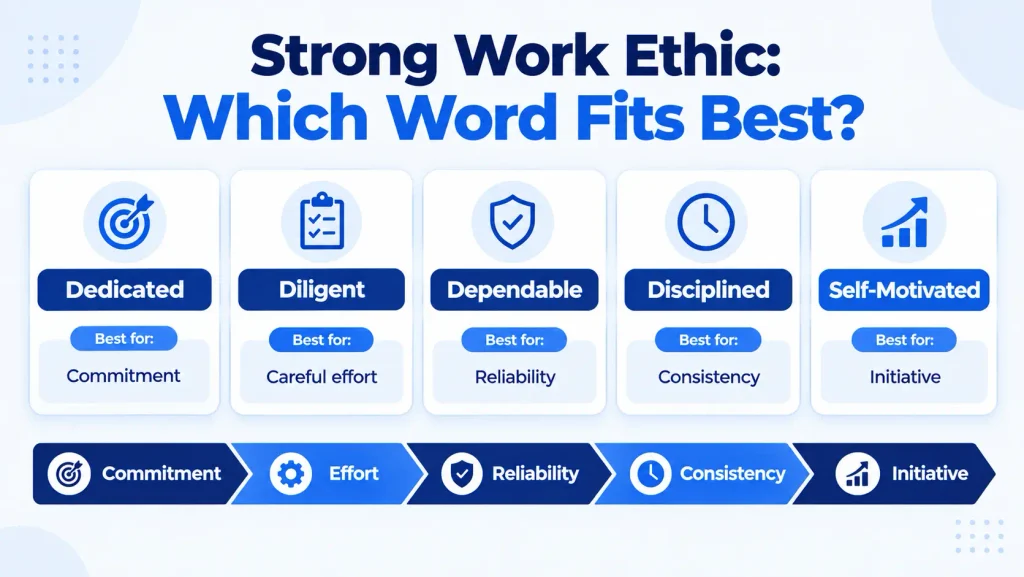
A more specific word can tell the reader why someone has a strong work ethic. For example, “diligent” emphasizes careful effort, while “dependable” focuses more on reliability.
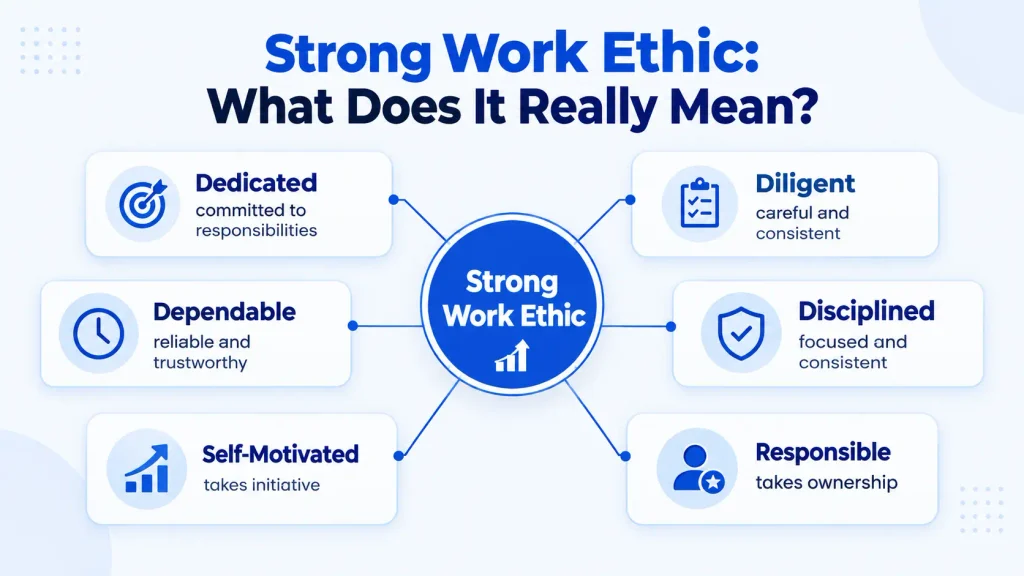
Strong work ethic means having a responsible and positive approach to work. It often includes qualities such as persistence, punctuality, accountability, discipline, reliability, and dedication.
Employers may use the phrase to describe someone who takes responsibilities seriously and consistently puts effort into completing tasks. On a resume or in an interview, though, simply claiming that you have a strong work ethic is less persuasive than showing it through specific achievements and behaviors.
For example:
“Demonstrated a strong work ethic by consistently meeting project deadlines.”
You could make the statement more specific by emphasizing the quality behind it:
“Consistently met project deadlines through disciplined planning and careful execution.”
There is nothing wrong with strong work ethic, but a more precise alternative can make your communication more specific and natural.
Consider using another phrase when you want to:
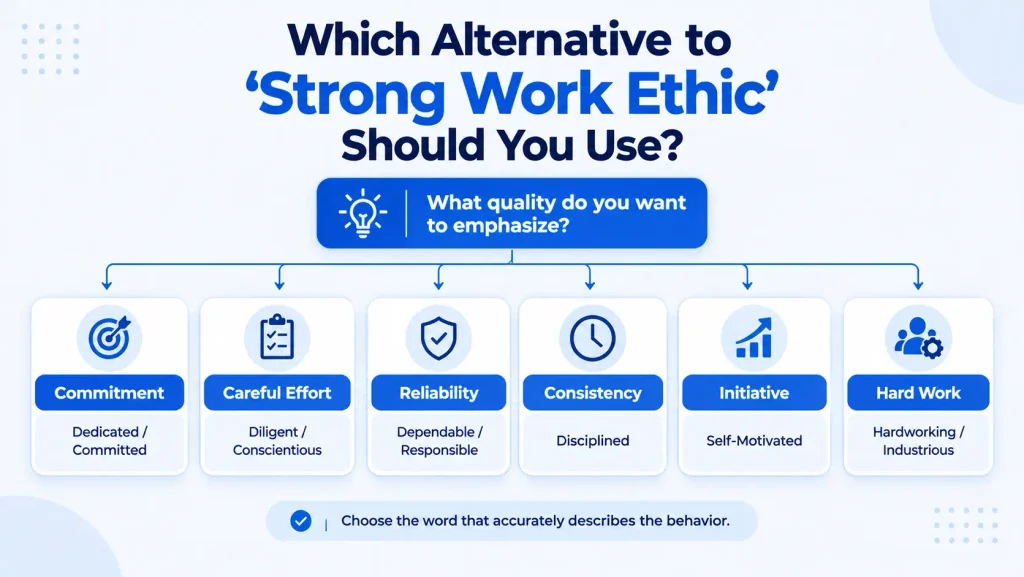
The key is to choose a phrase based on the quality you actually want to communicate.
Dedicated describes someone who is strongly committed to their work, responsibilities, or goals. It suggests that the person consistently gives time, attention, and effort to what they are responsible for.
She is a dedicated employee who consistently takes ownership of important projects.
His dedicated approach helped the team complete the client project ahead of schedule.
Use dedicated when you want to emphasize commitment rather than simply saying someone works hard.
Diligent describes someone who works carefully, consistently, and responsibly. It is especially useful when attention to quality and detail is an important part of the person’s work.
Her diligent research helped the company identify several opportunities for improvement.
The diligent analyst reviewed every report before submitting the final results.
Choose diligent when careful and consistent effort is more important than speed.
Hardworking is one of the simplest alternatives to “strong work ethic.” It directly communicates that someone puts substantial effort into their responsibilities and does not avoid challenging tasks.
We hired a hardworking assistant who quickly became an important member of the team.
She has earned a reputation as a hardworking professional who always meets her commitments.
Hardworking is easy to understand, but pair it with a specific achievement when using it on a resume.
Dependable emphasizes reliability rather than effort alone. A dependable employee can be trusted to meet responsibilities, follow through on commitments, and produce consistent results.
He is a dependable team member who consistently delivers assignments on time.
The department relies on Maya because she is dependable during demanding projects.
Use dependable when you want to show that someone can be trusted to follow through.
Committed describes someone who remains focused on a responsibility, goal, or organization. It communicates a willingness to stay engaged and put sustained effort into achieving an objective.
She is committed to providing accurate and responsive customer support.
Our committed staff continued serving customers effectively during the transition.
Follow committed with a clear goal or responsibility when possible to make the statement more meaningful.
Disciplined highlights self-control, consistency, and the ability to stay focused on responsibilities. It is a strong choice when someone’s work habits involve planning, organization, and steady follow-through.
His disciplined approach to project management helped the team stay on schedule.
She uses a disciplined workflow to manage competing priorities efficiently.
Use disciplined when the person’s strength comes from consistent habits and self-management.
Conscientious describes someone who takes their responsibilities seriously and makes a careful effort to do things properly. It often suggests both responsibility and attention to quality.
She is a conscientious employee who carefully checks her work before submitting it.
His conscientious approach has earned the trust of both clients and colleagues.
This is a particularly useful alternative when responsibility, care, and accuracy are central to the person’s work.
Self-motivated describes someone who can take initiative and maintain productivity without needing constant supervision. It suggests independence, drive, and personal responsibility.
She is a self-motivated professional who consistently identifies ways to improve team processes.
The company values self-motivated employees who can manage priorities independently.
Use self-motivated when you want to emphasize initiative and the ability to work independently.
Industrious means hardworking and productive, especially over a sustained period. It has a professional tone and can describe someone who consistently applies effort to their responsibilities.
His industrious nature helped the department complete several major assignments.
The industrious employee quickly learned the new system and helped train others.
Industrious is more formal than “hardworking,” so it works best in professional descriptions where a polished tone is appropriate.
Responsible focuses on accountability and the ability to handle duties properly. It does not necessarily mean someone works long hours; instead, it shows that they take ownership of what they are expected to do.
She is a responsible employee who consistently follows company procedures and meets deadlines.
His responsible handling of customer accounts reduced errors and improved service quality.
Use responsible when accountability and ownership are more important than simply emphasizing effort.
| Alternative | Best Used In | Tone |
| Dedicated | Resumes, recommendations, workplace descriptions | Professional |
| Diligent | Formal evaluations, resumes, professional writing | Formal |
| Hardworking | General professional descriptions | Professional |
| Dependable | Resumes, references, performance reviews | Professional |
| Committed | Goals, responsibilities, workplace descriptions | Formal |
| Disciplined | Resumes, interviews, performance reviews | Professional |
| Conscientious | Formal recommendations and evaluations | Formal |
| Self-Motivated | Resumes, job applications, interviews | Professional |
| Industrious | Formal professional descriptions | Formal |
| Responsible | Resumes, reviews, workplace communication | Professional |
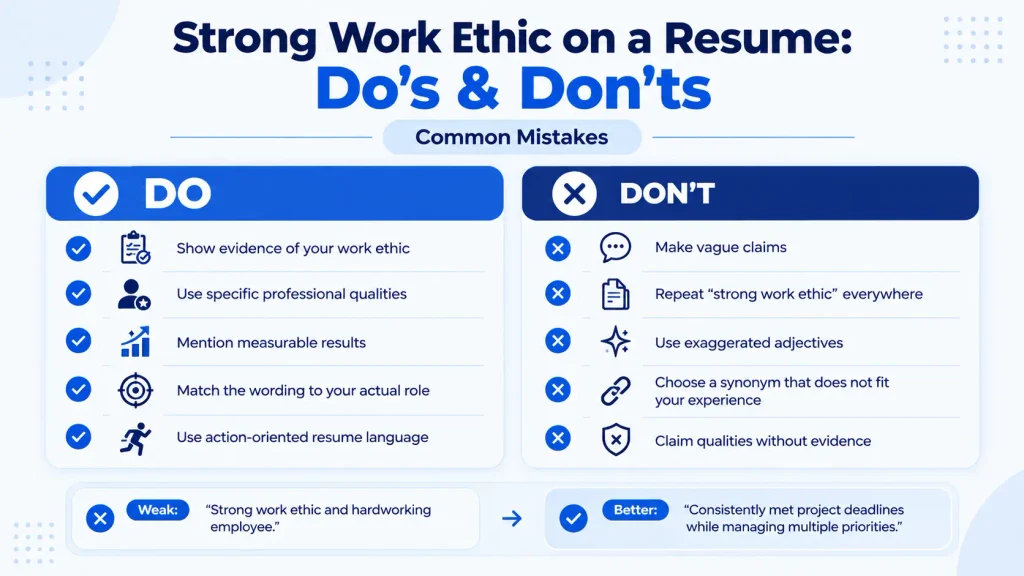
Simply saying someone has a strong work ethic does not show what they actually accomplished. Whenever possible, connect the quality to a behavior or measurable result.
“Dependable” and “diligent” are related to work ethic, but they emphasize different qualities. Choose dependable for reliability and diligent for careful, consistent effort.
Hardworking is perfectly acceptable, but repeating it throughout a resume can make your writing less varied. Use more specific terms when they better describe the candidate’s strengths.
Avoid calling yourself “highly dedicated” or “extremely disciplined” without showing evidence. A stronger resume demonstrates these qualities through achievements, responsibilities, and results.
Words such as industrious and conscientious can be useful, but they may not fit every context. If a simpler term communicates the idea more naturally, use it.
Some good alternatives include dedicated, diligent, hardworking, dependable, committed, disciplined, conscientious, self-motivated, industrious, and responsible. The best choice depends on the specific quality you want to emphasize. For example, use “dependable” for reliability and “self-motivated” when highlighting initiative and independent work.
Diligent, dedicated, conscientious, disciplined, and dependable are professional choices. Each has a slightly different meaning. “Diligent” emphasizes careful effort, “dedicated” highlights commitment, and “dependable” focuses on reliability. Choose the word that most accurately reflects the person’s actual behavior and responsibilities.
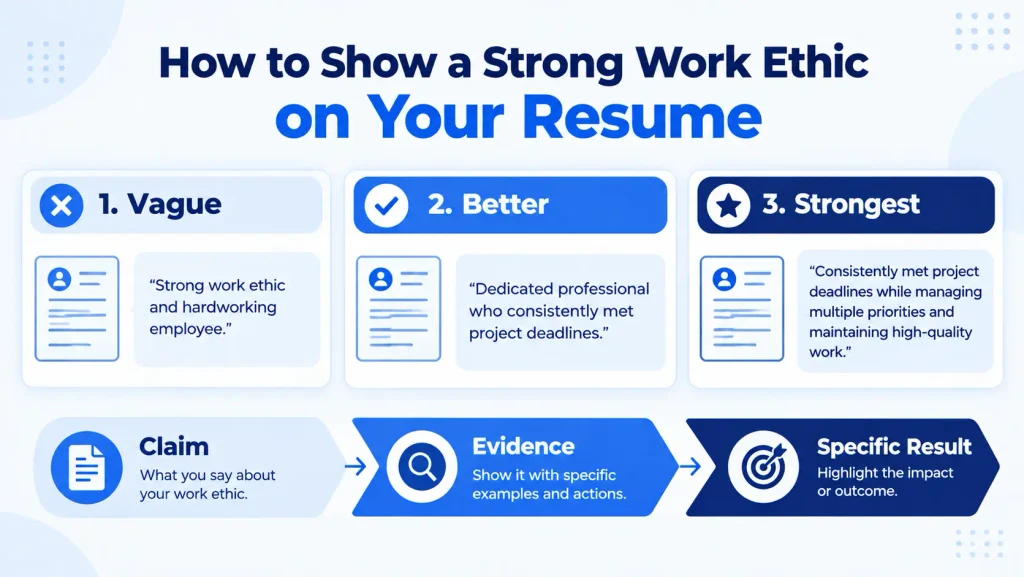
Instead of simply writing “I have a strong work ethic,” show it through specific actions and results. For example, mention consistently meeting deadlines, taking ownership of projects, improving a process, or completing demanding assignments. This gives employers evidence of your work habits instead of relying on a general claim.
Professional alternatives to hardworking include diligent, dedicated, industrious, conscientious, and committed. “Diligent” works especially well when careful effort matters, while “dedicated” is better for emphasizing commitment. On a resume, combine the adjective with a specific accomplishment whenever possible.
Yes, but it is a broad phrase that can be stronger when supported by evidence. Rather than only stating that you have a strong work ethic, describe behaviors that demonstrate it, such as consistently meeting deadlines, taking initiative, managing priorities, or completing projects successfully.
There is no single best synonym for every situation. Dedicated is a strong general choice, while diligent emphasizes careful effort, dependable emphasizes reliability, and self-motivated emphasizes initiative. Select the word that matches the specific professional quality you want the reader to notice.
Describe the person’s actions instead of using the phrase itself. You could mention that they consistently meet deadlines, take ownership of responsibilities, maintain high-quality work, solve problems independently, or support team goals. Specific evidence usually communicates work ethic more effectively than a general label.
During an interview, connect your work ethic to a real example. Explain a situation in which you faced a demanding task, describe what you did, and share the result. For instance, you could discuss how you managed competing deadlines while maintaining quality and completing the work on time.
There are many effective ways to say strong work ethic, but the best choice depends on the quality you want to highlight. Use dedicated when you want to emphasize commitment, diligent for careful effort, and hardworking for a simple and direct description. Choose dependable when reliability matters, disciplined for consistent work habits, and self-motivated when you want to emphasize initiative.
For formal writing, conscientious and industrious can provide a more polished tone, while responsible focuses on accountability. On a resume, however, the strongest approach is usually to demonstrate these qualities through specific actions and results rather than simply naming them.

Our editorial team brings together decades of expertise in applied linguistics, lexicography, and educational publishing. Dedicated to clarity, precision, and tone, our experts ensure that every resource meets the highest standards of professional and academic excellence.