
If you need another way to say hand in hand, useful options include together, side by side, in tandem, jointly, in partnership, and working together. The best choice depends on whether you mean physical closeness, teamwork, cooperation, or a close connection between two ideas.
“Hand in hand” is a common English expression that can describe people being physically close or working closely together. It can also describe two ideas, events, or conditions that are strongly connected.
Because the phrase has several meanings, the best replacement depends on your sentence. A simple word such as “together” may work in casual conversation, while “in tandem” can sound more appropriate in professional writing.
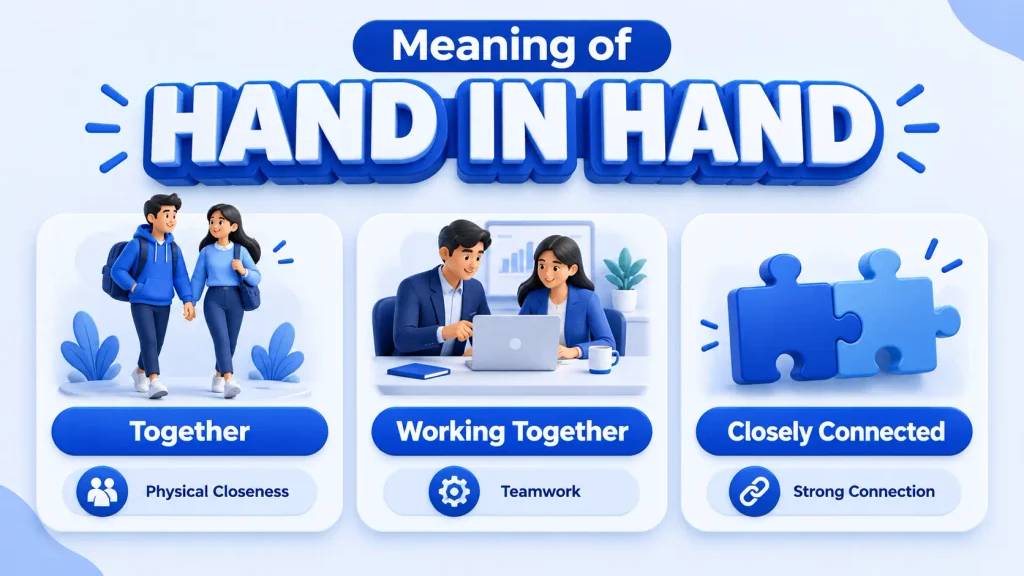
“Hand in hand” generally means together, alongside one another, or in close connection. Its meaning changes slightly depending on the context.
For example, “The couple walked hand in hand through the park” describes two people physically holding hands. In contrast, “Good communication and trust go hand in hand” describes two ideas that are closely connected.
The expression is commonly used in:
This makes the phrase flexible, but it also means that a direct synonym does not always work in every sentence.
For a standard dictionary reference and additional usage examples, readers can also consult the Merriam-Webster Thesaurus.
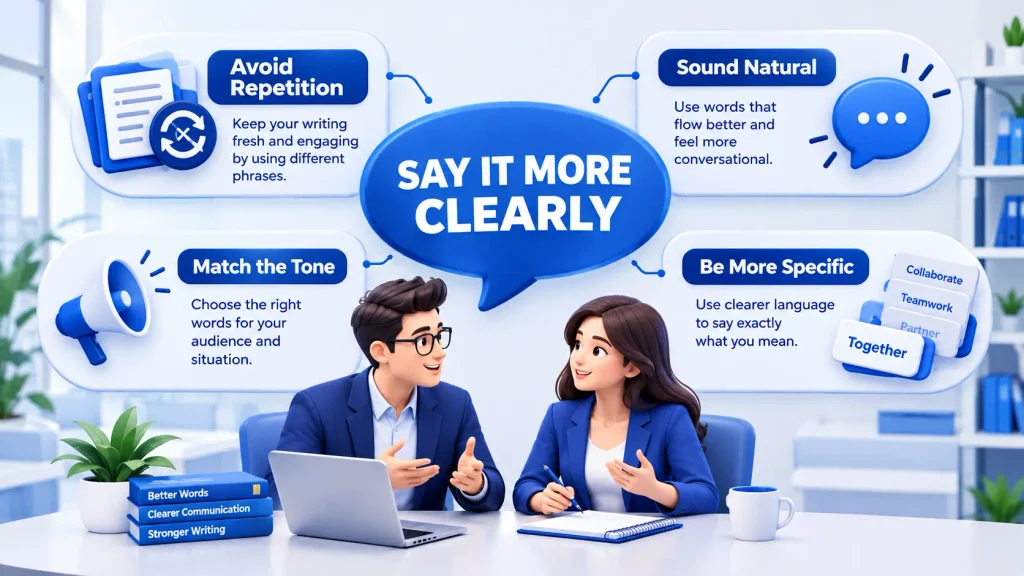
Using different expressions can make your writing more precise. Instead of relying on one phrase repeatedly, you can choose wording that clearly shows whether you mean teamwork, physical closeness, partnership, or a relationship between ideas.
You may want another expression to:
For example, “The teams worked in tandem” emphasizes coordination. “The friends walked side by side” focuses more on physical position.
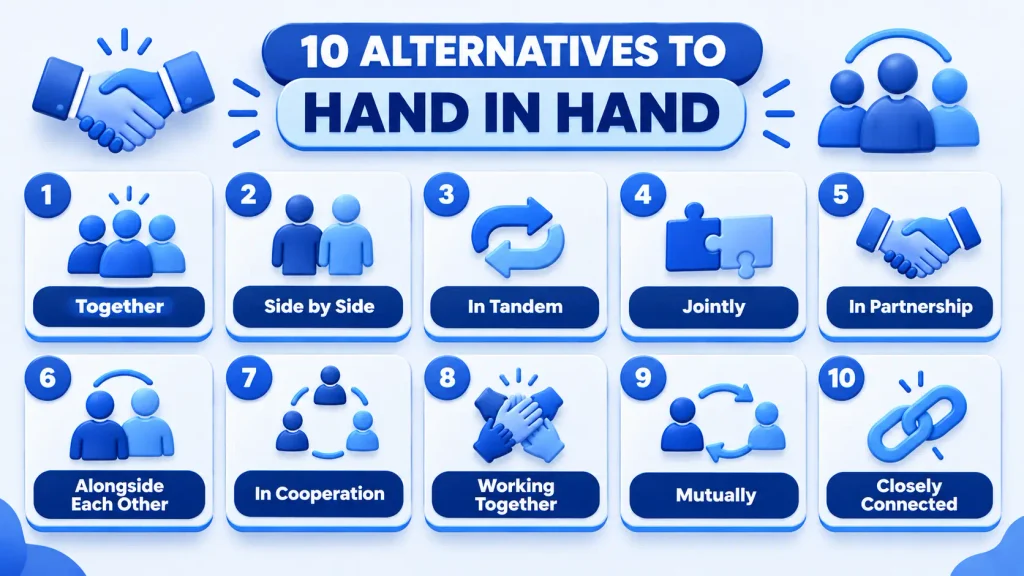
“Together” is the simplest and most flexible alternative. It can describe people doing something as a group or two things existing or happening in connection with each other.
We worked together to complete the community project.
The two brothers traveled together during the summer.
Use “together” when you want a natural phrase that works in both everyday and professional communication.
“Side by side” means next to someone or something. It can describe physical closeness, but it can also suggest cooperation between people or groups.
The volunteers worked side by side to prepare the shelter.
The children sat side by side during the school performance.
Choose this phrase when being physically close or cooperating closely is important to the meaning.
“In tandem” describes people, groups, systems, or processes working together in a coordinated way. It is especially common in professional and business writing.
The design and engineering teams worked in tandem on the new product.
The two departments operate in tandem to improve customer service.
Use “in tandem” when you want to emphasize coordination rather than simple togetherness.
“Jointly” means that two or more people or organizations do something together or share responsibility for it. It has a formal and professional tone.
The organizations jointly released the results of the study.
The directors jointly approved the final proposal.
“Jointly” is particularly useful when two or more parties share responsibility for an action.
“In partnership” emphasizes cooperation between people, businesses, organizations, or teams. It usually suggests a shared purpose or project.
The company created the program in partnership with a local university.
The nonprofit worked in partnership with community leaders to provide support.
Use this expression when the relationship involves a defined project, goal, or collaboration.
“Alongside each other” means being next to one another or working near and with one another. It can describe physical position as well as cooperation.
The designers worked alongside each other while reviewing the final concept.
The two teams trained alongside each other throughout the season.
This phrase is useful when you want to communicate both closeness and cooperation.
“In cooperation” highlights the act of working together toward a shared goal. It has a formal tone and often appears in business, government, research, or organizational writing.
The agencies worked in cooperation to improve public transportation.
The researchers completed the project in cooperation with several universities.
Choose this phrase when cooperation itself is an important part of the message.
“Working together” directly describes cooperation between people or groups. It is clear, natural, and easy for readers to understand.
The teachers and parents are working together to support the students.
Our teams are working together to meet the client’s needs.
Use “working together” when the original meaning focuses specifically on teamwork.
“Mutually” describes something that involves both sides or affects both parties. It is useful when the meaning involves shared benefits, interests, or agreements.
The companies reached a mutually beneficial agreement.
Both groups agreed to find a mutually acceptable solution.
“Mutually” is not a universal replacement. Use it when something is shared by or applies to both sides.
“Closely connected” works well when the expression refers to ideas, events, conditions, or factors that have a strong relationship. It focuses on connection rather than physical togetherness.
Employee satisfaction is closely connected to workplace culture.
Strong writing skills are closely connected to effective communication.
Choose this phrase when you are explaining a relationship between concepts rather than describing people working together.

| Alternative | Best Used In | Tone |
|---|---|---|
| Together | Everyday communication | Casual, Friendly |
| Side by Side | Physical closeness and teamwork | Friendly, Warm |
| In Tandem | Coordinated work | Professional, Formal |
| Jointly | Shared responsibility | Formal, Professional |
| In Partnership | Shared projects | Professional, Formal |
| Alongside Each Other | Close cooperation | Friendly, Warm |
| In Cooperation | Organized collaboration | Formal, Professional |
| Working Together | Teamwork | Casual, Professional |
| Mutually | Shared interests or benefits | Formal, Professional |
| Closely Connected | Related ideas or conditions | Formal, Academic |
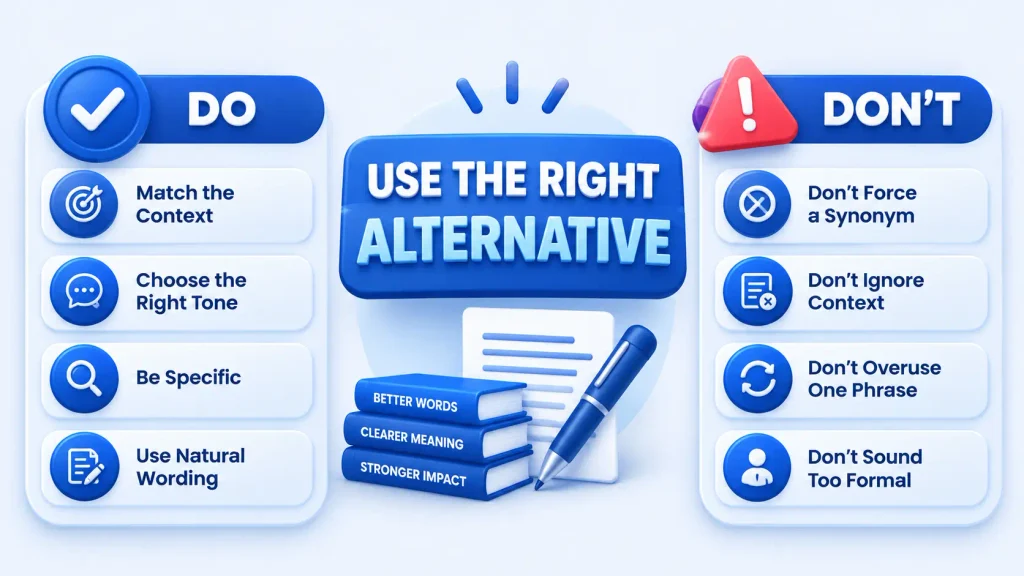
“Together” is flexible, but it can sometimes remove an important detail. If you are describing two ideas that have a strong relationship, “closely connected” may be more precise.
Words such as “jointly” and “in cooperation” can sound overly formal in a text message or casual conversation. In those situations, “together” or “side by side” may sound more natural.
The original expression can refer to physical closeness, teamwork, partnership, or related ideas. Always identify the intended meaning before choosing a replacement.
Not every synonym works in every sentence. For example, “mutually” focuses on something shared by two parties, while “side by side” can emphasize physical position.
Replacing the expression with “together” in every sentence can create another form of repetition. Use different alternatives when they provide a clearer or more precise meaning.
Common alternatives include “together,” “side by side,” “in tandem,” “jointly,” “in partnership,” and “working together.” The right choice depends on the context. “Side by side” emphasizes closeness, while “in tandem” focuses on coordination. If you are discussing related ideas, “closely connected” may be more accurate.
Professional alternatives include “in tandem,” “jointly,” “in partnership,” and “in cooperation.” These phrases work well when describing teams, organizations, business relationships, or shared responsibilities. However, “together” can also be perfectly professional when the sentence is simple and does not require a more specific meaning.
“Together” is usually the most natural casual alternative. “Side by side” and “working together” are also common choices. For example, instead of describing two friends as moving closely together, you could simply say that they walked together or walked side by side.
The two expressions overlap, but they are not always interchangeable. “Side by side” usually emphasizes people or things being next to one another. “Hand in hand” can describe physical contact, teamwork, or a close relationship between two ideas, so context determines the best choice.
Yes, when the intended meaning involves coordinated work or activity. “In tandem” is especially useful for professional writing about teams, departments, systems, or processes. It would not be appropriate when you literally mean that two people are holding hands.
You can say that two things are “closely connected,” “closely linked,” or “strongly related.” If the focus is on two things happening together, “go together” can also work. The best expression depends on whether you want to emphasize connection, timing, or mutual influence.
Formal choices include “jointly,” “in tandem,” “in cooperation,” and “in partnership.” “Jointly” is useful for shared actions, while “in partnership” works particularly well for organizations or groups working toward a common objective.
Yes, when the original meaning refers to cooperation or teamwork. “Working together” is direct and natural in both casual and professional communication. However, it does not replace the expression when you mean physical hand-holding or a close relationship between two concepts.
There are several useful alternatives to “hand in hand,” but the right choice depends on your intended meaning. Together is the easiest option for everyday communication, while side by side works well when physical closeness or close cooperation matters. For professional writing, in tandem, jointly, in partnership, and in cooperation can provide greater precision.
When you are discussing two ideas rather than people, closely connected may be the clearest option. If your focus is teamwork, working together is simple and direct. Instead of replacing an expression mechanically, consider the relationship, action, and tone in your sentence. Choosing the most precise alternative will make your writing sound clearer, more natural, and more purposeful.

Our editorial team brings together decades of expertise in applied linguistics, lexicography, and educational publishing. Dedicated to clarity, precision, and tone, our experts ensure that every resource meets the highest standards of professional and academic excellence.