
Another way to say excited to see you includes “looking forward to seeing you,” “can’t wait to see you,” “eager to see you,” “thrilled to see you,” and “so happy to see you.” The best choice depends on whether you want to sound professional, friendly, casual, warm, or strongly enthusiastic.
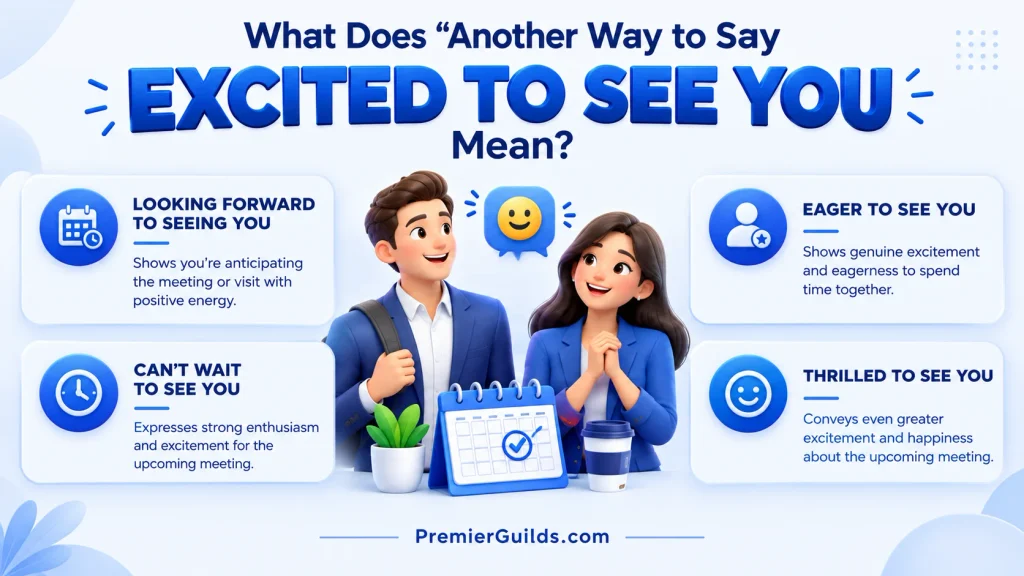
The phrase “excited to see you” means you feel happy, eager, or enthusiastic about meeting someone or spending time with them. It communicates positive anticipation before an upcoming meeting, visit, reunion, event, or conversation.
For example, you might tell a friend, “I’m excited to see you this weekend.” You could also use the phrase with a colleague when you want to express positive anticipation about an upcoming meeting.
The expression can work in personal and professional situations, although the level of warmth depends on context. “Excited to see you” is generally warm and positive, while alternatives can make the message more casual, formal, affectionate, or professional.
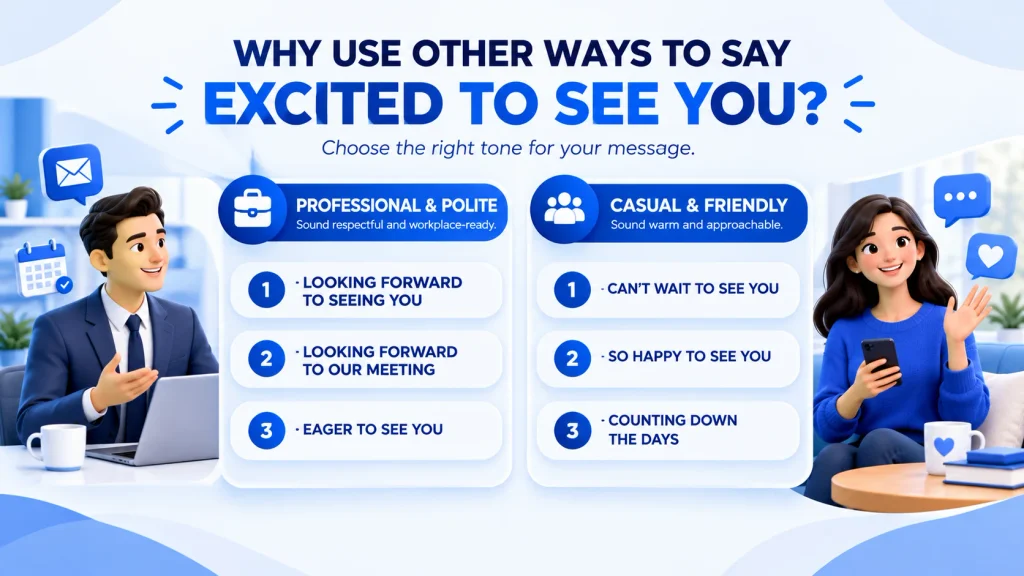
Using different expressions helps you communicate the same basic feeling without repeating the exact wording. It also lets you control how enthusiastic, warm, or professional your message sounds.
You may want an alternative to:
For example, “Looking forward to seeing you” sounds polished and flexible, while “Can’t wait to see you” feels more energetic and informal.
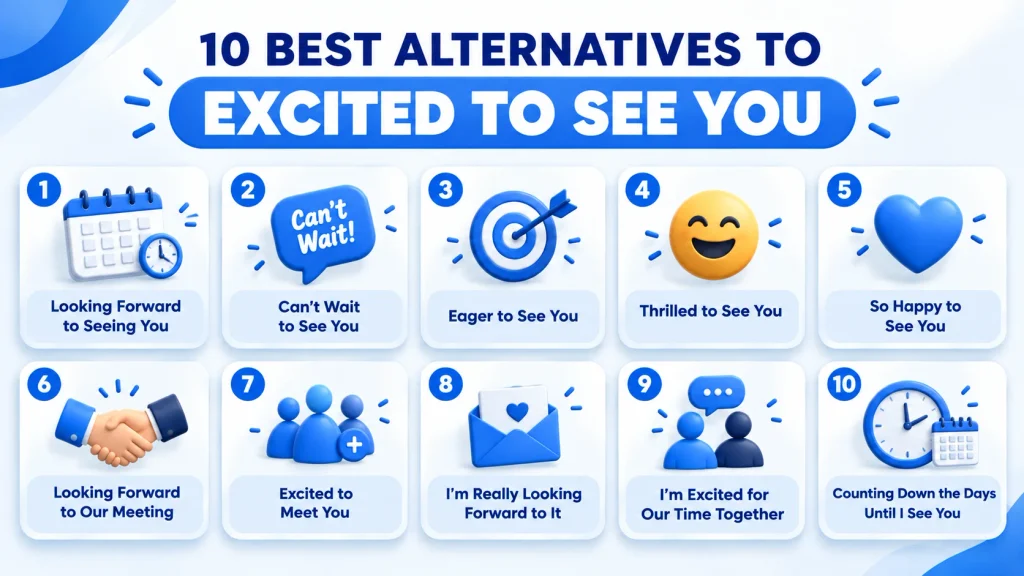
“Looking forward to seeing you” expresses positive anticipation about an upcoming meeting. It sounds natural without being overly emotional, making it one of the most flexible alternatives.
I’m looking forward to seeing you at the conference next week.
We’re all looking forward to seeing you again after the holidays.
Use this when you want a safe phrase that works in both professional and personal communication.
“Can’t wait to see you” shows strong enthusiasm about seeing someone. It is more energetic and informal than “looking forward to seeing you.”
I can’t wait to see you this Saturday and catch up over coffee.
We can’t wait to see you at the family barbecue.
Save this phrase for friends, family, or people you know well because it can sound too casual for formal business communication.
“Eager to see you” communicates enthusiasm and anticipation with a slightly more polished feel. It can sound less casual than “can’t wait to see you.”
I’m eager to see you at the leadership meeting tomorrow.
We’re eager to see you and hear your thoughts on the new project.
Use “eager” when you want to show genuine enthusiasm while maintaining a composed tone.
“Thrilled to see you” communicates a high level of happiness and excitement. It is stronger than simply saying you are looking forward to a meeting.
I’m thrilled to see you after all these years apart.
She was thrilled to see her old college roommate at the reunion.
Because “thrilled” expresses strong emotion, it works particularly well for reunions, celebrations, and meaningful personal meetings.
“So happy to see you” focuses more on happiness and warmth than anticipation. It is especially natural when meeting someone you care about.
I’m so happy to see you! It feels like forever since we last talked.
We’re so happy to see you back home for the holidays.
Choose this phrase when you want your message to feel affectionate and sincere rather than highly energetic.
“Looking forward to our meeting” focuses specifically on a planned meeting rather than simply seeing someone. It has a polished and professional tone.
I’m looking forward to our meeting on Thursday afternoon.
Thank you for your time. I’m looking forward to our meeting next week.
This is a strong option for business emails, scheduled appointments, interviews, and professional correspondence.
“Excited to meet you” is best when you are going to meet someone for the first time. It expresses enthusiasm about an upcoming introduction.
I’m excited to meet you and learn more about your work.
Our team is excited to meet you at the networking event.
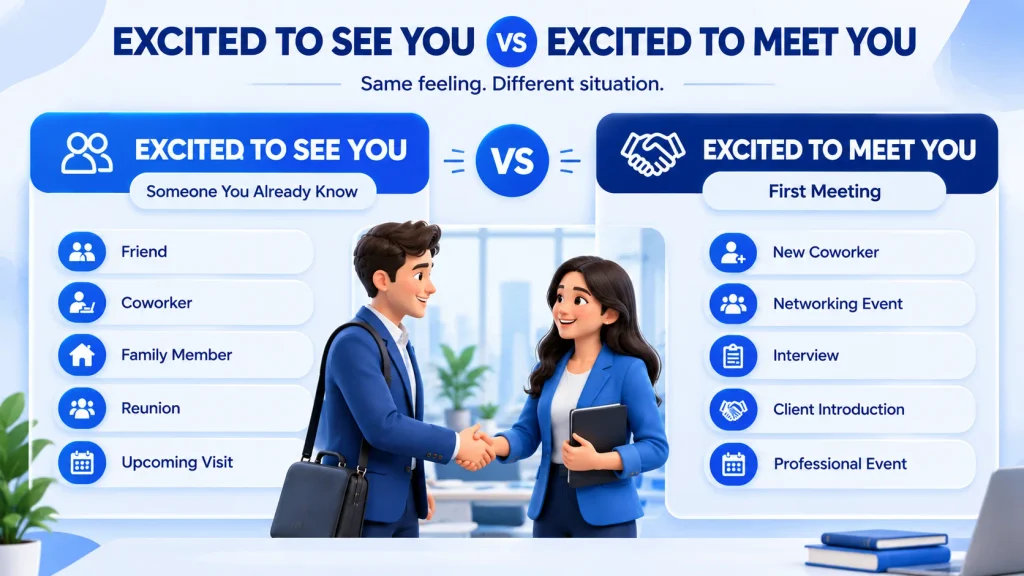
Use meet for a first encounter; use see when you already know the person and are meeting again.
“I’m really looking forward to it” expresses anticipation without repeating the words “see you.” It sounds natural when the upcoming event or meeting is already clear from the conversation.
Thanks for making the plans. I’m really looking forward to it.
The workshop sounds great, and I’m really looking forward to it.
Use this when the person already knows what “it” refers to. Otherwise, mention the meeting or event for clarity.
“I’m excited for our time together” emphasizes the experience of spending time with someone. It sounds warm and personal without being as intense as some highly emotional expressions.
I’m excited for our time together during your visit.
We’re excited for our time together and all the activities we have planned.
This works particularly well for visits, trips, family gatherings, and meaningful personal plans.
“Counting down the days until I see you” expresses strong anticipation. It suggests that the upcoming meeting is something you are actively looking forward to.
I’m counting down the days until I see you again!
We’ve been counting down the days until you arrive in town.
This phrase is highly enthusiastic, so it is better suited to personal messages than formal workplace emails.
| Alternative | Best Used In | Tone |
| Looking Forward to Seeing You | Emails, meetings, personal plans | Polite, warm |
| Can’t Wait to See You | Texts, friends, family | Casual, enthusiastic |
| Eager to See You | Professional messages, meetings | Polished, enthusiastic |
| Thrilled to See You | Reunions, celebrations, personal messages | Strong, warm |
| So Happy to See You | Friends, family, personal conversations | Warm, affectionate |
| Looking Forward to Our Meeting | Business emails, appointments | Professional, polite |
| Excited to Meet You | First meetings, networking | Friendly, professional |
| I’m Really Looking Forward to It | Conversations, emails, plans | Warm, flexible |
| I’m Excited for Our Time Together | Visits, trips, personal plans | Warm, personal |
| Counting Down the Days Until I See You | Personal texts, reunions | Casual, enthusiastic |
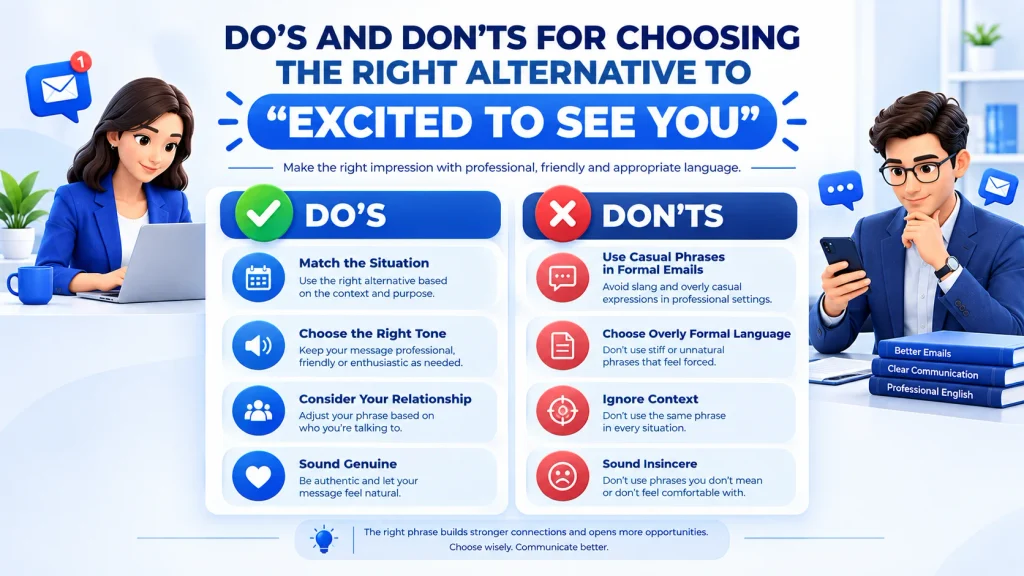
“Can’t wait to see you!” may sound too informal for a highly formal business message. “I’m looking forward to our meeting” is usually more polished.
A phrase such as “fondly anticipating our meeting” can sound stiff in an ordinary conversation. Match the wording to your relationship and the setting.
Using “I’m excited to see you” in every message can make your writing repetitive. Rotate between natural alternatives when the context allows.
“Excited to meet you” is generally associated with a first meeting, while “excited to see you” usually works when you already know the person. Choosing the wrong verb can make your message less precise.
Strong phrases such as “thrilled” or “counting down the days” communicate intense enthusiasm. Avoid them when your actual message only needs a simple, polite expression of anticipation.
“Looking forward to seeing you” is one of the most natural alternatives. It works across many situations, including friendly messages, professional emails, meetings, and personal plans. If you want a more casual and enthusiastic option, “can’t wait to see you” is also very common.
Yes. “Looking forward to seeing you” is commonly used in professional communication because it expresses positive anticipation without sounding overly emotional. You can use it when confirming a meeting, closing an email, preparing for a conference, or communicating with a colleague, client, or business contact.
“Can’t wait to see you” is generally more casual and enthusiastic than “looking forward to seeing you.” It works naturally with friends, family, and close acquaintances. In a formal business email, a more neutral phrase such as “I’m looking forward to seeing you” may fit better.
For professional communication, try “I’m looking forward to seeing you,” “I’m looking forward to our meeting,” or “I’m eager to see you.” These expressions communicate enthusiasm while keeping the tone polished and appropriate for workplace communication.
Yes. “Excited to see you” can work with coworkers, particularly in a friendly workplace or when you already have a comfortable relationship. For a more formal situation, such as meeting a new executive or client, “I’m looking forward to seeing you” may sound more measured.
For a friend, you can say “I can’t wait to see you,” “I’m so happy to see you soon,” “I’m thrilled to see you,” or “I’m counting down the days until I see you.” These phrases sound warm and enthusiastic without feeling overly formal.
“Excited to see you” usually suggests that you already know the person or are talking about seeing them again. “Excited to meet you” is commonly used when meeting someone for the first time, such as during an introduction, networking event, interview, or new professional relationship.
Not necessarily. The phrase can be friendly, professional, familial, or romantic depending on the surrounding context and relationship. For example, “I’m excited to see you at tomorrow’s meeting” sounds professional, while “I’m excited to see you tonight” could sound more personal. Context determines the intended tone.
There are many natural ways to say “excited to see you,” and the best choice depends on your relationship and the situation. For professional communication, “looking forward to seeing you” and “looking forward to our meeting” offer a polished tone. For friends and family, “can’t wait to see you,” “so happy to see you,” and “counting down the days” communicate more warmth and enthusiasm.
If you are meeting someone for the first time, “excited to meet you” is more precise than “excited to see you.” When you want a simple, flexible option that works in many settings, “looking forward to seeing you” is a dependable choice. The key is to match your words to the relationship, context, and level of emotion you genuinely want to express.

English Language & Communication Specialist
Dr. Emily Carter is an English language and communication specialist focused on vocabulary, word choice, professional writing, and practical English usage. She helps readers understand the differences between similar words and choose expressions that sound natural, clear, and appropriate for different contexts.