
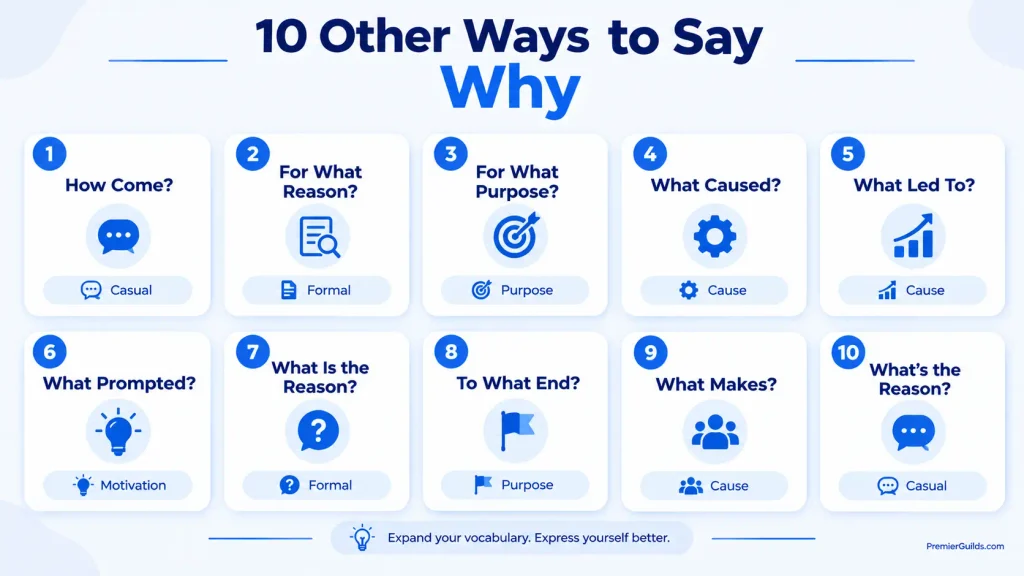
If you need another way to say why, try how come, for what reason, for what purpose, what caused, what led to, what prompted, what is the reason, or to what end. The best alternative depends on whether you are asking about a reason, cause, purpose, or motivation.
The word “why” is one of the most common question words in English. We use it to ask about a reason, cause, purpose, motivation, or explanation.
For example, “Why did you leave early?” asks about a reason, while “Why are we meeting?” may ask about the purpose of the meeting.
Because “why” can serve several purposes, there is no single replacement that works in every sentence. Alternatives such as “how come,” “for what reason,” “what prompted,” and “for what purpose” each fit slightly different situations.
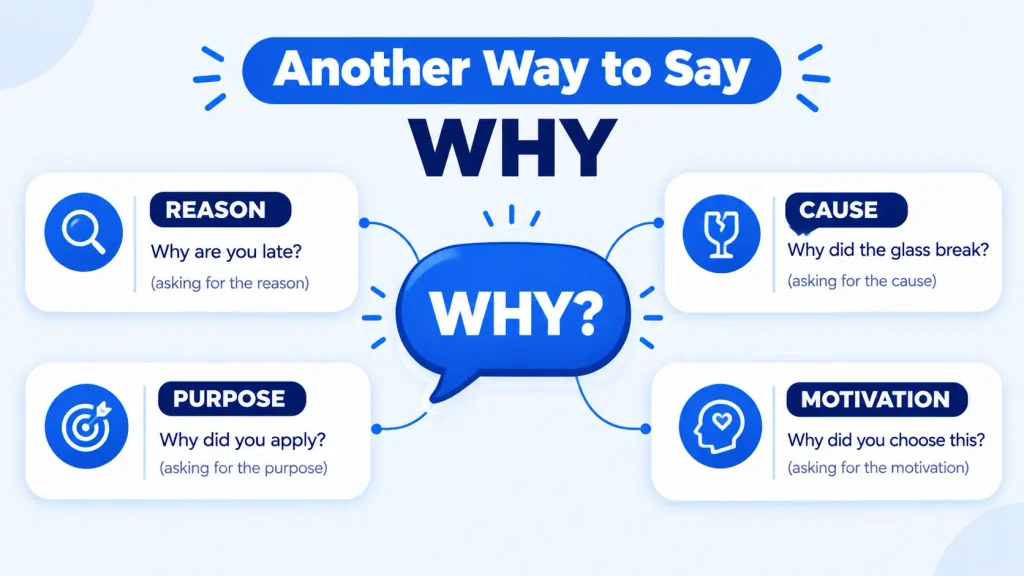
The phrase “another way to say why” refers to different words or phrases that can be used to ask about a reason, cause, purpose, or motivation.
“Why” is normally used as an interrogative adverb. It can ask what caused something to happen, why someone made a particular choice, or what purpose an action serves.
You may want an alternative because you are:
For example, “How come you left early?” is conversational, while “For what reason did you leave early?” sounds considerably more formal.
Using an alternative to “why” can make your question more precise. Instead of using one general question word for every situation, you can choose wording that shows exactly what information you want.
You might use an alternative to:
The key is not to replace “why” mechanically. Some alternatives are appropriate only when you are asking about a particular type of reason or purpose.
“How come?” is a common conversational way to ask why something happened or why someone did something. It is generally more informal than “why” and sounds natural in everyday American English. English-learning resources commonly list it as a direct alternative to “why.”
How come you decided to change your major?
How come the restaurant is closed today?
Use “how come?” in conversations and informal messages rather than highly formal documents.
“For what reason?” directly asks about the reason behind an action, event, or decision. It is more formal and deliberate than the simple word “why.”
For what reason was the application rejected?
For what reason did the committee postpone the vote?
Use this phrase when you want a formal question about a specific reason, especially in professional or official writing.
“For what purpose?” asks about the intended goal or function of something. Unlike “why,” which can ask about a cause, this phrase specifically focuses on what someone hopes to accomplish.
For what purpose was the survey distributed?
For what purpose will these additional funds be used?
Choose this phrase when the answer should explain the goal or intended use, not simply the cause.
“What caused?” focuses specifically on the cause of an event or situation. It is useful when you want to identify what produced a particular result rather than simply asking for a general explanation.
What caused the sudden increase in operating costs?
What caused the system to stop working overnight?
Use this alternative when you are investigating a direct cause or contributing factor.
“What led to?” asks about the events, decisions, or circumstances that resulted in something happening. It often encourages a more detailed explanation than a simple “why.”
What led to the decision to expand the program?
What led to the company’s decision to enter the new market?
Use “what led to” when you want to explore the process or circumstances behind an outcome.
“What prompted?” asks what caused someone to take a particular action or make a decision. It works especially well when the focus is on a trigger, event, or motivation.
What prompted you to apply for this position?
What prompted the team to revise the original proposal?
Use this when you want to understand what triggered a decision or action.
“What is the reason?” is a clear and direct way to ask for an explanation. It can sound neutral, although the tone may become more demanding depending on how it is delivered.
What is the reason for the change in schedule?
What is the reason behind the updated policy?
Use this construction when you want to identify a specific explanation without making the question overly complicated.
“To what end?” asks about the purpose, objective, or intended result of an action. It has a formal and somewhat literary tone, so it is less common in everyday conversation.
To what end was the additional research conducted?
To what end should the organization allocate these resources?
Use this phrase sparingly. It is best suited to formal writing or serious discussions about purpose.
“What makes?” can ask what factor causes someone or something to behave or appear in a particular way. It is especially useful when asking about a characteristic, motivation, or distinguishing factor.
What makes you think this approach will work?
What makes this solution different from the previous one?
Use “what makes” when you want the person to explain the factor behind an opinion, quality, or result.
“What’s the reason?” is a natural conversational alternative to “why.” It is straightforward and usually sounds less formal than “for what reason.”
What’s the reason you decided to move the meeting?
What’s the reason behind the sudden change?
Use this in everyday conversations when you want to ask for an explanation without sounding overly formal.
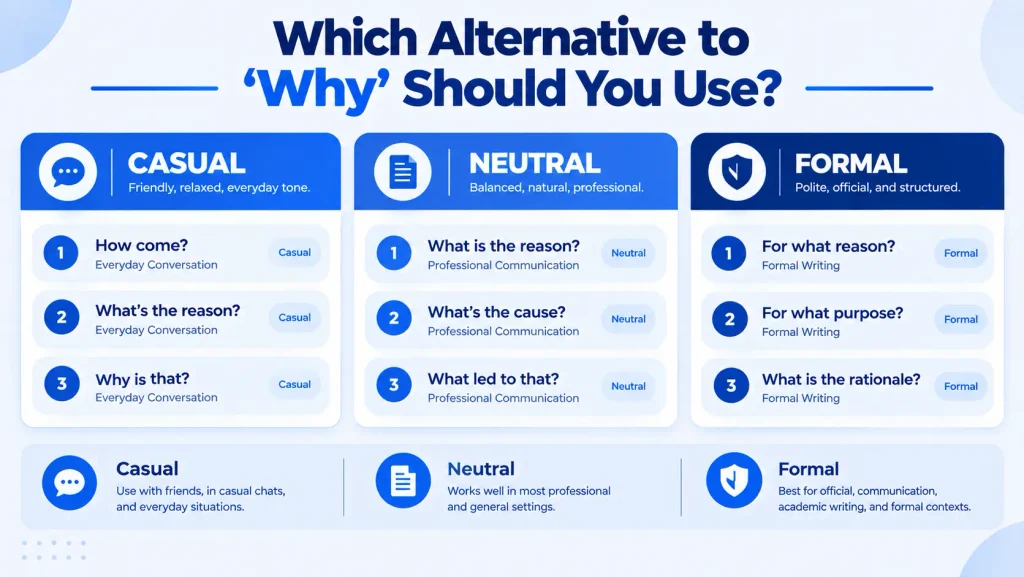
| Alternative | Best Used In | Tone |
| How come? | Everyday conversations | Casual/Friendly |
| For what reason? | Formal questions and documents | Formal/Professional |
| For what purpose? | Academic and professional writing | Formal/Professional |
| What caused? | Investigating causes | Formal/Academic |
| What led to? | Decisions and outcomes | Professional/Formal |
| What prompted? | Actions and decisions | Professional/Polite |
| What is the reason? | Direct explanations | Formal/Professional |
| To what end? | Purpose and objectives | Formal/Academic |
| What makes? | Opinions, qualities, and causes | Casual/Professional |
| What’s the reason? | Everyday questions | Casual/Friendly |
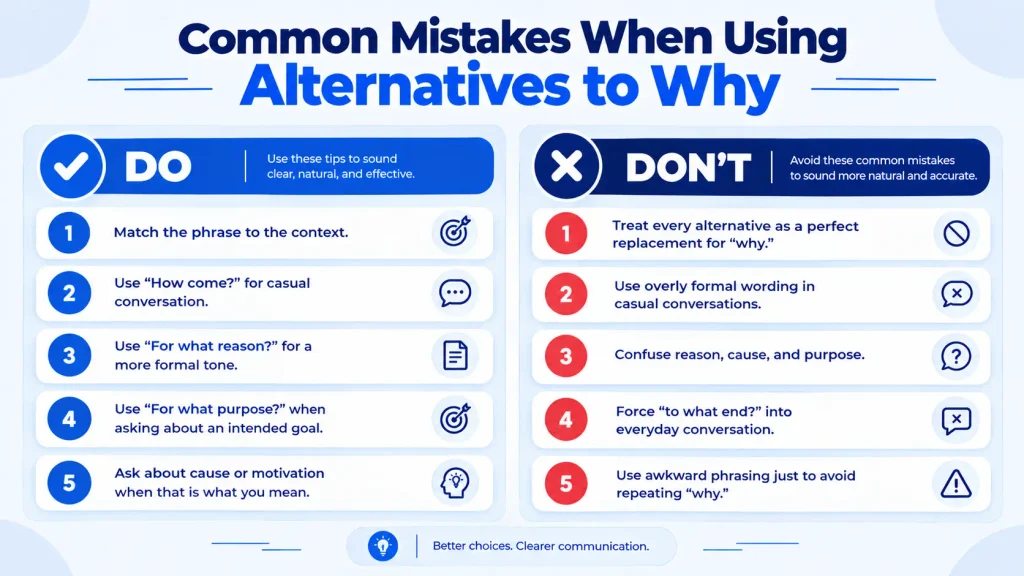
“How come?” is natural, but it has a conversational tone. Avoid it in formal reports, academic papers, or official correspondence when a more precise construction would fit better.
“Why” can ask about either a reason or a purpose. If you specifically want to know the intended goal, “for what purpose?” is more precise.
“What caused the delay?” works because a delay has a cause. But if you want to know why someone made a decision, “what prompted you?” may be more appropriate.
Phrases such as “to what end” and “for what reason” can sound stiff in casual conversation. Sometimes the best alternative is simply “how come?”
The alternatives do not all have exactly the same meaning. “What caused?” focuses on cause, “for what purpose?” focuses on intention, and “what prompted?” focuses on the trigger behind an action.
“How come?” is one of the most common conversational alternatives to “why.” It is natural in everyday American English and can ask about a reason or situation. For more formal writing, alternatives such as “for what reason?” or “what prompted?” may be more appropriate.
“For what reason?” is a direct formal alternative to “why.” If you are asking about an intended goal rather than a general reason, “for what purpose?” is more precise. In professional or academic writing, choose the phrase that matches the exact information you want the reader to provide.
In many everyday questions, “how come” and “why” have essentially the same purpose. However, “how come” is more conversational and has different grammatical behavior in questions. For example, you can say “How come you left?” rather than using the auxiliary inversion found in “Why did you leave?”
For professional communication, you can use “for what reason,” “what prompted,” “what led to,” or “what is the reason.” The best option depends on the situation. “What prompted the change?” is useful for decisions, while “what led to the change?” can invite a broader explanation.
Academic writing often benefits from more specific constructions such as “for what purpose,” “what caused,” “what led to,” or “what factors contributed to.” These phrases can clarify whether you are examining purpose, cause, or contributing factors instead of relying on the broad question word “why.”
“How come?” is a common casual alternative. You can also use constructions such as “what’s the reason?” depending on the context. “How come?” usually sounds natural when talking with friends, family members, or coworkers in relaxed conversations.
First, determine what you actually want to ask. If you need the reason for a decision, try “What prompted this decision?” If you need the cause of a problem, use “What caused the issue?” If you want to know the goal, use “For what purpose?” This makes the email more precise.
“Wherefore” is a historical or literary alternative to “why,” but it is uncommon in modern everyday American English. Standard thesaurus sources still list it as a synonym, but it can sound archaic or overly literary today. For normal communication, “how come” or “for what reason” is usually more natural.
Knowing another way to say why can help you make your questions more precise and appropriate for different situations. Although “why” works in almost any setting, alternatives can clarify whether you are asking about a cause, reason, purpose, or motivation.
For casual conversations, “how come?” is a natural choice. In professional or formal writing, “for what reason?” provides a more polished option, while “what prompted?” and “what led to?” work well when asking about decisions or outcomes. If you want to understand an intended goal, “for what purpose?” is more specific.
The most important point is that these expressions are not perfect substitutes in every sentence. Choose the phrase that matches the information you actually want.

English Language & Communication Specialist
Dr. Emily Carter is an English language and communication specialist focused on vocabulary, word choice, professional writing, and practical English usage. She helps readers understand the differences between similar words and choose expressions that sound natural, clear, and appropriate for different contexts.