
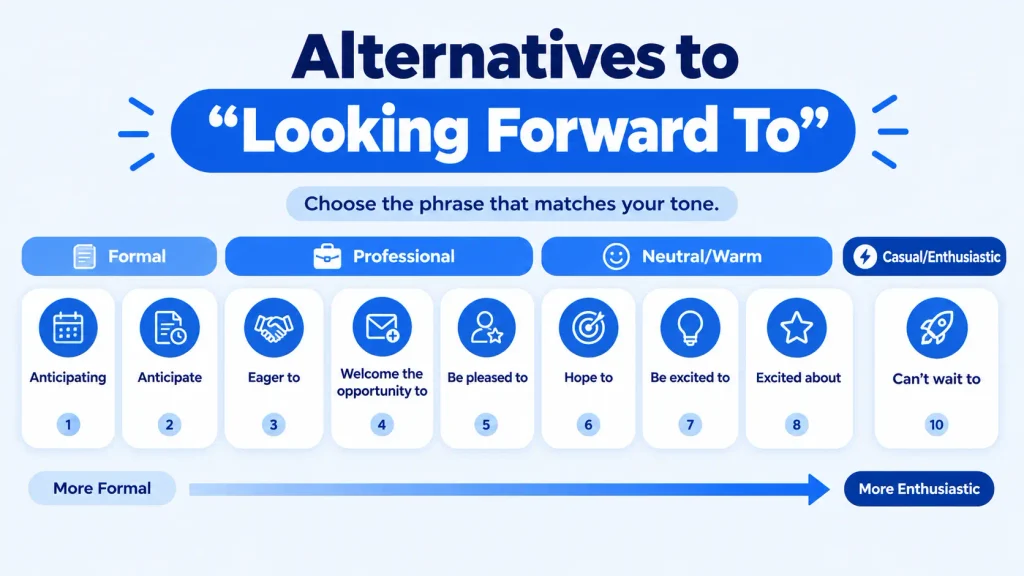
If you need another way to say looking forward to, try phrases such as eager to, excited about, anticipating, can’t wait to, or hope to. The best alternative depends on your tone and context. For professional emails, eager to and I look forward to work well, while can’t wait to sounds more casual and enthusiastic.
The phrase “looking forward to” means feeling pleased, excited, or hopeful about something that is expected to happen in the future. It is commonly used when talking about upcoming meetings, events, conversations, opportunities, or personal experiences.
For example, you might say, “I’m looking forward to meeting you next week.” The phrase is natural and widely accepted, but using alternatives can help you avoid repetition or adjust your tone.
You may want a different expression when writing a professional email, responding to an invitation, talking with a friend, or expressing strong excitement about an upcoming event.
Although “looking forward to” is natural, repeating it too often can make your writing feel predictable. A suitable alternative can also communicate a more specific emotion, such as enthusiasm, anticipation, hope, or excitement.
Using different expressions can help you:
Eager to means that you are very interested in or excited about doing something. It is a versatile expression that sounds natural in both professional and personal communication.
I’m eager to discuss the project with you during our meeting next week.
She is eager to begin her new role and meet the rest of the team.
Use eager to when you want to express positive anticipation without sounding overly excited.
Excited about directly expresses enthusiasm about something that will happen or is already happening. It is warmer and more energetic than many formal alternatives.
I’m excited about the opportunity to work on this new project.
We’re excited about having you join us for the celebration.
Use this phrase when you genuinely want to show enthusiasm, especially in friendly or conversational writing.
Anticipating means expecting or looking ahead to something that you believe will happen. It has a more formal tone and can work particularly well in polished professional or academic writing.
We are anticipating a productive discussion during tomorrow’s meeting.
The team is anticipating several changes to the schedule next month.
Choose anticipating when you want a formal expression of expectation rather than an openly emotional one.
Can’t wait to expresses strong excitement about something that is going to happen. It is highly conversational and often sounds warmer and more enthusiastic than “looking forward to.”
I can’t wait to see everyone at the reunion this weekend.
We can’t wait to hear all about your trip.
Avoid this phrase in very formal business writing because it can sound too casual or enthusiastic.
Hope to expresses a positive expectation or desire about something in the future. Unlike “looking forward to,” it can suggest that the event or action is not completely certain.
I hope to speak with you again after the interview.
We hope to welcome you to our office later this month.
Use hope to when the future action is possible or desired rather than firmly scheduled.
Anticipate can replace “look forward to” when you want to emphasize expectation. It is especially useful when discussing an upcoming event, result, response, or development.
We anticipate receiving your feedback by the end of the week.
The company anticipates strong demand for the new service.
Use anticipate for expected events or outcomes, particularly in business and formal writing.
Be excited to communicates clear enthusiasm about taking an action or participating in something. It is direct, positive, and common in everyday American English.
I’m excited to share the results with the team tomorrow.
She’s excited to start her first day at the new company.
Use this phrase when you want your enthusiasm to sound clear and genuine.
Welcome the opportunity to is a polished way to express positive interest in doing something. It works especially well when discussing professional opportunities or future conversations.
I would welcome the opportunity to discuss my qualifications further.
We would welcome the opportunity to work together on future projects.
This is particularly useful in cover letters, business emails, and other professional correspondence.
Be pleased to expresses positive feelings about an upcoming action or opportunity. It has a courteous and professional tone without sounding overly enthusiastic.
I’m pleased to have the opportunity to speak with you about the position.
We are pleased to welcome you to our annual conference.
Use be pleased to when you want your message to sound polished, respectful, and restrained.
Anticipate with enthusiasm emphasizes both expectation and excitement. It is more expressive than simply saying “anticipate” and can work when you want to highlight strong positive feelings.
The students anticipate the upcoming competition with enthusiasm.
Our team anticipates the next stage of the project with enthusiasm.
Use this expression sparingly because it is more formal and deliberate than everyday alternatives such as “excited about.”
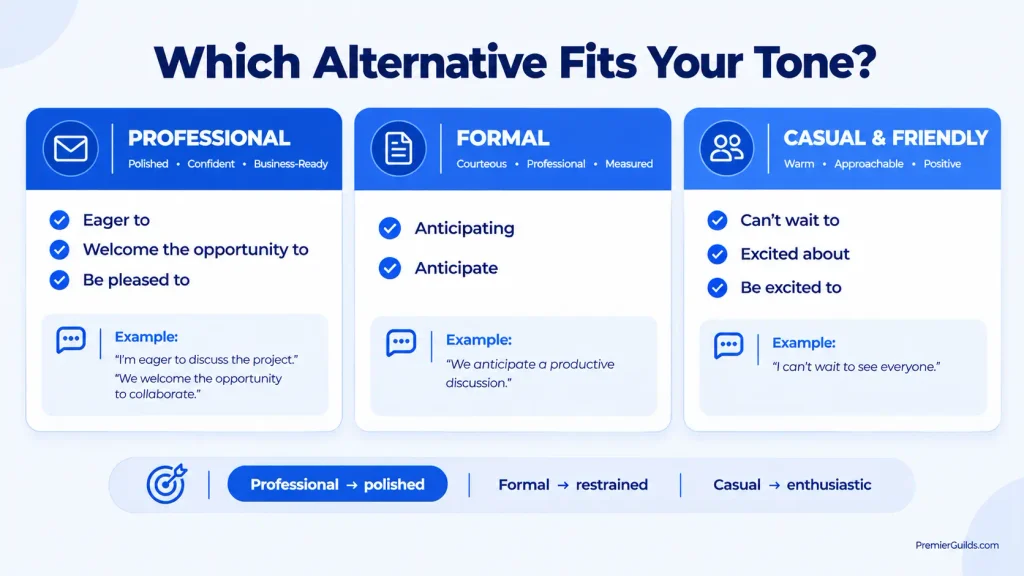
| Alternative | Best Used In | Tone |
| Eager to | Professional messages, future plans | Professional/Warm |
| Excited about | Conversations, announcements, positive news | Friendly/Warm |
| Anticipating | Formal writing and professional communication | Formal |
| Can’t wait to | Personal messages and casual conversations | Casual/Enthusiastic |
| Hope to | Emails, plans, uncertain future events | Polite/Professional |
| Anticipate | Business and formal writing | Formal/Professional |
| Be excited to | Personal and professional communication | Warm/Friendly |
| Welcome the opportunity to | Applications, business emails, professional discussions | Formal/Polite |
| Be pleased to | Professional announcements and correspondence | Formal/Polite |
| Anticipate with enthusiasm | Formal descriptions of future events | Formal/Warm |
Can’t wait to is natural, but it can sound too casual for highly formal communication. In a business email, eager to or welcome the opportunity to may better match the situation.
These expressions are not always interchangeable. Anticipate generally suggests that you expect something, while hope to expresses a desired possibility.
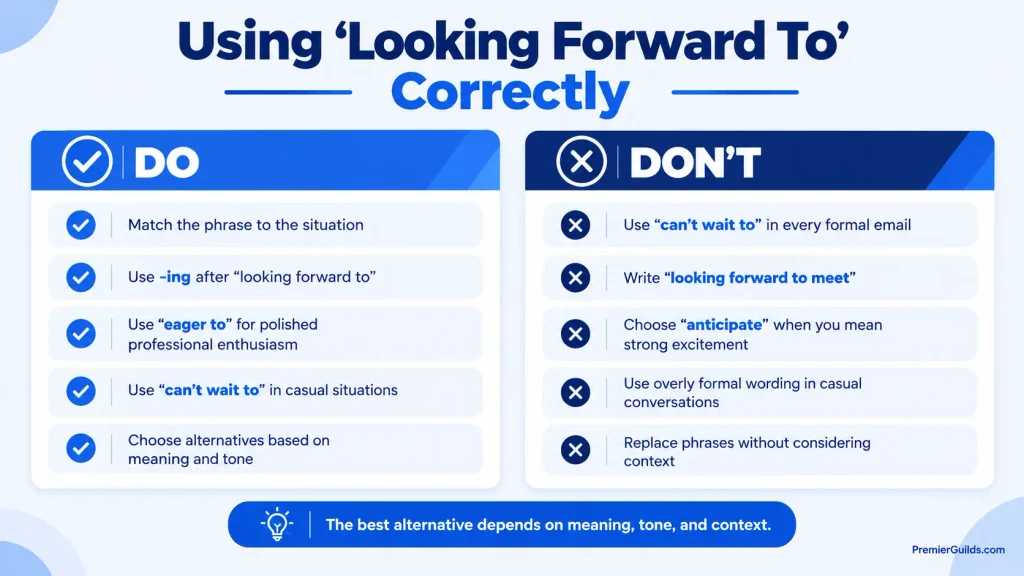
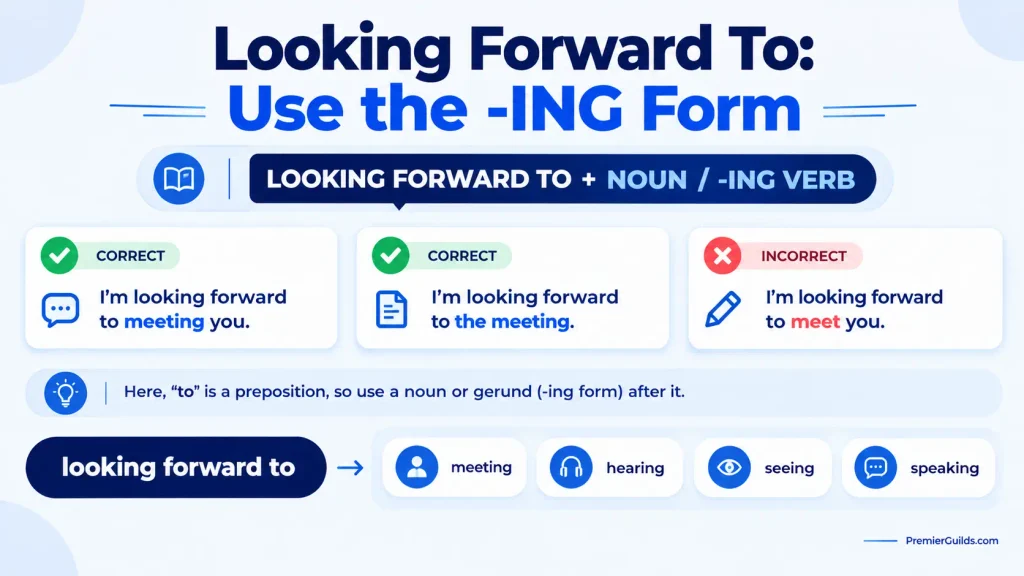
After looking forward to, use a noun or -ing form, not an infinitive.
Correct:
I’m looking forward to meeting you.
Incorrect:
I’m looking forward to meet you.
Here, to functions as a preposition, so it is followed by meeting, not meet.
A phrase such as can’t wait to shows strong excitement. It may not fit a formal message where a calmer expression such as eager to or pleased to would be more appropriate.
Not every synonym has exactly the same meaning. Hope to can introduce uncertainty, while anticipate can indicate expectation. Always choose the phrase that accurately reflects what you mean.
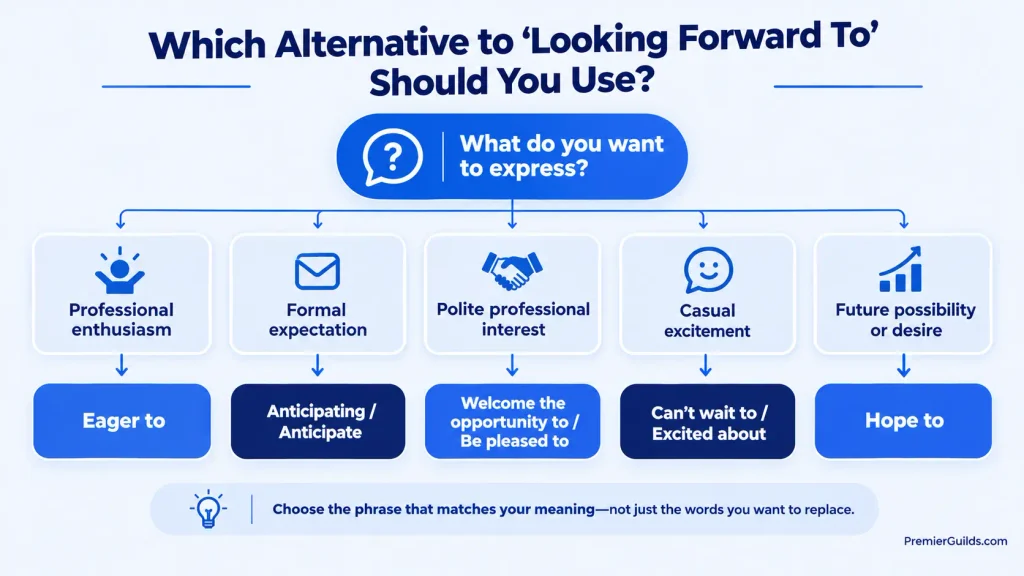
Common alternatives include eager to, excited about, anticipating, can’t wait to, hope to, and welcome the opportunity to. The best option depends on your tone. For professional writing, “eager to” is versatile, while “can’t wait to” is better suited to casual and enthusiastic conversations.
Eager to, anticipating, welcome the opportunity to, and pleased to can all work in professional communication. For example, instead of saying “I’m looking forward to discussing this,” you could write, “I’m eager to discuss this.” The right choice depends on how formal and enthusiastic you want to sound.
You can use “I hope to hear from you soon,” “I’m eager to hear your thoughts,” or “I welcome the opportunity to continue our conversation.” In professional emails, choose the option that matches the relationship and purpose of the message rather than replacing the original phrase automatically.
The two expressions are closely related but not identical. Eager to emphasizes your desire or enthusiasm to do something, while looking forward to emphasizes positive anticipation of a future event. In many professional situations, they can be used similarly, but “eager to” may sound slightly more direct.
Yes, excited to can be professional when the situation naturally calls for enthusiasm. For example, “I’m excited to join the team” is common in workplace communication. However, highly formal correspondence may benefit from a more restrained expression such as pleased to or eager to.
Can’t wait to is one of the most natural casual alternatives. You can also use excited to or really looking forward to when speaking with friends, family, or close colleagues. These expressions communicate more enthusiasm and warmth than many formal alternatives.
Yes, but the meaning and tone can change slightly. Anticipating often emphasizes expecting something to happen, while looking forward to usually carries a positive emotional sense. “Anticipating” is therefore more common in formal or business writing when discussing expected events or outcomes.
Hope to can be a good alternative when you are expressing a desired future action rather than certainty. For example, “I hope to meet with you next week” suggests that the meeting is desired but may not be confirmed. If the meeting is already scheduled, “looking forward to meeting you” is more direct.
There are many natural ways to say looking forward to, but the best choice depends on the situation and the emotion you want to communicate. Eager to is a versatile option for professional communication, while welcome the opportunity to works particularly well in formal business writing.
For warmer messages, excited about and be excited to clearly show enthusiasm. If you are speaking casually with friends or family, can’t wait to sounds natural and energetic. Meanwhile, anticipating and anticipate are useful when you want to emphasize expectation rather than emotion.
The key is to choose an expression that matches your relationship, purpose, and level of enthusiasm. Use the phrase that sounds natural for the situation—not simply the one that sounds more formal.

Our editorial team brings together decades of expertise in applied linguistics, lexicography, and educational publishing. Dedicated to clarity, precision, and tone, our experts ensure that every resource meets the highest standards of professional and academic excellence.