

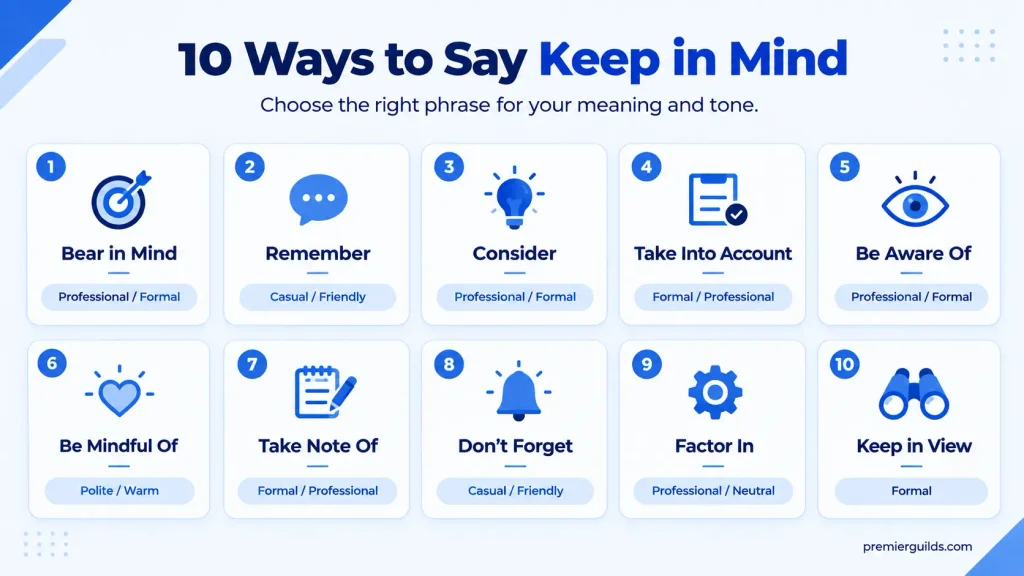
If you’re looking for another way to say keep in mind, you can use phrases such as bear in mind, remember, consider, take into account, be aware of, take note of, or be mindful of. The best choice depends on whether you want to sound professional, formal, casual, polite, or conversational.
“Keep in mind” is a common English expression used when you want someone to remember or consider something. It can introduce an important fact, reminder, condition, or point that should influence what someone does next.
Although “keep in mind” is perfectly natural, using another expression can make your writing or speech more precise. The best alternative depends on whether you mean remember something, consider something, pay attention to it, or account for it.
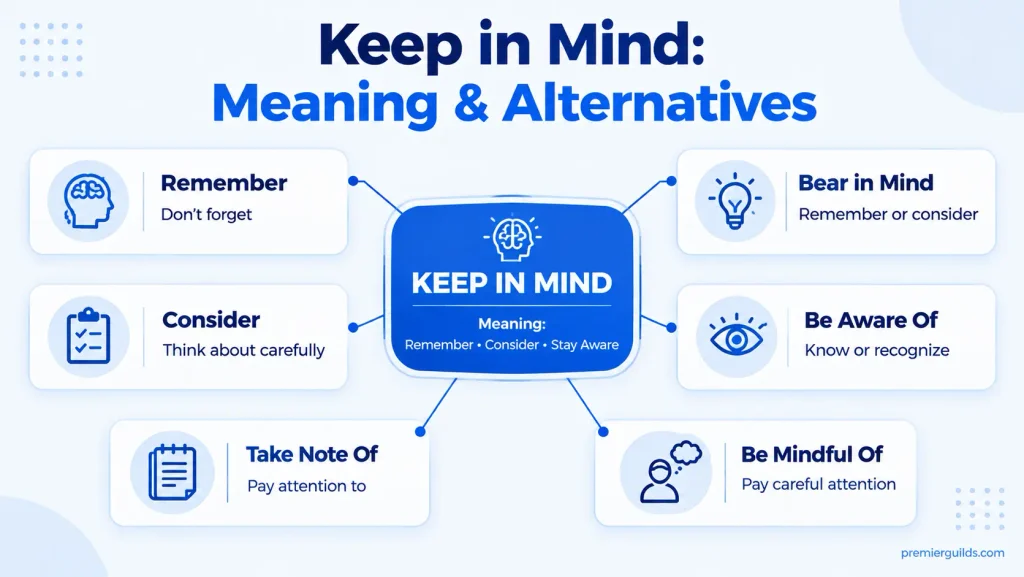
Keep in mind means to remember, consider, or remain aware of something while thinking or making a decision. Cambridge lists related meanings around remembering, retaining information, and considering something.
For example:
Keep in mind that the store closes at 8 p.m.
Here, the speaker is reminding someone to remember an important fact.
The phrase is common in everyday conversations, instructions, emails, workplace communication, advice, and educational writing. Because it works in many settings, the best replacement depends on the context.
There is nothing wrong with saying “keep in mind.” However, another phrase may communicate your intended meaning more precisely or help you avoid repeating the same expression.
Consider using an alternative when you want to:
For example, remember focuses more directly on memory, while take into account emphasizes considering a factor before making a decision.
Bear in mind is one of the closest alternatives to “keep in mind.” It means to remember, consider, or remain aware of something while thinking or acting.
Bear in mind that delivery times may change during the holiday season.
Bear in mind the needs of your audience when preparing the presentation.
Use bear in mind when you want a polished alternative that still preserves the original meaning.
Remember is a simple and direct replacement when your main point is that someone should not forget something. It sounds natural in both everyday speech and professional communication.
Remember to bring your identification to the appointment.
Remember that the final application deadline is Friday.
Choose remember when the focus is memory rather than carefully considering a factor.
Consider works well when “keep in mind” means to think carefully about something before making a decision. It is concise and especially useful in professional, academic, and formal writing.
Consider the long-term costs before choosing the cheaper option.
Please consider how this change could affect existing customers.
Use consider when you want the reader to actively think about something, not simply remember it.
Take into account means to consider a particular fact, condition, or factor when making a decision. It is more specific than “keep in mind” when something needs to influence an outcome.
Please take into account the team’s current workload before assigning new tasks.
The committee took customer feedback into account when revising the policy.
This phrase is especially effective when discussing decisions, planning, evaluations, or comparisons.
Be aware of tells someone to recognize or have knowledge of something. It is useful when the information involves a condition, possibility, risk, or situation they should understand.
Be aware of the updated requirements before submitting your application.
Employees should be aware of the company’s privacy guidelines.
Choose this phrase when awareness is more important than actively weighing a factor.
Be mindful of means to pay careful attention to something and consider its effect. It often sounds thoughtful and polite, making it useful for reminders about behavior, communication, or other people’s needs.
Please be mindful of other guests when using the shared workspace.
Be mindful of your tone when discussing sensitive topics with customers.
Use be mindful of when you want a reminder to sound considerate rather than demanding.
Take note of means to pay attention to or remember a particular piece of information. It works especially well when highlighting a detail that someone should notice or remember.
Take note of the revised meeting time before updating your calendar.
Please take note of the safety instructions posted near the entrance.
Use this phrase when you want to draw attention to a specific fact or detail.
Don’t forget is a direct and conversational way to remind someone about something important. It is common in everyday communication and can sound friendly when used appropriately.
Don’t forget to send me the address before you leave.
Don’t forget that we need to arrive at least 15 minutes early.
Use don’t forget for friendly reminders, but choose a softer expression when writing a formal business message.
Factor in means to include something as part of your thinking or calculation when reaching a decision. It is particularly useful when a specific circumstance can affect the final result.
Factor in travel time when planning the day’s schedule.
We need to factor in the additional maintenance costs before approving the project.
Use factor in when the information should directly influence a calculation, plan, or decision.
Keep in view means to continue considering or remembering something while dealing with a situation. It has a more formal tone and is less common in everyday American conversation than alternatives such as “remember” or “consider.”
Keep the company’s long-term objectives in view when evaluating the proposal.
The team kept the customer’s needs in view throughout the redesign process.
Use this phrase mainly in formal or carefully written contexts; keep in mind or consider will usually sound more natural in everyday American English.
| Alternative | Best Used In | Tone |
| Bear in mind | Reminders, advice, professional writing | Professional/Formal |
| Remember | Everyday reminders and instructions | Casual/Neutral |
| Consider | Decisions, advice, analysis | Professional/Formal |
| Take into account | Decisions and evaluations | Formal/Professional |
| Be aware of | Warnings, conditions, important facts | Professional/Formal |
| Be mindful of | Polite reminders and considerate behavior | Polite/Warm |
| Take note of | Important details and instructions | Formal/Professional |
| Don’t forget | Friendly reminders | Casual/Friendly |
| Factor in | Planning, calculations, decisions | Professional/Neutral |
| Keep in view | Formal consideration of goals or factors | Formal |
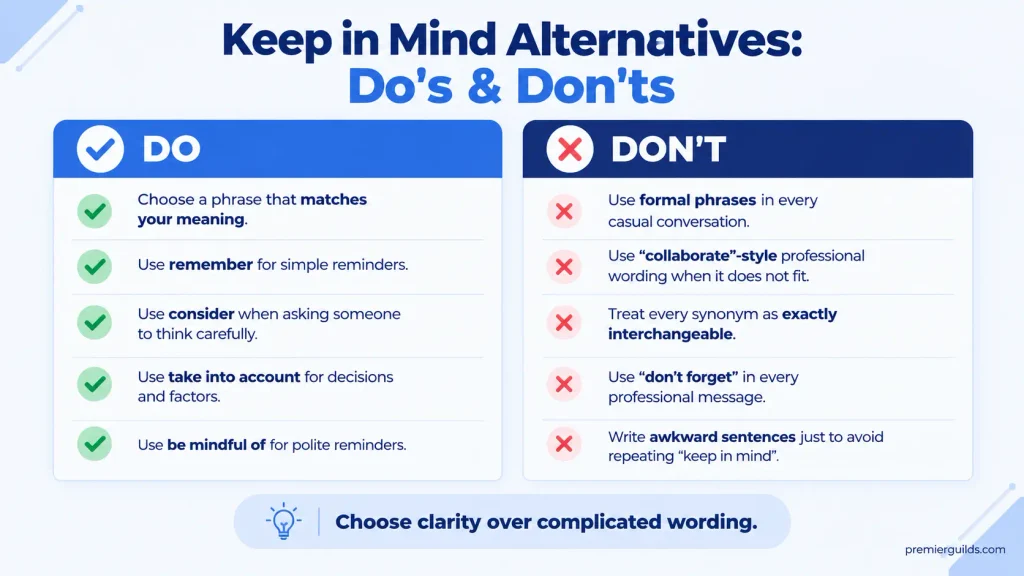
Phrases such as take into account or keep in view may sound unnecessarily formal with friends or family. In casual situations, remember or don’t forget is usually more natural.
The alternatives do not always have exactly the same meaning. Remember focuses on memory, while consider asks someone to think about something carefully.
“Be mindful of” can sound thoughtful, but using it repeatedly may make straightforward instructions feel more complicated than necessary.
“Don’t forget” is natural, but it can sound too direct in certain professional messages. A softer option such as please take note of or please be aware of may fit better.
The correct expression is bear in mind, not bare in mind. “Bear in mind” means to remember or consider something; “bare” does not fit the expression.
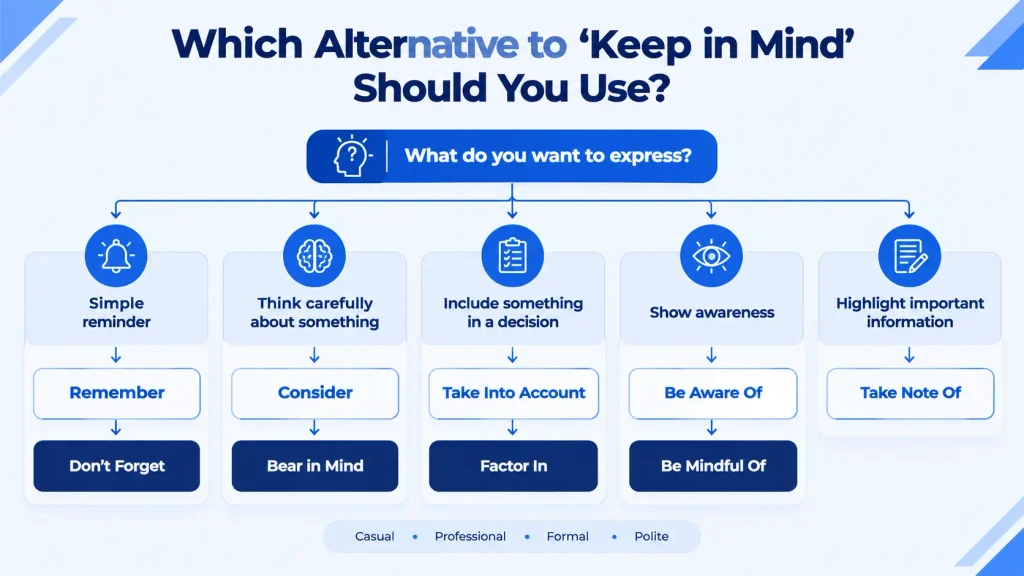
Common alternatives include bear in mind, remember, consider, take into account, be aware of, be mindful of, and take note of. The right choice depends on what you mean. For example, use “remember” for a simple reminder and “take into account” when something should influence a decision.
Bear in mind, consider, take into account, be aware of, and take note of can all work in professional communication. “Consider” is especially useful when asking someone to evaluate an issue, while “take into account” works well when a factor should influence a decision or plan.
Please be mindful of, please take note of, and please be aware of can make a reminder sound polite and professional. The best choice depends on the message. “Be mindful of” is especially useful when you want to remind someone about other people’s needs, behavior, or circumstances.
Yes. Bear in mind and keep in mind are very close in meaning and can both mean to remember, consider, or remain aware of something. Cambridge lists “bear in mind” among the related expressions for “keep in mind.”
For casual conversations, remember and don’t forget are simple, natural choices. For example, instead of “Keep in mind that the restaurant closes early,” you could say, “Remember that the restaurant closes early.” The best choice depends on how direct or friendly you want to sound.
In an essay, consider, note, take into account, and bear in mind can work depending on the sentence. “Consider” is often the most concise choice when discussing an idea, while “take into account” is useful when explaining how a factor affects an argument or conclusion.
Use take into account when something should be considered as part of a decision, judgment, or plan. For example, “Keep in mind the budget” can become “Take the budget into account when planning the project.” The second version emphasizes that the budget should affect the decision.
Yes, but the meaning has a slightly different emphasis. Be mindful of suggests paying careful attention to something and considering its impact, while “keep in mind” can simply mean remembering information. It is particularly useful for polite reminders about behavior, communication, or other people’s needs.
There are many useful ways to say keep in mind, but the best alternative depends on what you want to communicate. Bear in mind is a close substitute, while remember works naturally for everyday reminders. For decisions, consider, take into account, and factor in can communicate the idea more precisely.
If you want to emphasize awareness, choose be aware of. For thoughtful or polite reminders, be mindful of works well, while take note of draws attention to an important detail. In casual situations, don’t forget may sound more natural.
The key is to match the phrase to your meaning and audience. Instead of replacing “keep in mind” simply for variety, choose the expression that makes your message clearer.

Our editorial team brings together decades of expertise in applied linguistics, lexicography, and educational publishing. Dedicated to clarity, precision, and tone, our experts ensure that every resource meets the highest standards of professional and academic excellence.