

If you need another way to say resulting in, useful alternatives include leading to, causing, producing, creating, bringing about, contributing to, giving rise to, and culminating in. The best choice depends on the relationship between the action and outcome, as well as whether you need a formal, professional, academic, or conversational tone.
“Resulting in” is a common phrase used to show that one action, event, or condition produces a particular outcome. For example, “The heavy rainfall flooded several roads, resulting in major traffic delays.”
The phrase is useful, but repeating it throughout an article, report, essay, or professional document can make your writing feel predictable. More importantly, not every cause-and-effect relationship is equally strong, so a more precise alternative can sometimes communicate your meaning better.
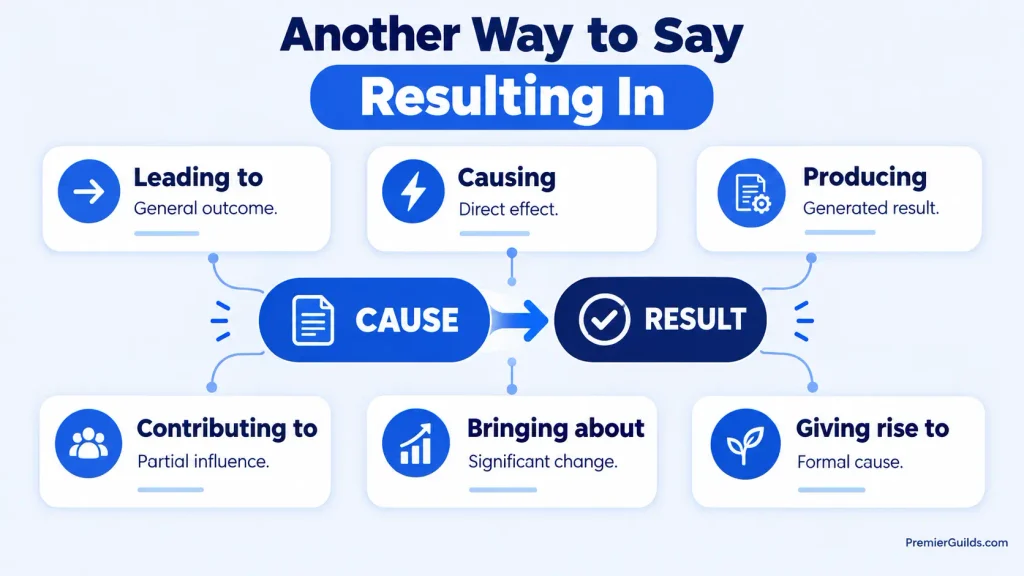
Resulting in means causing something to happen or producing a particular outcome. It connects an action, event, or condition with the consequence that follows it.
For example:
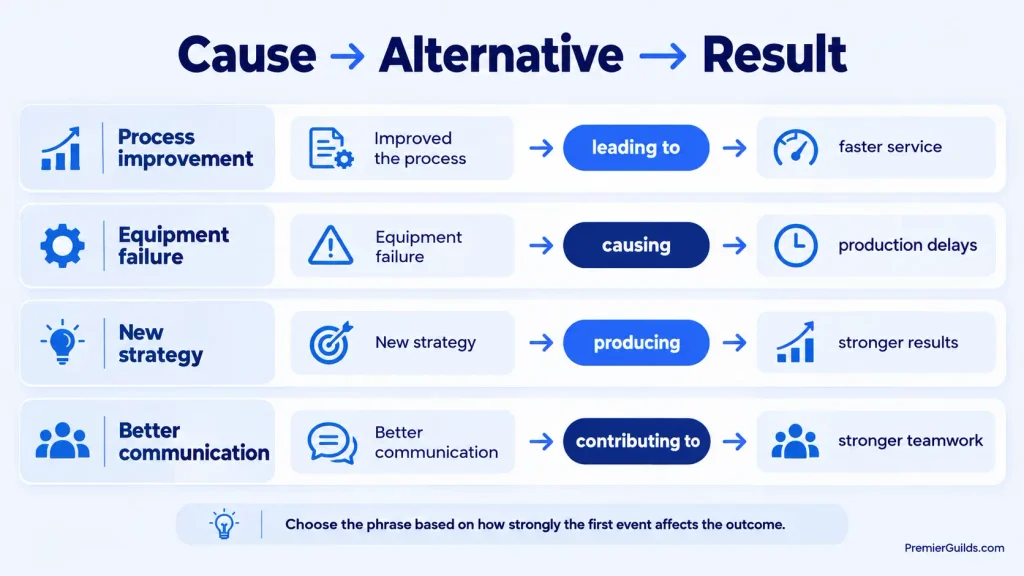
The company upgraded its software, resulting in faster processing times.
Here, the software upgrade is presented as the action, while faster processing times are the outcome.
The expression is common in professional writing, academic papers, business reports, news writing, technical documents, and everyday explanations. Because it clearly expresses cause and effect, it can fit many situations.
However, context matters. If something directly caused an outcome, causing may be more precise. If something played only a partial role, contributing to may be more accurate.
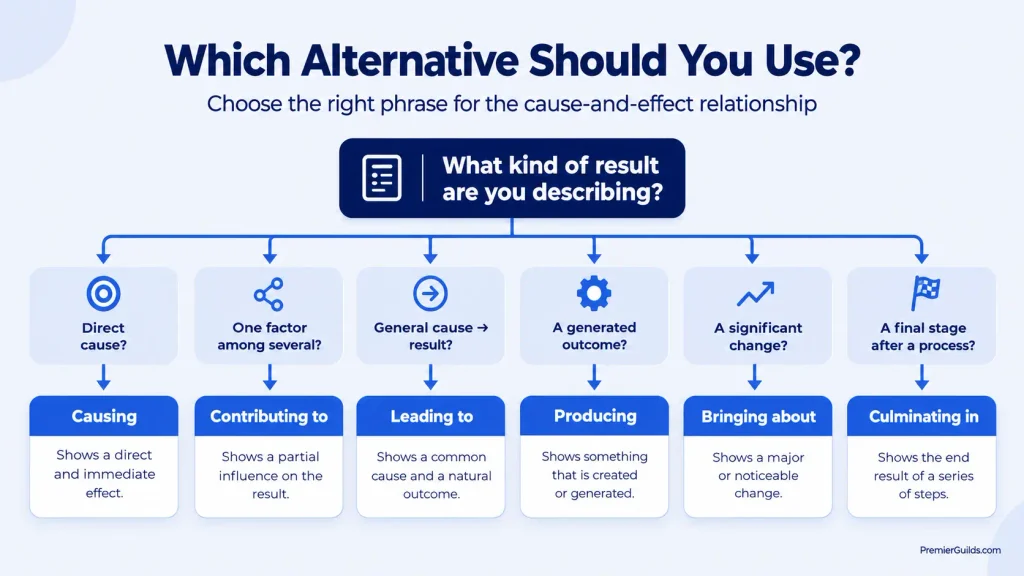
Using different expressions can make cause-and-effect writing clearer and more natural. It also helps you avoid repeating the same construction across multiple sentences.
Consider another alternative when you want to:
For example, compare:
The company reduced unnecessary expenses, resulting in higher profits.
with:
The company reduced unnecessary expenses, leading to higher profits.
Both sentences work, but leading to gives the sentence a slightly more natural flow.
Leading to is one of the closest and most versatile alternatives to “resulting in.” It shows that an action, event, or condition produced or contributed to a later outcome.
The team improved its customer support process, leading to higher satisfaction scores.
Several delays occurred, leading to changes in the project’s completion date.
Use leading to when you want a natural replacement that works in both professional and everyday writing.
Causing directly connects an action or event with its effect. It is stronger than some alternatives because it generally suggests that the first event actually produced the second outcome.
The faulty equipment caused a temporary production shutdown.
Heavy traffic caused several employees to arrive late.
Use causing when the cause-and-effect relationship is clear and direct. Avoid it when the factor merely played a small part.
Producing emphasizes the outcome generated by an action, process, or effort. It works particularly well when the result is something measurable, observable, or deliberately created.
The new training program produced significant improvements in employee performance.
The updated process produced more consistent results across all departments.
Choose producing when you want to focus on the outcome generated by a process or action.
Creating suggests that an action or situation brought something new into existence. Unlike “causing,” it often focuses on the resulting condition rather than simply emphasizing the causal relationship.
The redesign simplified the checkout process, creating a better experience for customers.
The policy change created new opportunities for small businesses.
Use creating when the result is a new situation, opportunity, condition, or experience.
Bringing about means causing a particular change or outcome to happen. It has a somewhat formal tone and is useful when discussing significant changes, developments, or improvements.
The new leadership strategy brought about major improvements in team communication.
Increased public awareness brought about changes to the community program.
Use bringing about when describing a meaningful change rather than a simple or immediate consequence.
Contributing to indicates that something helped produce an outcome without necessarily being the only cause. It is a useful choice when several factors influenced the final result.
Improved communication contributed to stronger relationships between the departments.
Rising operating costs contributed to the company’s decision to revise its pricing strategy.
Use this phrase when you want to avoid claiming that one factor was entirely responsible for the outcome.
Giving rise to means causing something to develop, occur, or exist. It is more formal than “leading to” and can work well in reports, essays, and analytical writing.
The rapid expansion of the business gave rise to new management challenges.
The court’s decision gave rise to several questions about the policy’s future.
Reserve giving rise to for situations where a formal or analytical tone is appropriate.
Culminating in describes a process or series of events that eventually reaches a final result. It emphasizes the endpoint after development over time rather than an immediate cause.
Years of research culminated in the development of a more efficient treatment method.
The team’s preparation culminated in a successful product launch.
Use culminating in when the result comes after a sequence of events, efforts, or developments.
Which led to is a flexible way to connect a completed action or event with its consequence. It is especially useful when you want to create a complete clause rather than use a simple “-ing” construction.
The manager changed the scheduling system, which led to fewer staffing conflicts.
The company expanded its online services, which led to a noticeable increase in customer inquiries.
Use which led to when you want the cause and result to be expressed as two clearly connected parts of a sentence.
Sometimes the best alternative to “resulting in” is a different sentence structure rather than another synonym. You can restructure the sentence using a direct verb such as caused, produced, or led to to make the relationship clearer.
The company reduced processing errors, resulting in faster customer service.
The revised schedule improved employee coverage, resulting in shorter wait times.
Avoid forcing a synonym when the original phrase already sounds natural. Change the structure only when doing so improves clarity or variety.
| Alternative | Best Used In | Tone |
| Leading to | General cause-and-effect statements | Professional/Neutral |
| Causing | Direct causes and clear consequences | Direct/Professional |
| Producing | Measurable outcomes and processes | Professional |
| Creating | New conditions, opportunities, or experiences | Neutral/Professional |
| Bringing about | Significant changes or developments | Formal |
| Contributing to | Partial or shared causes | Professional/Formal |
| Giving rise to | Analytical and formal writing | Formal |
| Culminating in | Long processes and final outcomes | Formal |
| Which led to | Complete cause-and-effect clauses | Neutral/Professional |
| Resulting in | Broad cause-and-effect situations | Neutral |
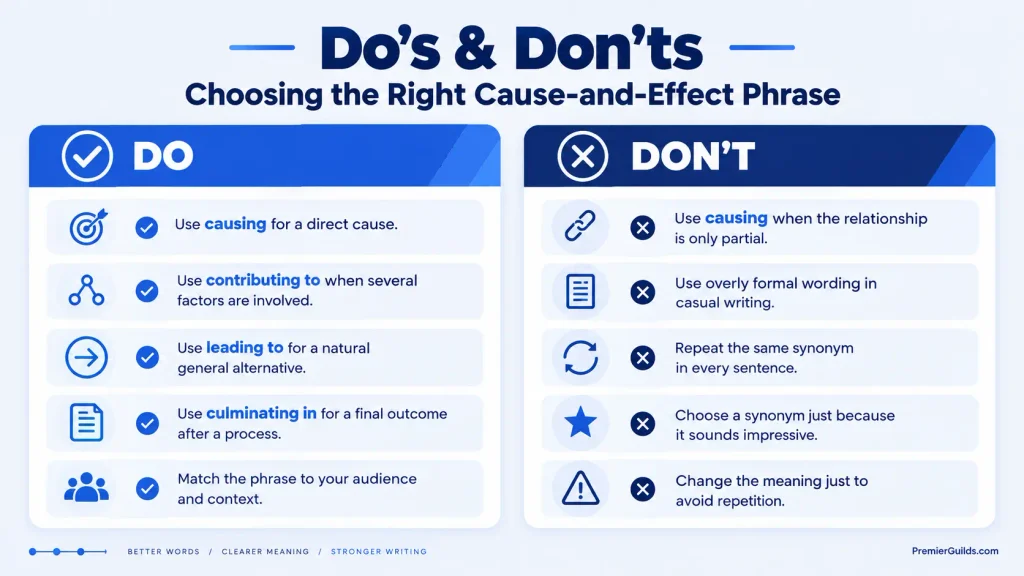
“Causing” can imply a direct connection. If several factors contributed to an outcome, contributing to may be more accurate.
Phrases such as giving rise to and culminating in have legitimate uses, but they may sound stiff in casual writing. In many situations, leading to is simpler and more natural.
Culminating in suggests a final result after a process or sequence of events. It is not always a suitable replacement for an immediate consequence.
Replacing “resulting in” with “leading to” throughout an article does not solve repetition. Vary your wording according to the actual relationship between the cause and outcome.
Be careful when describing cause and effect, particularly in academic or professional writing. If the available information only shows an association or partial influence, contributing to may be safer than causing.
Common alternatives include leading to, causing, producing, creating, bringing about, contributing to, giving rise to, and culminating in. The best choice depends on the relationship you want to express. “Leading to” is a versatile option, while “causing” is stronger and suggests a more direct connection between an action and its outcome.
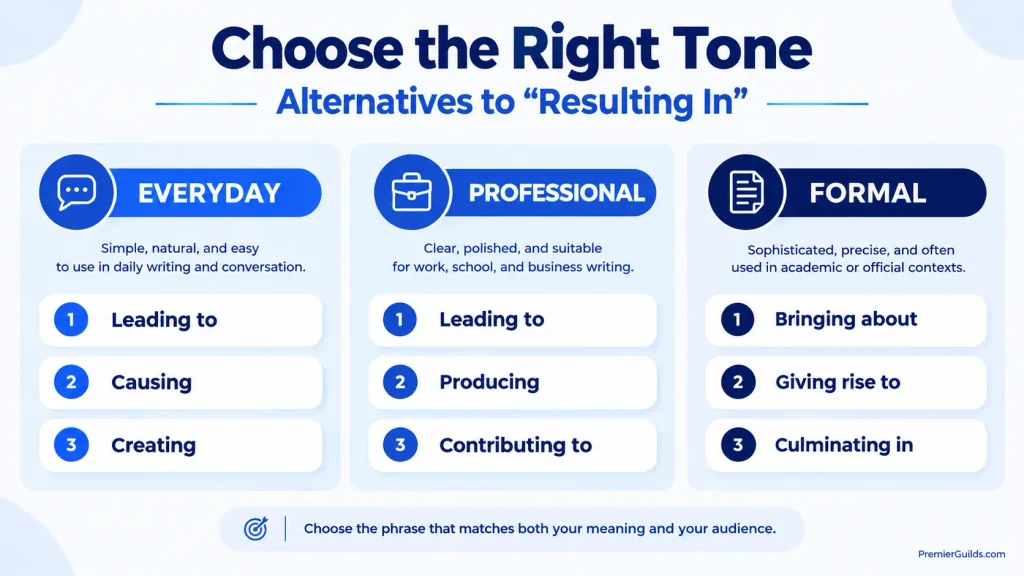
Leading to, contributing to, producing, bringing about, and giving rise to can work well in professional writing. For most business communication, leading to is a clear and natural choice. Use contributing to when multiple factors influenced the result rather than one action being solely responsible.
Formal alternatives include giving rise to, bringing about, culminating in, and contributing to. The correct option depends on the context. Culminating in is particularly appropriate when a result follows a long process, while giving rise to works well when describing how one development creates another.
In many contexts, leading to and resulting in can be used interchangeably because both connect an action or event with an outcome. However, “leading to” can sometimes suggest a path or contribution toward a result, while “resulting in” more directly presents the outcome as a consequence.
Yes, but only when the relationship is sufficiently direct. Causing generally makes a stronger claim about the connection between two events. If an action was only one of several factors behind the outcome, contributing to may communicate the situation more accurately.
For essays, useful alternatives include leading to, contributing to, giving rise to, bringing about, and culminating in. Your choice should match the type of relationship you are describing. Academic writing benefits from precise cause-and-effect language, so avoid choosing a synonym merely because it sounds more sophisticated.
On a resume, leading to, producing, creating, and contributing to can work well. For example, instead of “Improved the process, resulting in fewer errors,” you could write, “Improved the process, leading to a 20% reduction in errors.” Whenever possible, include a measurable outcome to show the value of your work.
Start by identifying the exact relationship between the action and outcome. Use causing for direct effects, contributing to for partial influence, leading to for general connections, and culminating in for final results after a longer process. This creates meaningful variety instead of simply swapping synonyms.
Finding another way to say resulting in can make your writing more precise, especially when you regularly describe cause-and-effect relationships. Leading to is the most flexible alternative and works across professional, academic, and everyday contexts. Causing is stronger when one action directly produces an outcome, while contributing to is better when several factors play a role.
For formal writing, bringing about, giving rise to, and culminating in can provide a more polished tone. Producing and creating work well when you want to focus on the outcome itself.
The key is to choose based on meaning rather than simply replacing words. Before selecting an alternative, ask whether the cause was direct, partial, immediate, or the final stage of a longer process. The most effective synonym is the one that describes the relationship accurately.

English Language & Communication Specialist
Dr. Emily Carter is an English language and communication specialist focused on vocabulary, word choice, professional writing, and practical English usage. She helps readers understand the differences between similar words and choose expressions that sound natural, clear, and appropriate for different contexts.