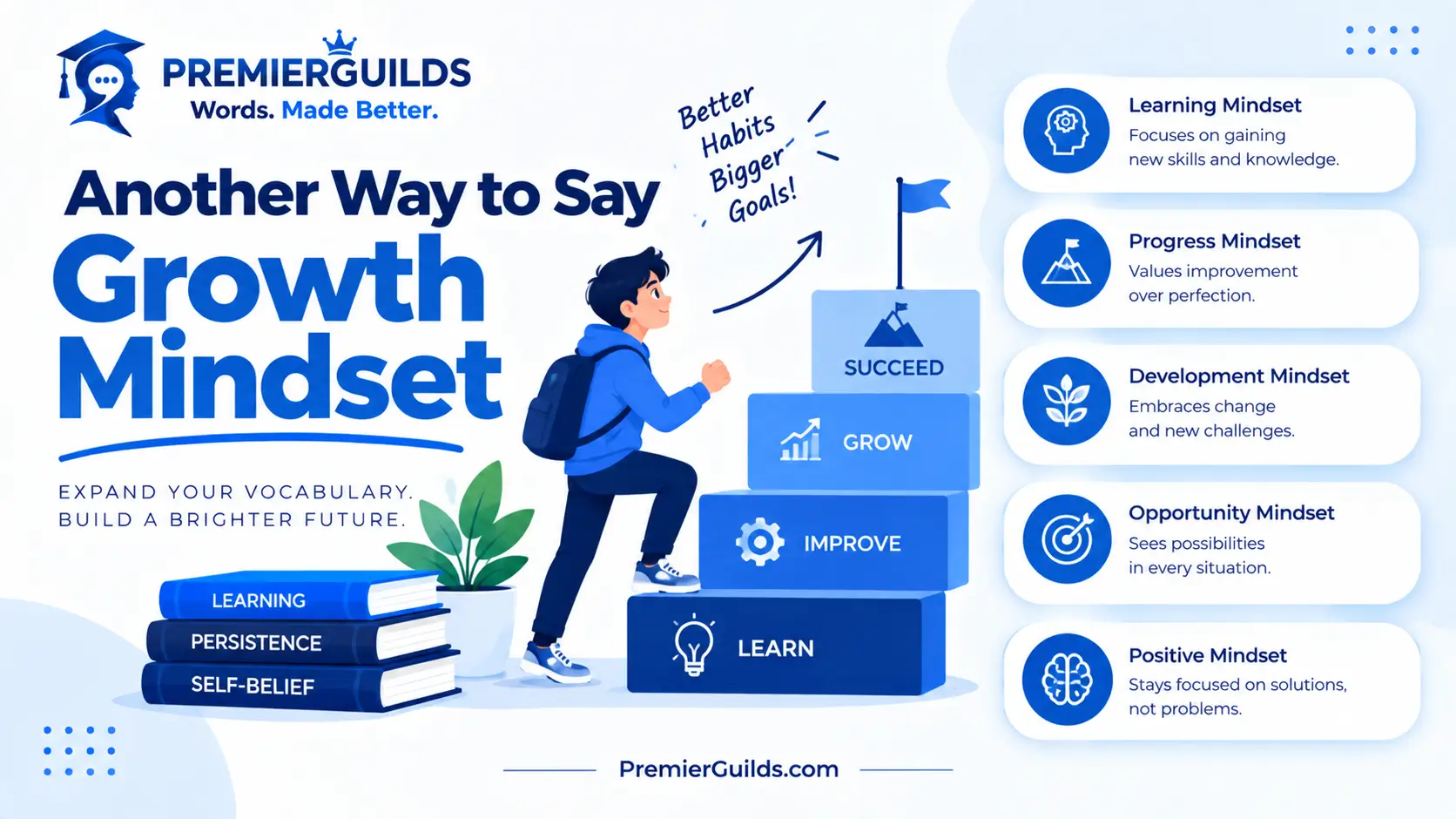
A growth mindset is the belief that people can develop their abilities through effort, learning, practice, and feedback. If you want another way to say “growth mindset,” you can use phrases such as learning mindset, development mindset, continuous improvement, or a willingness to learn. The best alternative depends on whether you are writing for school, work, or everyday conversation.
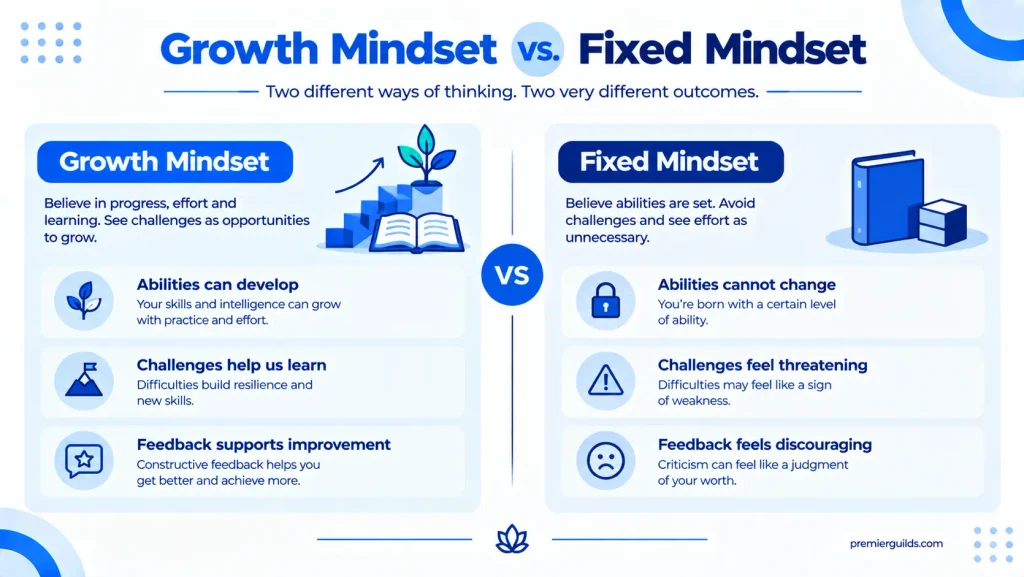
The phrase “another way to say growth mindset” refers to different words or expressions that communicate the idea of believing that abilities, skills, and intelligence can improve through learning, effort, and practice.
People commonly use this phrase when writing essays, preparing resumes, describing personal qualities, or discussing education and professional development. Finding the right alternative helps you express the same idea without repeating the words “growth mindset.”
Using alternative expressions can make your writing clearer, more natural, and better suited to your audience. Although these phrases share a similar meaning, each one highlights a slightly different aspect of learning and improvement.
Here are some reasons to use alternatives:
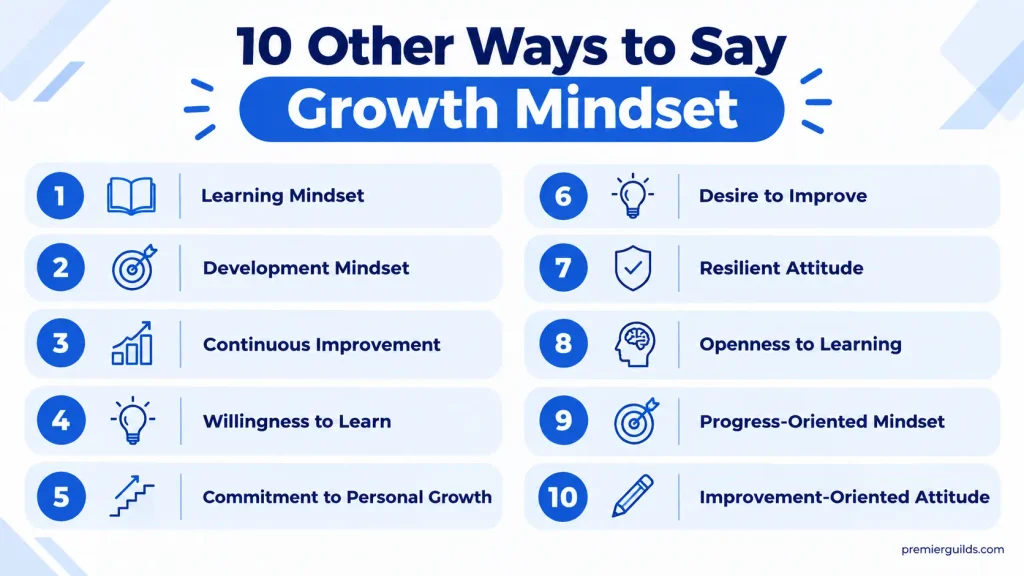
The following alternatives are useful in American English. Some are close synonyms, while others emphasize a particular part of the growth mindset, such as learning, persistence, or self-improvement.
A learning mindset describes an attitude focused on gaining knowledge, developing skills, and learning from experience. It suggests that a person welcomes new information and sees learning as an ongoing process.
This phrase is especially useful when discussing education, training, or personal development.
Students with a learning mindset are more likely to ask questions when they do not understand a lesson.
She brings a learning mindset to every new project and actively seeks feedback from her coworkers.
Use “learning mindset” when you want to emphasize curiosity and gaining knowledge rather than overcoming a particular challenge.
A development mindset focuses on improving abilities, building experience, and making steady progress over time. It is a useful expression when discussing personal growth, career advancement, or skill development.
Unlike “growth mindset,” this phrase may place more emphasis on a planned process of improvement.
Our team values employees who bring a development mindset to their roles.
His development mindset helped him create a clear plan for improving his leadership skills.
Choose this expression when your writing focuses on building specific abilities or making progress toward a goal.
Continuous improvement means making regular efforts to improve skills, processes, habits, or results. It emphasizes progress over time rather than expecting immediate perfection.
This expression is common in business, education, personal development, and workplace training.
The company encourages continuous improvement through regular training and employee feedback.
Her commitment to continuous improvement helped her become a more confident public speaker.
Use “continuous improvement” when discussing measurable progress, workplace performance, or a habit of becoming better over time.
Willingness to learn describes a person’s openness to gaining new knowledge and developing unfamiliar skills. It suggests that someone is ready to accept guidance, try new approaches, and learn from mistakes.
This expression is particularly natural when describing a person’s attitude in a professional or educational setting.
The hiring manager appreciated Maya’s willingness to learn new software.
His willingness to learn helped him adjust to the demands of his first leadership position.
Use this phrase when describing a specific personal quality, especially in a resume, cover letter, or performance review.
Commitment to personal growth refers to a strong desire to improve yourself through learning, reflection, and new experiences. It suggests that someone actively works on developing their abilities and becoming a better version of themselves.
The phrase often sounds thoughtful and purposeful.
Her commitment to personal growth encouraged her to attend workshops and seek advice from experienced mentors.
A commitment to personal growth can help people respond constructively to difficult experiences.
Use this expression when discussing long-term self-improvement, personal goals, or character development.
A desire to improve means wanting to become better at something through effort, practice, or learning. It is a simple and direct expression that can describe improvement in skills, behavior, or performance.
Unlike “growth mindset,” it does not necessarily suggest a broader belief about the ability to change.
Her desire to improve motivated her to practice public speaking every week.
The coach noticed his desire to improve, even after he made several mistakes during training.
Choose “desire to improve” when you want to highlight motivation rather than describe a complete approach to learning.
A resilient attitude describes the ability to recover from setbacks and continue working toward a goal. It emphasizes persistence, adaptability, and the determination to keep trying after difficulties.
This phrase overlaps with a growth mindset because both can involve learning from failure and treating challenges as opportunities to improve.
Her resilient attitude helped her handle criticism and continue improving her presentation skills.
The athlete showed a resilient attitude after losing the first two matches of the season.
Use this phrase when the main focus is overcoming challenges rather than learning in general.
Openness to learning means being receptive to new ideas, information, feedback, and experiences. It suggests that a person is willing to reconsider old assumptions and explore better ways of doing things.
This expression works well when describing curiosity and flexibility.
Her openness to learning made it easier for her to adapt to the new teaching methods.
Employers often value candidates who show openness to learning and accept constructive feedback.
Use “openness to learning” when you want to emphasize receptiveness to advice, new ideas, or unfamiliar experiences.
A progress-oriented mindset focuses on making meaningful progress instead of expecting perfect results immediately. It encourages people to set goals, track improvement, and recognize small achievements.
This phrase is useful when discussing motivation, productivity, education, or professional development.
A progress-oriented mindset helped the student focus on improving her writing one assignment at a time.
Our manager promotes a progress-oriented mindset by celebrating steady improvements in team performance.
Choose this expression when you want to emphasize gradual progress and realistic goals.
An improvement-oriented attitude describes a person’s tendency to look for ways to improve skills, decisions, habits, or results. It suggests that someone evaluates their performance and takes practical steps to do better.
This expression is especially suitable for workplace communication and professional development.
His improvement-oriented attitude helped him identify weaknesses in his presentation and correct them.
The supervisor praised Lena for her improvement-oriented attitude during the employee training program.
Use this phrase when discussing practical changes, performance reviews, or someone’s efforts to improve results.
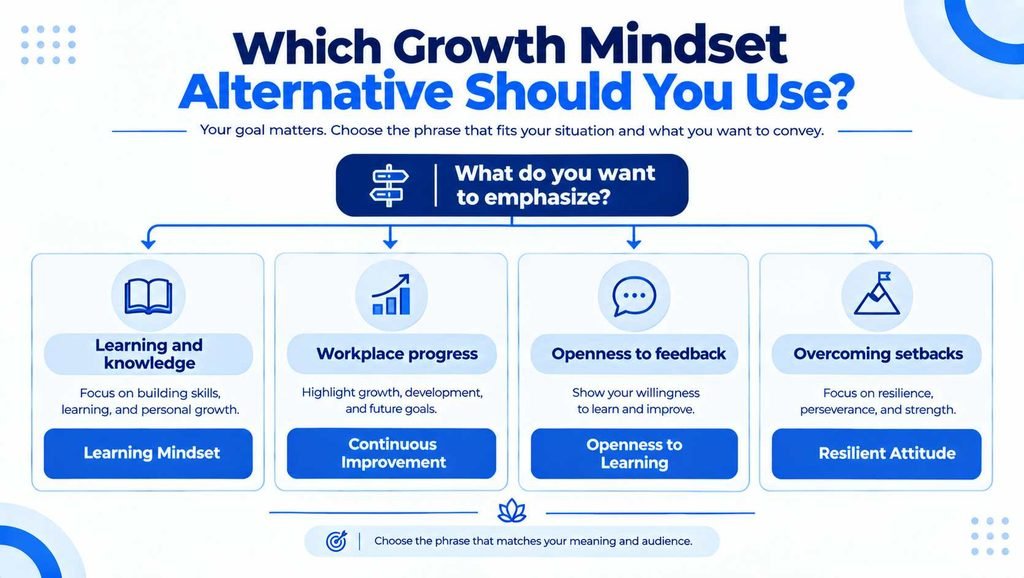
| Alternative | Best Used In | Tone |
| Learning mindset | Education, everyday writing, professional communication | Natural and positive |
| Development mindset | Career development, formal writing | Professional |
| Continuous improvement | Business, training, personal development | Practical and formal |
| Willingness to learn | Resumes, interviews, workplace communication | Positive and direct |
| Commitment to personal growth | Personal development, reflective writing | Warm and thoughtful |
| Desire to improve | Everyday conversation, personal descriptions | Simple and encouraging |
| Resilient attitude | Challenges, setbacks, sports, work | Strong and encouraging |
| Openness to learning | Education, teamwork, feedback | Positive and receptive |
| Progress-oriented mindset | Goals, productivity, education | Motivational and practical |
| Improvement-oriented attitude | Performance reviews, workplace writing | Professional and purposeful |
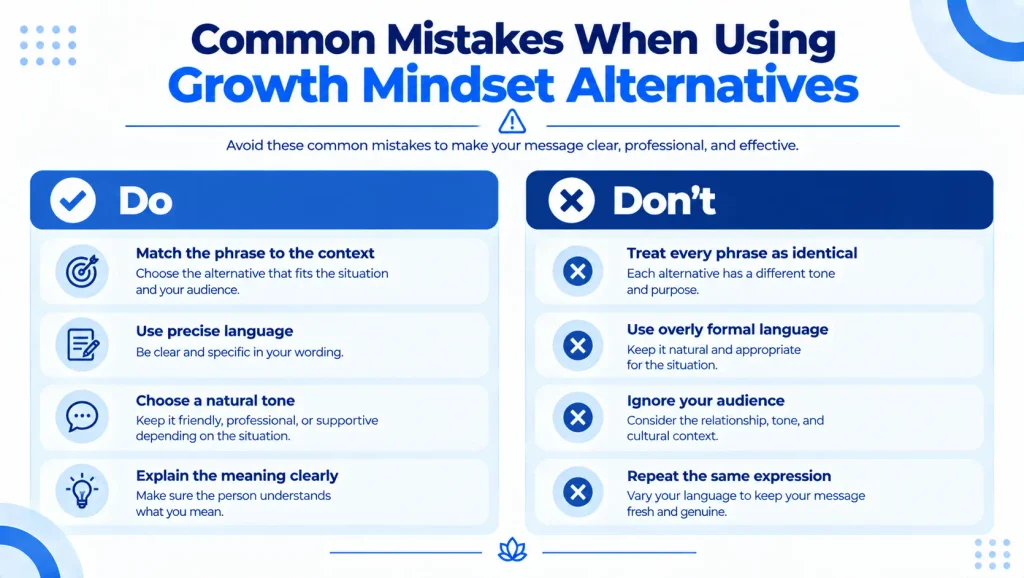
Not every expression has precisely the same meaning. For example, “resilient attitude” focuses on recovering from setbacks, while “willingness to learn” emphasizes openness to gaining knowledge.
How to avoid it: Choose the phrase that matches the specific quality you want to describe.
Expressions such as “desire to improve” may work well in everyday conversation but may sound less specific in a formal academic essay or professional evaluation.
How to avoid it: Use terms such as “continuous improvement” or “development mindset” when the context calls for a more formal tone.
A growth mindset does not mean that anyone can achieve every goal simply by trying harder. Improvement also depends on resources, instruction, time, health, and opportunities.
How to avoid it: Describe growth as a process that involves effort, learning, feedback, and realistic expectations.
Using “growth mindset,” “learning mindset,” and “development mindset” repeatedly in the same paragraph can make the writing feel repetitive.
How to avoid it: Use a clear main term and introduce alternatives only when they add a different meaning or improve the flow.
“Continuous improvement” may sound natural in a workplace report, but it may feel too formal in a casual conversation with a friend.
How to avoid it: Consider your audience, purpose, and tone before selecting an alternative.
Learning mindset is one of the closest and most natural alternatives to “growth mindset.” It describes an attitude of gaining knowledge, developing skills, and learning from experience. However, “continuous improvement” may be better for workplace writing, while “willingness to learn” works well when describing a person’s qualities on a resume.
Useful alternatives include willingness to learn, commitment to personal growth, continuous improvement, and openness to learning. These phrases can help describe your professional attitude without relying on a popular buzzword. Choose one that reflects a real behavior, such as learning new software, accepting feedback, or developing new skills.
You can describe a growth mindset as a belief that abilities can develop through effort, practice, learning, and feedback. Depending on the essay, you may also use “learning mindset” or “commitment to personal growth.” Explain how the person responds to challenges or improves over time to make the idea clearer.
The two expressions are closely related, but they are not identical. A growth mindset is a belief that abilities can develop, while continuous improvement describes the ongoing effort to make something better. Someone with a growth mindset may practice continuous improvement, but the terms emphasize different parts of the process.
In professional writing, development mindset, continuous improvement, and improvement-oriented attitude are useful choices. “Willingness to learn” is also effective when describing an employee or job candidate. The best expression depends on whether you want to emphasize learning, skill development, performance, or openness to feedback.
You can use “positive attitude” in some contexts, but it is not an exact replacement. A positive attitude generally means approaching situations with optimism, while a growth mindset involves believing that abilities can develop through learning and effort. Use “positive attitude” only when optimism is the main idea.
You could say that someone is open to learning, embraces challenges, values feedback, or is committed to continuous improvement. For example, “She is open to learning from mistakes” communicates an important part of a growth mindset. Choose the expression that best describes the person’s actual behavior.
Yes, “desire to improve” is a natural alternative when you want to describe someone’s motivation to become better at something. However, it focuses on wanting improvement rather than believing that abilities can develop. For a more complete explanation, combine it with a specific example of learning, practice, or responding to feedback.
There are several natural ways to say “growth mindset,” but the best alternative depends on what you want to emphasize. Learning mindset is a strong choice for education and everyday writing, while continuous improvement fits professional and workplace contexts. If you are describing someone’s personal qualities, “willingness to learn” and “openness to learning” sound clear and natural.
For writing about long-term self-development, “commitment to personal growth” offers a thoughtful and positive tone. Meanwhile, “resilient attitude” works better when the focus is on handling setbacks and continuing to try.
Remember that these expressions are related but not always interchangeable. Choose the phrase that accurately reflects the person’s actions, goals, and attitude toward learning. The most effective alternative is the one that makes your meaning clearer.

English Language & Communication Specialist
Dr. Emily Carter is an English language and communication specialist focused on vocabulary, word choice, professional writing, and practical English usage. She helps readers understand the differences between similar words and choose expressions that sound natural, clear, and appropriate for different contexts.