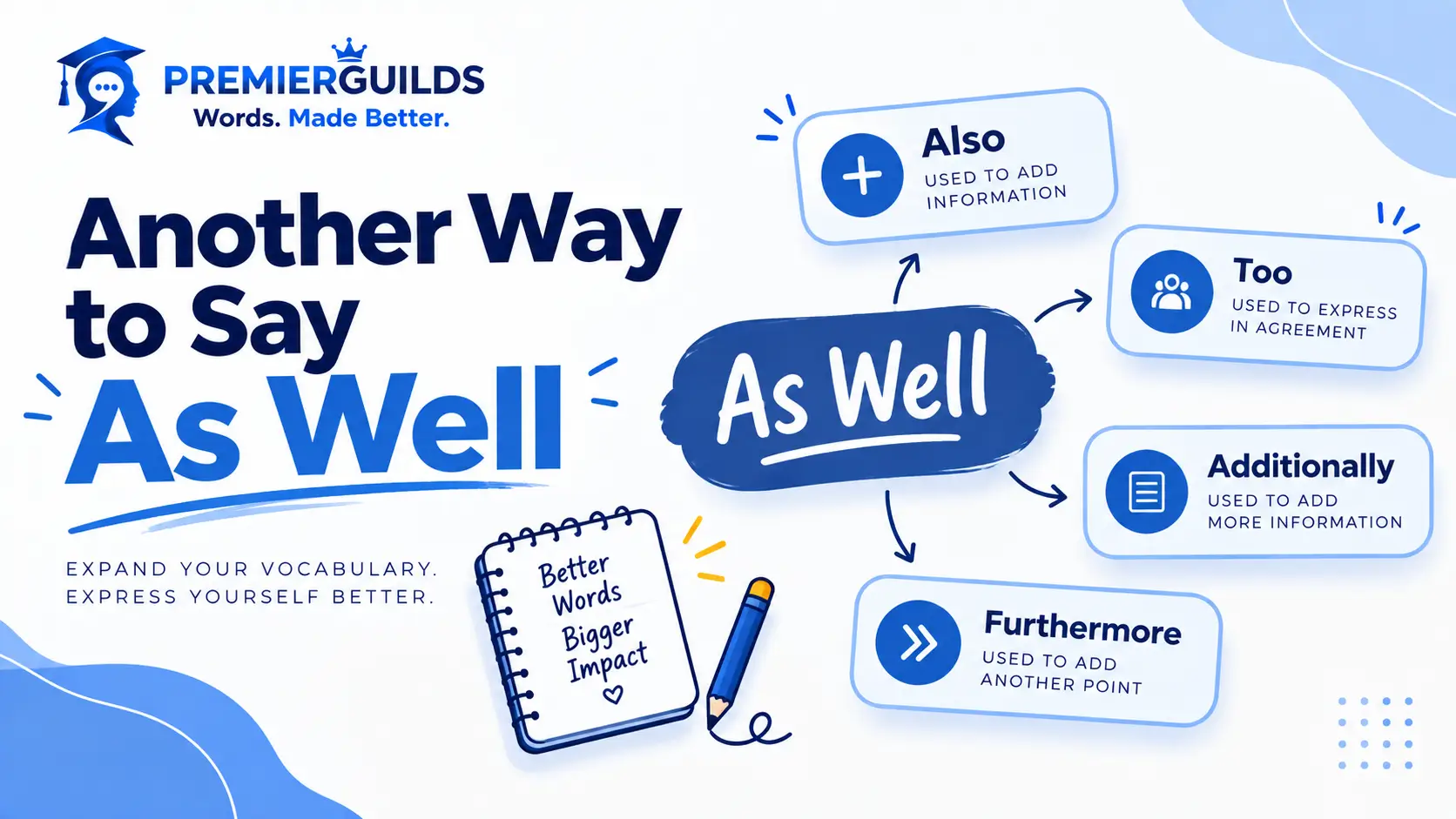
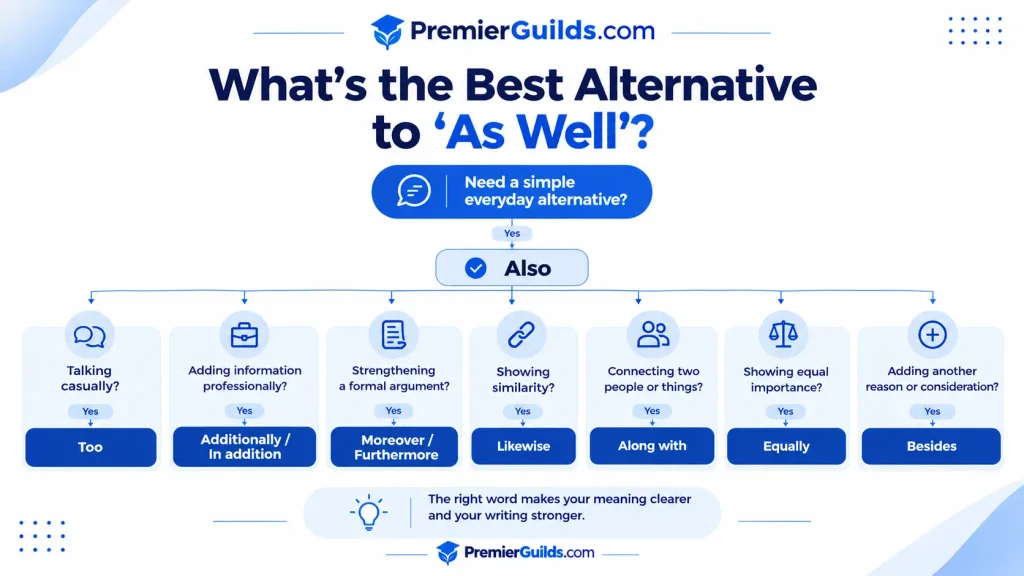
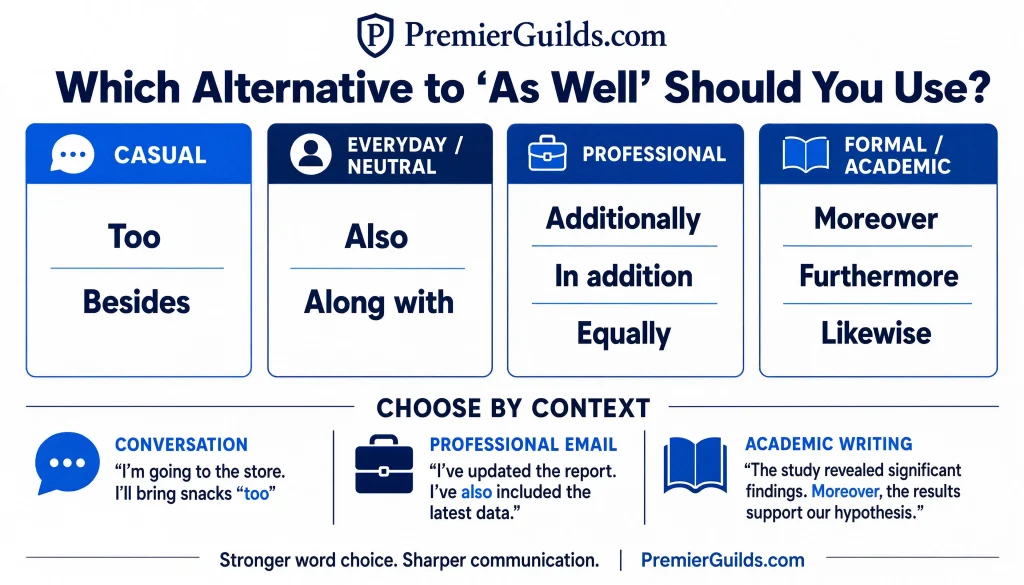
If you need another way to say “as well,” you can use also, too, additionally, in addition, moreover, furthermore, likewise, besides, equally, or along with. The best choice depends on the sentence, tone, and context. For everyday conversation, “also” and “too” are natural, while “in addition” and “moreover” work better in formal writing.
“As well” is commonly used to mean “also,” “too,” or “in addition.” It adds another person, thing, action, or idea to something that has already been mentioned.
For example, “She speaks Spanish as well” means that she speaks Spanish in addition to another language. The phrase is common in everyday American English, professional communication, emails, and general writing.
People often search for another way to say “as well” because they want to avoid repetition or choose wording that fits a particular situation more naturally.
Using different alternatives can make your writing more precise and natural. Although “as well” is correct, repeating it throughout an article, email, or conversation can make your language sound predictable.
Here are some reasons to use alternatives:
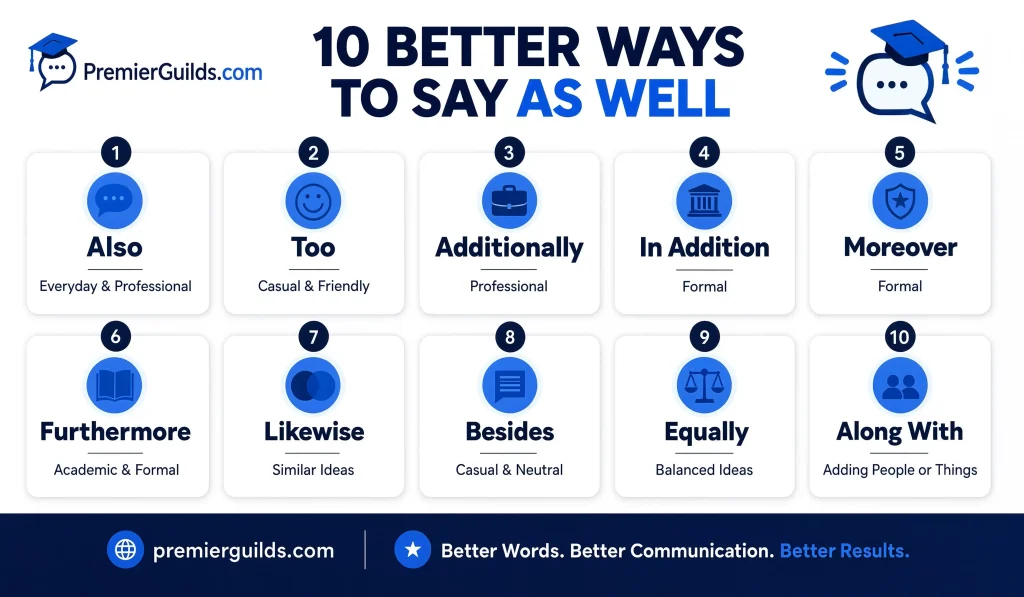
“Also” means that something is true or applies in addition to something else. It is one of the closest and most versatile alternatives to “as well.”
She also manages the company’s social media accounts.
I also wanted to ask whether the meeting time had changed.
Use “also” when you want a simple replacement that works naturally in most types of writing.
“Too” can mean “also” or “as well.” It is especially common in everyday American English and usually appears near the end of a sentence.
I’d love to come to the party too.
Marcus enjoyed the new restaurant too.
“Too” sounds conversational, so choose another option when writing highly formal or academic content.
“Additionally” introduces another related fact, point, or piece of information. It creates a clear connection between ideas and is common in professional writing.
Additionally, the report includes updated sales figures for the third quarter.
The software is easy to install. Additionally, it requires very little maintenance.
Use “additionally” when you are adding a new supporting point, especially in reports, articles, or business documents.
“In addition” means that something is added to what has already been mentioned. It works well when introducing another fact, benefit, responsibility, or consideration.
In addition, all employees will receive access to the new training program.
The apartment has a large kitchen. In addition, it includes a private balcony.
Use “in addition” as a sentence-level transition when you want the connection between two ideas to be obvious.
“Moreover” means “in addition” but often carries a stronger sense of emphasis. It introduces information that adds weight to the point you have already made.
The proposal is affordable. Moreover, it can be implemented within two weeks.
The candidate has extensive experience. Moreover, she has successfully led several large projects.
“Moreover” can sound formal, so it is usually better for reports, essays, and polished professional writing than casual conversation.
“Furthermore” introduces another point that supports or strengthens the previous statement. It is particularly common in formal and academic writing.
The policy reduces unnecessary expenses. Furthermore, it makes the approval process faster.
The study provides useful data. Furthermore, it identifies several areas for future research.
Use “furthermore” when the new information strengthens your argument rather than simply adding an unrelated detail.
“Likewise” means “in the same way” or “similarly.” Unlike “also,” it is best when you are showing that a similar situation, action, or feeling applies to another person or thing.
The first department supported the proposal, and the marketing team responded likewise.
She appreciated the opportunity, and I likewise enjoyed working with the team.
Do not use “likewise” for every simple instance of “as well.” Choose it when there is a clear sense of similarity.
“Besides” can mean “in addition to” or “apart from.” It often adds another reason, fact, or consideration and can sound natural in both conversations and informal writing.
Besides the lower price, the new plan offers better customer support.
I don’t want to leave early. Besides, we still have plenty of time.
Use “besides” carefully because it can sometimes mean “except for,” depending on the sentence.
“Equally” can introduce an additional point that deserves similar consideration or importance. It is useful when two ideas have comparable value.
The company values technical ability and, equally, strong communication skills.
The program benefits new employees and is equally useful for experienced staff.
Use “equally” when you want to highlight balance or similar importance, rather than simply adding information.
“Along with” means “together with” or “in addition to.” It usually connects two people, things, or actions within the same sentence.
Along with the application, please submit two professional references.
She brought her laptop along with several printed copies of the presentation.
“Along with” works best when you are directly connecting one item or person to another.
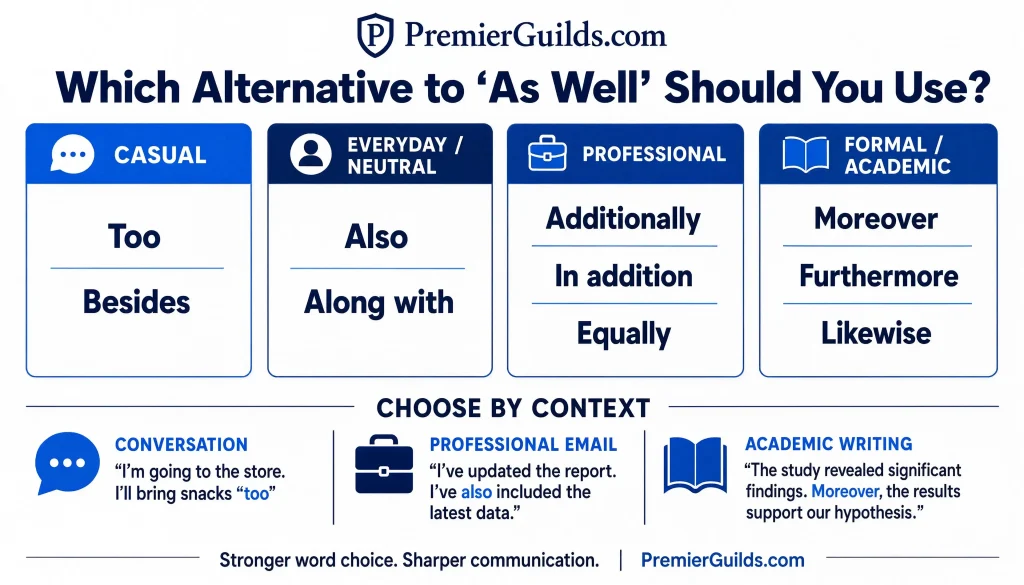
| Alternative | Best Used In | Tone |
| Also | Everyday, professional, academic writing | Neutral |
| Too | Conversations, casual messages | Casual |
| Additionally | Reports, business writing, articles | Professional |
| In addition | Formal and professional writing | Formal |
| Moreover | Essays, reports, formal arguments | Formal |
| Furthermore | Academic and professional writing | Formal |
| Likewise | Similar situations or responses | Neutral/Formal |
| Besides | Conversations and informal writing | Casual/Neutral |
| Equally | Balanced comparisons and arguments | Formal |
| Along with | Combining people, things, or actions | Neutral |
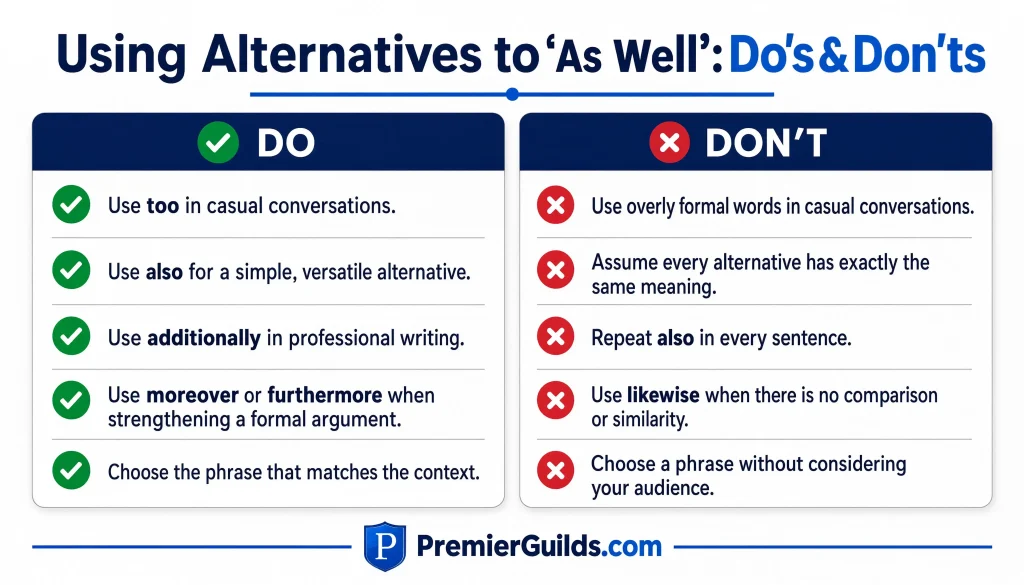
Words such as “moreover” and “furthermore” can sound unnecessarily formal in everyday speech. “Also” or “too” will usually sound more natural.
These words do not always have exactly the same meaning. For example, “likewise” emphasizes similarity, while “also” simply adds information.
Although “also” is versatile, repeating it in every sentence can make your writing feel monotonous. Rotate your wording when the context allows it.
“Besides” can mean “in addition to,” but it can also have an “apart from” meaning. Read the complete sentence to make sure your intended meaning is clear.
A professional report may benefit from “additionally” or “in addition,” while a text message usually sounds better with “too.” Always consider your audience before choosing an alternative.
“Also” is generally the best all-purpose alternative to “as well.” It works in casual conversations, professional emails, articles, and many academic contexts. However, “too” may sound more natural at the end of an everyday sentence, while “additionally” or “in addition” may be better for formal writing.
In a professional email, you can use “also,” “additionally,” “in addition,” or “along with,” depending on the sentence. “Also” is the simplest option, while “additionally” and “in addition” are useful when introducing another point, request, detail, or piece of information.
In many sentences, “too” and “as well” have the same meaning and can be used interchangeably. Both can mean “also.” For example, “I would like to attend too” and “I would like to attend as well” communicate essentially the same idea, although “too” can sound slightly more conversational.
Yes. “Also” is one of the closest replacements for “as well.” The main difference is placement. “Also” commonly appears before the main verb or after a form of “be,” while “as well” often appears at the end of a sentence.
For formal writing, consider “additionally,” “in addition,” “moreover,” or “furthermore.” The right choice depends on the relationship between your ideas. “Additionally” simply adds information, while “moreover” and “furthermore” often introduce points that strengthen an argument.
In an essay, useful alternatives include “also,” “additionally,” “in addition,” “moreover,” and “furthermore.” Avoid replacing every occurrence automatically. Instead, choose a transition that accurately describes how the new information relates to the previous point.
The most natural replacement is often “too.” For example, “She wants to join us as well” can become “She wants to join us too.” In more formal writing, you can restructure the sentence and use “also” or “in addition” where appropriate.
“Likewise” can sometimes replace “as well,” but the meanings are not always identical. “Likewise” specifically suggests similarity or the same action, opinion, or situation. If you simply want to add another fact, “also” is usually a more accurate choice.
There are many natural ways to say “as well,” but the best alternative depends on your audience and purpose. For everyday English, “also” and “too” are simple and natural choices. For professional or formal writing, “additionally,” “in addition,” “moreover,” and “furthermore” can make your ideas flow more clearly. If you’re unsure about the differences between as well, also, and too, a grammar guide can help you choose the right expression.
If you are comparing similar actions or responses, “likewise” may be the better choice. “Along with” works well when connecting two people or things, while “equally” emphasizes similar importance.
The key is not to replace “as well” automatically. Choose the expression that communicates your exact meaning and matches the tone of your sentence. This small change can make your writing sound clearer, more varied, and more natural.

English Language & Communication Specialist
Dr. Emily Carter is an English language and communication specialist focused on vocabulary, word choice, professional writing, and practical English usage. She helps readers understand the differences between similar words and choose expressions that sound natural, clear, and appropriate for different contexts.