
If you’re looking for another way to say “you’re welcome,” try “my pleasure,” “of course,” “no problem,” “happy to help,” or “anytime.” The best alternative depends on the situation. Use more polished expressions in professional settings and warmer or more casual phrases with friends, family, and people you know well.
“You’re welcome” is the standard response when someone thanks you. It is polite, correct, and suitable for almost any situation, but sometimes you may want a response that sounds warmer, more professional, more casual, or more personal.
The best alternative depends on what you want your response to communicate. For example, “my pleasure” emphasizes genuine willingness to help, while “no problem” keeps the conversation relaxed.
The phrase “another way to say you’re welcome” refers to alternative expressions you can use after someone thanks you.
“You’re welcome” acknowledges another person’s gratitude, but English offers many other natural responses. You might say “my pleasure” in a professional setting, “of course” with a friend, or “happy to help” when you want to emphasize your willingness to assist.
These expressions are commonly used in conversations, emails, customer service, workplaces, and social situations.
The important difference is tone. Some alternatives sound formal and polished, while others feel relaxed and conversational.
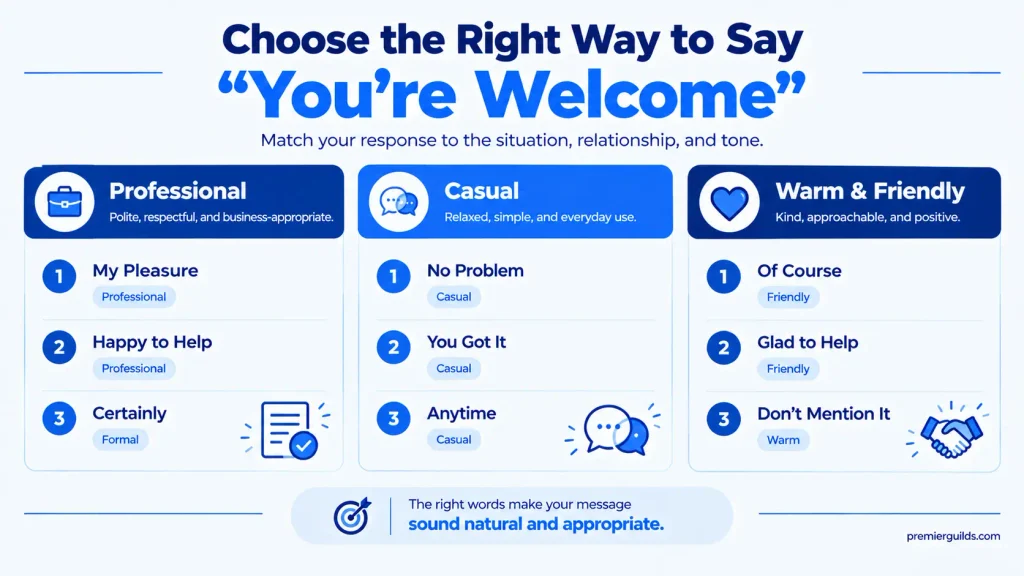
Using different responses can make your conversations sound more natural and better suited to the situation.
You may want an alternative to:
For example, responding to a coworker with “happy to help” can sound more personal than simply saying “you’re welcome.” With a close friend, “anytime” may feel more natural.
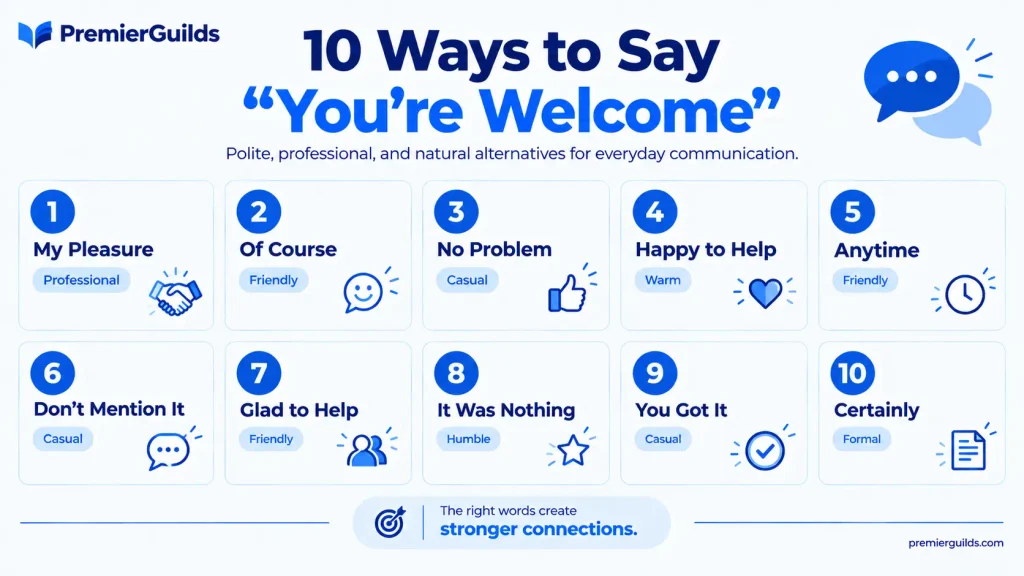
“My pleasure” is a warm and polished way to respond when someone thanks you. It suggests that you were genuinely glad to help and did not consider the favor a burden.
Thank you for helping me prepare for the presentation.
My pleasure. I’m glad we had time to review it together.
I really appreciate you staying late to finish this project.
My pleasure. We make a good team.
Choose “my pleasure” when you want to sound especially courteous without being overly formal.
“Of course” is a natural response that tells someone their request was reasonable and that you were happy to help. It can sound friendly, reassuring, and effortless.
Thanks for picking up my package.
Of course! I was heading that way anyway.
Thank you for explaining how the software works.
Of course. Let me know if you have any other questions.
Use “of course” when you want your response to feel easygoing and generous.
“No problem” is a relaxed response that means the favor or assistance was not difficult or inconvenient. It is common in everyday American English.
Thanks for saving me a seat.
No problem. I knew you were running late.
Thanks for sending me the address.
No problem! Hope you find the place easily.
Although common, “no problem” can feel slightly less formal than “my pleasure,” so choose a more polished option for formal correspondence.
“Happy to help” emphasizes that you were willing and pleased to provide assistance. It works particularly well when someone thanks you for completing a task or solving a problem.
Thanks for walking me through the new process.
Happy to help. It can be confusing the first time.
I appreciate you answering all my questions.
Happy to help. I’m glad we could get everything sorted out.
Use this phrase when you want to make your willingness to assist the main focus of your response.
“Anytime” tells someone that you would be willing to help again in the future. It sounds generous and informal, making it a natural choice among friends, family members, and familiar coworkers.
Thanks for helping me move the boxes.
Anytime! Just give me a call if you need anything else.
Thank you for recommending that restaurant.
Anytime. I’m glad you enjoyed it.
Use “anytime” when you want to leave the door open for future help.
“Don’t mention it” is a courteous expression that means the person does not need to thank you for what you did. It can sound modest and friendly.
Thanks for bringing me some coffee.
Don’t mention it. I was getting one for myself anyway.
I really appreciate you helping with the cleanup.
Don’t mention it. We all needed to pitch in.
This phrase works best when you want to downplay the effort you made.
“Glad to help” communicates that you were pleased to assist. It is slightly warmer than a simple acknowledgment and works well in both professional and personal communication.
Thank you for helping me fix the formatting issue.
Glad to help. It looks much better now.
Thanks for taking the time to review my resume.
Glad to help. I hope the suggestions are useful.
Choose “glad to help” when you want to sound sincere without becoming overly formal.
“It was nothing” minimizes the effort involved in helping someone. It can make your response sound modest and relaxed when the favor was small.
Thanks for carrying that box upstairs.
It was nothing. It only took a minute.
I appreciate you fixing that small issue for me.
It was nothing. I was happy to take care of it.
Use this phrase for small favors rather than significant acts of help, where it could sound dismissive.
“You got it” is an informal expression that can respond to thanks while also suggesting that you were happy to take care of the request. It sounds confident and conversational.
Thanks for grabbing an extra copy for me.
You got it!
I appreciate you changing the appointment time.
You got it. The new time works for me too.
Use “you got it” in relaxed conversations, texts, and informal workplace exchanges rather than formal business correspondence.
“Certainly” is a concise and courteous response that works particularly well in professional environments. It can communicate willingness to help while maintaining a polished tone.
Thank you for arranging the meeting.
Certainly. I’m glad we could find a time that works for everyone.
I appreciate your assistance with this request.
Certainly. Please let me know if you need anything else.
Use “certainly” when you want a professional response that sounds respectful without being overly elaborate.
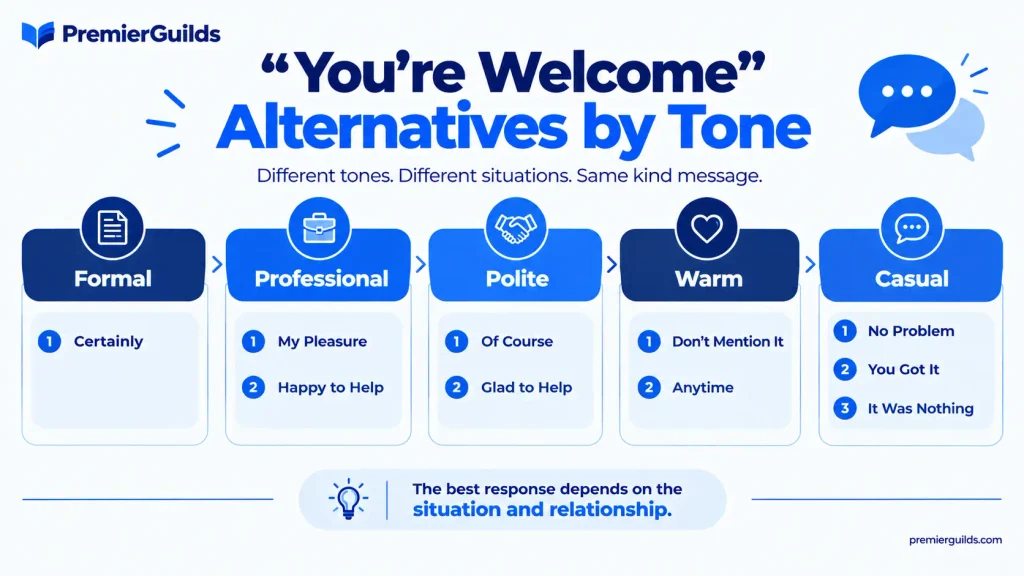
| Alternative | Best Used In | Tone |
| My Pleasure | Professional conversations, polite exchanges | Warm, courteous |
| Of Course | Everyday conversations | Friendly, reassuring |
| No Problem | Casual conversations | Relaxed, informal |
| Happy to Help | Work, customer service, everyday help | Warm, professional |
| Anytime | Friends, family, familiar coworkers | Friendly, generous |
| Don’t Mention It | Personal conversations, small favors | Warm, modest |
| Glad to Help | Work and personal situations | Warm, sincere |
| It Was Nothing | Small favors, casual conversations | Modest, casual |
| You Got It | Informal conversations and messages | Casual, confident |
| Certainly | Formal and professional settings | Polished, courteous |
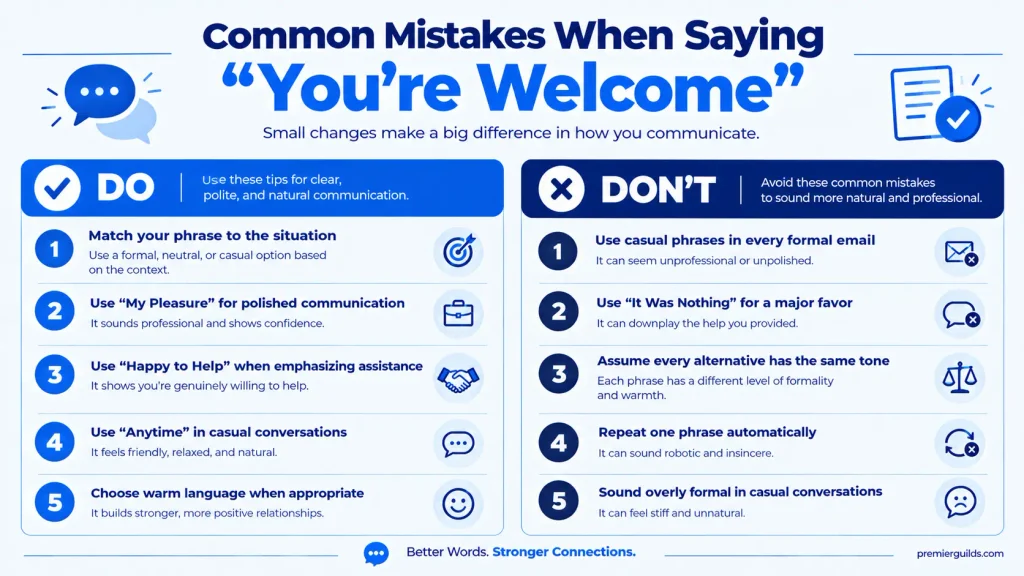
Expressions such as “you got it” and “no problem” may sound too relaxed in a formal email. For business communication, consider “my pleasure,” “happy to help,” or “certainly.”
“It was nothing” may sound inappropriate when someone is thanking you for a significant effort. In that situation, “my pleasure” or “glad to help” can better acknowledge the exchange.
These phrases are not exact substitutes in every situation. “Anytime” sounds casual and open-ended, while “certainly” has a more formal and professional feel.
Using “you’re welcome” every time is perfectly correct, but it can make conversations feel repetitive. Choosing an alternative that fits the situation can make your responses sound more natural.
The words you choose should match your tone and relationship with the other person. A highly formal response can feel distant in a friendly conversation, while an overly casual response may seem careless in a professional setting.
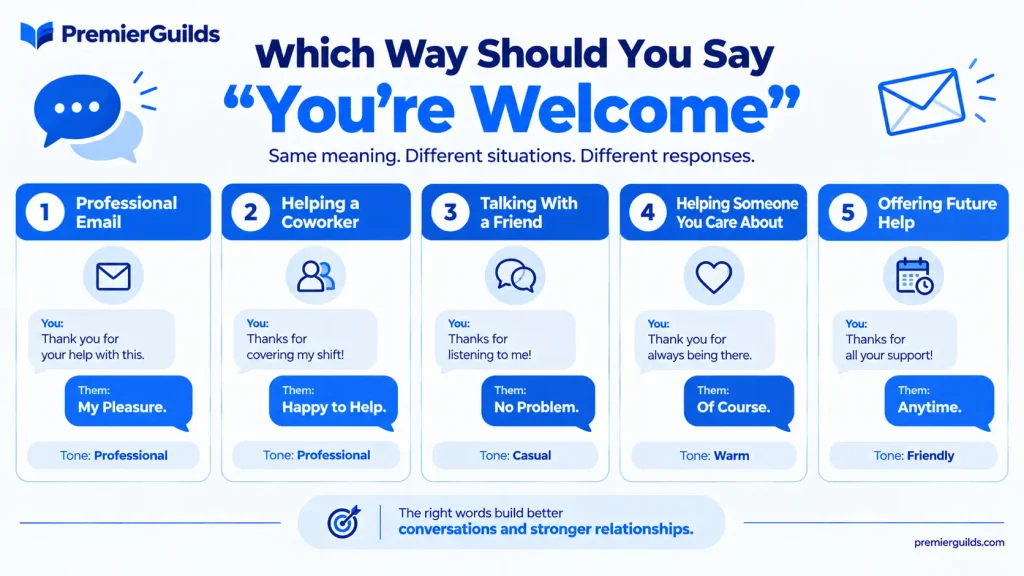
“My pleasure” is one of the strongest professional alternatives because it sounds courteous and sincere. “Happy to help” is also excellent when you want to emphasize your willingness to assist. For a more formal setting, “certainly” can work well, especially when responding to a request or acknowledgment.
For casual conversations, try “no problem,” “of course,” “anytime,” or “you got it.” These expressions are common in everyday American English and usually feel relaxed rather than formal. Your relationship with the other person should guide which one sounds most natural.
Neither phrase is universally better. “My pleasure” can sound warmer and more intentional because it suggests that you enjoyed helping. “You’re welcome” is more neutral and works in almost any situation. Choose based on the tone and relationship rather than treating one phrase as universally superior.
Yes, but it depends on the workplace and situation. “No problem” is widely understood and can be perfectly acceptable in relaxed professional communication. However, when writing to a client, executive, or someone you do not know well, “happy to help” or “my pleasure” may create a more polished impression.
Good email alternatives include “my pleasure,” “happy to help,” “glad to help,” and “certainly.” Your choice should match the level of formality. For example, “Happy to help” feels friendly and professional, while “My pleasure” adds a little more warmth and courtesy.
“My pleasure,” “of course,” “glad to help,” and “anytime” can all sound warm. If someone is thanking you for meaningful support, a response such as “I’m glad I could help” may feel more personal because it directly acknowledges the value of your assistance.
Yes. “Anytime” is a friendly way to suggest that you would gladly help again. It is best suited to casual or familiar relationships. In a formal business email, however, “happy to help” or “my pleasure” usually sounds more appropriate.
“My pleasure” emphasizes that you were happy to help, while “no problem” emphasizes that the favor was not an inconvenience. As a result, “my pleasure” often sounds warmer and more polished, whereas “no problem” feels more casual and relaxed.
There are many natural ways to say “you’re welcome,” and the best choice depends on the situation. “My pleasure” is a strong option for professional or polished communication, while “happy to help” works well when you want to emphasize your willingness to assist.
For everyday conversations, “of course,” “no problem,” and “anytime” sound friendly and relaxed. If you want to be more formal, “certainly” provides a concise and courteous response.
The goal is not simply to replace “you’re welcome” with different words. Choose an expression that matches the relationship, setting, and feeling behind the conversation. A thoughtful response can make even a short exchange sound warmer, more natural, and more genuine. For more guidance, see the meaning and usage of “you’re welcome.”

English Language & Communication Specialist
Dr. Emily Carter is an English language and communication specialist focused on vocabulary, word choice, professional writing, and practical English usage. She helps readers understand the differences between similar words and choose expressions that sound natural, clear, and appropriate for different contexts.