

If you need another way to say “I feel like,” the best choice depends on your meaning. For an opinion, use “I think,” “I believe,” “in my opinion,” or “from my perspective.” For a personal impression, try “it seems to me” or “I get the sense that.” When “feel like” means desire, use “I’d like to” or “I want to.”
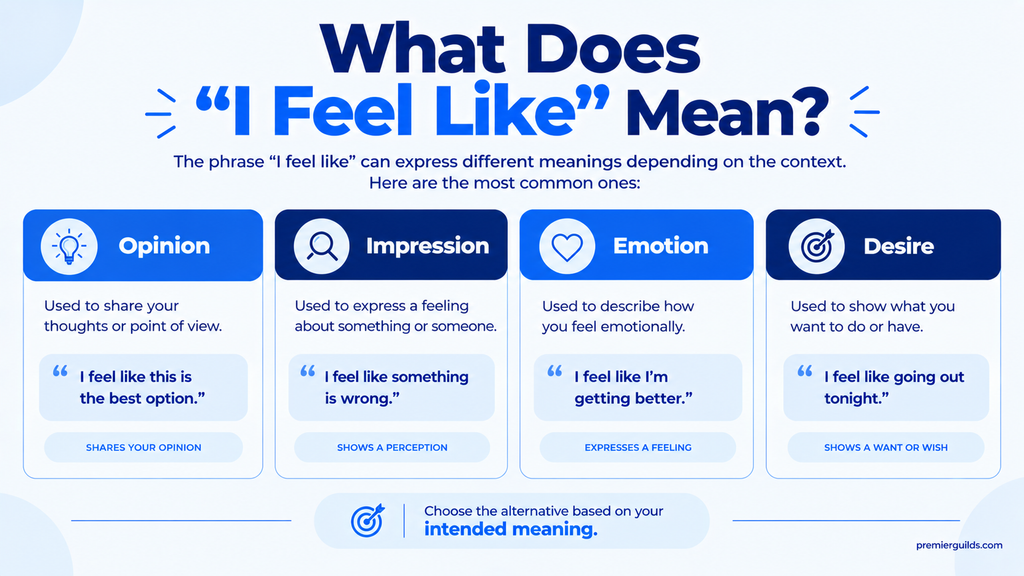
The phrase “I feel like” can have several meanings in American English. Most often, people use it to introduce an opinion, personal impression, emotional response, or uncertain judgment.
For example, “I feel like this plan will work” expresses an opinion. However, “I feel like going home” means “I want to go home.” English learners and writers should choose an alternative based on the intended meaning.
The phrase is common in conversations, texts, workplace discussions, emails, and informal writing. It is not grammatically wrong, but replacing it can make your writing more precise or better suited to a particular situation.
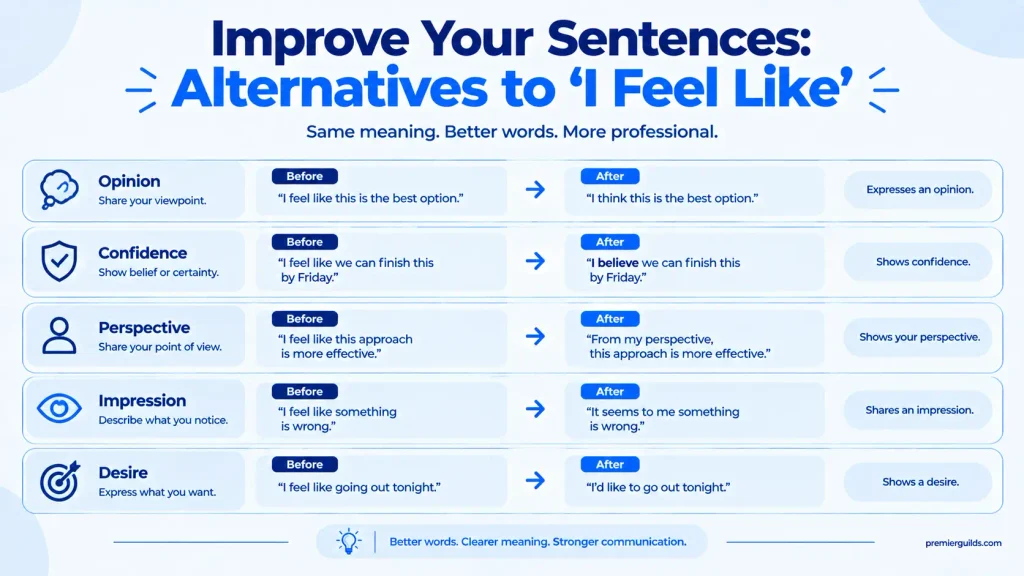
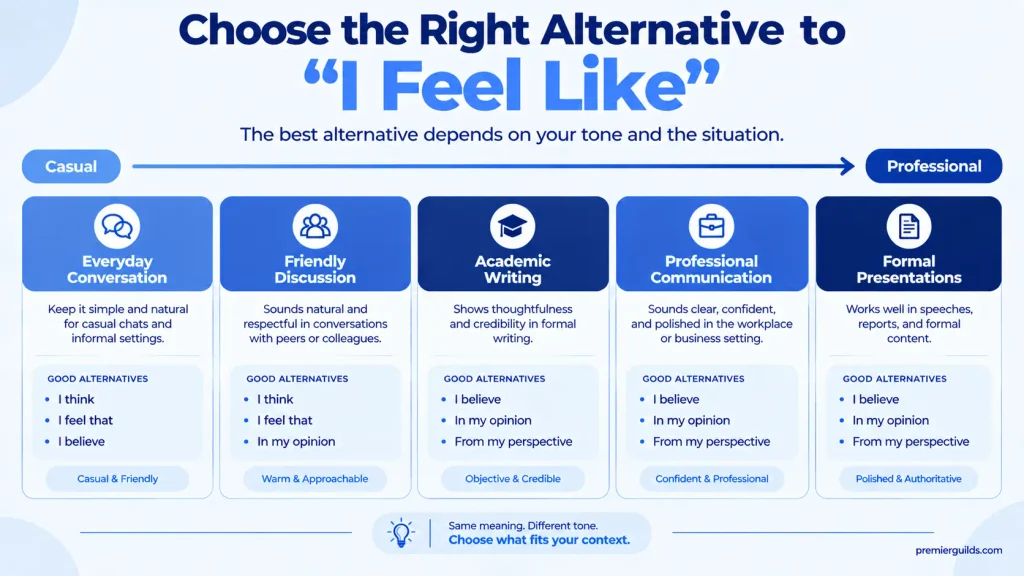
Using different expressions can make your communication clearer and more natural. The best alternative depends on whether you are sharing an opinion, describing an impression, expressing uncertainty, or talking about something you want to do.
Other benefits include:
Overusing “I feel like” can sometimes make a statement sound less direct, especially when you are presenting an opinion or recommendation. However, it remains useful when you are genuinely describing a personal feeling or subjective experience.
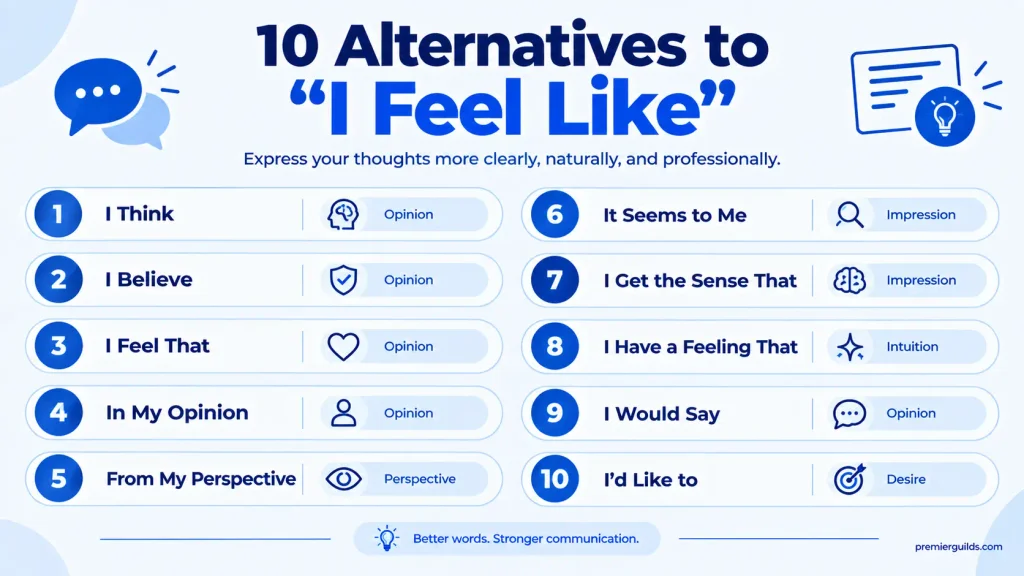
“I think” is one of the most natural alternatives to “I feel like” when expressing an opinion or personal judgment. It sounds clear, neutral, and conversational.
I think we should review the proposal before sending it to the client.
I think this color works better with the rest of the design.
Use “I think” when you want to clearly identify something as your opinion without sounding overly formal.
“I believe” presents an opinion with a slightly more thoughtful or confident tone than “I think.” It works especially well when you have considered the issue carefully.
I believe this approach will save the team several hours each week.
I believe the updated policy will benefit both employees and customers.
Choose “I believe” when you want your opinion to sound considered and purposeful.
“I feel that” keeps the personal and subjective quality of “I feel like” while sounding slightly more polished. It is useful when discussing opinions, reactions, or personal judgments.
I feel that the introduction could be clearer for first-time readers.
I feel that we have enough information to move forward.
Use “I feel that” when you want to retain the personal tone of “I feel like” but make the sentence sound more formal.
“In my opinion” directly tells the reader that you are sharing your personal viewpoint. It removes ambiguity and works well when several reasonable opinions may exist.
In my opinion, the shorter version is more effective.
In my opinion, the company should focus on customer retention first.
Use this phrase when you want to clearly separate your personal judgment from an established fact.
“From my perspective” emphasizes that your opinion comes from your particular experience, role, or point of view. It is useful when other people may see the same situation differently.
From my perspective, the biggest issue is the lack of clear communication.
From my perspective, the new schedule gives everyone more flexibility.
This is a strong choice for meetings, workplace discussions, presentations, and thoughtful written communication.
“It seems to me” introduces an impression or conclusion without presenting it as an absolute fact. It sounds measured and can be useful when you do not have complete certainty.
It seems to me that the customer misunderstood the instructions.
It seems to me that the second option offers better long-term value.
Use this phrase when you want to sound reasonable and leave room for additional information.
“I get the sense that” describes an impression you have based on what you notice, hear, or experience. It is more conversational than “it seems to me.”
I get the sense that the team needs more time to prepare.
I get the sense that she is still unsure about the decision.
This phrase works best when your conclusion comes from observations rather than firm evidence.
“I have a feeling that” communicates an intuition, suspicion, or personal impression. It usually suggests that you believe something may happen even though you cannot fully prove it.
I have a feeling that they will announce the results tomorrow.
I have a feeling that this restaurant will become one of our favorites.
Keep this phrase for informal situations when you are expressing intuition rather than evidence-based certainty.
“I would say” is a flexible way to introduce an opinion, estimate, or judgment. It sounds natural in conversation and can make a statement feel less absolute.
I would say the project is about 80 percent complete.
I would say this is our strongest option so far.
Use “I would say” when you want to give an opinion while keeping the tone relaxed and conversational.
When “I feel like” means “I want to” rather than “I think,” “I’d like to” is often a better replacement. It expresses a desire or intention in a polite way. “Feel like” can also mean “want” when followed by a noun or an -ing form.
I’d like to discuss the project timeline with you.
I’d like to take a short break before we continue the meeting.
Use “I’d like to” when your original sentence means “I want to,” not when you are simply giving an opinion.
| Alternative | Best Used In | Tone |
| I think | Everyday opinions, discussions | Neutral |
| I believe | Professional opinions, formal writing | Confident |
| I feel that | Personal judgments, workplace writing | Thoughtful |
| In my opinion | Formal opinions, essays, discussions | Direct |
| From my perspective | Work, meetings, different viewpoints | Professional |
| It seems to me | Impressions, uncertain conclusions | Measured |
| I get the sense that | Observations, conversations | Conversational |
| I have a feeling that | Intuition, predictions | Casual |
| I would say | Estimates, judgments, discussions | Relaxed |
| I’d like to | Desires, requests, intentions | Polite |
“I’d like to” means you want to do or have something. It does not normally replace “I feel like” when you mean “I think.”
Better: “I think this is the right option.”
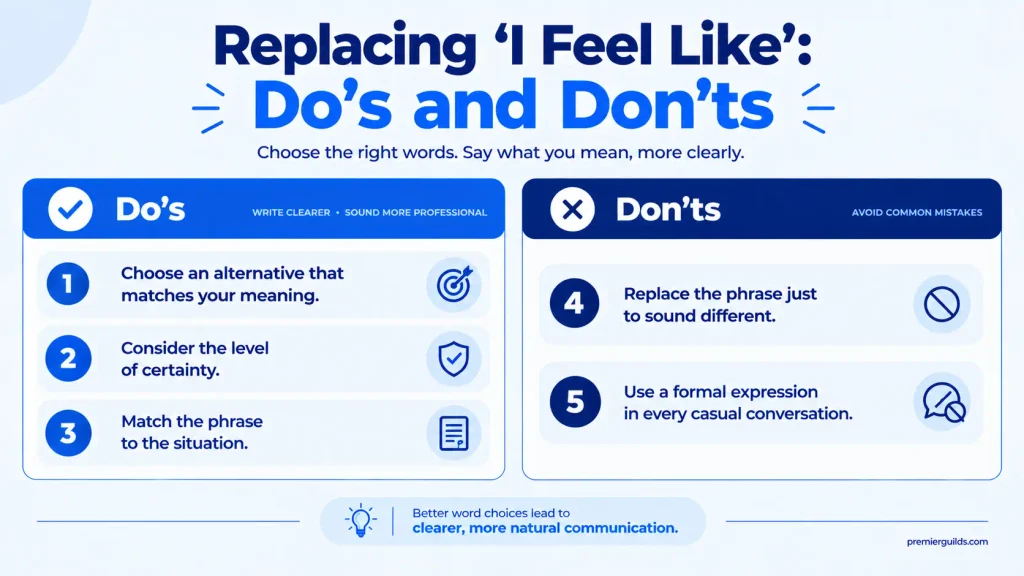
Replacing “I feel like” with a very direct statement can sometimes remove important uncertainty.
For example, “It seems to me” may be better than a definite claim when you only have limited information.
Expressions such as “from my perspective” can sound unnatural in a casual text. In everyday conversation, “I think” is usually simpler and more natural.
Always check whether “feel like” means “think,” “have an impression,” “experience an emotion,” or “want.” The correct alternative changes with the meaning.
Not every use of “I feel like” needs to be replaced. When you are describing a genuine emotional or personal experience, keeping the phrase may be more natural and accurate.
“I believe,” “I think,” “from my perspective,” and “I feel that” are strong professional alternatives. The best choice depends on your meaning. “I believe” sounds confident, while “from my perspective” emphasizes that the statement reflects your particular viewpoint. For a simple workplace opinion, “I think” is often the most natural choice.
Not always. “I think” is usually better when you are stating an opinion or conclusion, while “I feel like” can be more appropriate for a personal impression or emotional experience. For example, “I think the plan will work” gives an opinion, while “I feel like something is wrong” emphasizes a personal sense or intuition.
For professional emails, try “I think,” “I believe,” “I feel that,” “from my perspective,” or “it seems to me.” Choose the phrase based on your level of certainty and the tone you need. “I believe” works well for a considered opinion, while “I think” keeps the message simple and approachable.
Use a phrase that accurately reflects your level of confidence. “I believe,” “I recommend,” or a direct statement can sound stronger when you have good reasons or evidence. However, avoid removing uncertainty when uncertainty is genuine. Clear communication is more important than simply trying to sound confident.
“In my opinion,” “from my perspective,” “I believe,” and “it seems to me” are useful formal alternatives. “In my opinion” clearly identifies a personal view, while “it seems to me” sounds more cautious. For professional writing, choose the phrase that matches both your intended meaning and your level of certainty.
When followed by an -ing verb, “I feel like” can mean “I want to” or “I would like to.” For example, “I feel like going for a walk” means that you want to go for a walk. In this use, “I’d like to go for a walk” is a polite alternative.
Yes. “I feel that” is grammatically correct and can introduce a personal opinion or judgment. It is often more suitable than “I feel like” in formal writing. For example, “I feel that this approach is more effective” clearly presents a personal assessment without using the more conversational “feel like.”
The best short alternative is often “I think.” It is natural, versatile, and easy to use in both conversation and professional communication. However, if “I feel like” means “I want to,” use “I want to” or “I’d like to” instead. The shortest option should still preserve the original meaning.
There are many useful alternatives to “I feel like,” but the right choice depends on what you mean. For a simple opinion, “I think” is usually the clearest option. Use “I believe” when you want to sound more confident, “from my perspective” for a specific viewpoint, and “it seems to me” when you are describing an impression. If you are expressing intuition, “I have a feeling that” works naturally. When “I feel like” means “I want to,” choose “I’d like to” instead. Most importantly, do not replace the phrase just for the sake of variety. Choose the alternative that accurately communicates your meaning, tone, and level of certainty by considering English word choice and usage.

Senior English Editor & Stylistics Director
Michael Bennett is a veteran editor, lexicographer, and publishing consultant with more than two decades of experience in academic and educational publishing. Formerly a senior editorial director at major university presses, he specializes in structural editing, register refinement, and vocabulary development. Michael oversees tone, precision, and stylistic consistency across all publication channels, ensuring content meets rigorous editorial and pedagogical standards.