
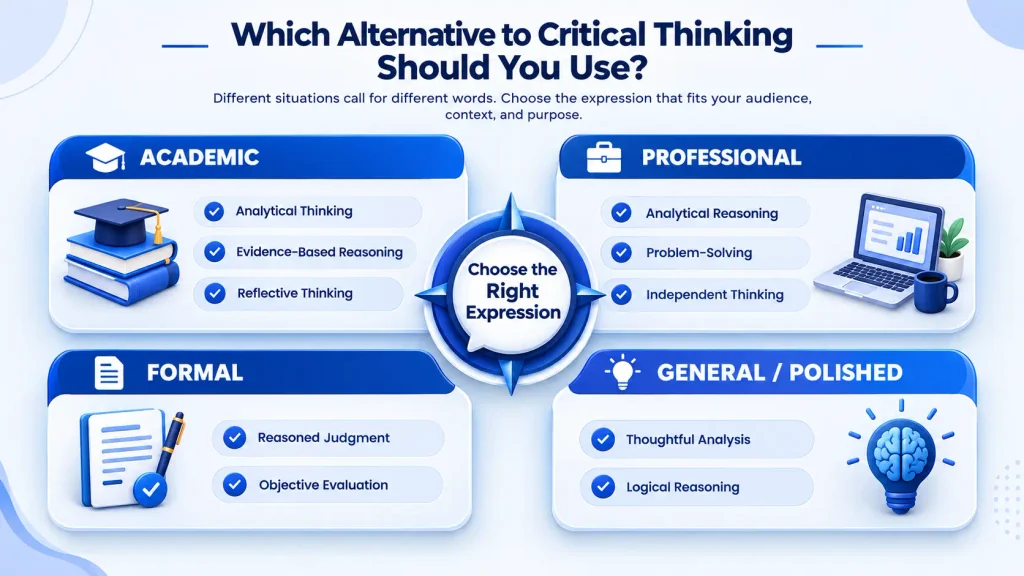
Another way to say critical thinking includes analytical thinking, logical reasoning, reflective thinking, reasoned judgment, independent thinking, and thoughtful analysis. The best alternative depends on what you want to emphasize, such as analyzing information, evaluating evidence, solving problems, or making well-reasoned decisions.
“Critical thinking” describes the process of carefully examining information, questioning assumptions, evaluating evidence, and using reasoning to reach a sound conclusion. It is common in academic writing, workplace communication, research, problem-solving, and everyday decision-making.
Because the phrase covers several related skills, there is no single replacement that works perfectly in every situation. For example, analytical thinking emphasizes examining information, while logical reasoning focuses more on how someone connects ideas and reaches conclusions.
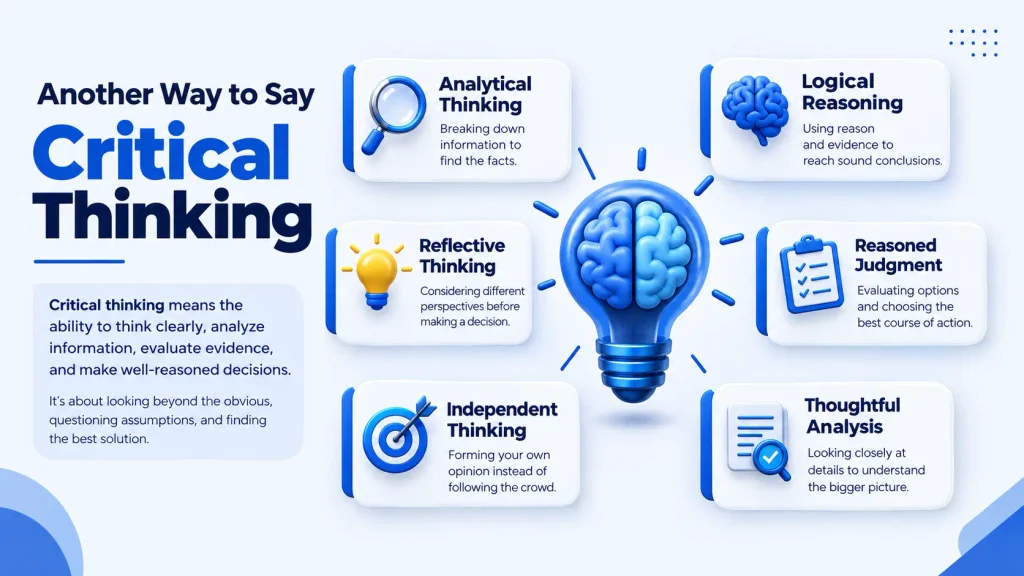
The phrase “another way to say critical thinking” means looking for a different expression that communicates a similar idea.
Critical thinking generally involves analyzing, interpreting, evaluating, and reasoning about information before reaching a judgment. Academic sources describe it as careful, purposeful thinking that uses evidence, reasoning, and appropriate standards to guide conclusions or actions.
You may want an alternative when writing an essay, describing someone’s abilities, improving a resume, preparing a recommendation, or avoiding repetition.
Common contexts include:
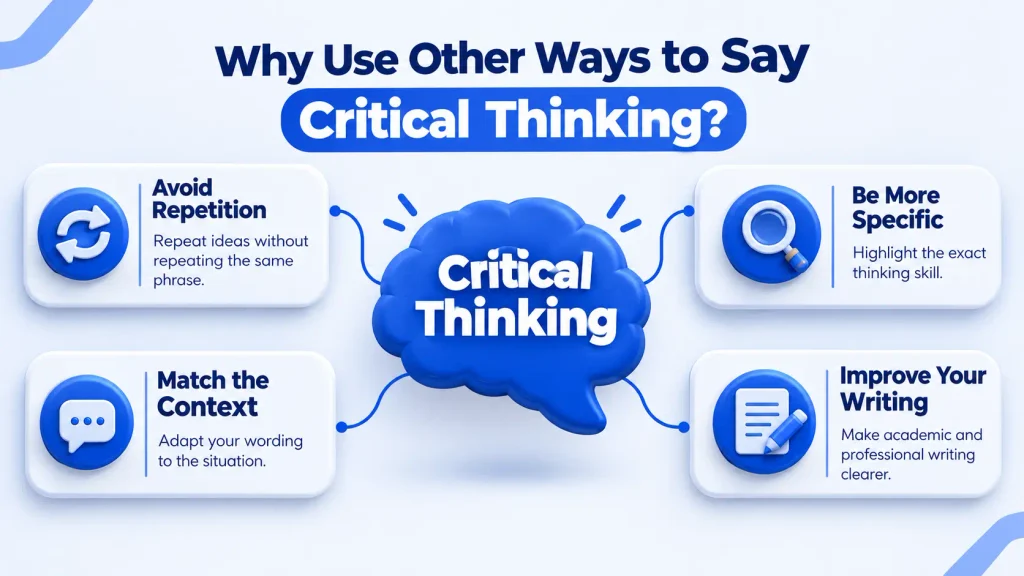
Using alternatives can make your writing more precise. Instead of repeating “critical thinking,” you can choose a phrase that highlights the specific skill you mean.
For example, analytical thinking emphasizes examining information, while reasoned judgment emphasizes reaching a conclusion after considering evidence.
Other benefits include:
Analytical thinking focuses on breaking information, ideas, or problems into smaller parts and examining how those parts relate to one another. It is a strong alternative when you want to emphasize careful analysis.
Her analytical thinking helped the research team identify patterns in the survey results.
The course develops analytical thinking through case studies and detailed problem analysis.
Use analytical thinking when the main idea is examining information rather than simply making a decision.
Logical reasoning refers to using connected ideas, evidence, and sound principles to reach a reasonable conclusion. It places more emphasis on the reasoning process than on general analysis.
His logical reasoning helped the team identify the most likely cause of the problem.
The assignment tests students’ ability to use logical reasoning when evaluating competing arguments.
Choose this phrase when you want to emphasize logic and conclusions.
Analytical reasoning combines careful examination with structured reasoning. It works especially well when describing someone’s ability to understand complex information and draw conclusions from it.
The position requires strong analytical reasoning and attention to detail.
Analytical reasoning allowed the students to compare several possible explanations.
This is a useful choice for resumes, academic assessments, and professional descriptions.
Reflective thinking involves carefully considering information, experiences, assumptions, or decisions before reaching a conclusion. It emphasizes thoughtful consideration rather than a quick reaction.
The term has a long connection with discussions of critical thinking in education.
Reflective thinking encouraged students to reconsider their initial assumptions.
The journal gives employees an opportunity to practice reflective thinking after each project.
Use reflective thinking when the context involves learning from experience or reconsidering an idea.
Reasoned judgment describes a conclusion reached after carefully considering relevant information, evidence, and reasoning. It is especially useful when the result of the thinking process matters.
The committee reached its decision through careful reasoned judgment.
Students should use evidence to support their reasoned judgments in argumentative essays.
Choose this expression when your sentence focuses on the conclusion or decision.
Independent thinking highlights the ability to form your own conclusions instead of simply accepting another person’s ideas. It can involve questioning assumptions and considering evidence before deciding what you believe.
The professor encourages independent thinking rather than memorizing prepared answers.
Her independent thinking helped her develop a different approach to the research problem.
Use this alternative when you want to emphasize original judgment and intellectual independence.
Thoughtful analysis suggests that information has been examined carefully and with attention to important details. It has a natural, polished tone and works well when describing writing, research, or discussion.
The report provides thoughtful analysis of the company’s changing customer needs.
His thoughtful analysis gave the team a clearer understanding of the issue.
This phrase works particularly well when complimenting someone’s written or verbal analysis.
Objective evaluation emphasizes assessing information, ideas, or evidence fairly and without allowing personal preferences to control the conclusion. It is useful when fairness and evidence are central.
The review process requires objective evaluation of each proposal.
Students should practice objective evaluation when comparing different sources.
Use this phrase when the key idea is fair assessment based on relevant evidence.
Evidence-based reasoning focuses on using relevant evidence to support an interpretation, conclusion, or decision. It is a precise alternative when the original phrase refers specifically to evaluating information before reaching a conclusion.
The report demonstrates evidence-based reasoning when discussing the proposed changes.
Researchers rely on evidence-based reasoning when interpreting their findings.
This is especially effective in academic, research, scientific, and professional contexts.
Problem-solving focuses on identifying a problem, considering possible approaches, and developing an effective solution. It overlaps with critical thinking but is more specifically concerned with resolving problems.
The workshop helps employees strengthen their problem-solving skills.
Critical analysis and problem-solving are important skills for engineering students.
Use problem-solving only when the critical thinking involves finding or implementing a solution.
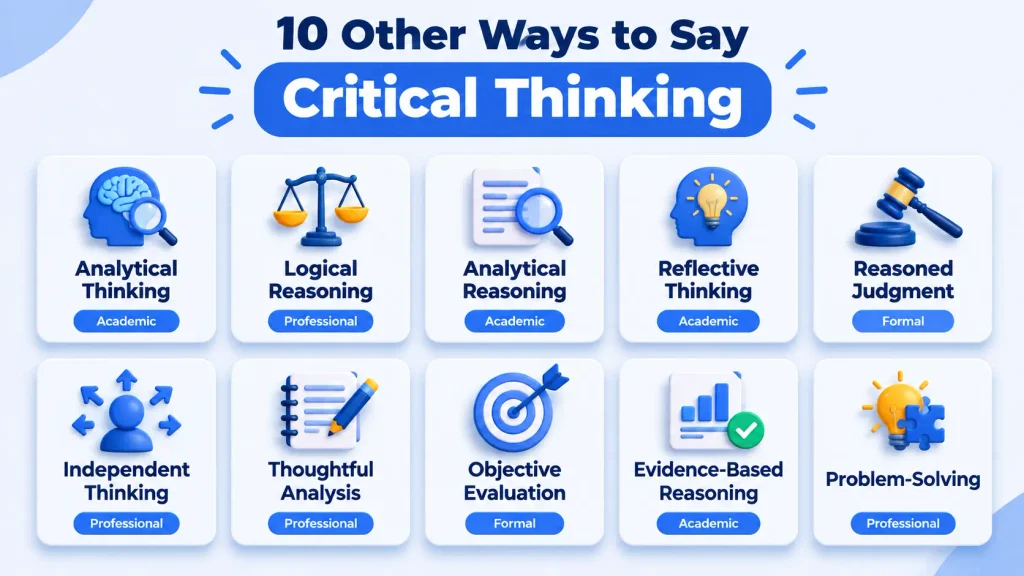
| Alternative | Best Used In | Tone |
| Analytical Thinking | Academic, professional writing | Formal |
| Logical Reasoning | Essays, research, professional writing | Formal |
| Analytical Reasoning | Resumes, education, workplace | Professional |
| Reflective Thinking | Education, learning, personal development | Thoughtful |
| Reasoned Judgment | Academic and professional decisions | Formal |
| Independent Thinking | Education, evaluations, professional writing | Professional |
| Thoughtful Analysis | Essays, reports, reviews | Polished |
| Objective Evaluation | Research, assessments, workplace | Formal |
| Evidence-Based Reasoning | Research, academic writing | Academic |
| Problem-Solving | Workplace, education, resumes | Professional |
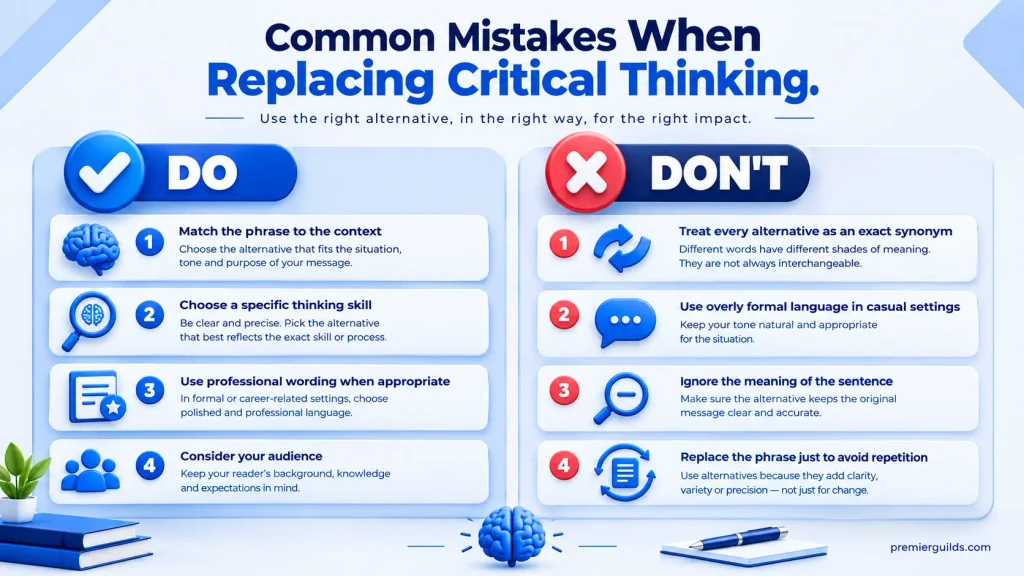
Not every alternative means precisely the same thing. Problem-solving, for example, focuses on solutions, while critical thinking can involve evaluating information without solving a specific problem.
Phrases such as objective evaluation or evidence-based reasoning can sound overly formal in everyday conversation. Choose simpler language when the situation is casual.
Think about what the person actually did. If they compared evidence, “analytical thinking” may fit. If they reconsidered their assumptions, “reflective thinking” may communicate the idea better.
Using the same phrase throughout an essay or report can make the writing feel repetitive. Replace it selectively with a phrase that preserves the intended meaning.
“Critical thinking” covers several abilities, including analysis, evaluation, reasoning, and judgment. Choosing a more specific expression can make your writing clearer and more informative.
Common alternatives include analytical thinking, logical reasoning, analytical reasoning, reflective thinking, reasoned judgment, independent thinking, thoughtful analysis, objective evaluation, and evidence-based reasoning. The right choice depends on the specific skill you want to emphasize. Some alternatives focus on analysis, while others highlight judgment, logic, evidence, or problem-solving.
Professional alternatives include analytical thinking, analytical reasoning, reasoned judgment, objective evaluation, and evidence-based reasoning. For a resume or professional profile, it is often even stronger to describe the behavior directly, such as “evaluates complex information” or “makes evidence-based decisions.”
You can say analytical skills, reasoning skills, analytical reasoning skills, problem-solving skills, evaluation skills, or decision-making skills, depending on the specific ability. These terms are related but are not identical. Choose the one that accurately describes what the person can do rather than replacing the phrase automatically.
Analytical thinking overlaps significantly with critical thinking, but the terms are not always interchangeable. Analytical thinking focuses strongly on breaking information into parts and examining relationships. Critical thinking is broader and can also include interpretation, evaluation, reasoning, questioning assumptions, and forming judgments.
For an essay, useful alternatives include analytical thinking, reflective thinking, reasoned judgment, thoughtful analysis, and evidence-based reasoning. The best option depends on the sentence. For example, “thoughtful analysis” works well when discussing an author’s ideas, while “evidence-based reasoning” fits arguments supported by sources.
On a resume, consider specific phrases such as analytical reasoning, problem-solving, objective evaluation, independent thinking, or evidence-based decision-making. Even better, describe the actual skill with an accomplishment, such as “analyzed complex data to identify process improvements.” Specific evidence gives employers more information than a general skill label.
You can describe someone as an analytical thinker, logical thinker, independent thinker, reasoned decision-maker, thoughtful evaluator, or analytical problem-solver. Choose the expression according to the person’s demonstrated ability. For example, someone who carefully compares evidence may be an analytical thinker, while someone who develops solutions may be an analytical problem-solver.
Problem-solving can be an alternative in some contexts, but it is not an exact synonym. Problem-solving focuses on identifying and resolving a particular issue. Critical thinking is broader and may involve evaluating evidence, questioning assumptions, analyzing arguments, or making a judgment even when there is no specific problem to solve.
There are several useful ways to say critical thinking, but the best alternative depends on the exact skill you want to describe. Analytical thinking works well for examining information, while logical reasoning emphasizes sound conclusions. Reflective thinking highlights careful consideration, and reasoned judgment focuses on making a conclusion after reviewing relevant information.
For academic writing, terms such as thoughtful analysis and evidence-based reasoning can add precision. In professional contexts, analytical reasoning, objective evaluation, and problem-solving may communicate specific workplace skills more clearly.
The key is to choose a phrase based on meaning, not just similarity. When your wording accurately describes the thinking process, your writing becomes clearer, more specific, and more effective.

Senior English Editor & Stylistics Director
Michael Bennett is a veteran editor, lexicographer, and publishing consultant with more than two decades of experience in academic and educational publishing. Formerly a senior editorial director at major university presses, he specializes in structural editing, register refinement, and vocabulary development. Michael oversees tone, precision, and stylistic consistency across all publication channels, ensuring content meets rigorous editorial and pedagogical standards.