

Another way to say “thank you for your understanding” includes “I appreciate your understanding,” “I’m grateful for your patience,” “Thank you for being so understanding,” “I appreciate your flexibility,” and “Thank you for your patience and support.” The best choice depends on whether you are writing a professional email, personal message, apology, or workplace communication.
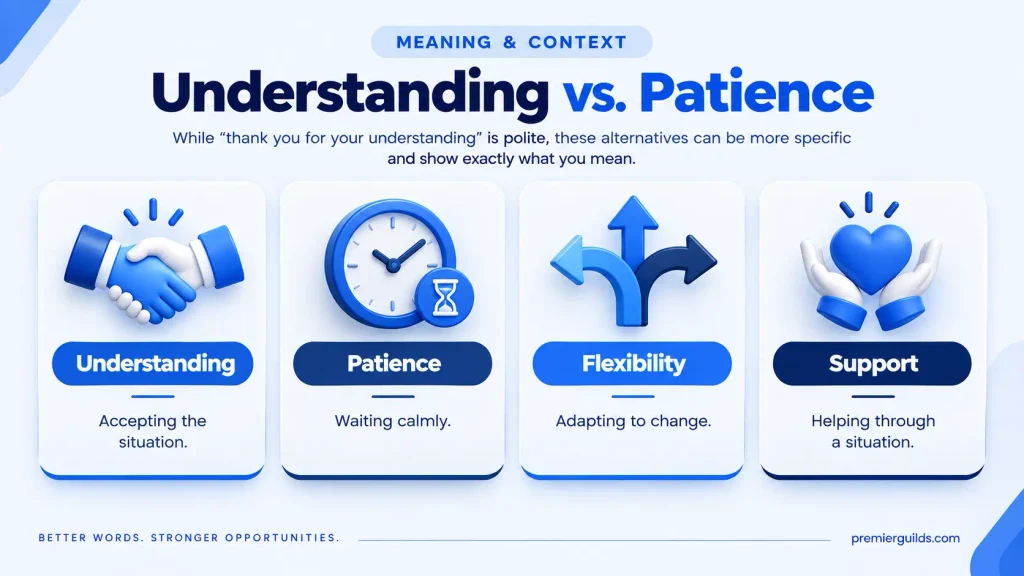
“Thank you for your understanding” is a polite way to show appreciation when someone accepts your situation, decision, explanation, delay, mistake, or request. It often appears when you expect another person to recognize why something happened or agree to an adjustment.
The phrase is common in emails, workplace messages, customer service, announcements, and personal conversations. For example, you might use it when apologizing for a delayed response or explaining a change in plans.
Because the phrase can become repetitive, choosing a suitable alternative can make your message sound more natural and personal.
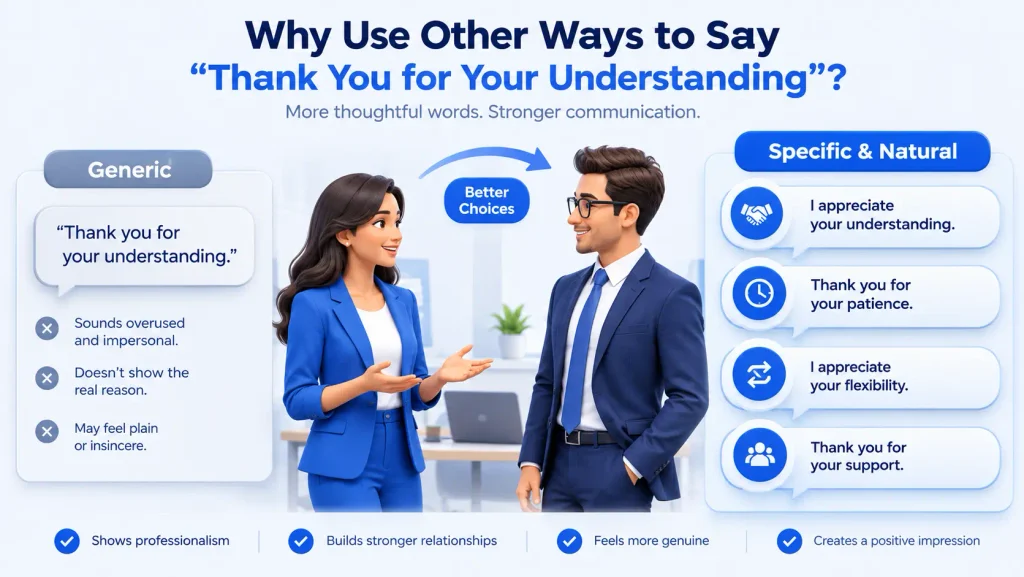
Using different expressions helps you match your message to the situation. While “thank you for your understanding” is polite, another phrase may better communicate patience, flexibility, support, or appreciation.
You may want an alternative to:
The key is to choose an alternative that describes what you are actually thanking the person for.
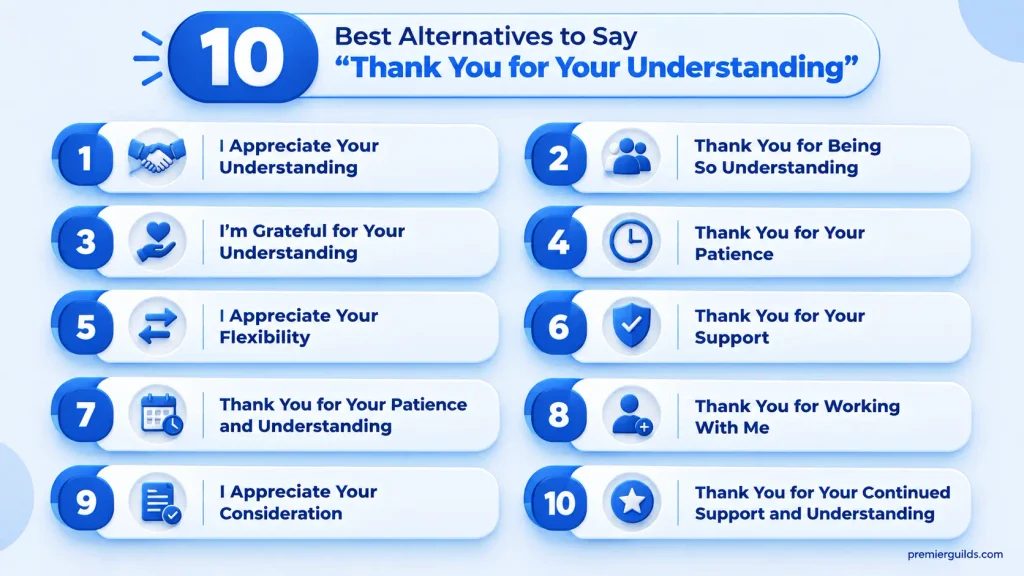
“I appreciate your understanding” expresses sincere gratitude for someone recognizing or accepting your situation. It is one of the closest alternatives to the original phrase.
Thank you for allowing us additional time to complete the project. I appreciate your understanding.
I appreciate your understanding while we work to resolve this issue.
Use this phrase when you want a professional alternative that keeps almost the same meaning as the original.
This phrase sounds slightly warmer and more personal than “thank you for your understanding.” It directly recognizes the other person’s considerate response.
Thank you for being so understanding about the change in our travel plans.
I know the situation was unexpected, so thank you for being so understanding.
Use this option when you want your gratitude to sound personal rather than formal or scripted.
“I’m grateful for your understanding” communicates stronger personal appreciation. It can sound heartfelt while still being appropriate in many professional situations.
I’m grateful for your understanding as I take some time to handle this matter.
We’re grateful for your understanding while our team completes the necessary updates.
Choose this phrase when you want to emphasize sincere appreciation rather than simply acknowledge someone’s cooperation.
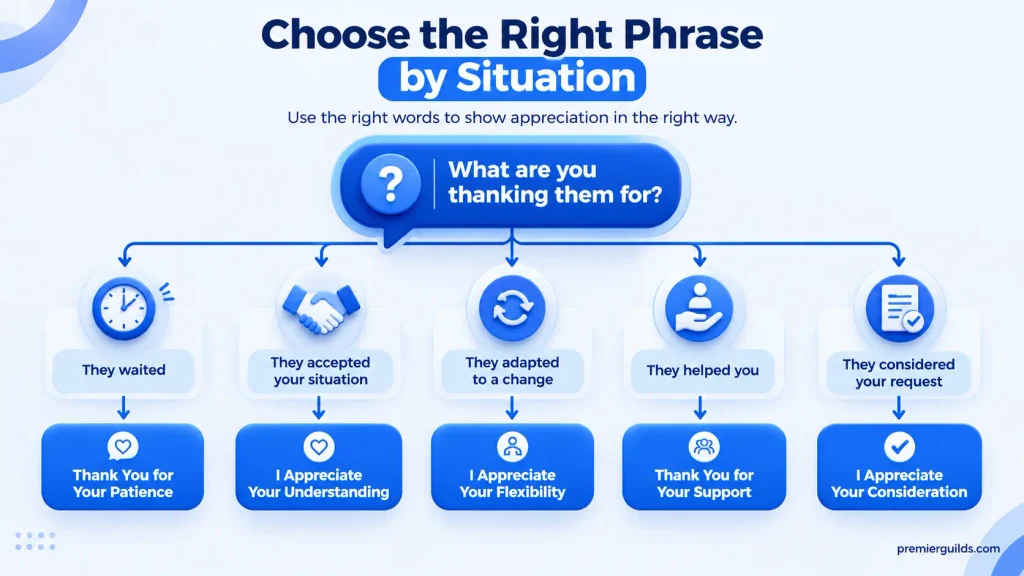
“Thank you for your patience” is ideal when someone has waited for a response, service, decision, repair, or resolution. It focuses specifically on their willingness to wait.
Thank you for your patience while we review your application.
We appreciate your patience as our support team investigates the issue.
Use “patience” instead of “understanding” when waiting is the main inconvenience the person has experienced.
This phrase thanks someone for adapting to a change, adjustment, new schedule, or unexpected situation. It is especially useful in workplace communication.
I appreciate your flexibility as we move the meeting to Thursday.
Thank you for working with us on the revised delivery schedule. I appreciate your flexibility.
Use this alternative when the person’s willingness to adapt is more important than their understanding of the situation.
“Thank you for your support” expresses appreciation when someone has helped, encouraged, or stood by you during a difficult or changing situation. It is broader than “understanding.”
Thank you for your support while we adjust to the new process.
I truly appreciate your support as we work through this transition.
Use this phrase when the person has actively helped you rather than simply accepted your circumstances.
This phrase combines two ideas: appreciation for someone’s willingness to wait and gratitude for their acceptance of the situation. It works well when both qualities matter.
I’m thankful for your patience and understanding while we correct the billing issue.
We’re thankful for your patience and understanding during this temporary disruption.
Use this wording when you want to acknowledge both the inconvenience and the person’s considerate response.
“Thank you for working with me” shows appreciation for someone’s cooperation. It feels collaborative and is useful when both people have made adjustments to reach a solution.
Thank you for working with me to find a schedule that works for everyone.
I appreciate you working with me while we finalize the project details.
This phrase is especially effective when the other person has actively participated in solving a problem.
“I appreciate your consideration” thanks someone for carefully considering your request, circumstances, or proposal. It is more formal than many other options.
I appreciate your consideration of my request and the time you took to review it.
Thank you for considering the circumstances surrounding the proposed schedule change.
Use this phrase when the person is evaluating a request rather than simply accepting an explanation.
This expression communicates ongoing gratitude toward someone who has repeatedly shown patience, support, or acceptance. It works well for longer situations rather than one-time interactions.
Thank you for your continued support and understanding as we complete the transition.
We sincerely appreciate your continued support and understanding during this period of change.
Use “continued” when the situation has lasted for some time and the person’s support has been consistent.
| Alternative | Best Used In | Tone |
| I Appreciate Your Understanding | Professional emails and workplace communication | Professional |
| Thank You for Being So Understanding | Personal messages and friendly communication | Warm |
| I’m Grateful for Your Understanding | Personal and professional appreciation | Warm |
| Thank You for Your Patience | Delays and waiting periods | Polite |
| I Appreciate Your Flexibility | Schedule or plan changes | Professional |
| Thank You for Your Support | Difficult situations and transitions | Warm |
| I’m Thankful for Your Patience and Understanding | Delays and disruptions | Warm |
| Thank You for Working With Me | Collaborative situations | Friendly |
| I Appreciate Your Consideration | Requests and formal communication | Formal |
| Thank You for Your Continued Support and Understanding | Ongoing situations | Professional |
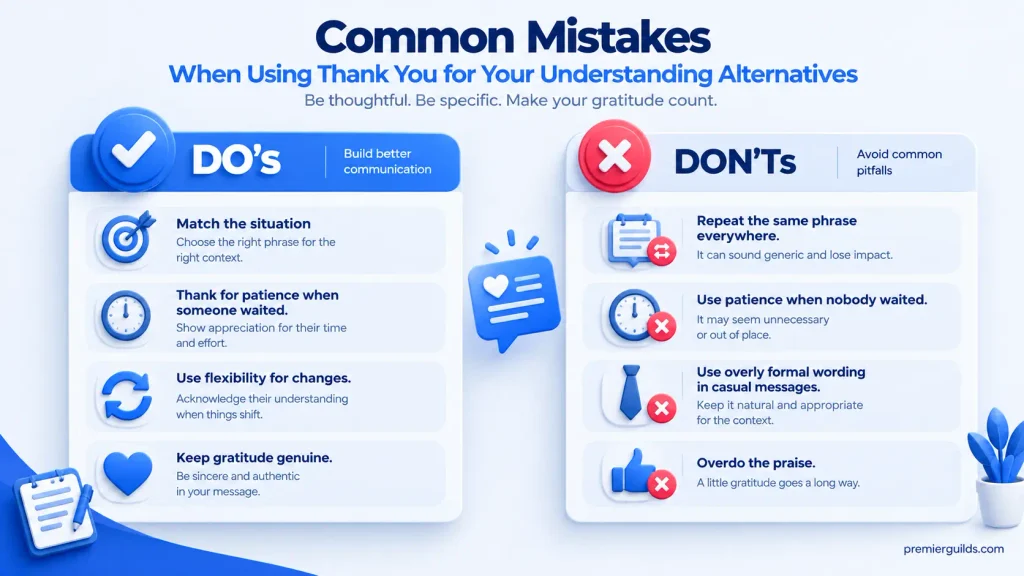
Repeating “thank you for your understanding” in every message can make your writing feel automatic. Choose an alternative that reflects the specific reason for your gratitude.
“Patience” specifically relates to waiting or tolerating a delay. If someone simply accepted your decision or explanation, “I appreciate your understanding” may be more accurate.
Phrases such as “I appreciate your consideration” can sound formal in a casual conversation. Match your wording to the relationship and communication channel.
A short thank-you can work, but adding context often makes the message more sincere. For example, mention their patience, flexibility, support, or cooperation when appropriate.
Avoid adding excessive praise just to soften an uncomfortable message. A simple, genuine expression of appreciation usually sounds more professional than exaggerated gratitude.
Common alternatives include “I appreciate your understanding,” “I’m grateful for your understanding,” “thank you for your patience,” and “I appreciate your flexibility.” Choose the phrase based on what the other person actually did. If they waited, thank them for their patience; if they adapted to a change, thank them for their flexibility.
“I appreciate your understanding” is one of the most natural professional alternatives. You can also say “I appreciate your flexibility” when someone accommodated a change or “thank you for your patience” when they experienced a delay. These options work well in workplace emails and customer communication.
You can write, “I appreciate your understanding regarding the change in schedule,” or “Thank you for your patience while we resolve this matter.” For a warmer email, try “Thank you for being so understanding.” Choose the version that matches the situation rather than using one phrase for every message.
Both phrases are polite and professional, so neither is universally better. “I appreciate your understanding” can sound slightly more personal and conversational, while “thank you for your understanding” is a familiar standard expression. The better choice depends on your relationship with the reader and the tone of the message.
After an apology, you can say “I appreciate your patience,” “Thank you for being so understanding,” or “I’m grateful for your understanding.” If the issue caused a delay, “thank you for your patience” may be especially appropriate because it directly acknowledges the inconvenience.
Focus on what the other person did and thank them for that specific action. Use “thank you for your patience” for delays, “I appreciate your flexibility” for changes, and “thank you for your support” when someone actively helped you. This approach makes your language more natural.
“Thank you for being so understanding” is a warm and natural choice. “I’m grateful for your understanding” is another option when you want to express stronger personal appreciation. Both work well in messages to friends, coworkers, clients, or people who have responded kindly to a difficult situation.
For a formal letter, consider “I appreciate your consideration,” “I appreciate your understanding,” or “Thank you for your patience and cooperation.” The appropriate phrase depends on the context. “Consideration” works well for requests, while “patience and cooperation” is better when someone has dealt with a delay or process.
Knowing another way to say “thank you for your understanding” helps you make your messages more natural and specific. While “I appreciate your understanding” is an excellent all-purpose professional option, other phrases can communicate a more precise kind of gratitude.
Use “thank you for your patience” when someone has waited, “I appreciate your flexibility” when they have adapted to a change, and “thank you for your support” when they have actively helped you. For warmer communication, “thank you for being so understanding” can feel more personal.
The best expression depends on the situation, relationship, and reason for your gratitude. Instead of choosing a phrase simply because it sounds polished, identify what you are actually thanking the person for. That small adjustment can make your communication clearer, warmer, and more genuine.

Senior English Editor & Stylistics Director
Michael Bennett is a veteran editor, lexicographer, and publishing consultant with more than two decades of experience in academic and educational publishing. Formerly a senior editorial director at major university presses, he specializes in structural editing, register refinement, and vocabulary development. Michael oversees tone, precision, and stylistic consistency across all publication channels, ensuring content meets rigorous editorial and pedagogical standards.