

Looking for another way to say thank you for your patience? Try “I appreciate your patience,” “thank you for waiting,” “thanks for bearing with us,” or “I appreciate your understanding.” Choose a phrase based on the situation, tone, and relationship, especially when writing professional emails, customer updates, or workplace messages.

“Thank you for your patience” is a polite expression used to show appreciation when someone has waited, tolerated a delay, or allowed extra time for something to be completed. It is common in professional emails, customer service messages, workplace updates, and business communication.
For example, a customer support representative might write, “Thank you for your patience while we investigate the issue.” A coworker might say, “Thank you for your patience while I finish the report.”
The phrase is grammatically correct and remains appropriate for professional communication. However, because it is frequently used in emails and customer service, repeating it too often can make a message sound routine or scripted.
A more specific alternative can make your message sound more natural. It can also help you acknowledge the person’s time, flexibility, understanding, or willingness to wait.

Although the original phrase is useful, you may want another expression when you need a different tone or a more specific message.
Using alternatives can help you:
For example, “Thank you for waiting” directly acknowledges the wait, while “I appreciate your flexibility” is better when someone has adjusted to a schedule or deadline change. Current professional-writing guidance similarly recommends choosing the wording according to the situation rather than relying on one phrase for every delay.
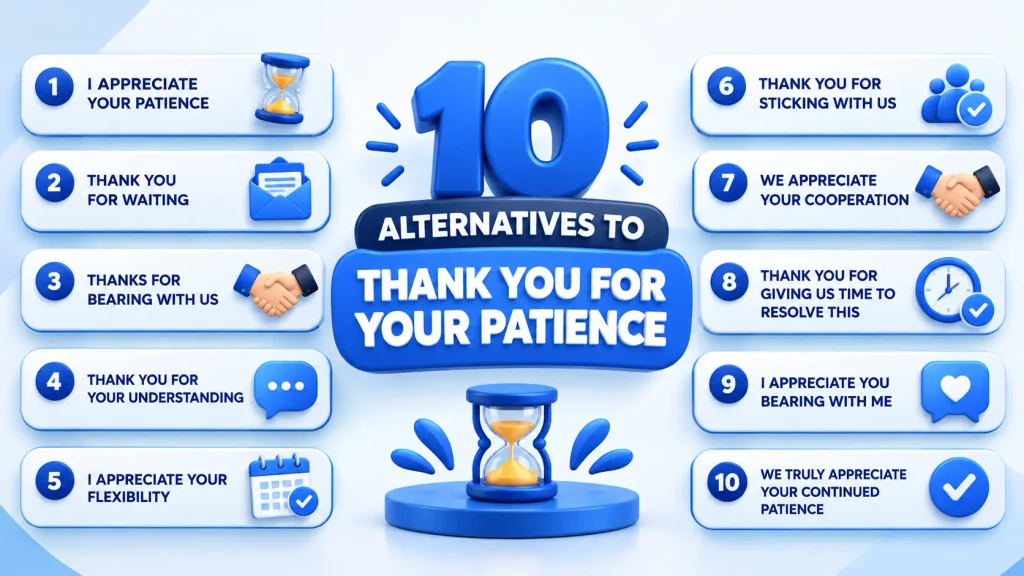
“I appreciate your patience” expresses personal gratitude for someone’s willingness to wait or give you extra time. It has the same basic meaning as the original phrase but sounds slightly more personal because it directly identifies the speaker.
“I appreciate your patience while I review the details of your request.”
“We appreciate your patience as our team works to complete the necessary updates.”
Use this as your go-to alternative for professional emails when you want a polished but natural tone.
“Thank you for waiting” directly acknowledges the time someone spent waiting for a response, decision, service, or result. It is simple and clear, making it useful when the waiting period is the main issue.
“Thank you for waiting while I checked the availability with our scheduling team.”
“Thank you for waiting; I now have the information you requested.”
Choose this phrase when you have a specific wait to acknowledge rather than a general ongoing delay.
“Thanks for bearing with us” thanks someone for staying cooperative during a difficult, inconvenient, or delayed situation. It feels more conversational than “thank you for your patience.”
“Thanks for bearing with us while we complete the website maintenance.”
“Thanks for bearing with us as we work through the unexpected scheduling changes.”
Use “us” when speaking on behalf of a company, team, or department.
“Thank you for your understanding” focuses more on someone’s acceptance of a situation than on the waiting itself. It works especially well when you have explained a delay, limitation, change, or inconvenience.
“Thank you for your understanding while we make the necessary changes to your account.”
“Thank you for your understanding regarding the revised meeting schedule.”
Use this phrase when the reader has had to accept a change or inconvenience, not simply wait.
“I appreciate your flexibility” recognizes that someone adjusted their schedule, expectations, plans, or approach to accommodate a change. It is different from thanking someone simply for waiting.
“I appreciate your flexibility as we move the presentation to next Thursday.”
“Thank you for adjusting the timeline, and I appreciate your flexibility throughout the process.”
Use this when the person actively adapted to a change rather than simply waited for an outcome.
“Thank you for sticking with us” expresses appreciation for someone’s continued support during a delay, problem, or extended process. It has a warm, human tone and can help a business sound less scripted.
“Thank you for sticking with us while we worked to resolve the billing issue.”
“We truly appreciate you sticking with us as we improve the new customer portal.”
This phrase works especially well when a customer or client has stayed engaged through an extended problem.
“We appreciate your cooperation” focuses on someone’s willingness to work with you or follow a process. It is particularly useful when the situation involves requests, procedures, documentation, or changes.
“We appreciate your cooperation while our team completes the verification process.”
“Thank you for providing the requested documents, and we appreciate your cooperation.”
Choose this when the person’s active participation matters more than the amount of time they waited.
This phrase directly connects the person’s patience with the work being done to solve a problem. It sounds specific because it explains why the extra time was needed.
“Thank you for giving us time to investigate the issue thoroughly.”
“We appreciate you giving our team time to review the account and identify the cause of the error.”
Use this when you want your gratitude to be connected to a clear action or resolution.
“I appreciate you bearing with me” is a personal and conversational way to thank someone for staying patient while you handle something. It is more informal than corporate phrases such as “we appreciate your cooperation.”
“I appreciate you bearing with me while I pull together the final numbers.”
“Thanks for bearing with me while I work through the last few questions.”
Use “me” for a personal message and “us” when communicating on behalf of a team or company.
“We truly appreciate your continued patience” adds emphasis to the gratitude and works when someone has been waiting for an extended period. It acknowledges that the situation has lasted longer than a normal interaction.
“We truly appreciate your continued patience as we work toward a permanent solution.”
“Our team truly appreciates your continued patience while the system upgrade is completed.”
Reserve this expression for longer or ongoing situations so the word “continued” has a clear purpose.

| Alternative | Best Used In | Tone |
| I Appreciate Your Patience | Professional emails, client communication | Professional, Warm |
| Thank You for Waiting | Customer service, direct updates | Polite, Friendly |
| Thanks for Bearing With Us | Support messages, team updates | Friendly, Warm |
| Thank You for Your Understanding | Delays, changes, difficult situations | Professional, Polite |
| I Appreciate Your Flexibility | Schedule or deadline changes | Professional, Warm |
| Thank You for Sticking With Us | Ongoing customer or team issues | Warm, Friendly |
| We Appreciate Your Cooperation | Formal processes and requests | Formal, Professional |
| Thank You for Giving Us Time to Resolve This | Problem-solving and support | Professional, Polite |
| I Appreciate You Bearing With Me | Personal workplace communication | Friendly, Warm |
| We Truly Appreciate Your Continued Patience | Extended delays or ongoing issues | Formal, Warm |
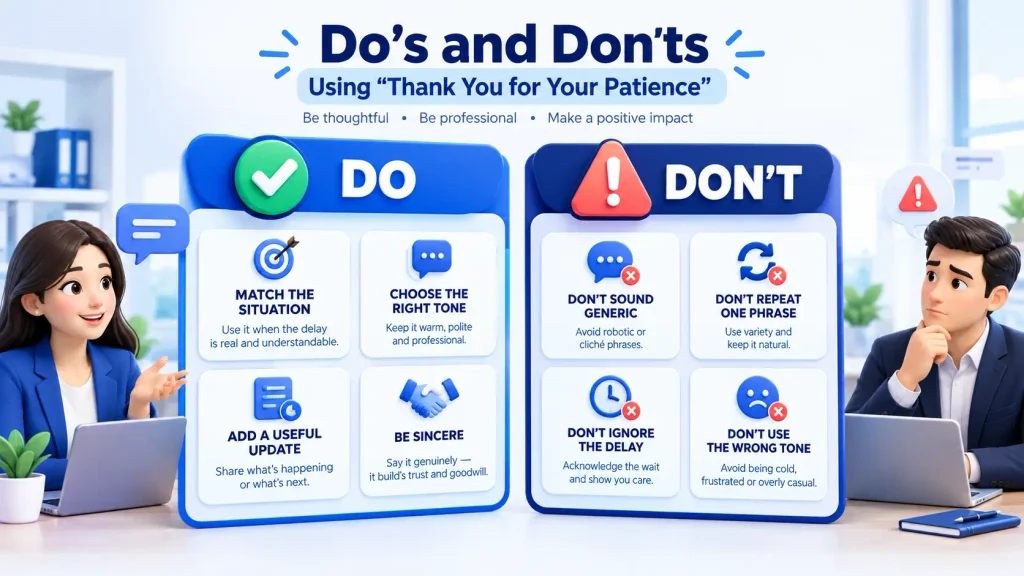
Even a polite phrase can become repetitive when it appears in every customer response or workplace update. Vary your wording when the context changes so your communication feels intentional.
“Thanks for bearing with us” can sound friendly and natural, but a highly formal business letter may call for “We appreciate your cooperation” instead. Always consider your relationship with the reader.
Gratitude alone may not satisfy someone who has been waiting for a resolution. When possible, tell the reader what has happened, what you are doing, and what they can expect next.
If someone changed a meeting time or adjusted a deadline, “I appreciate your flexibility” may be more accurate than “thank you for your patience.” The two expressions recognize different types of cooperation.
A generic phrase can feel impersonal when used after a significant delay or mistake. In those situations, acknowledge the specific problem and, when appropriate, include a genuine apology and a clear next step. Professional communication guidance commonly recommends combining appreciation with useful context rather than using a thank-you phrase by itself.
Common alternatives include “I appreciate your patience,” “thank you for waiting,” “thanks for bearing with us,” and “thank you for your understanding.” The best choice depends on the situation. For a professional email, “I appreciate your patience” is a safe and natural option, while “thank you for waiting” is more direct.
Yes. “Thank you for your patience” is a polite and professional phrase used in business emails, customer service, workplace communication, and other situations involving delays. It is grammatically correct and widely accepted. However, if you use it repeatedly, an alternative can make your communication sound more specific and less routine.
“I appreciate your patience” is one of the most natural professional alternatives. You can also say “We appreciate your understanding,” “We appreciate your cooperation,” or “I appreciate your flexibility,” depending on the situation. For the strongest message, connect the phrase to a specific update or next step.
You can write, “I appreciate your patience while I review your request,” or “Thank you for waiting while our team investigates the issue.” If there has been a significant delay, add a clear update or timeline. This makes the message more useful than simply thanking the recipient for waiting.
For customers, “Thank you for waiting,” “We appreciate your understanding,” and “Thanks for bearing with us” can work well. The best wording depends on the situation. If the customer experienced a genuine problem, acknowledge the inconvenience and explain what your team is doing to resolve it.
Yes, but it has a more conversational tone than “I appreciate your patience.” It works well with coworkers, familiar clients, or informal workplace messages. For a formal customer complaint or executive communication, “I appreciate your patience” or “We appreciate your understanding” may sound more appropriate.
“Patience” focuses on someone’s willingness to wait or tolerate a delay. “Understanding” focuses more on someone’s acceptance of a situation, explanation, or inconvenience. For example, use “thank you for your patience” when someone is waiting for a response and “thank you for your understanding” when someone has accepted a change or limitation.
It depends on what happened. “Thank you for your patience” emphasizes appreciation, while “sorry for the delay” directly acknowledges responsibility for a late response or outcome. If your organization caused a significant delay, you can use both: apologize for the delay, explain the next step, and thank the person for their time.
“Thank you for your patience” remains a polite and professional expression for situations involving delays, waiting, and ongoing processes. Still, using the same phrase repeatedly can make emails and workplace messages sound routine. Choosing a more specific alternative can make your communication feel more natural and thoughtful.
Use “I appreciate your patience” for a polished professional message, “thank you for waiting” for a direct acknowledgment, and “thanks for bearing with us” for a warmer tone. When someone has adjusted to a change, “I appreciate your flexibility” is more precise.
The best phrase depends on what the other person actually did. Match your wording to the situation, and whenever possible, include a useful update or next step. That makes your gratitude sound genuine rather than automatic.

Our editorial team brings together decades of expertise in applied linguistics, lexicography, and educational publishing. Dedicated to clarity, precision, and tone, our experts ensure that every resource meets the highest standards of professional and academic excellence.