

Another way to say please be advised includes please note, please be aware, kindly note, for your information, I’d like to inform you, and this is to inform you. The best alternative depends on your purpose and tone. For most professional emails, please note is a clear, natural, and modern choice.
“Please be advised” is a formal expression used to draw attention to important information, an update, instruction, reminder, or notice. It is common in professional emails, business correspondence, policies, customer service messages, and official notices.
Although the phrase is grammatically correct, it can sometimes sound stiff, distant, or overly formal in modern workplace communication. A more natural alternative can make your message clearer while keeping the appropriate level of professionalism.
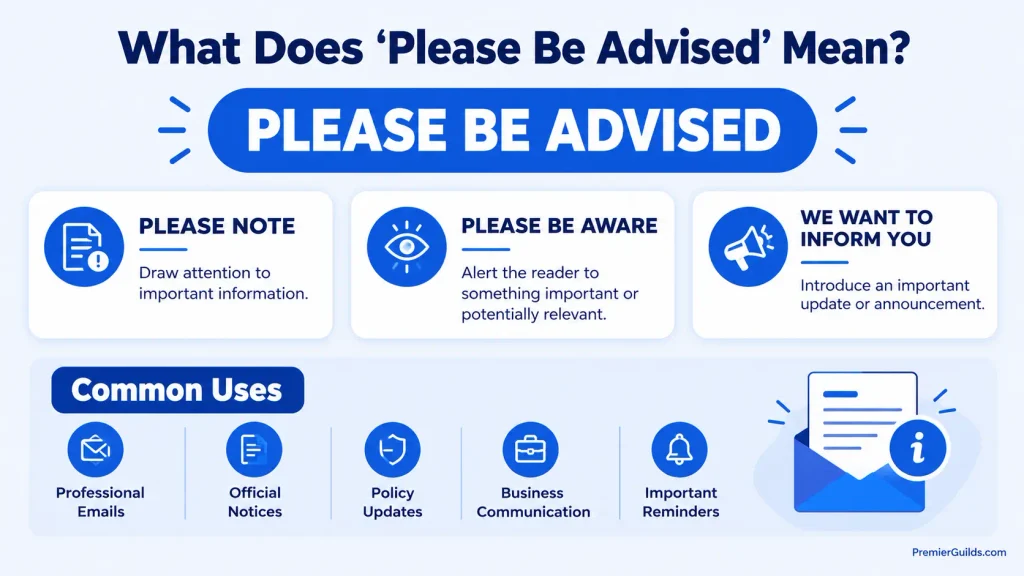
Please be advised essentially means “please note,” “please be aware,” or “we want to inform you.” It introduces information that the writer believes the reader should know or consider.
For example:
Please be advised that the office will close at 3 p.m. on Friday.
The sentence tells the reader about an important schedule change. The phrase does not necessarily ask the reader to take action; sometimes it simply signals that the following information is important.
You will most often see it in business emails, official notices, customer communications, policies, and formal correspondence.
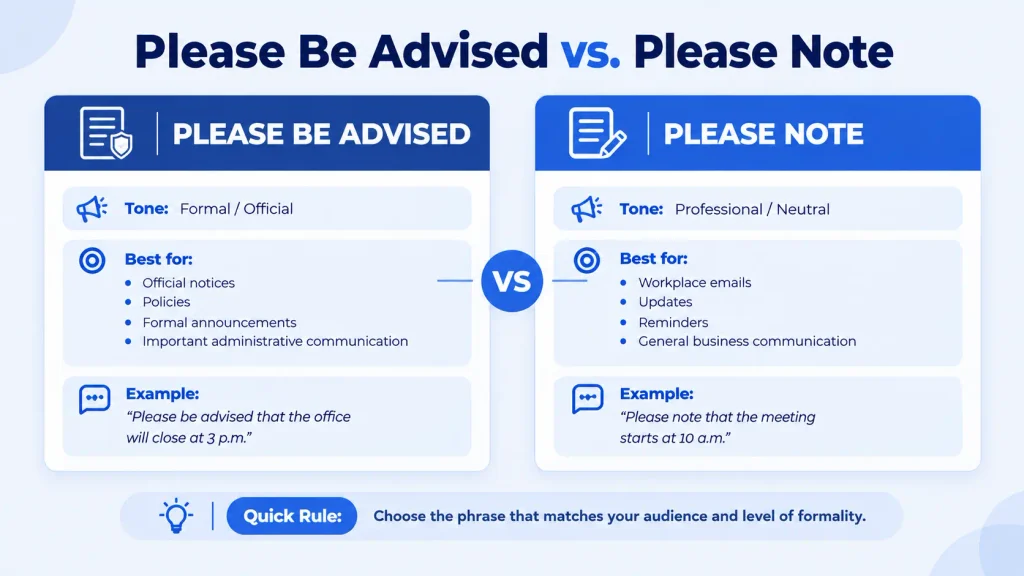
The phrase is not wrong, but choosing a different expression can help your message match the audience and situation. Modern professional writing generally benefits from language that is direct, clear, and easy to understand.
Using alternatives can help you:
Sometimes, the best alternative is actually no introductory phrase at all. Instead of “Please be advised that the meeting has moved,” you can simply write, “The meeting has moved.” This is shorter and more direct.
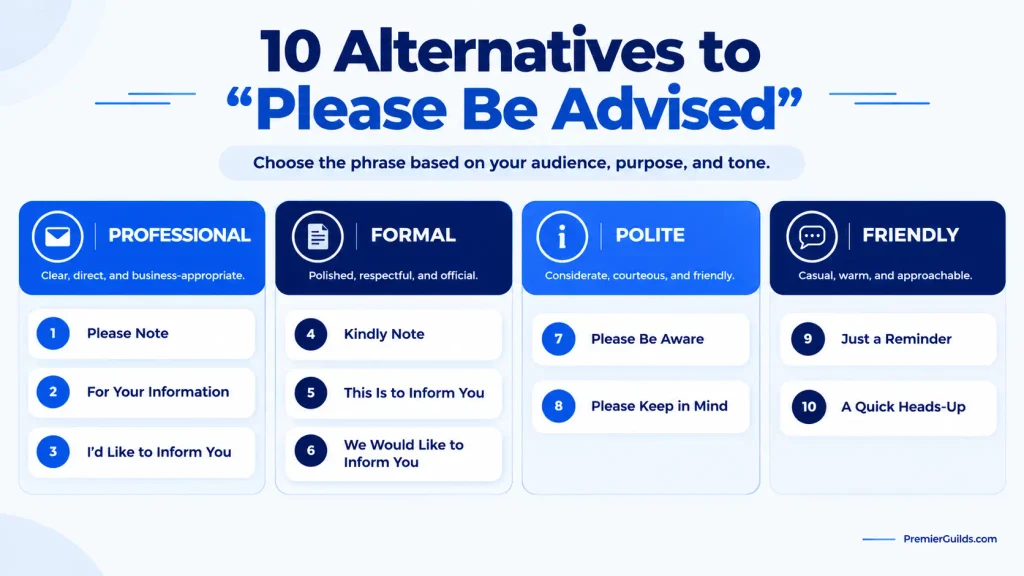
Please note asks the reader to pay attention to important information. It is one of the most natural and versatile replacements for “please be advised” in professional writing.
Please note that the application deadline has been extended to Friday.
Please note that all visitors must check in at the front desk.
Use please note as your default alternative when you need a professional phrase that works in most business emails.
Please be aware tells someone that they should know about a particular fact, condition, risk, or possible issue. It can sound more direct than “please note.”
Please be aware that processing times may be longer during the holiday season.
Please be aware that the new security policy applies to all employees.
Choose this phrase when the information could affect the reader or requires particular attention.
Kindly note is a polite and formal way to introduce information or a reminder. It is especially common in formal business communication and international English.
Kindly note that payment must be received before the order can be shipped.
Kindly note that the revised schedule begins next Monday.
Use kindly note when you want a respectful tone, but avoid using it in every email because it can sound formulaic.
For your information tells the reader that you are sharing something they may find useful or important. It generally does not imply that the reader must take action.
For your information, the updated employee handbook is now available online.
For your information, the client has already approved the revised proposal.
Use this phrase when you are primarily sharing information, not giving an instruction or warning.
I’d like to inform you creates a more personal and direct tone than “please be advised.” It clearly tells the reader that you are about to provide an important update.
I’d like to inform you that your interview has been moved to Thursday.
I’d like to inform you that your request has been approved.
This option works especially well when communicating directly with customers, clients, applicants, or other people outside your immediate team.
This is to inform you introduces an official announcement or notification. It has a formal tone and is best suited to situations where the information has administrative or organizational importance.
This is to inform you that the building will be closed for maintenance on Saturday.
This is to inform you that your membership will expire at the end of the month.
Use this phrase for official notices, but avoid it in casual workplace conversations where simpler wording would sound more natural.
Please keep in mind reminds the reader to consider a particular fact while making a decision or completing an activity. It sounds more conversational than “please be advised.”
Please keep in mind that delivery times may vary depending on location.
Please keep in mind that all expenses must be approved before reimbursement.
Choose this phrase when the reader needs to consider information, rather than simply receive an announcement.
Just a reminder is a friendly way to repeat information that the reader has probably received before. It is useful for deadlines, appointments, meetings, and previously communicated requirements.
Just a reminder that the team meeting starts at 9 a.m. tomorrow.
Just a reminder that expense reports are due by the fifth of each month.
Use it for follow-up messages, not for introducing completely new or serious information.
We would like to inform you is a formal but courteous alternative that works well when an organization is communicating with customers, clients, employees, or other stakeholders.
We would like to inform you that your order has been shipped.
We would like to inform you that our customer support hours have changed.
Use this option when writing on behalf of a company or organization and you want a professional, respectful tone.
A quick heads-up is an informal way to alert someone about information they should know. It is much more relaxed than “please be advised” and works best in friendly workplace communication.
Just a quick heads-up: the meeting room has changed to Conference Room B.
A quick heads-up that the software update will begin tonight at 8 p.m.
Use this phrase with coworkers or familiar contacts, but avoid it in highly formal notices or serious client communication.
| Alternative | Best Used In | Tone |
| Please note | General professional emails and notices | Professional |
| Please be aware | Warnings and important information | Direct/Professional |
| Kindly note | Formal business communication | Polite/Formal |
| For your information | Sharing useful updates | Neutral/Professional |
| I’d like to inform you | Direct updates to clients or contacts | Warm/Professional |
| This is to inform you | Official announcements | Formal |
| Please keep in mind | Guidance and considerations | Friendly/Professional |
| Just a reminder | Follow-ups and reminders | Friendly |
| We would like to inform you | Company or organizational notices | Formal/Professional |
| A quick heads-up | Informal workplace updates | Casual/Friendly |
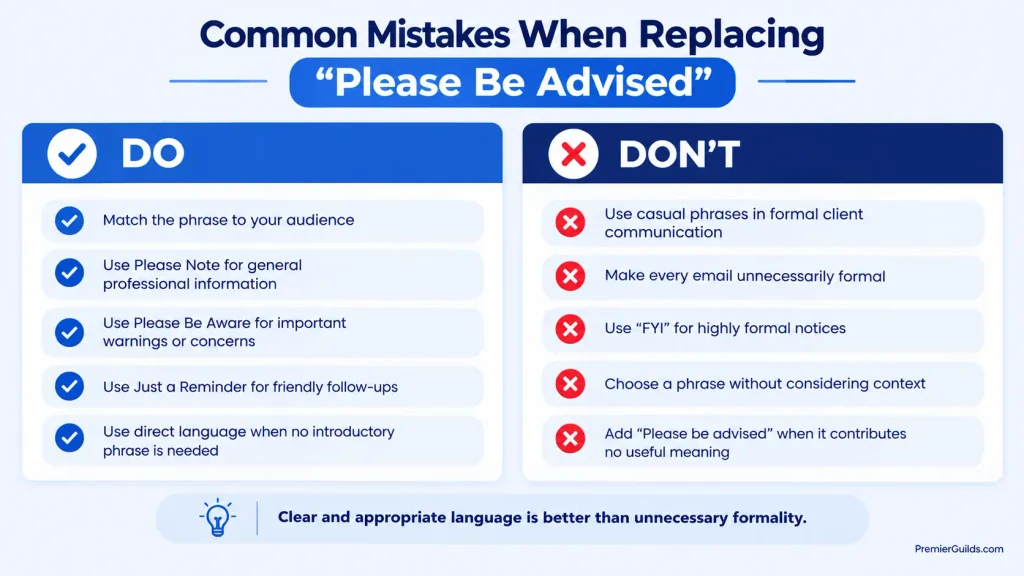
Expressions such as “a quick heads-up” may work with coworkers but can sound too relaxed in legal, official, or highly formal communication.
Not every update needs “This is to inform you” or “Kindly note.” If a direct sentence works, simpler language may be more effective.
For your information generally presents information rather than requesting action. If the reader needs to do something, state the action clearly.
“Please be aware” can suggest that something requires special attention or carries a potential concern. For routine information, please note may sound more natural.
Compare:
Please be advised that I have attached the report.
with:
I have attached the report.
The second version is clearer because the important information is already obvious. Good professional writing does not need a formal phrase before every statement.
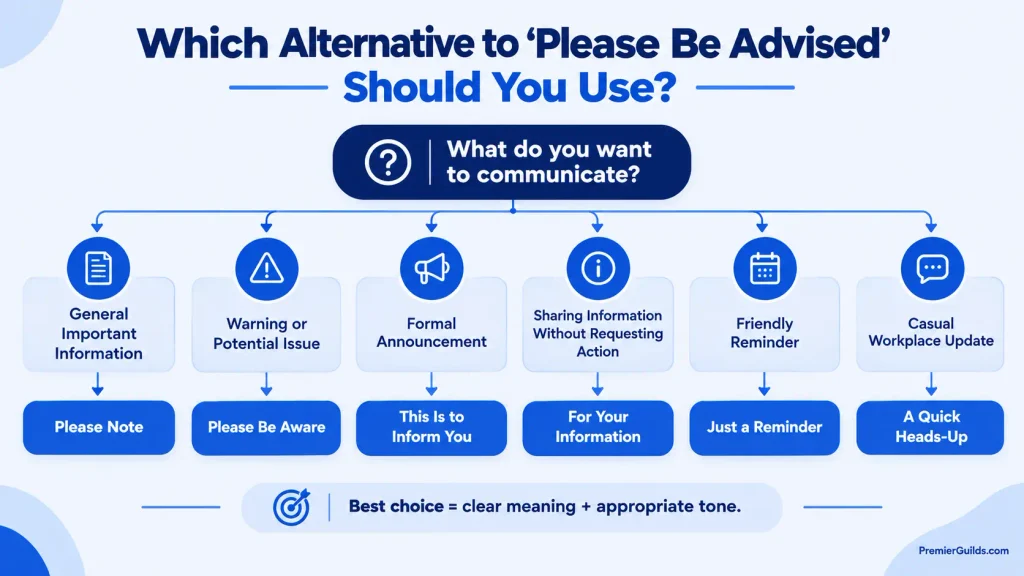
Please note is usually the best general professional alternative. It is concise, clear, and appropriate for many workplace emails, announcements, and notices. If the message involves a potential issue or risk, please be aware may be more suitable. For a formal announcement, we would like to inform you can work well.
Yes, please be advised is grammatically correct and has traditionally been used in professional and official communication. However, it can sound stiff, distant, or overly formal in some modern workplace settings. The phrase is still appropriate in certain formal notices, but a simpler alternative often sounds more natural in everyday business emails.
The phrase is not inherently rude, but its tone can feel authoritative or impersonal depending on the context. This is especially true when it introduces a warning or correction. If you want a warmer tone, alternatives such as please note, please keep in mind, or I’d like to inform you can make the message feel more approachable.
Kindly note is a polite and formal option, while please note is a neutral professional choice. If you want a warmer, more personal tone, try I’d like to inform you. For a friendly reminder, just a reminder may be better. The right choice depends on your audience and the purpose of the message.
In a professional email, you can use please note, please be aware, kindly note, for your information, or I’d like to inform you. For a reminder, just a reminder works well. If the sentence is already clear without an introductory phrase, you can also remove “please be advised” entirely.
In many modern professional emails, please note sounds simpler and more natural. Both phrases are correct, but “please be advised” can feel more formal or institutional. Use please note for routine business information and reserve stronger or more formal wording for situations where the context actually calls for it.
You can use FYI, or “for your information,” in informal workplace communication, particularly with coworkers. However, it may be too casual for formal client emails, official notices, or sensitive communication. If you are unsure, writing for your information gives you a more polished and neutral option.
Not necessarily. The phrase is correct and can still suit formal notices, policies, or important announcements. However, you should not use it automatically. If a direct sentence, “please note,” or another context-specific phrase communicates the information more clearly, that option will usually make the email easier to read.
Knowing another way to say please be advised gives you more control over the tone of your professional communication. Please note is the best all-purpose option for most business emails, while please be aware works well when highlighting an important condition or possible issue. For a formal announcement, this is to inform you or we would like to inform you may be more appropriate.
For a warmer message, I’d like to inform you or please keep in mind can sound more personal. If you are simply reminding a coworker about something, just a reminder is often enough.
Most importantly, do not replace “please be advised” just for the sake of using a synonym. Consider your audience, purpose, and tone first. Clear, direct language is usually more effective than unnecessary formality.

English Language & Communication Specialist
Dr. Emily Carter is an English language and communication specialist focused on vocabulary, word choice, professional writing, and practical English usage. She helps readers understand the differences between similar words and choose expressions that sound natural, clear, and appropriate for different contexts.