

If you need another way to say because of, common alternatives include due to, owing to, as a result of, on account of, thanks to, as a consequence of, as a result of, stemming from, and resulting from. The best choice depends on whether you want a formal, professional, neutral, or positive tone.
The phrase “because of” explains the reason or cause behind something. It is one of the most common ways to connect a cause with a result in American English.
For example, you might say, “The game was canceled because of heavy rain.” In professional writing, academic work, emails, and everyday conversation, you may want a different expression to avoid repetition or create a more precise tone.
The best alternative depends on your sentence. Some options, such as due to and owing to, sound more formal, while thanks to usually highlights a positive cause.
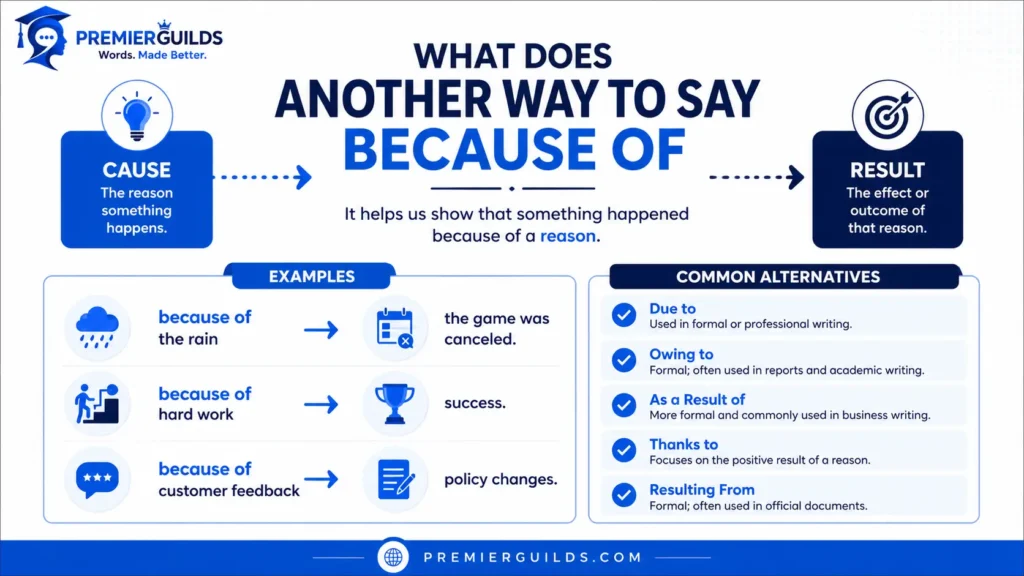
“Another way to say because of” means finding a different word or phrase that communicates cause, reason, or explanation.
The phrase “because of” is normally followed by a noun, pronoun, or noun phrase:
People often look for alternatives when writing business emails, essays, reports, resumes, academic assignments, and professional documents. Choosing the right expression can make your writing sound smoother and better suited to the situation.
Although “because of” is perfectly correct, repeating it throughout an article or document can make your writing feel predictable.
Using appropriate alternatives can help you:
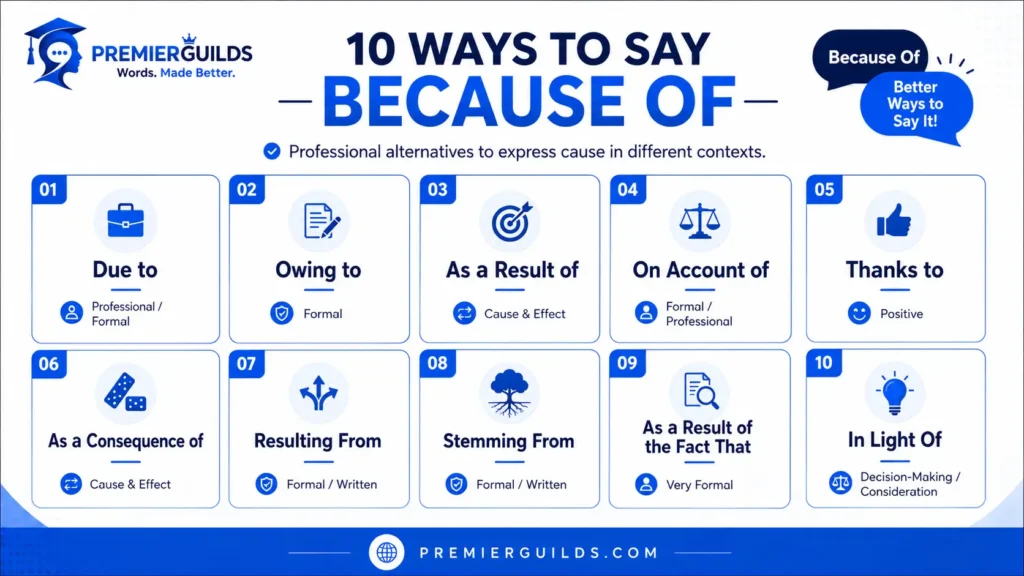
Due to means “because of” or “as a result of.” It is widely used in professional, formal, and everyday writing, although some style guides recommend paying attention to how it connects grammatically to the rest of the sentence.
The outdoor event was postponed due to severe weather.
Production slowed due to a shortage of materials.
Use due to when you want a concise, professional-sounding way to identify a cause.
Owing to means “because of” and is especially common in formal written English. It clearly identifies the reason something happened without sounding overly complicated.
The shipment arrived late owing to transportation problems.
Several roads were closed owing to heavy snowfall.
Owing to is a good choice when you want a formal alternative to “because of,” particularly in reports and official writing.
As a result of connects an event or condition with the outcome it caused. It puts slightly more emphasis on the result than the simple phrase “because of.”
The store experienced longer wait times as a result of staff shortages.
The company gained new customers as a result of its improved service.
Choose as a result of when you want to make the cause-and-effect relationship especially clear.
On account of means “because of” or “for the reason of.” It is grammatically correct but can sound more formal or old-fashioned than some other alternatives.
The museum closed early on account of a maintenance issue.
He missed the meeting on account of an unexpected emergency.
Use this phrase sparingly in everyday conversation because because of or due to usually sounds more natural.
Thanks to means that something happened because of a particular person, action, or condition. It often suggests that the cause produced a positive or helpful result.
Thanks to the new software, our team finished the project ahead of schedule.
Thanks to her careful planning, the event ran smoothly.
Use thanks to when you want to give credit or emphasize a favorable outcome.
As a consequence of means that something happened because another event or condition caused it. It strongly highlights the relationship between an action and its resulting effect.
Several flights were canceled as a consequence of the storm.
The company changed its policy as a consequence of customer feedback.
This phrase is useful when the result is important and you want to emphasize the consequences of a particular cause.
Resulting from describes something that occurs as a consequence of another event, action, or condition. It works especially well when describing problems, changes, benefits, or outcomes.
The delays resulting from the system outage affected hundreds of customers.
We reviewed the expenses resulting from the unexpected repairs.
Use resulting from when you want to describe an outcome that directly comes from a specific cause.
Stemming from means originating from or being caused by something. It is useful when the cause developed earlier and continues to influence a current situation.
The disagreement stemming from the contract changes delayed the negotiations.
Many of the improvements stemmed from customer suggestions.
Use stemming from when you want to show where a problem, idea, change, or situation originated.
As a result of the fact that communicates cause and effect but introduces a complete clause rather than simply a noun phrase. It is grammatically useful in some situations, although shorter alternatives are usually cleaner.
The project was delayed as a result of the fact that several approvals were missing.
Attendance increased as a result of the fact that the program became more accessible.
Use this longer construction only when necessary. In many cases, rewriting the sentence with because, since, or as a result of will be more concise.
In light of means considering or because of new information, circumstances, or facts. It does not always mean exactly “because of,” but it can work when a situation changes as a response to new circumstances.
In light of recent changes, the company updated its return policy.
The team revised its plans in light of the latest research.
Use in light of when a decision or action is influenced by new information rather than simply caused by an event.
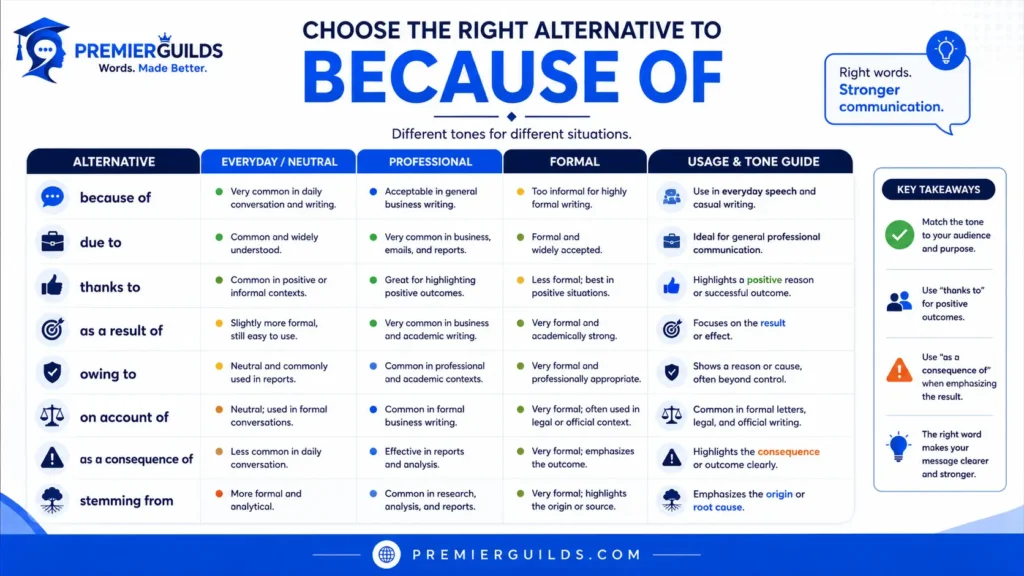
| Alternative | Best Used In | Tone |
| Due to | Business, reports, general writing | Professional |
| Owing to | Formal documents, reports | Formal |
| As a result of | Business and academic writing | Professional |
| On account of | Formal writing | Formal |
| Thanks to | Positive situations, everyday writing | Warm |
| As a consequence of | Formal cause-and-effect writing | Formal |
| Resulting from | Reports, business, technical writing | Professional |
| Stemming from | Problems, changes, causes | Professional |
| As a result of the fact that | Formal clauses | Formal |
| In light of | Decisions and changing circumstances | Professional |
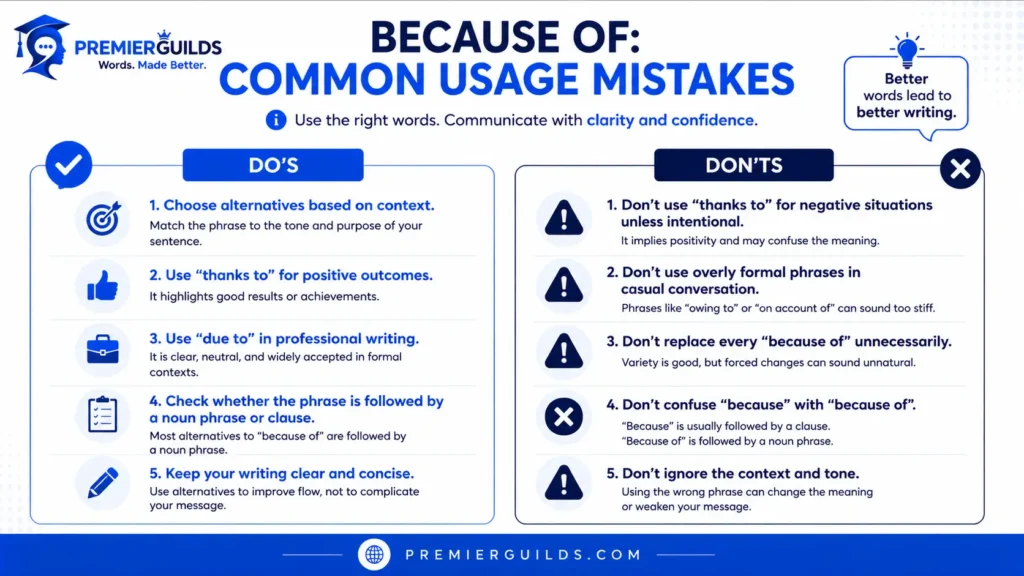
“Thanks to” often carries a positive or appreciative meaning. Saying “The project failed thanks to poor planning” can sound sarcastic or unintended.
Phrases such as as a consequence of may sound unnecessarily formal in a casual conversation. Sometimes the simple “because of” is the most natural option.
Because of normally introduces a noun phrase, while because introduces a clause. For example, write “because of the rain,” but “because it rained.”
In light of usually means that someone considers information or circumstances when making a decision. It does not always express a simple cause.
Replacing every instance of “because of” with a longer phrase can make your writing less clear. Choose an alternative only when it improves meaning, tone, or flow.
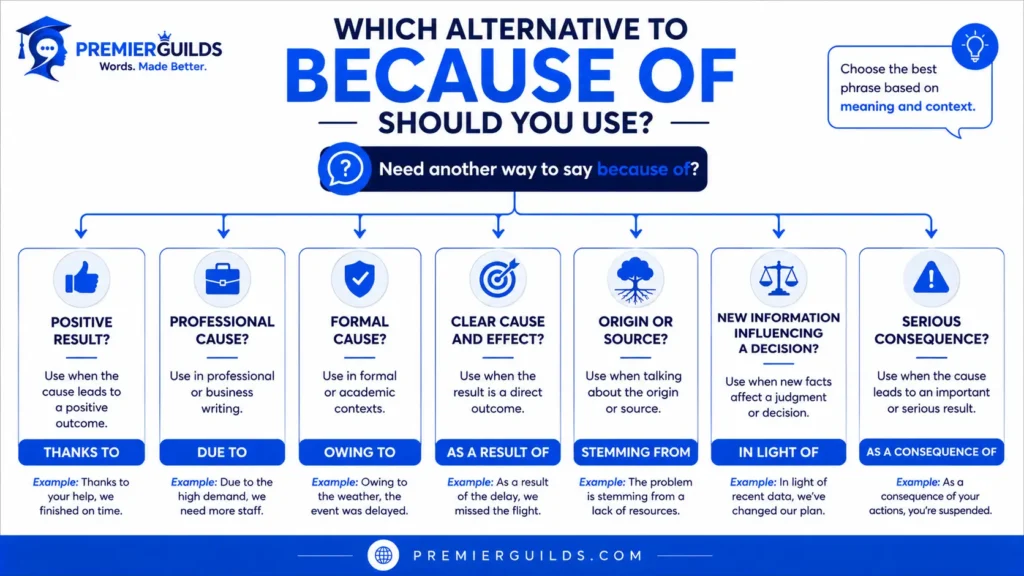
Professional alternatives include due to, owing to, as a result of, resulting from, and stemming from. The best choice depends on the sentence. “Due to” is concise and widely understood, while “as a result of” makes the relationship between the cause and outcome more explicit.
Common formal alternatives include owing to, due to, as a consequence of, and on account of. “Owing to” works particularly well in formal written English, while “as a consequence of” is useful when you want to emphasize the effect produced by a particular cause.
Depending on the sentence, you can use as a result, therefore, consequently, because of this, or for this reason. “For this reason” is especially clear in essays and professional writing because it directly connects the previous point with the conclusion or action that follows.
For an essay, useful choices include due to, owing to, as a result of, as a consequence of, and stemming from. However, you should not replace “because of” automatically. Choose the alternative that best communicates the exact cause-and-effect relationship in your sentence.
Due to and because of often communicate the same basic idea: they identify a cause or reason. However, they can differ in grammatical construction and style. “Because of” is very flexible, while “due to” often sounds more formal and concise in professional writing.
Thanks to is the most natural positive alternative in many situations. It often gives credit to a person, action, or circumstance that produced a favorable result. For example, “Thanks to the team’s hard work, we completed the project early.”
You can often replace because of the fact that with the shorter because, since, or as. For example, instead of “The event was canceled because of the fact that it rained,” write “The event was canceled because it rained.” The shorter version is usually clearer.
Yes. Because of is grammatically correct and appropriate for formal writing. You do not need to replace it simply because you are writing an academic paper, report, or business email. Alternatives such as “due to” or “as a result of” are useful when they provide better variety or fit the sentence more precisely.
There are many useful alternatives to because of, and the best choice depends on your sentence, audience, and intended tone. Due to and owing to are strong options for professional or formal writing, while as a result of clearly shows a cause-and-effect relationship. Thanks to is a better choice when you want to highlight a positive cause or give credit.
For more formal contexts, as a consequence of and on account of can work well, while resulting from and stemming from are useful for describing the source of an outcome or situation. Remember that not every alternative has exactly the same meaning or grammatical use. The strongest writing comes from choosing the expression that communicates your cause clearly and naturally.You can also explore more cause-and-effect expressions in English to understand how different linking phrases work in context.

English Language & Communication Specialist
Dr. Emily Carter is an English language and communication specialist focused on vocabulary, word choice, professional writing, and practical English usage. She helps readers understand the differences between similar words and choose expressions that sound natural, clear, and appropriate for different contexts.