
Another way to say please note includes “please be aware,” “please be advised,” “kindly note,” “keep in mind,” “take note,” and “for your information.” The best alternative depends on your audience and purpose, especially when writing professional emails, reports, announcements, instructions, or workplace messages.
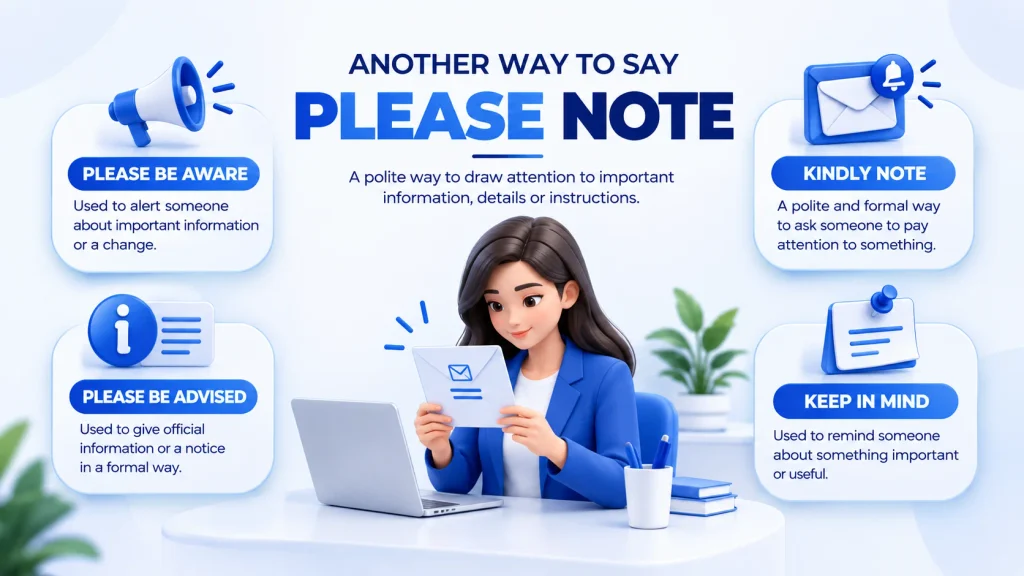
The phrase “please note” is used to direct someone’s attention to important information. It often tells the reader to pay attention to a detail, instruction, reminder, change, or announcement.
For example, you might write, “Please note that the office will close at 3 p.m. on Friday.” The phrase is polite, clear, and widely understood in professional writing.
You commonly see “please note” in emails, reports, notices, instructions, customer messages, and workplace announcements. While it remains professional, repeating it too often can make your writing feel generic or stiff.

Using alternatives gives you more control over your tone and helps your writing sound natural. The right phrase can make a reminder feel friendly, a notice feel formal, or an important detail feel more direct.
You may want an alternative to:
For example, “Please be advised” has a more formal feel, while “Keep in mind” sounds more conversational.
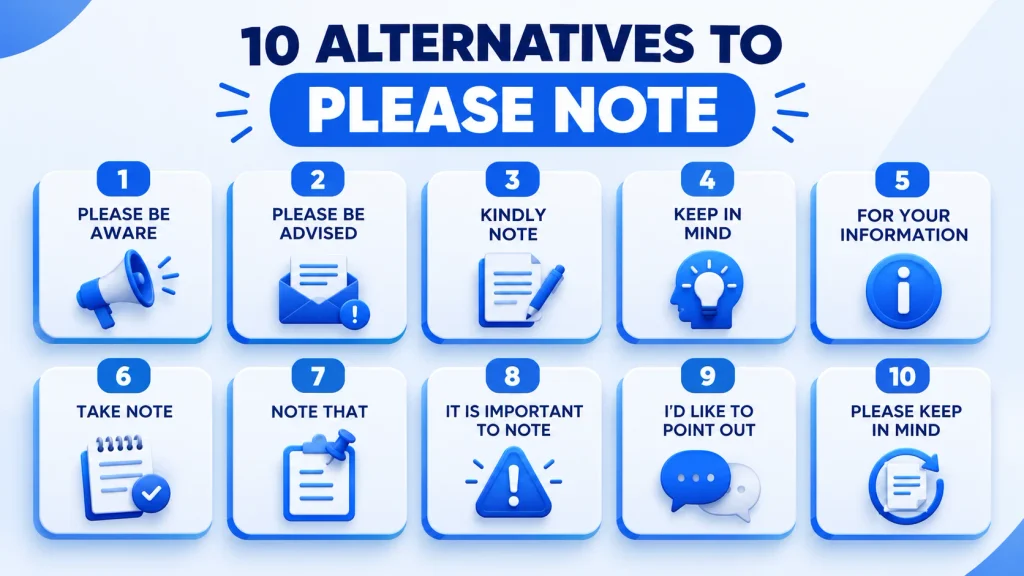
“Please be aware” politely tells someone that they should know or consider a particular piece of information. It is clear without sounding overly forceful.
Please be aware that the parking lot will be closed after 6 p.m.
Please be aware that processing times may vary during the holiday season.
Use this phrase when you want to alert someone to a condition, change, or potential issue without sounding harsh.
“Please be advised” is a formal way to notify someone about important information. It is especially common in business notices, official correspondence, policies, and customer communication.
Please be advised that your appointment has been moved to Tuesday.
Please be advised that all completed forms must be submitted by noon.
Choose this when the information has an official or administrative quality.
“Kindly note” politely asks the reader to pay attention to a specific detail. It has a formal and courteous tone and can work well in business correspondence.
Kindly note that the revised schedule begins next Monday.
Kindly note the updated contact information at the bottom of the document.
Use it sparingly because it can sound more formal than everyday American workplace language.
“Keep in mind” reminds someone to remember or consider something important. Compared with “please note,” it feels more conversational and approachable.
Keep in mind that delivery times may change during severe weather.
Keep in mind that the new system requires a separate login.
This is a strong choice when you want professional communication to sound less stiff.
“For your information” introduces information that may be useful or relevant to the reader. It does not always require the person to take action.
For your information, the updated employee handbook is now available online.
For your information, the client approved the revised proposal this morning.
Use this when your main goal is to share information rather than issue an instruction.
“Take note” directly tells the reader to pay attention to or remember something. It is concise and can be useful when highlighting an important point.
Take note of the revised submission deadline before completing the application.
Take note of these changes before your next scheduled appointment.
Use it when the reader needs to remember a detail or act on the information later.
“Note that” is a shorter and more direct alternative to “please note that.” It works particularly well in instructions, reports, guides, and professional writing.
Note that the final price includes all applicable service fees.
Note that applications received after Friday may require additional processing time.
Choose this when you want to remove unnecessary wording and make your sentence more direct.
“It is important to note” emphasizes the significance of the information that follows. It is useful when the reader needs to understand that a particular detail matters.
It is important to note that this offer is available to new customers only.
It is important to note that the figures are based on preliminary data.
Use this in reports, presentations, articles, and formal documents when the detail deserves extra emphasis.
“I’d like to point out” introduces something you want the reader or listener to notice. It feels more personal and conversational than an impersonal phrase such as “it is important to note.”
I’d like to point out that the second proposal includes additional support.
I’d like to point out one small change to the original schedule.
This works especially well when you are personally highlighting a detail during a discussion, presentation, or email.
“Please keep in mind” combines the politeness of “please” with the conversational quality of “keep in mind.” It gently asks someone to consider important information.
Please keep in mind that availability may be limited during peak hours.
Please keep in mind that each application is reviewed individually.
Use this when you want to emphasize an important consideration without making the message sound too formal.

| Alternative | Best Used In | Tone |
| Please Be Aware | Emails, notices, updates | Professional, polite |
| Please Be Advised | Formal notices, business communication | Formal, professional |
| Kindly Note | Business emails, correspondence | Formal, polite |
| Keep in Mind | Emails, conversations, reminders | Friendly, conversational |
| For Your Information | Information-sharing emails | Professional, neutral |
| Take Note | Instructions, reminders | Direct, professional |
| Note That | Reports, guides, instructions | Direct, formal |
| It Is Important to Note | Reports, presentations, formal writing | Formal, authoritative |
| I’d Like to Point Out | Emails, meetings, discussions | Professional, personal |
| Please Keep in Mind | Workplace messages, reminders | Polite, friendly |
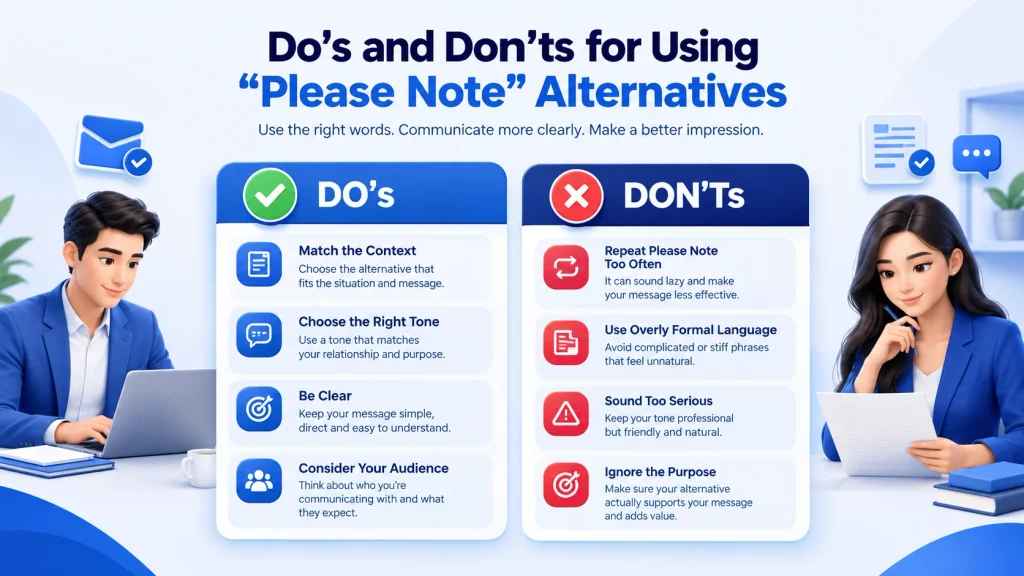
Expressions such as “Heads up” or “Just so you know” can work with coworkers but may feel too casual in a formal client email. Choose a phrase that matches your audience.
Not every message needs “It is important to note.” In a simple team message, “Keep in mind” may sound clearer and more natural.
Using the same phrase throughout an email, report, or article can make the writing repetitive. Vary your wording when several important points need attention.
An alternative should match what you want the reader to do. “For your information” mainly shares information, while “Take note” places more emphasis on remembering a detail.
Some expressions can make ordinary information sound like an official warning. Before choosing a formal phrase, consider whether the information genuinely requires that level of emphasis.
Common alternatives include “please be aware,” “please be advised,” “kindly note,” “keep in mind,” “take note,” and “for your information.” The best option depends on the situation. For professional emails, “please be aware” is flexible, while “please be advised” is more formal.
Professional alternatives include “please be aware,” “please be advised,” “kindly note,” and “it is important to note.” These expressions work well in business emails, reports, announcements, and workplace communication. Your choice should depend on whether you are simply sharing information, highlighting a change, or asking someone to remember an important detail.
Yes, “please note” is a professional and polite expression used to direct attention to important information. It commonly appears in emails, notices, reports, instructions, and business communication. However, repeating it too frequently can make writing feel generic or repetitive, so alternatives can provide more variety.
“Please be advised” is not necessarily better; it simply has a more formal and official tone. It works well for notices, policies, deadlines, and administrative communication. For ordinary workplace messages, “please note” or “please be aware” may sound more natural and less formal.
“Keep in mind” and “please keep in mind” are friendly alternatives that still sound professional. Depending on the audience, “just so you know” can also work in casual communication. Choose the phrase based on your relationship with the reader and how important or formal the information is.
In an email, you can use “please be aware,” “please be advised,” “keep in mind,” “for your information,” or “I’d like to point out.” For example, “Please be aware that the deadline has changed” sounds polished, while “For your information, the schedule has been updated” simply shares an update.
“Note that” is one of the shortest direct alternatives. “Take note” is another concise option when you want the reader to pay attention or remember something. For casual workplace communication, “FYI” can also work when you are simply sharing information, although it has a less formal tone.
Yes, “kindly note” generally sounds formal and polite. It is often used in business correspondence, notices, and other professional writing. However, American workplace communication can sometimes sound more natural with “please be aware,” “keep in mind,” or a direct statement, depending on the context.
There are many useful alternatives to “please note,” and the best one depends on your purpose and audience. For professional emails, “please be aware” offers a clear and polite tone, while “please be advised” works better for formal notices or official information. If you want something more conversational, “keep in mind” and “please keep in mind” are natural choices.
When you are simply sharing useful information, “for your information” can be appropriate. For stronger emphasis, try “it is important to note” or “take note.” The key is not to replace “please note” automatically, but to choose the phrase that accurately reflects your message. A small wording change can make professional communication clearer, more natural, and better suited to its audience.

Our editorial team brings together decades of expertise in applied linguistics, lexicography, and educational publishing. Dedicated to clarity, precision, and tone, our experts ensure that every resource meets the highest standards of professional and academic excellence.